 Write to the booksellers
MARTIAL (Marcus Valerius Martialis)
Epigrammata.
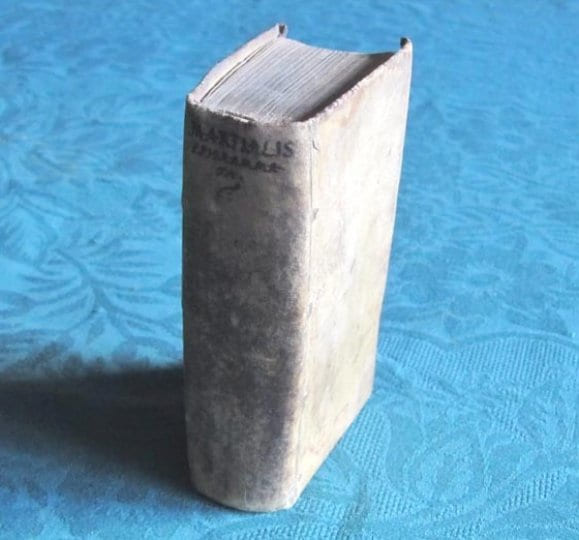
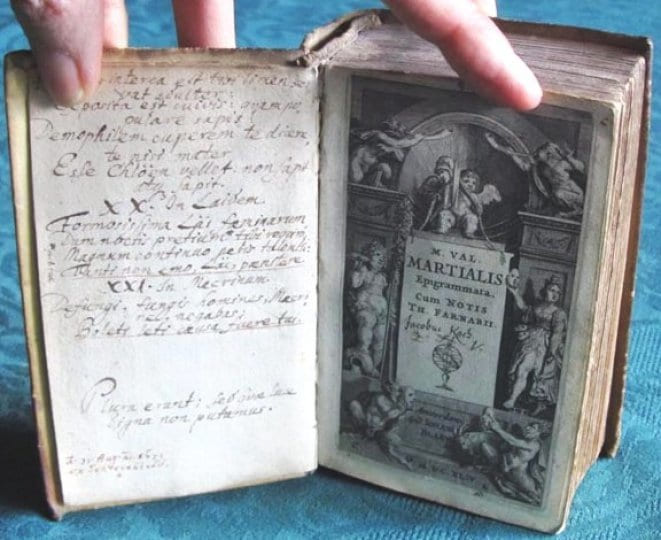
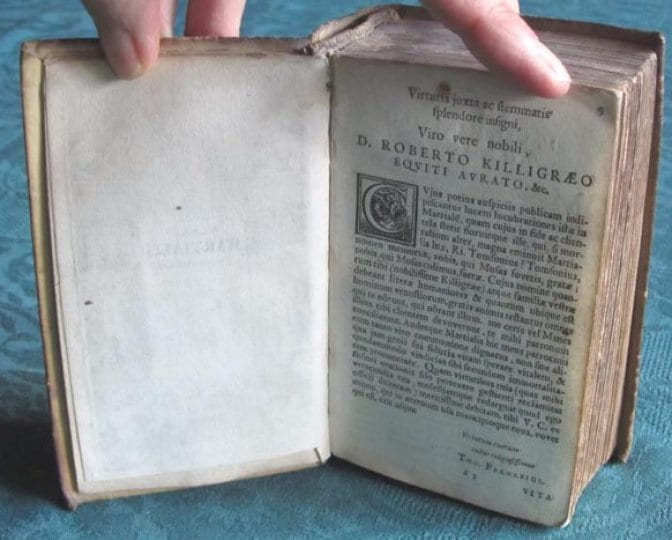
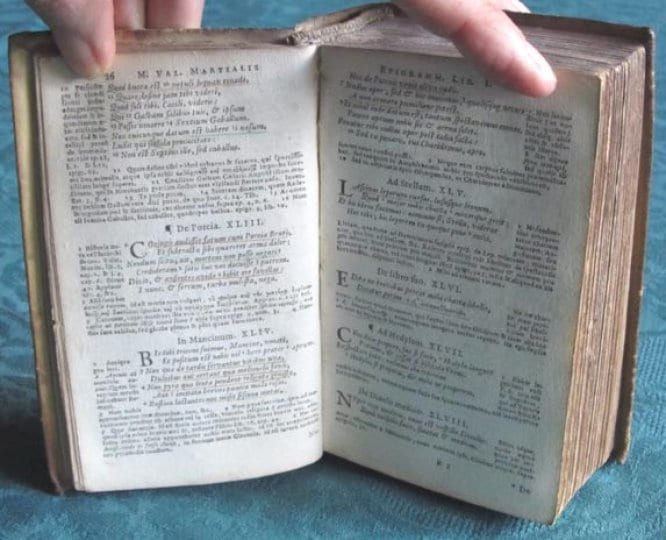
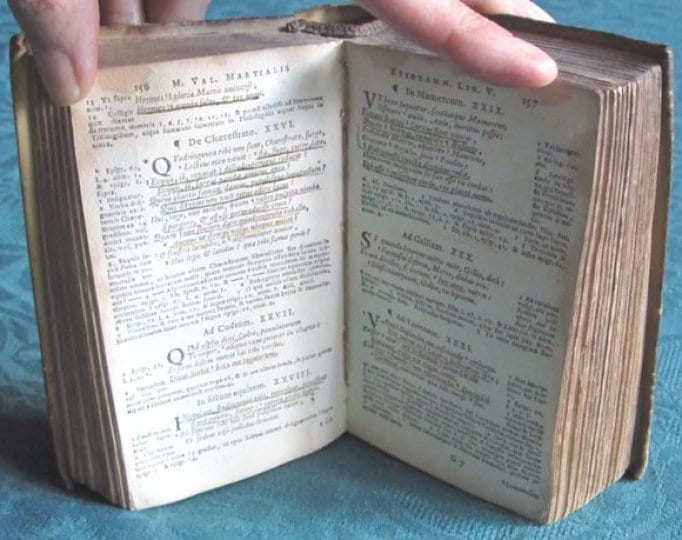
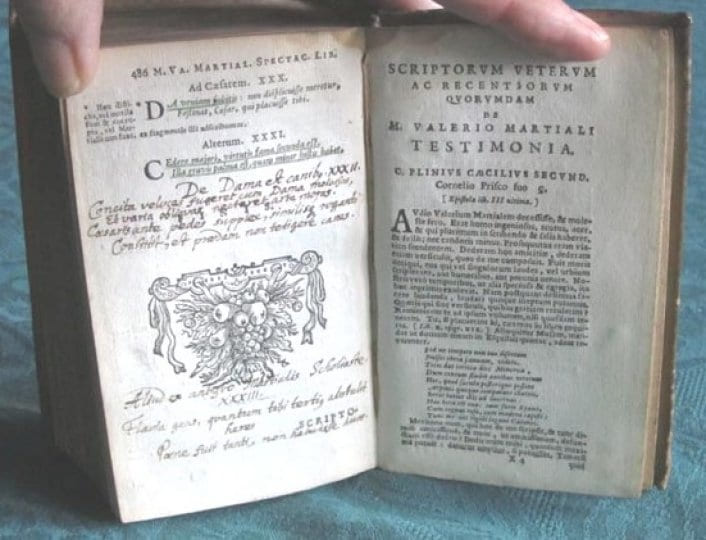
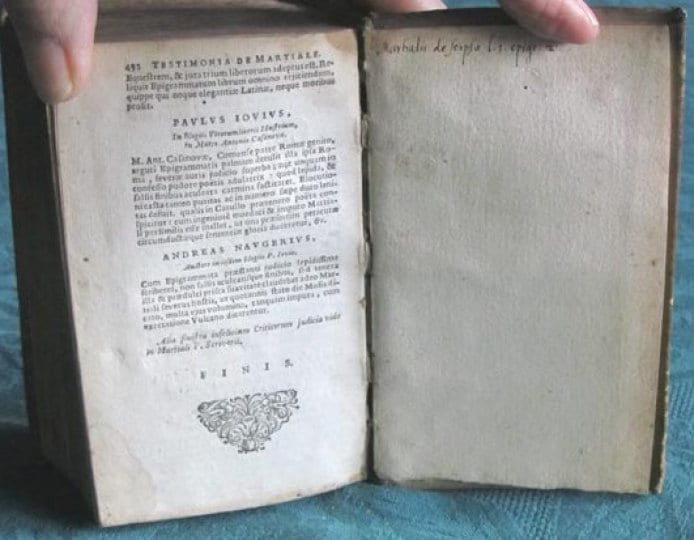
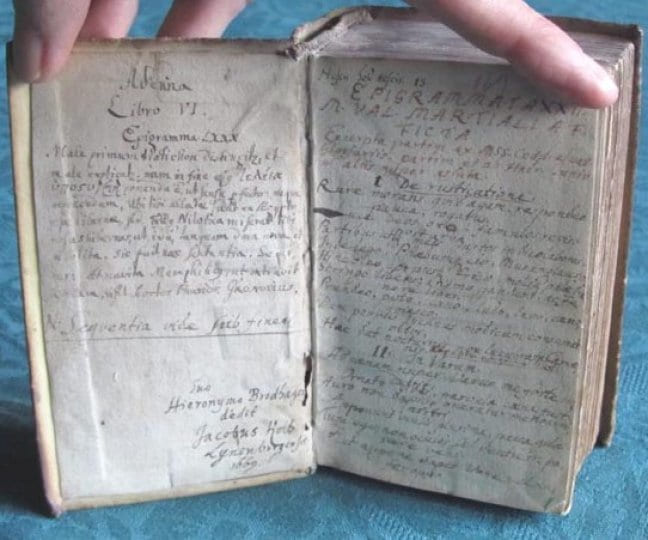
Cum Notis Th. Farnabii. Epigrammes en latin de Martial.Amsterdami, Apud Ioani Blaev 1644. Titre illustré.Reliure plein vélin à recouvrement et couture hollandaise de l'époque. Dos avec titre manuscrit. Dos noirci. Nombreuses phrases soulignées au crayon. 7 pages de textes manuscrits anciens datées 1671 sur les gardes et contreplats. Pas de rousseur. Bon état. Format in-16°(13x8).Martial (en latin Marcus Valerius Martialis), (40-104) est un poète latin, connu pour ses Épigrammes, où il attaque, entre autres, les débauchés et les femmes âgées.
Reference : 14431
Bookseller's contact details
Livres et Collections P. Commerot
M. Philippe Commerot
8 allée des Acacias
92310 Sèvres
France
09 67 04 07 48
Payment mode


Sale conditions
Les livres sont expédiés le jour même de la réception du règlement. Vous pouvez passer vos commandes par mail, ou par téléphone. Règlements en euros, par carte bancaire, chèque français, virement bancaire, ou lien de paiement Stripe. Evitez paypal.
5 book(s) with the same title
Iulii Caesaris Scaligeri viri clarissimi Poemata in duas partes divisa. Pleraque omnia in publicum iam primum prodeunt; reliqua vero quam ante emendatius edita sunt. Sophoclis Aiax Lorarius, stylo Tragico a Josepho Scaligero Iulii F. translatus. Eiusdem epigrammata quaedam, tum Graeca tum Latina, cum quibusdam e Graeco versis.
N.pl. (Geneva), Apud Petrum Santandreanum (Pierre de Saint-André), 1591.
8vo. 3 parts in 1: (VIII),663,(1 blank); 336; 70,(1 errata),(1 blank) p. Calf, end 19th century. 17 cm (Ref: GLN-2264; USTC no. 450529; Smitskamp's 'The Scaliger collection' no. 147; cf. Brunet 5,179; cf. Graesse 6/289 & & 6,444; cf. Hoffmann 3,425; Ebert 20452) (Details: Printed in italics. Some signs of censorship in the text. Nice binding. Gilt panelled back with 5 raised bands. Boards with triple fillet gilt borders and an oval gilt ornament. Edges of the boards and the turn-ins gilt. All edges gilt. Marbled endpapers. 'Veritas' woodcut printer's device on the title, depicting a woman, the naked truth, seated on a cubus, holding a radiant sun in her right hand. In her left hand she holds an opened book and a palm leaf. Her feet rest on the globe; the garland of fruit which surrounds her shows a motto in Greek: 'Alêtheia Pandamatôr', i.e. 'Allmighty Truth'. 2 red/yellow/blue book ribbons. Each of the 3 parts has a title-page of its own. Part 1 contains: Apiculae, p. 1; Nemesis, p. 59; Teretismata, Satyra, p. 76; Nova Epigrammata, p. 113; Farrago, p. 150; Thaumantia, p. 224; Arae Fracastoreae, p. 256; Nymphae indigenae, p. 272; Adamantij Catulli tumulus, p. 391; Heroes, p. 307; Archilochus, p. 339; Hipponax, p. 385; Sidera, p. 458; Lacrymae, p. 526; Aenigmata, p. 546; Urbes, p. 582; Logogriphi, p. 614; Manes Catulliani, p. 634. Part 2 contains: Ata, p. 3; Hymni, p. 79; Epidorpidum libri octo, p. 98; De Regnorum eversionibus, p. 324; Part 3 contains a Latin translation of the Ajax of Sophocles by the son of Julius Caesar, Josephus Justus Scaliger, and concludes with 20 pages epigrammata composed by junior) (Condition: Some slight wear to the binding. Oval stamp cut out of the first 2 title-pages, but skillfully repaired. In old ink 'Expurgata' written on the title page. Paper yellowing, sometimes browning. Occasionally a word, or a line, or sometimes a complete poem has been made illegible with ink stripes by a censuring cleric. Scaliger's Poemata figured in the Catholic 'Index librorum prohibitorum'. This 'Index' of forbidden books contained publications that were banned by the Catholic Church, because they were deemed heretical, anti-clerical or immoral. The censoring sometimes came down to the erasing or cutting out of names, or passages, or the removal of leaves, even complete chapters by catholic librarians. Such a librarian must have written, after having completed the job, at the foot of the title-page, 'Expurgata') (Note: The classical scholar Julius Caesar Scaliger (Giulio Bordone della Scala), 1484-1558, was of Italian origin. In 1524 he moved to France where he became physician to bishop Antonio della Rovere of Agen, and where his brilliant son Joseph Juste was born in 1540, the same year in which his 'De causis linguae latinae libri tredecim' was published. This book is among his most important philological works. Another work of fundamental importance is his 'Poetices libri septem' (1561), a manual for the apprentice poet, that became Europe's standard in matters of Neo-Latin poetry for two centuries. Scaliger published collections of his Neo-Latin poetry in 1533 and 1546. He considered the mastery of Latin composition not as a pastime, but as the scholar's most valuable skill. In 1574 his son Joseph Juste (Josephus Justus) produced a new edition of his father's collected poems during his stay at Geneva, where he took refuge because of the French wars of religion and St. Bartholomew's Day Massacre. Here Scaliger jr. delivered public lectures and tutored students, and met fellow humanists, Beza, Henricus Stephanus et alii, all interested in or writing Neo-Latin poetry. This edition of 1591 is a line by line reissue of the edition of 1574. To the edition of his father's poetry the son added a work of himself, the translation of Sophocles' Ajax. This translation was first published in 1573 in Paris with a Greek text and the translation on the facing page. The appropriate medium for the translation of the Ajax was in Scaliger's eyes archaic Latin. 'He used as many arcane or distinctively pre-classical words as possible (...). He dressed ordinary words in primitive spellings (...). And, like the archaic poets, he freely coined new compound words'. (Grafton,A., Joseph Scaliger, a study in the history of scholarship', volume 1, Oxford 1983, p. 114/115) After the Ajax Scaliger jr. added 20 pages with epigrammata, Greek and Latin, also of his own) (Provenance: Before the title have been bound 2 leaves, the first from 1890, the 2nd much older, after 1633. The text of the first manuscript leaf: 'Ce volume, que j'ai acheté aux libraires Mayer et Muller, de Berlin, était alors relié avec un exemplaire du Poemata de J. César Scaliger, de l'édition rarisssime de 1546. L'un et l'autre, ainsi réunis avaient appartenu à une Bibliothèque de Vérone (on le voit à la maculature laissée par le timbre, en tête de la 2e partie). L'un et l'autre portait les suppressions imposées par l'Index. - Voir, à ce sujet, la note italienne écrite ci après, probablement par un religieux du couvent dont la Bibliothèque possédait ces volumes. Dans l'éd. de 1546, beaucoup des pièces biffées ici n'avaient pas été supprimées. R. Dezeimeris, 1890.' The French historian and politician Reinold Dezeimeris, was 'Conservateur' of the 'Bibliothèque municipale' of Bordeaux, and a passionate bibliophile, but most of all he is remembered for his scholarly activities. He devoted many studies to Renaissance authors from his dear city. He participated in an important edition of the 'Essais' of Montaigne, Bordeaux 1870-1873. This title on offer of father and son Scaliger will have caught his attention, because of their connection with Bordeaux. On the authority of Dezeimeris, who must have had sharp eyes, we assume that the removed stamp from the first 2 title-pages belonged to a library at Verona. In the leaf immediately after the second title the dent of the stamp that was cut out of the title is indeed still visible, though hardly legible. (See for much more on Dezeimeris: rfhl.org/pages/historique/bibliophiles-bordelais/reinhold-dezeimeris-1835-1913.html and especially a biography at: saint-blaise-cadillac.eklablog.com/reinhold-dezeimeris-a46642037. Scaliger pretended to be a descendant of the house of La Scala, for hundred and fifty years lords of Verona. Dezeiremis apparantly split up the binding with works of Scaliger that he bought from the famous price-cutting Berlin 'Antiquariat Mayer & Müller'. This fine binding with Scaliger's Poemata of 1591 was probably commissioned by him. The librarian who wrote 'Expurgata' on the title, probably also wrote the text on the leaf bound before the first flyleaf. It is in Italian, and refers to the decree of the Church for the prohibition of Scaliger's works, dated March 19, 1633) (Collation: *4, a-z8, A-S8, T4 (leaf T4 verso blank); Aa-Xx8; AA-DD8, EE4 (leaf EE4 verso blank))
M.V. Martialis epigrammata. M.V. Marcial Epigrams: translated and explained by
M.V. Martialis epigrammata. M.V. Marcial Epigrams: translated and explained by A. Fet. In two parts. In Russian /M.V. Martialis epigrammata. M.V. Martsiala Epigrammy: v perevode i s obyasneniyami A. Feta.V dvukh chastyakh. Moscow: Type. A.I. Mamontov and K, 1891. XXIII, 934 p. We have thousands of titles and often several copies of each title may be available. Please feel free to contact us for a detailed description of the copies available. SKUalb7b0f81254195a240.
Illustrissimi principis Francisci Lotharaeni de funestissimo obitu threnodia. In qua : Paramythicum, Epitaphia, Aetiologicum ad Petrum Securum, Epigrammata ... Nicolao Lescotio Trescensi auctore
Paris : Thomae Richardi, 1563. UN RARE TOMBEAU POÉTIQUE NÉO-LATIN PUBLIÉ À LA SUITE DE L'ASSASSINAT DE FRANÇOIS DE LORRAINE, DUC DE GUISE
Plaquette petit in-4° (229 x 174 mm), deux cahiers libres non numérotés, [8] ff., sig. A-B4, en latin et en grec. Plaquette en vers (9 pièces en latin et 1 en grec) composée par Nicolas Lescot pour condamner l'assassinat de François de Lorraine et louer le disparu. Précipitée par le massacre de Wassy (1562), la première guerre de religion oppose en France protestants et catholiques, représentés par la Maison de Guise. François de Lorraine, duc de Guise, oeuvrant pour leur cause, mène son armée à Orléans : il est blessé par Jean Poltrot de Méré d'une balle de pistolet en retournant à son logis, et meurt le 24 février 1563. Célébrée par les protestants, pleurée par les catholiques, sa mort suscite une polarisation des opinions qui se reflète dans la littérature : d'un côté, les vers satiriques et « réjouissances rimées » (Rouget, « L'assassinat [...] » p. 99) des protestants circulent clandestinement : ces manuscrits louent l'héroïsme de Poltrot de Méré tout en condamnant sa victime, dont la mort « symbolise le début d'une lutte contre les tyrans » (p. 103). Le camp catholique, pour sa part, fait circuler en l'an 1563, en France et à l'étranger, un nombre relativement important d'hommages imprimés : François Rouget en dénombre une trentaine, et suppose qu'il en existe davantage. Presque tous proviennent des presses de Thomas Richard, dont l'échoppe « à la Bible d'or » se trouvait devant le Collège de Reims, qui bénéficiait du patronage de Charles de Lorraine. Le volume important et inhabituel de cette production d'hommages mène François Rouget à suppose l'existence d'une « entreprise concertée de propagande pour défendre l'image des Guises dans l'opinion publique » (p. 109) à laquelle Thomas Richard aurait pu contribuer, soit comme commanditaire des oeuvres, soit comme intermédiaire entre la Maison de Guise et les poètes. 3 ex. au CCFr (Toulouse BM, BnF Tolbiac, Nancy BS). OCLC : un exemplaire en Allemagne (Augsburg), 2 aux Etats-Unis (Harvard, University of Illinois). Bibliographie : François Rouget, L'assassinat de François de Lorraine (1563) et la polarisation des publics, in Renaissance and Reformation / Renaissance et Réforme, Vol. 42, n°1. ; le même : Ronsard et la célébration poétique de la mort de François de Lorraine (1563), in Revue d'Histoire littéraire de la France, 2 - 2017, 117e année - n° 2.


M. Val. Martialis Epigrammata, Demptis obfcenis, cum interpretatione, ac notis
collection d'épigrammes écrites par le poète latin Marcus Valerius Martialis, plus couramment connu sous le nom de Martial. Cette œuvre est également souvent appelée "Épigrammes de Martial". Martial était un poète romain du 1er siècle après J.-C., connu pour sa maîtrise de l'épigramme, un genre poétique court et incisif. Les épigrammes de Martial sont des poèmes succincts qui traitent de divers sujets, tels que la vie quotidienne, la satire, les portraits, l'amour et les aspects sociaux de la Rome impériale. L'œuvre complète de Martial est divisée en quinze livres, chacun contenant un grand nombre d'épigrammes. Ces poèmes offrent un aperçu vivant de la vie à Rome à l'époque impériale, avec des descriptions colorées de la société, des personnalités et des coutumes de l'époque. Les épigrammes de Martial sont souvent acérées et sarcastiques, utilisant l'humour et la satire pour critiquer certains aspects de la société et de la culture romaines. Les œuvres de Martial ont eu une influence durable sur la poésie épigrammatique et satirique ultérieure. Sa façon de jouer avec les mots, son sens de l'observation et sa capacité à capturer des détails de la vie quotidienne en ont fait un poète populaire de son époque et au-delà. Les épigrammes de Martial offrent également des informations précieuses sur la vie à Rome et sur les attitudes culturelles de cette période. En somme, "Epigrammata" de Marcus Valerius Martialis (Martial) est une collection d'épigrammes qui offre un aperçu fascinant de la vie et de la culture de la Rome impériale à travers le prisme de la poésie satirique et humoristique. "Je vis dans une petite cellule, avec une fenêtre qui ne ferme même pas, Dans lequel Boreas lui-même ne voudrait pas vivre." vol in-8, 170x100, relié pleine basane époque, solidement relié, tranches jaspées, très bel état, leg traces brunes sur qq pages, 690pp + index. Parisiis, Simonis Benard, 1693. Rare ref/22/1
Callimachi Hymni, epigrammata et fragmenta ex recensione Theodori J.G.F. Graevii, cum ejusdem animadversionibus. Accedunt N. Frischlini, H. Stephani, B. Vulcanii, P. Voetii, A.T.F. Daceriae, R. Bentleii commentarius, et annotationes viri illustrissimi Ezechielis Spanhemii, nec non praeter fragmenta, quae ante Vulcanius & Daceria publicarant, nova, quae Spanhemius & Bentleius collegerunt, & digesserunt. Hujus cura & studio quaedam quoque inedita epigrammata Callimachi nunc primum in lucem prodeunt.
Utrecht (Ultrajecti), Apud Franciscum Halmam, Guilielmum vande Water, 1697.
8vo. 2 volumes: (XXXII),1-438; 369-496,(138); (16),758,(64 index) p., frontispiece, 6 engraved plates, and occasional engraved text illustrations. Vellum 21 cm (Ref: STCN ppn 833518089; Hoffmann 1,429: 'Vorzügliche Werth erh. diese Ausg. durch Spanheim's u. Bentley's Noten'; Dibdin 1,368/69: 'An excellent and erudite edition' and the scholar 'will have abundant reason to rejoice in the acquisition of this edition'; Moss 1,249; Brunet 2,1481/2: 'Belle édition faisant partie de la collection Variorum'; Graesse 2,17; Ebert 3344) (Details: 6 thongs laced through both joints. The frontispiece depicts Callimachus while offering to the gods. Title of the first volume in red & black. Engraved printer's mark on the title, it depicts Athena and Ceres, who are holding between them a painting with an allegorical scene which shows people harvesting a crop. They are surrounded by putti, the motto is: 'cultior his vita est'; another and bigger version of the printer's mark on the second title. 6 plates, showing statues of Greek gods, drawn by G. Hoet, and etched by I. van Vianen. Greek text with opposing Latin translation, commentary & notes) (Condition: Vellum slightly soiled; some gatherings are yellowing) (Note: The Greek poet and scholar Callimachus of Cyrene, c. 305 - c. 240 B.C. was given employment at the famous Alexandrian library. There he produced the first scientific literary history. 'It is clear that Callimachus was a poet of great originality and extraordinary refinement. His amazing productivity (...) was accompanied by bold experimentation in his poetry, and a great versatility of style. The scholarly element, it is true, often adds a frigidity to his verse, but the lively personal and realistic touches which appear, never allow his writings to degenerate into arid selections of obsure myths'. (OCD 2nd ed. p. 195/6) This edition of the surviving works of Callimachus of 1697 was prepaired by the Dutch scholar Theodorus Georgius Graevius (1669-1692), the promising son of the professor of Classics at the University of Utrecht, Johannes Georgius Graevius (1632-1703). The young man died when 23. The book was finished and published posthumously by his mourning father in 1697 with pain in his heart. 'Id non potest non gravissimum rescindere vulnus' he laments in the 'Dedicatio'. Johannes Georgius Graevius (Greffe), of German descent, was the last 42 year of his life a star of the first order which adorned the University of Utrecht. (Van der Aa 7,353/58 & Van der Aa 7,358). The young man, the father tells in the 'praefatio', was fascinated by Callimachus, and he was planning an edition of that poet with his own notes and commentary and that of others. Alas, an immature death took away the young man's hopes and promisses, but still he left his Callimachus finished. 'Non infrequenter' had he also corrected the Latin translation. When the German scholar Ezechiel Spanheim, 1629-1710, heard that the father was preparing the posthumous edition, he sent him all he had written about Callimachus. His 'In Callimachi Hymnos observationes' fill the second volume of the set. The fame of Graevius also enticed the 'splendissimum Britanniae lumen' Richard Bentley, 1662-1742, to send him old and new material, emendations and notes, he had on Callimachus in his portfolio. (On Spanheim see Sandys 2,327)) (Collation: Volume I: *-2*8, A-2D8 (minus leaf B8; STCN erroneously doesnot mention this omitted leaf; nothing however is missing, the pagination is correct, the catchword between p. 30 and 31 is correct, and the text also connects correctly), Ee4. 2a-2i8 (between leaf 2i3 and 2i4 have been bound 2 gatherings: +8, 2+4, in STCN notation: 2i8(2i3+8 24)), 2k-2p8, 2q4 (leaf 2q4 recto has 'aan den binder' (for the binder), where the irregular pagination of the first volume is explained) Volume II: 2*8, 2A-3E8, 3F4 (leaf 3F4 blank)) (Photographs on request)

