 Write to the booksellers
Crystal David
Linguistics
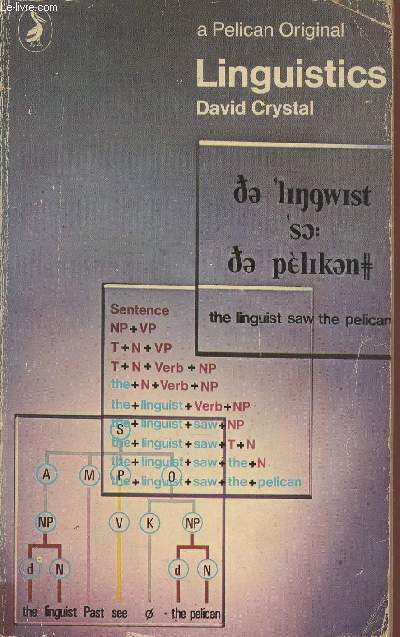
Penguin books. 1972. In-12. Broché. Etat d'usage, Couv. défraîchie, Dos abîmé, Papier jauni. 267 pages. Texte en anglais. Nombreuses rousseurs. Notes à l'encre et au crayon en page de faux titre. Coins frottés. Accrocs au dos, dos fané.. . . . Classification Dewey : 420-Langue anglaise. Anglo-saxon
Reference : RO60147217
ISBN : 0140213325
Classification Dewey : 420-Langue anglaise. Anglo-saxon
Bookseller's contact details
Le-livre.fr / Le Village du Livre
ZI de Laubardemont
33910 Sablons
France
05 57 411 411
Payment mode


Sale conditions
Les ouvrages sont expédiés à réception du règlement, les cartes bleues, chèques , virements bancaires et mandats cash sont acceptés. Les frais de port pour la France métropolitaine sont forfaitaire : 6 euros pour le premier livre , 2 euros par livre supplémentaire , à partir de 49.50 euros les frais d'envoi sont de 8€ pour le premier livre et 2€ par livre supplémentaire . Pour le reste du monde, un forfait, selon le nombre d'ouvrages commandés sera appliqué. Tous nos envois sont effectués en courrier ou Colissimo suivi quotidiennement.
5 book(s) with the same title
Cours de linguistique générale. Publié par Charles Bally et Albert Sechehaye. Avec la collaboration de Albert Riedlinger. - [FOUNDING STRUCTURAL LINGUISTICS]
Lausanne & Paris, 1916. Lex 8vo. Uncut in the orig. printed wrappers. Minor wear w. minor loss to capitals and corner of front wrapper, otherwise an exceptionally nice copy. A few pages w. underlining. Text-illustrations. 336, (1, -errata) pp.
The first edition of Saussure's seminal main work, which marks a turning point in the history of linguistics and had a monumental impact on related fields such as philosophy, logic, sociology, literary theory, etc. Because of this work, Saussure is considered the father of 20th century linguistics, and the influence of his ideas on the development of linguistic theory in the first half of the 20th century can hardly be overstated.After having published his ""Mémoire sur le système primitif des voyelles dans les langues indo-européenes"" in 1878, Saussure did not publish another full-length work in his life-time, and his ""Course in General Linguistics"" is a summary of the three lecture-courses he gave on linguistics at the University of Geneva in 1906-07, 1908-09 and 1910-11. The work was published posthumously by two of his former students and based on lecture notes. In this monumental work, based on his lectures, Saussure sets out to examine the relationship between language (langue) and speaking (parole), both as the relation of a social phenomenon to an individual phenomenon, and as the relation of a system to the concrete use of this system. He determines that there is a structured system of common signs between the users of a language, and that language can be analyzed as a formal system of elements. These elements are signs, signs that again can be divided into expression (signifiant) and content (signifié). This theory of language has deeply influenced all later theories of language.With this work, Ferdinand Saussure (1857-1913) thus came to occupy a seminal place in the history of language theory. In this work he is strongly focused on creating a science of language, free of its former embedment in archaeology, psychology, and also -or perhaps especially- the history of language. And he succeeds. Before his work, linguistics had had been dominated by a historical, though also partly structural, understanding of language, but now, Saussure introduced and determined the purpose and meaning of linguistics, the universal science of language. With Sausurre, linguistics now became, not only the study of the history of languages and of the influences that determine the development of it, but also, and primarily, the study of language and the study of the manifestations of human speech, of what makes human speech possible.Thus, there is no doubt as to the monumental impact of this groundbreaking work, and almost all language theoreticians ever since have been deeply influenced by it. In Europe, the Prague School with e.g. Roman Jakobson and the Copenhagen School with e.g. Louis Hjelmslev, and in America, Leonard Bloomfield and his followers (later Noam Chomsky), were all influenced by Saussure's theories and based their formings of structural linguistics on his basic notions.Saussure's work reached much farther, though, and the principles of structuralism came to deeply influence thinkers such as Jacques Lacan, Claude Lévi-Strauss etc., etc.

Reference : alba98b0a2586b2b6c4
Rudakova A.V. Cognitology and Cognitive Linguistics. In Russian /Rudakova A.V.
Rudakova A.V. Cognitology and Cognitive Linguistics. In Russian /Rudakova A.V. Kognitologiya i kognitivnaya lingvistika. The brochure examines the emergence of cognitive linguistics and its separation from cognitive linguistics, as well as the basic concepts and methods of cognitive linguistics. It can be used in general linguistics classes, section Cognitive linguistics. We have thousands of titles and often several copies of each title may be available. Please feel free to contact us for a detailed description of the copies available. The delivery of this book might be delayed beyond the usual timeframe due to extended processing and preparation before shipment, and faster shipping options are not offered. Please inform us if you need the order by a certain date or have a deadline. SKUalba98b0a2586b2b6c4
Transformational Grammar as a Theory of Language Acquisition: A Study in the Empirical Conceptual and Methodological Foundations of Contemporary ... Studies in Linguistics 10 Band 10)
Cambridge University Press 2009 360 pages in8. 2009. Broché. 360 pages.
Bon état couverture un peu défraîchie intérieur propre
Reference : alb076e44bdefce743a
Actual Problems of Linguistics and Literature: In 2 Volumes. T.1: Linguistics.
Actual Problems of Linguistics and Literature: In 2 Volumes. T.1: Linguistics. In Russian /Aktualnye problemy lingvistiki i literaturovedeniya: V 2-kh tomakh. T.1: Lingvistika. Proceedings of the Young Scientists Conference (April 5-7, 2012. You are welcome to reach out to us for a detailed description of the copies currently available. Delivery of this book may take longer than usual including extended processing and pre-shipping time, no expedited shipping is available. Please advise us if you have a set date or a deadline to receive your order. SKUalb076e44bdefce743a
Reference : alb9b9aa179f82e21d7
Problems of linguistics, language theory and applied linguistics. In Russian /P
Problems of linguistics, language theory and applied linguistics. In Russian /Problemy yazykoznaniya, teorii yazyka i prikladnoy lingvistiki. Book 3. Monograph. Novosibirsk CRNS 2016. Contact us for details or to request photos of available books. Delivery of this book could take longer than normal due to additional handling time before shipping, and no rush delivery options are available. Please let us know if you have a specific date by which you need to receive your order.SKUalb9b9aa179f82e21d7

