 Write to the booksellers
MOON Teddy / DARENCY Pierre
NORVEGIA
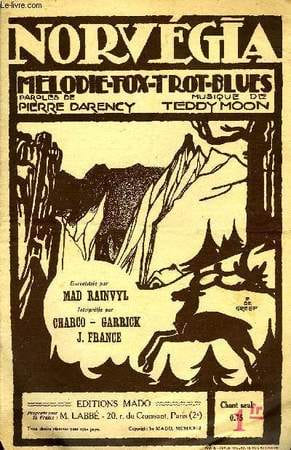
Marcel LABBE. 1923. In-8. En feuillets. Bon état, Couv. légèrement passée, Dos satisfaisant, Intérieur frais. Non paginé. 3 pages environ. Gravure brune et blanche de P. de Greef en couverture. Pliures.. . . . Classification Dewey : 780.26-Partitions
Reference : RO50016387
4030. Partitions pour chant. Classification Dewey : 780.26-Partitions
Bookseller's contact details
Le-livre.fr / Le Village du Livre
ZI de Laubardemont
33910 Sablons
France
05 57 411 411
Payment mode


Sale conditions
Les ouvrages sont expédiés à réception du règlement, les cartes bleues, chèques , virements bancaires et mandats cash sont acceptés. Les frais de port pour la France métropolitaine sont forfaitaire : 6 euros pour le premier livre , 2 euros par livre supplémentaire , à partir de 49.50 euros les frais d'envoi sont de 8€ pour le premier livre et 2€ par livre supplémentaire . Pour le reste du monde, un forfait, selon le nombre d'ouvrages commandés sera appliqué. Tous nos envois sont effectués en courrier ou Colissimo suivi quotidiennement.
5 book(s) with the same title
Bell'Europa N°346 Febraio 2022 Norvegia la magia delle Lofoten Sommaire: Norvegia la magia delle Lofoten; Costa Azzurra: nizza capitale delle vancaze belle époque; Londra Riapre il museo dei capolavori impressionisti ...
au bureau. 2022. In-4. Broché. Etat du neuf, Couv. convenable, Dos satisfaisant, Intérieur frais. 128 pages augmentées de nombreuses photos en couleurs dans texte.. . . . Classification Dewey : 450-Italien, roumain, rhéto-romain
Texte écrit en italien.Sommaire: Norvegia la magia delle Lofoten; Costa Azzurra: nizza capitale delle vancaze belle époque; Londra Riapre il museo dei capolavori impressionisti ... Classification Dewey : 450-Italien, roumain, rhéto-romain


norvegia Costantinopoli Condizioni
2003 2003. Thorvald Steen (Norvegia) Costantinopoli Eo 2003 Condizioni La descrizione di questo articolo è stata tradotta automaticamente. Se hai dubbi o domande ti invitiamo a contattarci. in OTTIME CONDIZIONI ; completo e solido senza annotazioni o lacrime interni in buone condizioni pulito e fresco; struttura quasi nuova. Cosa fece Sigurd Jorsalfer tra il 1108 quando appena diciottenne lasciò Bergen con una flotta di sessanta navi e un migliaio di uomini e il suo ritorno dalla Crociata quattro anni dopo con una nave? Andò in Inghilterra a Mont-Saint-Michel a Saint-Jacques-de-Compostelle conquistò Lisbona le Baleari andò alla corte di Sicilia ad Alessandria in Terra Santa dove il patriarca di Gerusalemme gli diede un pezzo della Vera Croce. Sulla via del ritorno fece una deviazione attraverso Costantinopoli per essere accolto con sfarzo dall'imperatore Alessio. Parallelamente ecco la storia di Amina Arslan una rifugiata musulmana a Gerusalemme che a malapena evita di essere massacrata dai cristiani. Con suo padre che afferma di essere convertito fugge dalla Terra Santa e si stabilisce a Costantinopoli. Qui incontra Sigurd. Un amore intenso quanto breve unirà il re norvegese - il difensore della Vera Fede portando una reliquia che Amina sa essere falsa - e Amina che non ha mai rinunciato alla sua fede musulmana. Un romanzo che mescola il respiro della storia con un'esplorazione appassionata delle problematiche contemporanee: la convivenza delle religioni e talvolta il fanatismo e l'intolleranza. Circa l'autore: Thorvald Steen è nato nel 1954 e vive a Oslo. Ha debuttato in letteratura nel 1983. La sua importanza sta crescendo oggi; è salutato come uno dei più notevoli autori scandinavi della sua generazione. Tradotto in quattordici lingue il suo romanzo Don Carlos (Calmann-Lévy 1994) è stato ampiamente elogiato dalla stampa internazionale. ovviamente spese di spedizione raggruppate in caso di acquisti multipli. Perlenbook company n ° Siret 49982801100010. Esca RCS Tgi 499828911 N ° GESTION 2007 A 111. Creato da eBay
Très bon état
Literaturae scientiae rerum naturalium in Dania, Norvegia & Holsatia.
Havniae (Copenhagen), Elmquist, 1829. 8vo. Uncut in recent marbled paper covered boards with gilt lettering to spine. A fine and clean copy. (16), 233, (13) pp.
Uncommon first edition of Winther's bibliography on the natural sciences in Denmark, Norway and Holstein up to the year 1829. Bibliotheca danica II, 157.
Danicorum Monumentorum Libri Sex: E spissis antiquitatum tenebris et in Dania ac Norvegia extantibus ruderibus eruti + Regum Daniae Series duplex et Limitum inter Daniam & Sveciam Descriptio. Ex vetustissimo Legum Scanicarum Literis Runicis in membran... - [THE FOUNDATION OF RUNOLOGY]
Hafnia, Joachim Moltke, 1643 + Melchior Martzan, 1642. Folio (290 x 200 mm). In contemporary full calf with four raise bands and embossed super ex-libris (C. H. Helwerskov (1655 - 1733), Danish landowner and supreme court judge) to front- and back-board. Rebacked and back-board with repair. Annotations to pasted down front end-paper and front free end-paper. Closed tear to leaf B2. A very nice, clean and wide margined copy printed on heavy paper. Engraved title-page (by Simon de Pas). (24), 526, (16) pp. + large folded woodcut plate (the Golden Horn). Large woodcuts in the text + (12), 36 pp. The text is in two columns, in Latin and runes. Captions and some runic letters printed in red.
A very nice wide margined copy printed on good paper of the scarce first editions of both of Worm's famous masterpieces on runes - 1) ""Danicorum Monumentorum"" being Worm's runic magnum opus, which not only constitutes the first written study of runestones and the first scientific analysis of them, but also one of the only surviving sources for depictions of numerous runestones and inscriptions from Denmark, many of which are now lost"" 2) ""Regum Daniae"", which contains the highly important reproduction of The Law of Scania in runes as well as in Latin translation with commentaries. The ""Danicorum Monumentorum"", with its numerous woodcut renderings of monuments with rune-inscriptions - including the world-famous folded plate of the Golden Horn, which had been found only five year previously, and which is now lost - is arguably the most significant work on runes ever written, founding the study of runes and runic monuments. Most of the woodcuts were done after drawings by the Norwegian student Jonas Skonvig"" they are now of monumental importance to the study of runes and runic monuments, not only because they appeared here for the first time in print, but also because many of the monuments are now lost and these illustrations are the only surviving remains that we have. Ole Worm (Olaus Wormius) (1588-1655) was a famous Danish polymath, who was widely travelled and who had studied at a range of different European universities. Like many of the great intellectuals of the Early Modern era, Worm's primary occupation was as a physician, for which he gained wide renown. He later became court doctor to King Christian IV of Denmark. In 1621, Worm had become professor of physics, but already the year before, in 1620, had he begun the famous collection that would become one of the greatest cabinets of curiosites in Europe (and one of the first museums) and which would earn him the position as the first great systematic collector (within natural history) in Scandinavia. It was his then newly begun collection that enabled him, as professor of physics, to introduce demonstrative subject teaching at the university, as something completely new. He continued building and adding to his magnificent collection, now known as ""Museum Wormianum"", throughout the rest of his life. Worm's fascination for antiquarian subjects not only resulted in his famous ""Museum Wormianum"", but also in a deep fascination with early Scandinavian and runic literature and the history and meaning of runestones. These monuments found throughout Scandinavia, were carved with runic inscriptions and set in place from about the fourth to the twelfth centuries. In most cases, they are burial headstones, presumably for heroes and warriors.Worm published works on the runic calendar, translations of runic texts and explications of folklore associated with the runestone histories. By far his most extensive and important work was the ""Danicorum Monumentorum"", which was the first serious attempt at scientifically analyzing and recording all 144 then known runestone sites in Denmark. With the King's blessing and support, Worm contacted bishops all over the country who were instructed to provide details and drawings of the barrows, stone circles and carved inscriptions in their regions.Many of the monuments recorded in this splendid work have since disappeared. Some of them appeared in the fire of Copenhagen, to which they were brought at the request of Worm himself. The book thus contains highly valuable data about missing sites in Scandinavian archaeology and is an invaluable source to anyone studying runes and runic monuments. Included in the work are Worm's three earlier, small treatises on runes, here collected for the first time and set into a systematic an scientific context, among them his 1641 treatise on the Golden Horn. For Danes, the Golden Horns, discovered on 1639 and 1734 respectively, with their amazing, complicated, and tragic story, constitute the Scandinavian equivalent to the Egyptian pyramids and have been the object of the same kind of fascination here in the North, causing a wealth of fantastical interpretations, both historical, literary, mystical, linguistic, and artistic. The two golden horns constitute the greatest National treasure that we have. They are both from abound 400 AD and are thought to have been a pair. A span of almost 100 years elapsed between the finding of the first horn and the finding of the second. Both findings are now a fundamental part of Danish heritage. In 1802 the horns were stolen, and the story of this theft constitutes the greatest Danish detective story of all times. The thief was eventually caught, but it turned out that he had melted both of the horns and used the gold for other purposes.Before the horns were stolen, a copy of the horns was made and shipped to the King of Italy, but the cast which was used to make this copy was destroyed, before news had reached the kingdom of Denmark that the copies made from the cast were lost on their way to Italy, in a shipwreck. Worm's work constitutes not only the earliest description of the seminal first horn, but also the most important source that we now have to the knowledge of the horn. It is on the basis of the description and depiction in the present work that the later copies of the first horn were made. Both horns were found in Gallehus near Møgeltønder, the first in 1639, by Kirsten Svendsdatter, the second in 1734, by Jerk (Erik) Lassen.Kirsten Svendsdatter made her discovery on a small path near her house, initially thinking that she had stumbled upon a root. When she returned to the same place the following week, she dug up the alleged root with a stick, and took it for an old hunting horn. She brought it back home and began polishing it. During the polishing of it, a small piece broke off, which she brought to a goldsmith in Tønder. It turned out that the horn was made of pure gold, and rumors of Kirsten's find quickly spread. The horn was eventually brought to the King, Christian IV, and Kirsten was given a reward corresponding to the gold value of the horn. The king gave the horn to his son, who had a lid made for it so that he could use it as a drinking horn. An excavation of the site where the horn was found was begun immediately after, but nothing more was found - that is until 95 years later when Jerk Larsen was digging clay on his grounds - merely 25 paces from where Kirsten had found the first horn. The year was now 1734. The horn that Larsen found was a bit smaller in size and was lacking the tip, but it still weighed 3,666 kg. As opposed to the first horn, this second horn had a runic inscription. After the horn had been authenticated, it was sent to King Christian VI, where it was placed in a glass case in the royal art chamber, together with the first horn. Before being placed here, a copy was made of both horns. These copies were lost in a ship wreck, however, and the casts had already been destroyed. In the fatal year of 1802, the gold smith and counterfeiter Niels Heldenreich broke in to the royal art chamber and stole the horns. By the time the culprit was discovered, the horns were irrevocably lost - Heldenreich had melted them and used the gold to make other things, such as jewellery. A pair of ear rings that are still preserved are thought to have been made with gold from the horns, but this is all that we have left of the original horns. New horns were produced on the basis of the descriptions and engraved illustrations that were made after the finding of the horns. And thus, the plate used in the present works constitute our main source of knowledge of the appearance of the first horn. ""The longest of the golden horns was found in 1639 and described by Ole Worm in the book 'De Aureo Cornu', 1641 (a treatise which is also included in his greater ""Danicorum Monumentorum""). The German professor at Soro Academy Hendrich Ernst, disagreed with Worm’s interpretation of the horn. Ernst believed that the horn came from Svantevits temple on Rügen, while Worm interpreted it as a war trumpet from the time of Frode Fredegods, decorated with pictures, calling for virtue and good morals. Worm immediately sent his book to Prince Christian and the scholars at home and abroad. You can see in his letters, that not only did the horn make an impression, but also the letter and the interpretation. In that same year there were such lively discussions on the horn among the scholars of Königsberg, now Kaliningrad!In 1643 Worm reiterated the description of the golden horn in his great work on Danish runic inscriptions, 'Monumenta Danica'. In 1644, his descriptions of the horn reached for scholars and libraries in Schleswig, Königsberg, London, Rome, Venice and Padua. Several learned men wrote poems for him, and the golden horn was mentioned in an Italian manus. Map Cartoonist Johannes Meyer placed the finds on several of his map of South Jutland. When the Swedish commander Torstensson attacked Jutland in 1643, Peter Winstrup wrote a long poem in Latin addressed to the bishop of Scania (which at that time still belonged to Denmark), the poem was called 'Cornicen Danicus'. It was immediately translated into Danish, entitled 'The Danish Horn Blower'. He interpreted the horn and its images as an warning of war, and his interpretations were very hostile to the Swedish. Paul Egard and Enevold Nielssen Randulf were among some of the other scholars who interpreted the Golden Horn In the 1640s. They were both deans in Holstein, and had a more Christian interpretation of the horn.All these works were illustrated with copies of Worms depictions of the horn. The Golden Horn remained known throughout the 1600s, both in terms of interpretations of the horn and designs. The found of the short golden horn in 1734 renewed the interest of the meaning of the horns."" (National Museum of Denmark). Thesuarus: 727 & 733Biblioteca Danica III, 23
[de Greef Peter ] - Charco Louis,Garrick,Rainvyl Mad - Moon Teddy - Darency Pierre
Reference : 18106
(1923)
Partition de la chanson : Norvégia Légende Norvégienne Légende
Partitions sur l'Europe Mado 1923
Bon état Petit format

