 Write to the booksellers
WAJSBROT CECILE
MEMORIAL
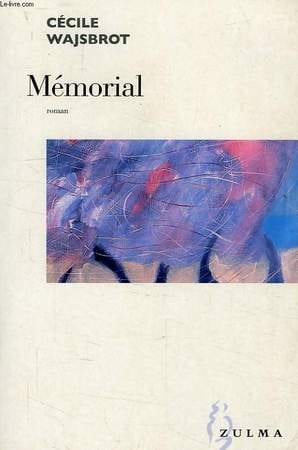
Zulma. 2005. In-8. Broché. Bon état, Couv. convenable, Dos satisfaisant, Intérieur frais. 173 pages. Envoi manuscrit de l'auteur en page de faux-titre.. . . . Classification Dewey : 840.092-XXI ème siècle
Reference : RO40124880
ISBN : 2843043352
Roman. Couverture d'après David Lee Fong. Classification Dewey : 840.092-XXI ème siècle
Bookseller's contact details
Le-livre.fr / Le Village du Livre
ZI de Laubardemont
33910 Sablons
France
05 57 411 411
Payment mode


Sale conditions
Les ouvrages sont expédiés à réception du règlement, les cartes bleues, chèques , virements bancaires et mandats cash sont acceptés. Les frais de port pour la France métropolitaine sont forfaitaire : 6 euros pour le premier livre , 2 euros par livre supplémentaire , à partir de 49.50 euros les frais d'envoi sont de 8€ pour le premier livre et 2€ par livre supplémentaire . Pour le reste du monde, un forfait, selon le nombre d'ouvrages commandés sera appliqué. Tous nos envois sont effectués en courrier ou Colissimo suivi quotidiennement.
5 book(s) with the same title
[Recueil concernant la maison d'Orléans composé de :] Précis généalogique, historique et littéraire de la maison d'Orléans, avec notes, tables et tableaux, par un membre de l'Université [Gabriel Peignot]. Paris, Crapelet, 1830 [Relié avec :] Mémorial des pensées et actions du duc de Chartres, aujourd'hui Louis-Philippe Ier, roi des français, écrit par lui même en 1790 et 1791; tiré de la correspondance de Louis-Philippe-Joseph, avec Louis VI, la reine, Montmorin, Liancourt, etc., imprimée et publiée en 1800 avec un discours préliminaire, notes et appendice. Paris, Delaunay et Lecointe, 1830 [Relié avec :] Notices biographiques des princes et princesses de la maison d'Orléans. Paris, Plassan, 1824
Paris, Crapelet, Delaunay, Lecointe et Plassan, 1824-1830. 555 g In-8, demi veau blond à coins, [2] ff., xxii-[1]-172-[8] pp., xxvi-[1]-68 pp., 150 pp., portrait, tableau généalogique dépliant.. Saffroy, 11453 pour le premier texte. Le premier plat ne tenant plus que par une ficelle est presque détaché. . (Catégories : Histoire, )
Mémorial pour la fortification permanente et passagère - Mémorial pour l'attaque des places. Edition autographe, enriche d'additions tirées des autres manuscrits de l'auteur - Mémorial pour la défense des places. Faisant suite au mémorial pour l'attaque.
A Paris, Chez Barrois / Chez Anselin et Pochard, 1809 - 1806 -1822. 3 volumes in-8 de XVI-390 / XVI-296 et XXIII-386-4 pages, demi-basane (2 en rouge, avec tomaison, 1 caramel, sans tomaison), dos lisses (un peu taché pour le dernier) ornés de filets et titre dorés, tranches jaunes, quelques rares rousseurs. Inscription à la plume à un faux-titre. A noter que le relieur a indiqué sur le dos le tome 2 comme étant le 3. Très pâle inscription au crayon à la page de titre du dernier volume: "Revue, corrigée et augmentée par un capitaine du génie", qui fait référence à de petites notes discrètes au crayon dans le texte.
1 tableau et 25 planches en 2 séries (16 + 8, dont la huitième à double, la seconde non reliée) au premier volume, 2 tableaux et 16 planches en fin du 2e vol. et 15 planches en fin du 3e volume, soit un total de 3 tableaux et 56 planches (dont 1 à double), tous dépliants. "En 1744, Louis-Charles de Cormontaingne est nommé directeur des fortifications des Trois-Evêchés (Metz, Toul et Verdun). Il meurt au siège de Metz en 1752. Homme de terrain et travailleur acharné, Cormontaingne se consacre dès 1728 à remodeler le système défensif de Metz qui devient alors l'axe principal de la défense française en Lorraine. Inconnu de son temps, il fut considéré à tort dès le début du XIXesiècle comme l'héritier de Vauban et exerça une grande influence sur le corps du Génie. Comme Vauban, il laissa de nombreux mémoires militaires: Le Mémorial pour l'attaque des places, Le Mémorial pour la défense des places, Le Mémorial pour la fortification permanente et passagère. Contrairement à Vauban, il donna une grande importance à l'artillerie qui avait fait d'énormes progrès et préconisa la construction d'ouvrages avancés puissants destinés à l'abriter tout en augmentant le nombre des lignes de défense." [Catherine BRISAC, Encyclopædia Universalis]. La mention "Edition autographe" veut sans doute dire faite sur les manuscrits de la main de l'auteur. Les volumes sur la fortification (1809) et celui sur l'attaque (1806) sont ici en édition originale. A noter que l'éditeur mentionne la fortification comme premier tome, alors qu'il a bel et bien été imprimé 3 ans après les autres [Biographie universelle ancienne et moderne, Louis-Gabriel Michaud, 1813]. Rarissime, complet en 3 volumes.
Reference : alb8fd43845dba4a910
Ba Ngoc.-Memorial Site of Ho Chi Min In Hanoi Ho Chi Minh Memorial in Hanoi. -
Ba Ngoc.-Memorial Site of Ho Chi Min In Hanoi Ho Chi Minh Memorial in Hanoi. - In Russian /Ba Ngoc.-Memorial Site of Ho Chi Min In Hanoi Memorial Kho Shi Mina v Khanoe. - Hanoi: The Gioi Publishers, 2006. Contact us for details or to request photos of available books. Delivery of this book could take longer than normal due to additional handling time before shipping, and no rush delivery options are available. Please let us know if you have a specific date by which you need to receive your order.SKUalb8fd43845dba4a910
Reference : alb851fb47f1adcf3f0
Memorial to the dead in Nord-Ost. Book of Memory. Nord-Ost. Memorial Book of Lo
Memorial to the dead in Nord-Ost. Book of Memory. Nord-Ost. Memorial Book of Lost Hostels. In Russian /Memorial pogibshikh v Nord-Oste. Kniga pamyati. Nord-Ost. Memorial Book of Lost Hostages. Moscow 2011. Contact us for details or to request photos of available books. Delivery of this book could take longer than normal due to additional handling time before shipping, and no rush delivery options are available. Please let us know if you have a specific date by which you need to receive your order.SKUalb851fb47f1adcf3f0
De Danske RunemindesmÊrker. UndersÞgte og tolkede af Ludv. F. A. Wimmer. Afbildningerne udfÞrte af J. Magnus Petersen. [The Danish Memorial Runestones. Investigated and interpreted by L. F. Wimmer. With illustrations by J. Magnus Petersen]. 4 volumes bound in six
Wimmer, Ludvig F. A.: De Danske RunemindesmÊrker. UndersÞgte og tolkede af Ludv. F. A. Wimmer. Afbildningerne udfÞrte af J. Magnus Petersen. [The Danish Memorial Runestones. Investigated and interpreted by L. F. Wimmer. With illustrations by J. Magnus Petersen]. 4 volumes bound in six. Copenhagen: Gyldendal, 1895-1908. 4 volumes bound in 6. Copenhagen: Gyldendal, 1895-1908. Volume I.i. [General Introduction]. Volume I.ii Historical memorial runestones]. Volume II [Runestones in Jutland and the Islands]. Volume III [Runestones in Skåne and Bornholm]. Volume IV.i [Runic and memorial stones linked to churches]. Volume IV.ii [ Word list supplement with corrections. Directory] 1,510 pages. Hardback. 39.7x31cms. Hardback. 39.7x31cms. Although the birth of the modern study of runic inscriptions can be dated as far back as the 17th century, it was not until the end of 1800 that runic studies were given methodologically sound, philologically rigorous basis. Ludwig Wimmer's Danmarks runenindskrifter - the first most comprehensive survey of Danish runestones - laid the firm foundations upon which all subsequent generations of scholars have investigated, interpreted and reclassified the vast material. Julius Magnus Petersen (1827-1917) was a Danish copper engraver and artist-archeologist. His family was of Scottish origin. He engraved plates on numismatic and natural history subjects, and collaborated with the Society of Antiquaries periodical Archaeologia. He was closely associated with the Museum of Nordic Antiquities and Runic Works. His knowledge of the memorial runestone benefitted from the numerous journeys he took at home and abroad, especially in the Skåne provinces and in Schleswig and Holstein, from which he returned carrying large cycles of drawings. Most are held in the National Museum in Copenaghen. Text in Danish.
Although the birth of the modern study of runic inscriptions can be dated as far back as the 17th century, it was not until the end of 1800 that runic studies were given methodologically sound, philologically rigorous basis. Ludwig Wimmer's Danmarks runenindskrifter - the first most comprehensive survey of Danish runestones - laid the firm foundations upon which all subsequent generations of scholars have investigated, interpreted and reclassified the vast material. Julius Magnus Petersen (1827-1917) was a Danish copper engraver and artist-archeologist. His family was of Scottish origin. He engraved plates on numismatic and natural history subjects, and collaborated with the Society of Antiquaries periodical Archaeologia. He was closely associated with the Museum of Nordic Antiquities and Runic Works. His knowledge of the memorial runestone benefitted from the numerous journeys he took at home and abroad, especially in the Skåne provinces and in Schleswig and Holstein, from which he returned carrying large cycles of drawings. Most are held in the National Museum in Copenaghen. Text in Danish


