 Write to the booksellers
Coustet Ernest
L'électricité
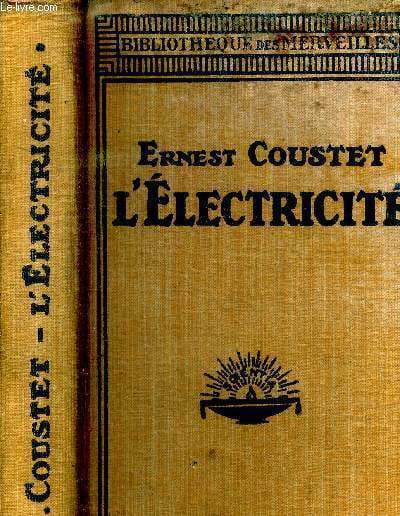
Hachette. 1932. In-12. Cartonné. Etat d'usage, Couv. partiel. décollorée, Dos satisfaisant, Papier jauni. 187 pages augmentées de quelques illustrations en noir et blanc dans le texte.. . . . Classification Dewey : 537-Electricité
Reference : RO40004726
Bibliothèque des merveilles. Classification Dewey : 537-Electricité
Bookseller's contact details
Le-livre.fr / Le Village du Livre
ZI de Laubardemont
33910 Sablons
France
05 57 411 411
Payment mode


Sale conditions
Les ouvrages sont expédiés à réception du règlement, les cartes bleues, chèques , virements bancaires et mandats cash sont acceptés. Les frais de port pour la France métropolitaine sont forfaitaire : 6 euros pour le premier livre , 2 euros par livre supplémentaire , à partir de 49.50 euros les frais d'envoi sont de 8€ pour le premier livre et 2€ par livre supplémentaire . Pour le reste du monde, un forfait, selon le nombre d'ouvrages commandés sera appliqué. Tous nos envois sont effectués en courrier ou Colissimo suivi quotidiennement.
5 book(s) with the same title
Exposé des applications de l'électricité -- BEL EXEMPLAIRE -- 4 VOLUMES (COMPLETE SET) BIEN COMPLET DE SES 27 PLANCHES DEPLIANTES
P., Hachette, 1856/1862, 4 volumes in 8 reliés en demi-chagrin rouge, dos ornés de fers et filets dorés (reliures de l'époque), (quelques rousseurs), T.1 : 11pp., 480pp., 8 PLANCHES DEPLIANTES, T.2 : (2), 490pp., (1), 10 PLANCHES DEPLIANTES, T.3 : (2), 464pp., 4 PLANCHES DEPLIANTES, T.4 : (2), 616pp., 3 PLANCHES DEPLIANTES, soit 25 PLANCHES DEPLIANTES, nombreuses figures dans le texte
---- BEL EXEMPLAIRE bien complet de ses 27 planches dépliantes ---- Seconde édition revue et AUGMENTEE D'UN VOLUME et LA PREMIERE ILLUSTREE DE FIGURES ET DE PLANCHES hors texte. Les planches sont parfois reliées en un seul volume constituant ainsi un cinquième tome ; dans notre exemplaire les planches ont été reliées à la fin de chaque volume ---- "Du Moncel's interest in electricity began in 1852 and spanned the most fertile period of its development, from Faraday to Edison. His publications analyzed each discovery and invention in the framework of the entire science... His popular work, Exposé des applications de l'électricité, appeared in Paris in two volumes in 1853-1854 and was expanded in five volumes (1856-1862), making it a valuable reference encyclopedia of electrical development up to that time. In it Du Moncel reviewed Charles Bourseul's proposal for the electric transmission of speech, the earliest approach to practical telephony. Du Moncel worte of this, "I thought it incredible", yet it was held to have contained the germ of later Bell and Gray inventions. In the contests among telephone inventions, Du Moncel soon differentiated between those devices capable of transmitting only music and those which could transmit the more complex articulations of the human voice. He gave maximum praise to Bell. Du Moncel also described electromagnetic equipment and its widening use in telegraphy, mechanics and medicine...". (DSB IV) - Wheeler gift N° 1351 ---- Electricité statique, dynamique - Magnétisme - Electro-magnétisme - Transmission de l'électricité - De la pile - Des circuits et des courants - Organes électriques susceptibles d'être employés dans les applications de l'électricité - Relais et rhéotomes - Intermédiaires électro-mécaniques - Machines d'induction - Instruments d'expérimentation - Télégraphie électrique - Application de l'électricité à la sécurité des chemins de fer - Horlogerie électrique - Application de l'électricité aux observations scientifiques et de précision - Applications à l'industrie, aux arts et aux usages domestiques - Applications physiologiques de l'électricité (électricité médicale, galvanisme...) - Revue des découvertes en 1857 et 1858**1831/L6DE.L6AR
La Lumière électrique. : Journel universel d'électricité. Revue scientifique illustrée.Du Moncel, Th. [Théodore] (Dir. scientifique)
Reference : 9533
La Lumière électrique. : Journel universel d'électricité.Journal universel d'électricité. Revue Scientifique Illustrée. Applications de l'électricité - Lumière électrique - Télégraphie et téléphonie - Science électrique, etc. Revue scientifique illustrée.,directeur Dr.Cornelius HERZ, 1890,tome 36
AUX BUREAUX DU JOURNAL1890,in4 reliure demi basane,dos lisse,tome 36 du 5/04/1890(N14) au 26/06/1890(N 26),650p (tables),texte à 2 colonnes,illustré
rare,bon état .Nous nous appliquerons à suivre le plan arrêté dès le mois d'octobre [1879] par notre directeur scientifique, M. Th. du Moncel, qui pense qu'en raison des découvertes multipliées qui se font journellement dans la science électrique, il fallait consacrer dans chaque numéro un long article à un résumé succinct des ces différentes découvertes, quitte à développer plus tard, en les accompagnant de gravures, celles d'entre elles qui sont les plus importantes. Le journal comprendra donc à l'avenir quatre parties: une partie contenant les articles de fond se rapportant aux travaux importants faits dans la science électrique, au point de vue théorique comme au point de vue pratique, une seconde consacrée à la revue des travaux récents en électricité; une troisième qui contiendra la correspondance et les réponses qu'elle incombera; enfin une quatrième dans laquelle seront rapportés les nouvelles et faits divers, concernant l'électricité. Remise de 20% pour toutes commandes supérieures à 200 €
Recueil de Traités sur l'électricité, traduits de l'Allemand et de l'Anglois
Paris, Sebastien Jorry, 1748, , 3 parties en un volume in-12 : [2]-VII-[3]-156 pp. et 2 pl. + XII-141 pp. et 4 pl. + VIII-112 pp. et 1 pl. +, basane marbrée brune de l'époque, dos lisse et fleuronné, pièce de titre rouge, tranches rouges, Quatre ouvrages sont réunis dans ce volume qui présente l'état le plus avancé des recherches sur l'électricité à la veille des travaux de Benjamin Franklin : Winckler, Essai sur la nature, les effets et les causes, de l'électricité, avec une description de deux nouvelles machines à l'électricité. Première et seule édition française, elle est ornée de 2 planches gravées dépliantes figurant des machine à électricité. Watson, Expériences et observations, pour servir à l'explication de la nature et des propriétés de l'électricité. Première édition française traduite d'après la seconde édition anglaise. Les jolies planches sur cuivre qui l'accompagnent représentent des machines à électricité manipulées par d'élégants jeunes hommes et jeunes femmes. Watson, Essai sur la cause de l'électricité, où l'on examine, pourquoi certaines choses ne peuvent pas être électrifiées. Et quelle est l'influence de l'électricité dans les rhumatismes du corps humain, dans la nielle des arbres, dans les vapeurs des mines et dans la plante sensitive. Seconde édition française traduite Watson. Newton, Essai sur l'électricité, contenant des recherches sur sa nature, ses causes et propriétés, fondées sur la théorie du mouvement de vibration de la lumière et du feu de M. Newton... Première édition française traduite par Benjamin Martin. Une planche qui représente des éléments d'expérience électrique. Dos légèrement gauchi, minuscules épidermures, coiffe supérieure arasée, 1 mors fendu, rares taches. Étiquette et tampons de l'Institut catholique. Wheeler Gift, 313c ; Bakken, p. 100 et 118. Couverture rigide
Bon 3 parties en un volume in-12


[R.G.E. Revue Générale d'Electricité] - R.G.E. Revue Générale de l'Electricité ; Société Hydrotechnique de France ; Union des Syndicats de l'Electricité
Reference : 32332
(1932)
R.G.E. Revue Générale de l'Electricité , Tome XXI , Année 1932 , Premier Semestre [ Parties "Bulletin R.G.E." et "Documentation", Semestre complet , N° 1 à 26 ] ; Union des Syndicats de l'Electricité , Premier Semestre 1932 [ N° 1 à 8 ] ; Comptes rendus des travaux de la Société Hydrotechnique de France (Séance plénière du 20 mars 1931)
1 vol. in-4 rel. demi-basane chagrinée verte, dos à 5 nerfs, contenant 3 séries de documents du premier semestre 1932, R.G.E. Revue Générale d'Electricité T. XXXI, du n° 1 au N° 26, partie "Bulletin R.G.E." 208 pp. (pp. 1 B à 208 B) et partie "Documentation", 212 pp. (pp. 1 D à 212 D) - Union des Syndicats de l'Electricité , N° 1 à 8, 60 pp. (pp. 1 U à 60 U) - Comptes rendu des travaux de la Société Hydrotechnique de France, n° 46 et 47 de "Société Hydrotechnique de France", pp. 565 à 632
Etat très satisfaisant (couv. très lég. frottée, bel exemplaire par ailleurs)
Histoire générale et particulière de l'électricité, ou Ce qu'en ont dit de curieux & d'amusant, d'utile & d'interessant, de réjouissant & de badin, quelques Physiciens de l'Europe. Première partie
1752 A Paris, Chez Rollin, Quay des Augustins, à Saint Athanase & au Palmier - M. DCC. LII. 1752 - Avec Approbation & Privilége du Roi - In-12 (9,,5 x 16,5cm environ), reliure pleine peau brune, 5 nerfs, fleurons dorés et pièce de titre au dos - Tranches rouges et signet - x, 197 pages - Rares bandeaux et lettrines
Assez bon état, reliure compacte malgré charnières à nue (sans impacte) - Bords, coiffes et coins éraflés - Quelques tâches sur les plats et la tranche latérale - Quelques manques de peau sur le quatrième plat (voir photos) - Légères rousseurs intérieures - Un nom à la plume en page de garde - Trace d'ancienne étiquette sur le deuxième plat

