 Write to the booksellers
Rousseau J.J
Émile ou de l'éducation.
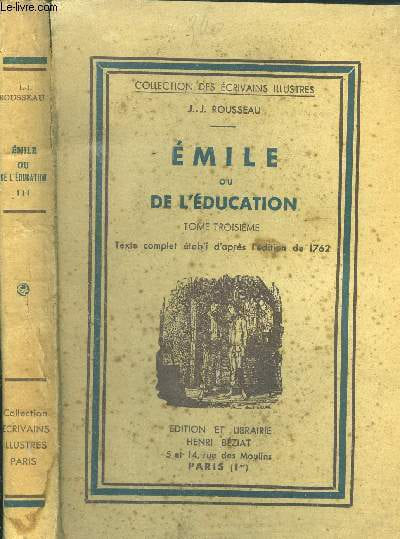
Henri Béziat. Non daté. In-12. Broché. Etat d'usage, Couv. convenable, Dos satisfaisant, Papier jauni. 254 pages.. . . . Classification Dewey : 840.05-XVIII ème siècle
Reference : RO40003773
Collection des Ecrivains Illustres. Tome troisième. Classification Dewey : 840.05-XVIII ème siècle
Bookseller's contact details
Le-livre.fr / Le Village du Livre
ZI de Laubardemont
33910 Sablons
France
05 57 411 411
Payment mode


Sale conditions
Les ouvrages sont expédiés à réception du règlement, les cartes bleues, chèques , virements bancaires et mandats cash sont acceptés. Les frais de port pour la France métropolitaine sont forfaitaire : 6 euros pour le premier livre , 2 euros par livre supplémentaire , à partir de 49.50 euros les frais d'envoi sont de 8€ pour le premier livre et 2€ par livre supplémentaire . Pour le reste du monde, un forfait, selon le nombre d'ouvrages commandés sera appliqué. Tous nos envois sont effectués en courrier ou Colissimo suivi quotidiennement.
5 book(s) with the same title
Émile ou de l'éducation. 4 Tomes. - [THE EDUCATION OF MAN]
A la Haye, Chez Jean Néaulme, (Recte: Paris, Duchesne), 1762. 8vo. Bound in four beautiful uniform contemporary full mottled calf bindings with gilt title-and tome-lables to richly gilt spines. Gilt line-border to edges of bords. Lovely patterned edges. Spines and some corners lightly and expertly restored, barely noteable. Occasional very light brownspotting or dusting, but overall very nice and clean. Printed on good, heavy paper, with wide margins. An excellent copy. (2), VIII, (2), 466, (6) pp. + (4), 407, (1) pp. + (4), 384 pp." (4), 455, (1) pp. + 5 engraved plates (used as frontispieces and facing p. (141) of vol. 1 respectively). The first plate ""Thétis"" in the variant state without title (as described in MacEachern). Fully complete, exactly as described in MacEachern. With all the misprints: Vol. 1: 88 as S8, 443 as 433, 465 as 46" vol. 2: 356 as 256, 357 as 257 vol. 3: 383 as 363 vol. 4: 336 with first 3 broken (according to McEachern this is just the case in some copies). With the usual cancelled leaves: Vol 1: Av + B4" vol. 2: H3 + N6 (called I6). The final leaf ends with ""FIN"" and has no grapes (MacEachern: ""The grapes appear in three different forms..."").
The very scarce actual first edition, being the rarer, more sought-after, nicer 8vo-edition (as opposed to the much more common 12mo edition, which was printed about simultaneously, but which seems to have appeared later), the 8vo format also being the one preferred by Rousseau himself and the format in which he wanted his great work to appear.This magnificent work constitutes the climax of Rousseau's genius as well as the most important work on education since Plato. In Émile, Rousseau poses an entirely new approach to education and the upbringing of children. His thoughts were exceedingly controversial, the work was burnt by the executioner immediately after its first appearance and Rousseau had to flee the country due to a warrant for his arrest. The printing history of ""Émile"" is extremely complicated and has been a matter of intense dispute for many decades. Until Maceachern's bibliography from 1989, the edition that has now been established as the ""Second Paris octavo"" (MacEachern 4A) was generally considered the first printing of the work, but there is no longer any dispute about the fact that the present edition is in fact the actual first (1A). The first edition appeared in both 8vo(1A) and 12mo(1B), and it seems to be generally accepted that the 8vo-edition was distributed first, but that parts of the 12mo-edition may have been in printing a bit earlier. Rousseau himself seems to have preferred the 8vo-edition and wished for his great work to appear as this form first (""The question of the format gave rise to some dissension, for while Rousseau felt that the work was more suited to the octavo format, Duchesne preferred to print a duodecimo and only a limited number of the more expensive octavo. Rousseau finally agreed to Duchesne's plan with reluctance, declaring that in his opinion Duchesne was committing an error of judgment and that the octavo would certainly be the more sought after of the two formats."" - MacEachern, pp. 18-19). Rousseau himself was more involved in the coming-to-be of ""Émile"" than perhaps any other author has been in any other book. Throughout the entire process there were a large number of misunderstandings between himself and Duchene which more than once endangered the printing and publishing of this seminal work, and which has contributed greatly to the extremely complicated bibliographical data of it. In fact, up until very late in the process, Rousseau did not believe that the work was actually going to be finished and it took several instances of mediation between the two to keep the work on tracks. Finally, however, the work was a reality, and with it one of the greatest works of Western culture had been born.Rousseau's ""Émile"" constitutes the most significant modern treatise on the education of man, surpassed only by Plato's ""Republic"". The comparison with Plato is all the more apt, seeing that both works grow out of and are meant to remedy lacunae in the political philosophy of their authors.The conclusion to Rousseau's work on the social contract, also written during Rousseau's stay in Montmorency, had pointed to a predicament of political thought: that only if man were himself naturally inclined to freedom, could he make use of political freedom. ""Émile"" is the analysis of the conditions, under which a child can develop into a free human being. As such, it presents the conclusion to Rousseau's earlier works on inequality, political freedom and servitude.The paradox of Émile is that, while the development of human nature must be natural, if the child is to develop into a free human being, steering that development in the right - that is, free - direction requires constant intervention which, moreover, must be hidden from the child. Rousseau details this intervention in his analysis of the five stages in the education of the child, covering the period from birth to the age of 25.Being one of the most influential thinkers of the 18th century, Rousseau is considered one of the indirect causes of the French Revolution. In Rousseau one certainly finds one of the most influential spokesmen for 18th century thought, and it is primarily the thoughts of him and Voltaire that are put into action with the Revolution.""The first and last of these (i.e. Héloise and Émile), with their sentimental expression of deism, gave much offence, and Rousseau, like Voltaire, was forced to flee to Prussia. Restless and locally unpopular, he fled again to England, where he had a great welcome. Hume, who had offered him asylum, looked after him patiently..."" (PMM 207, Printing and the Mind of Man).The totalitarian tendency of Rousseau's philosophy of education has been noted by a number of philosophers, in recent times most famously, Karl Popper.McEachern: 1A

Emile ou de l’éducation. Tome premier, tome II, tome troisieme et tome quatrieme. Collection complete des oeuvres de J. J. Rousseau, Citoyen de Geneve. Tome septieme, contenant les II premiers Livres d’Emile, ou de l’Education, tome huitieme, contenant le IIIe. & partie du IVe. Livre d’Emile, ou de l’Education, tome neuvieme, contenant la suite du IVe. & partie du Ve. Livre d’Emile, ou de l’Education, tome dixieme, contenant la suite du Ve. & dernier Livre d’Emile, ou de l’Education, Emile & Sophie ou les Solitaires. (4 Volumes).
Geneve, 1782, 210x140mm, cartonnage marbré, en attente de reliure. Ex-libris.
VIII - 386 + 368 + 445 + 380 pages, Pour un paiement via PayPal, veuillez nous en faire la demande et nous vous enverrons une facture PayPal
Émile, ou De l'éducation
L'un des livres majeurs du Siècle des Lumières relié en somptueux maroquin rouge de l'époque de Derome le jeune. L’Émile provenant de l’intelligente bibliothèque du Docteur Ripault (janvier 1924). 4 volumes in-8 ; maroquin rouge, triple filet doré encadrant les plats, dos à nerfs finement orné, filet or sur les coupes, roulette intérieure dorée, tranches dorées. Reliure parisienne de l'époque de Derome le jeune (1760-1788). 194 x 122 mm. Rousseau, Jean-Jacques. Émile, ou De l'éducation. La Haye, Jean Neaulme, 1762. Édition originale de l’Emile selon Calemard (voir Tchemerzine, V, 545) et Raymond Trousson (Dictionnaire de J.-J. Rousseau, Paris 1996 et 2001, pages 283 et 284). « Il est difficile de dire avec précision à quel moment Émile fut commencé. La correspondance ne nous donne guère de renseignement à ce sujet. Certains commentateurs ont situé sa rédaction dès 1754 ou vers la fin de 1757. P. Jimack qui a fait une étude très minutieuse des manuscrits, pense que le livre a été mis en chantier vers la fin de 1758 et que sa rédaction était terminée au début d'octobre 1760. En août 1761, Rousseau signa un contrat préliminaire avec l’éditeur Duchesne qui signa lui-même un accord avec J. Néaulme, libraire à La Haye pour distribuer le livre hors de France. Duchesne signa aussi secrètement un accord avec un éditeur de Lyon, J.-M. Bruyset, afin qu'il diffuse le livre dans les pays que Néaulme ne desservirait point. La première édition du livre fut publiée par Duchesne en mai 1762 dans un format in-8 et dans un format in-12. Le premier fut d’abord diffusé et il est considéré comme l'édition originale. Début juin, le livre ne peut plus être distribué ». McEachern, 4A. Sept ans auparavant, en 1989, Mac Eachern, et Dufour en 1925 la considérait comme la 2nde édition originale : « C’est la 2ème édition originale, imprimée à Paris par ou pour Duchesne » (Recherches bibliographiques sur J.J. Rousseau par T. Dufour 1925, page 171, n°190). Imprimée à Paris, elle est ornée de 5 figures gravées par Eisen. C'est cette édition in-8 qui a servi pour les distributions et cadeaux faits par Rousseau et Madame de Luxembourg. Avec l’Emile, pourtant jugé sévèrement à l’époque, c’est toute une éducation nouvelle qui se met en place, à travers une image nouvelle de l’enfant. La nouveauté et l’audace du livre de Rousseau ne peuvent être mesurées pleinement aujourd’hui, car une grande partie de ses idées sont désormais passées dans la pratique même de l’éducation, et ses principes sont suivis par tous. Qu’il suffise de dire qu’il a révolutionné complètement la pédagogie en commençant l’étude systématique de l’âme de l’enfant et en introduisant triomphalement, dans le domaine éducatif, les principes de la méthode expérimentale. Tous les célèbres éducateurs du XIXè siècle, depuis Pestalozzi, Herbart, Froebel, tout en le discutant, dérivent directement de Rousseau. Une forme passionnée et éloquente, un style direct et vivant, riche de digressions poétiques, conservent à ce livre toute sa vitalité. Cet exemplaire présente toutes les caractéristiques relevées par McEachern, signalons seulement que la page 248 du tome I est correctement numérotée. Comme tous les exemplaires vus par McEachern, le premier volume ne comporte pas de faux-titre. Superbe exemplaire relié en élégant maroquin rouge de l’époque de Derome le Jeune d’un livre majeur du Siècle des Lumières. Provenance : Docteur Armand Ripault (ex-libris armorié avec sa devise « D'esperer servira » ; I, 24-26 janvier 1924, n° 463. La reliure est donnée à Derome).
édition_originale

Emile, ou de l'éducation. Par J.J. Rousseau, Citoyen de Genève. [Suivi de: Supplément à l'Emile (...) Emile et Sophie].
4 volumes in-12, plein veau marbré de l'époque, dos lisses ornés de compartiments fleuronnés et cloisonnés, pièces de titre et de tomaison de maroquin bronze (reliure abîmée), (2), viii, (2) d' 'explications' et 'fautes', 466 p.; (4), 407 p.; (4), 381 p. et (4), 455 p., 112 p. pour 'Emile et Sophie', titres noir et rouge, 5 figures par Eisen gravées par Le Grand, Longueil et Pasquier. Amsterdam, Jean Néaulme, 1762 [i.e. Paris, Duchesne, 1774-1780].
Edition à la date de l'originale, troisième édition parisienne in-12° publiée à Paris chez Duchesne, selon McEachern, illustrée de 5 planches par Eisen, gravées par Le Grand, Longueil et Pasquier.Un des rares exemplaires à comporter le "Supplément à l'Emile" en pagination séparée à la suite du tome IV, dans une composition typographique différente. 'Emile et Sophie', suite peu connue de "l'Emile", désenchantée et déprimée, est demeurée inachevée par Rousseau. "Cest le roman expérimental de l 'Emile'. Rousseau veut mettre ses deux élèves à lépreuve de la nécessité pour vérifier leur liberté intérieure devant les aléas de lexistence. Comment vont-ils assumer lune un adultère malgré elle, lautre une rupture dont il se sent victime? " (cf. Frédéric S. Eigeldinger, Ed. Champion).Selon McEachern, qui se base sur le filigrane, cette édition serait antidatée et n'aurait pas été publiée avant 1774 et pour 'Emile et Sophie' après 1780, date de la première édition. Collation des faux-titres et titre conforme à la description donnée par McEachern.(Cohen, 436. McEachern, n°7, p. 123. Gagnebin, n°7-8, p. 1868).Reliure abîmée: mors fendillés, coiffes usées, épidermures, galerie de vers. Bon était intérieur.
Emile, ou de l'éducation.
Amsterdam, Jean Neaulme, 1762. 4 volumes in-12 (164 x 100 mm), 1 f. n. ch., X pp., 359 pp.; 1 f. n. ch., 336 pp.; 1 f. n. ch., 265 pp., mal ch. 255, XXIV pp.; 1 f. n. ch., 350 pp. Maroquin rouge, filet doré en encadrement avec fleurons d'angle, dos lisse orné, pièce de titre et de tomaison en maroquin blond, filet doré sur les coupes, tranches dorées, des rousseurs (reliure de l'époque).
Contrefaçon à la même date que l'édition originale, illustrée d'une copie des mêmes figures, soit 4 frontispices et une figure, le tout gravé par Longueil, Louis le Grand et Pasquier d'après les dessins d'Eisen. L’Emile fut imprimé pour la première fois à Paris par Duchêne sur le manuscrit de Rousseau. Celui-ci comptant sur la protection de Malesherbes, il s’était décidé à l'imprimer en France. Sa condamnation par le Parlement entraîna la saisie des exemplaires qui furent brûlés dans la cour du Palais. Cet événement marque le début de la vie errante et angoissée de l’auteur. "Encensé par certains, violemment critiqué par d'autres, condamné par les autorités civiles et religieuses dès sa parution, l'Emile enflamma l'Europe entière. Les traductions allemande (1762) et anglaise (1763) contribuèrent à répandre les principes pédagogiques de Rousseau, qui eurent un effet durable sur l'éducation des enfants" (Béatrice Mairé). C et exemplaire relié en maroquin du temps comporte six notes manuscrites dans la marge de cinq pages du premier tome. Son auteur s'interroge, cautionne ou donne un avis contraire aux pensées de Rousseau. Une note fut découpée et retirée. Peut-être son auteur la regretta-t-il… Il est à noter que plus aucune mention ne fut annotée dans les volumes suivants. Très bon exemplaire en maroquin du temps. McEachern Jo-Ann E., Bibliography of the writings of Jean-Jacques Rousseau to 1800, II-Emile ou de l'éducation, n°10, pp.139-142. BnF, Des livres rares depuis l'invention de l'imprimerie, Paris, 1998, n° 118, notice de Béatrice Mairé.

