 Write to the booksellers
McClean R.J.
Swedish
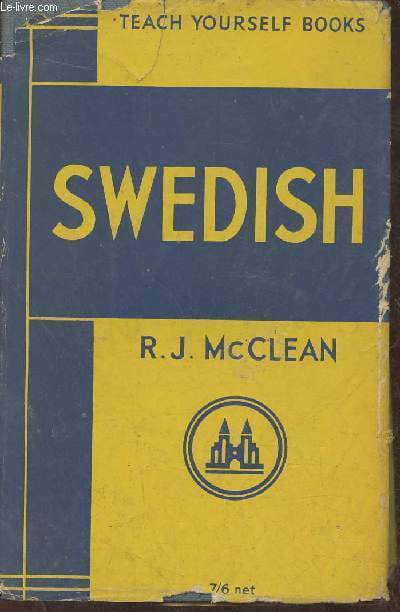
English universities Press Ltd. 1954. In-12. Cartonné. Etat d'usage, Couv. légèrement passée, Dos satisfaisant, Papier jauni. 322 pages. Nombreuses rousseurs. Jaquette passable. Texte en anglais et suédois.. Avec Jaquette. . . Classification Dewey : 490-Autres langues
Reference : RO30359124
"Collection ""Teach Yourself"". Classification Dewey : 490-Autres langues"
Bookseller's contact details
Le-livre.fr / Le Village du Livre
ZI de Laubardemont
33910 Sablons
France
05 57 411 411
Payment mode


Sale conditions
Les ouvrages sont expédiés à réception du règlement, les cartes bleues, chèques , virements bancaires et mandats cash sont acceptés. Les frais de port pour la France métropolitaine sont forfaitaire : 6 euros pour le premier livre , 2 euros par livre supplémentaire , à partir de 49.50 euros les frais d'envoi sont de 8€ pour le premier livre et 2€ par livre supplémentaire . Pour le reste du monde, un forfait, selon le nombre d'ouvrages commandés sera appliqué. Tous nos envois sont effectués en courrier ou Colissimo suivi quotidiennement.
5 book(s) with the same title
First Swedish Book
Svenska Bokförlaget Norstedts 175 pages in8. Sans date. reliure editeur. 175 pages. First Swedish Book est un manuel pratique pour apprendre le suédois conçu comme un complément à la grammaire Modern Swedish Grammar du même auteur. Publié par Svenska Bokförlaget Norstedts à Stockholm il a connu plusieurs éditions entre 1923 et 1960 et s'adresse aux étudiants anglophones
Bon état
Ilias. Öfversatt af Marc Wallenberg. I-XII. Sången + XIII-XXIV Sången. (I.e. fully complete). - [FIRST COMPLETE SWEDISH EDITION OF THE ILIAD]
Stockholm, Olof Grahn, 1814-15. 8vo. Bound in one lovely, contemporary brown half calf binding with gilt and blindstamped ornamentation to spine. A bit of wear to spine and extremities, but overall an excellent copy, also internally. The errata-leaf has been strengthened at the top, blank margin. Bound with both half-titles, which are not always present. (16), 303, (1)" (4), 327, (1, - errata) pp.
Scarce first edition of the first complete Swedish translation of The Iliad, Marcus Wallenberg's famous magnum opus, which constitutes the first full Scandinavian translation of any Homeric work and which in many ways introduced Homer to the Swedish public. The work exercised great impact upon the reading public of Sweden and came to be highly influential. It was both highly praised and the source of much controversy, over metrics and translation-principles in general. ""The first volume of Marcus Wallenberg's translation of the Iliad-which was going to be the first complete Swedish translation of the Homeric epics-appeared 1814… The reviewer in Stockholms Posten began by exclaiming ""A Swedish translation of Homer in metric verse!!"" He argued that the translation was a major achievement for Swedish literature and noteworthy for two reasons. Firstly, because of the source text. He describes Homer as the oldest and greatest poet in Greece and the world but says that he suspects that readers would be surprised by this description. This indicates that Homer was moving towards the top of the epic genre hierarchy and was overtaking Virgil, but that his position there was not quite uncontested yet. Secondly, because of the method of translating. The reviewer commends Wallenberg for choosing to make a faithful translation"" (Goldwyn, edt.: ""The Trojan Wars and the Making of the Modern World: Classical Reception Since Antiquity"", p. 161). At the turn of the 19th century, as Swedish translators of the classics began to question the old conventions governing translation, the Iliad became a locus of aesthetic contestation, and Wallennberg's great achievement became the centre of attention. But the translation not only played a central part in academic descussions about Homer, the classics, and translation-principles, it paved the way for an understanding of the Homeric epics in Sweden and placed Homer among the canonical authors that had otherwise been neglected. ""When the second volume of Wallenberg's Iliad appeared (1815), the whole Iliad was reviewed by Lorenzo Hammarsköld in Swensk Literatur-Tidning. Hammarsköld began by welcoming the translation and detailing the difficulties facing a Swedish translator of the Iliad, the main one being lack of interest and understanding for the Homeric epics among the Swedish readership. What Swedes of his time knew of Homer was, according to Hammarsköld, not much more than that Homer was sublime, majestic, and bold beyond description, but at times prosaic and unpolished, and that he, since he did not know of literary societies, could fall so far below epic grandeur, that he likened a king to a bull and a charming prince to a fly. Further, the Swedish public lacked in the education needed to properly appreciate the Homeric narrative and the beauty of his unaffected and unsentimental style. Therefore, Hammarsköld feared that ""a translation in the genuine and grand style"" would not be appreciated and that readers were likely to feel deceived, suspecting that a garrulous storyteller has been passed off as Homer and not know what to think of the translation at hand"" (ibid. pp. 171-72) The translation did in fact prove to be very popular indeed and he gave to the general Swedish public the opportunity of reading one of the greatest world classics in their own language. ""Marcus Wallenberg, lecturer in Greek in Linköping gymnasium and later bishop in the diocese of Linköping, was the author of the first complete Swedish translation of the Iliad (1814-1815) and the Odyssey (1819-1821). The preface to the first volume of the Iliad gives readers to understand that Wallenberg had been observing the translations of Homer with great interest. These, he says, had made him hope that it would appear soon in a complete Swedish hexametric translation, a translation so faithful that it would preserve the spirit of the original and reproduce the effect of the Greek verse.48 When no Swedish Iliad appeared, he started working on a translation of that sort, even though he had no intention of publishing it."" (ibid. p. 169)

""Om Beskatning"" (+) ""Om Jordbrukets förfall i Europa, efter Romerska Väldets undergäng"" (+) ""Om Handelsbalancen"" (+) ""Om Jordbruks-systemet I en Rikshushållning, samt om Economisterne I Frankrike"" (+) ""Om Pappers-myntet I Norr-Amerika Kolonierne, före... - [""THE EARLIEST APPEARANCE IN SWEDISH OF A NUMBER OF TRANSLATIONS FROM ADAM SMITH""]
Stockholm, Henrik A. Nordström, 1797-1801. 8vo. Uncut, partly unopened in the original wrappers. In 22 volumes as issued. Last volume name written on title-page, otherwise an exceptionally fine, clean and untouched set rarely seen in this condition. (4),102 pp." (2),182 pp. (2),107 pp. (2),157,(1) pp. (2),176,(4) pp. (4),138,(2) pp. (2),205,(1) pp. + 1 folded table (2),188 pp (2),190 pp. (2),89,(4) pp. (4),135,(1) pp. (2),116,(1) pp. (2),157 pp. (2),120 pp. (2),151,(1 blank,10) pp. + 1 folded map (2),215 pp. + 1 folded table (2),131,(5) pp. (4),207 pp. (2),183,(1) pp. + 1 folded table (2),218 pp. (2),144,(4) pp." (6),449,(1) pp. + 5 folded plates.""Om Beskatning"", Part: 36, 37, 38:Pp. 145-177""Om Jordbrukets förfall i Europa, efter Romerska Väldets undergäng"", Part: 27, 28. Pp. 93-120""Om Handelsbalancen"", Part: 25,26. Pp. 92-114""Om Jordbruks-systemet I en Rikshushållning, samt om Economisterne I Frankrike"", Part: 25-26. Pp. 43-92""Om Pappers-myntet I Norr-Amerika Kolonierne, före Revolutionen"". Part: 27-28. Pp.57-62""Om Krono-jord"". Part: 29,30,31. Pp 139-146.""Theorien för statsskulder"". Part: 44, 45, 46, 47, 48, 49 & 50. Pp. 151-161.
First, however partial, translation of Adam Smith's Wealth of Nations in Swedish rarely seen in this condition, thus making it the very first opportunity for Swedish speakers to study Adam Smith. A more lengthy translation was made in 1909 - 1911 but to this day a full Swedish translation has not been made.""Von Schulzenheim [nobleman, physician, country squire and politician] also published shorter articles in the review 'Läsning I blandade ämnen', an organ of the opposition to the absolutist and obscurantist regime of Gustavus IV Adolphus. The editor of the review was count Georg Adlersparre, an army officer and a political writer who in 1809 was to become one of the prime-movers behind the dethronement of the king. Adlersparre to was an admirer of Adam Smith. In 1799-1800 he published in the 'Läsning' his own Swedish translation of several selections from Wealth of Nations. In some cases Adlersparre added footnotes, making it easier for the readers to apply Smith's ideas to Swedish conditions. Those translations, to the best of my knowledge, were the first ones of Wealth of Nations in Sweden. They were followed by translations of other parts of Wealth of Nations, published in 1800 amd 1808. This time the translator was Erik Erland Bodell, an official of the Swedish Customs and thus, if you like, a colleague of Adam Smith."" ( Cheng-chung, Adam Smith Across Nations). Despite the comparatively late translation into Swedish, it still had a profound influence, not on economists since they were well aware of the original work in English, but upon politics and public opinion in general: ""There are few things more striking to the modem student of the history of ideas in Sweden than the negative phenomenon that Sweden was almost entirely uninfluenced by this fact and thus remained almost unaffected by English economic thought during a period when its superiority was most evident. As far as I am acquainted with the Swedish economic discussion and our popular economic literature of the 1860's and 1870's, there is almost no trace of any influence from English writers. [...]Of Adam Smith we have still only one abbreviated translation of his famous work and that was published as late as during this century"" and, as far as I know, nothing of Ricardo's or Malthus' exists in Swedish, nor do any of the major economic works of J.S. Mill."" (Heckscher, A survey of economic thought in Sweden, 1875-1950).The journal was preceded by Adlersparre's ""Läsning för landtmän"" 1795-96. The content is a mixture of literature, agriculture, law, philosophy and politics. Apart from the many contributions by Swedish authors, ""Läsning i blandade ämnen"" also contains texts by Kant, Gibbon and De Lolme OCLC lists copies at Yale, Minnesota, and Texas.
En Undersökning av Folkens Välstånd dess Natur och Orsaker. Översättning av D:r Emil Sommarin. [i.e. Swedish ""Wealth of Nations""]. 2 volumes. - [FIRST SWEDISH EDITION OF ""THE WEALTH OF NATIONS""]
Lund, C. W. K. Gleerups förlag, 1909 & 1911. 8vo. Both volumes in the original printed wrappers. Light wear to spines, otherwise a very fine and clean set. XVI,191, (4), 179 pp.
First edition of the first Swedish translation of Adam Smith's ground-breaking main work, the ""Inquiry into the Nature and Causes of the Wealth of Nations"". Smaller parts of the book had previously been translated into Swedish (in 1800, 1804 and 1869), but the present translation is considered the first actual translation of the work (even though some parts have been excluded by translator Emil Sommarin, who based his translation the 5th English edition, the last edition to be supervised by Adam Smith himself). It is to this date the only Swedish translation of the work, which tells us a lot about the history of Swedish economics. Despite the comparatively late translation into Swedish, it still had a profound influence, not on economists since they were well aware of the original work in English, but upon politics and public opinion in general: ""There are few things more striking to the modem student of the history of ideas in Sweden than the negative phenomenon that Sweden was almost entirely uninfluenced by this fact and thus remained almost unaffected by English economic thought during a period when its superiority was most evident. As far as I am acquainted with the Swedish economic discussion and our popular economic literature of the 1860's and 1870's, there is almost no trace of any influence from English writers. [...]Of Adam Smith we have still only one abbreviated translation of his famous work and that was published as late as during this century"" and, as far as I know, nothing of Ricardo's or Malthus' exists in Swedish, nor do any of the major economic works of J.S. Mill."" (Heckscher, A survey of economic thought in Sweden, 1875-1950).Translator Emil Sommarin (1874-1955) was a student of Knut Wicksell, arguably the most influential Swedish economist, and Sommarin succeeded Wicksell's professorship in national economics. Wicksell ""came to know his classics very well and became and remained an admirer of Adam Smith. Around 1910 he also assisted his former student and successor as economics professor in Lund, Emil Sommarin, with the translation of WN, still the most complete we have in Sweden. In this connection he wrote to a friend in Uppsala, ""It is almost unbelievable that we have been denied this masterpiece for 125 years and our economic policy is a result of the omission"" (Cheng-Chung Lai, Adam Smith Across Nations, p. 384).
En Undersökning av Folkens Välstånd dess Natur och Orsaker. Översättning av D:r Emil Sommarin. 2 volumes. - [FIRST SWEDISH EDITION OF ""THE WEALTH OF NATIONS""]
Lund, C. W. K. Gleerups förlag, 1909 & 1911. 8vo. Bound with the original wrappers of volume 1 in one contemporary half blue cloth binding with red leather titel label with gilt lettering to spine. A fine and clean copy. XVI,191, (4), 179 pp.
First edition of the first Swedish translation of Adam Smith's ground-breaking main work, the ""Inquiry into the Nature and Causes of the Wealth of Nations"". Smaller parts of the book had previously been translated into Swedish (in 1800, 1804 and 1869), but the present translation is considered the first actual translation of the work (even though some parts have been excluded by translator Emil Sommarin, who based his translation the 5th English edition, the last edition to be supervised by Adam Smith himself). It is to this date the only Swedish translation of the work, which tells us a lot about the history of Swedish economics. Despite the comparatively late translation into Swedish, it still had a profound influence, not on economists since they were well aware of the original work in English, but upon politics and public opinion in general: ""There are few things more striking to the modem student of the history of ideas in Sweden than the negative phenomenon that Sweden was almost entirely uninfluenced by this fact and thus remained almost unaffected by English economic thought during a period when its superiority was most evident. As far as I am acquainted with the Swedish economic discussion and our popular economic literature of the 1860's and 1870's, there is almost no trace of any influence from English writers. [...]Of Adam Smith we have still only one abbreviated translation of his famous work and that was published as late as during this century"" and, as far as I know, nothing of Ricardo's or Malthus' exists in Swedish, nor do any of the major economic works of J.S. Mill."" (Heckscher, A survey of economic thought in Sweden, 1875-1950).Translator Emil Sommarin (1874-1955) was a student of Knut Wicksell, arguably the most influential Swedish economist, and Sommarin succeeded Wicksell's professorship in national economics. Wicksell ""came to know his classics very well and became and remained an admirer of Adam Smith. Around 1910 he also assisted his former student and successor as economics professor in Lund, Emil Sommarin, with the translation of WN, still the most complete we have in Sweden. In this connection he wrote to a friend in Uppsala, ""It is almost unbelievable that we have been denied this masterpiece for 125 years and our economic policy is a result of the omission"" (Cheng-Chung Lai, Adam Smith Across Nations, p. 384).

