Write to the booksellers
Reza Yasmina
Art
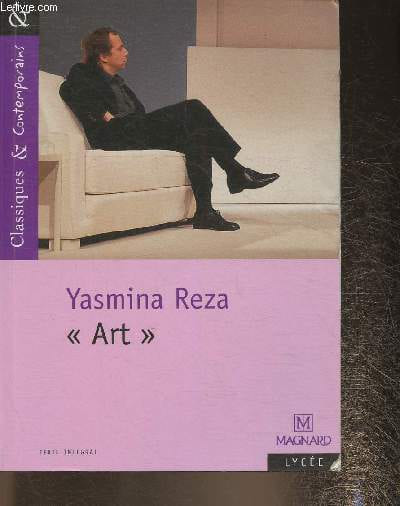
Magnard. 2001. In-12. Relié demi-cuir. Etat passable, Coins frottés, Dos satisfaisant, Intérieur frais. 122 pages.. . . . Classification Dewey : 792-Théâtre
Reference : RO30338808
ISBN : 221075447X
"Collection ""Classiques et contemporains"". Présentation, notes, questions et après-texte établis par Jocelyne Hubert. Classification Dewey : 792-Théâtre"
Bookseller's contact details
Le-livre.fr / Le Village du Livre
ZI de Laubardemont
33910 Sablons
France
05 57 411 411
Payment mode


Sale conditions
Les ouvrages sont expédiés à réception du règlement, les cartes bleues, chèques , virements bancaires et mandats cash sont acceptés. Les frais de port pour la France métropolitaine sont forfaitaire : 6 euros pour le premier livre , 2 euros par livre supplémentaire , à partir de 49.50 euros les frais d'envoi sont de 8€ pour le premier livre et 2€ par livre supplémentaire . Pour le reste du monde, un forfait, selon le nombre d'ouvrages commandés sera appliqué. Tous nos envois sont effectués en courrier ou Colissimo suivi quotidiennement.
5 book(s) with the same title
Geschichte der Kunst des Alterthums. Nach dem Tode des Verfassers herausgegeben und dem Fürsten Wenzel von Kaunitz-Rietberg gewidmet von der kaiserlichen königlichen Akademie der bildenden Künste. 2 vols. - [FOUNDATIONAL WORK OF MODERN ART HISTORY]
Wien, im Akademischen Verlage, 1776. 4to. Two volumes uniformly bound in two contemporary full sprinkled calf bindings with five raised bands and gilt lettering and ornamentation to spine. Bindings with light wear and and some scratches. Spine-ends with minor loss of leather. Ex-libris to verso of front boards and previous owner's name in contemporary hand to front free end-papers. Internally very fine and clean. Printed on good paper. (14), LXXII, 618 pp. + frontispiece (3), 620-881, (54) pp. Blank leaves bound in the back.
First edition of Winckelmann’s seminal history of ancient art, one of the foundational works of modern art history and classical archaeology. In the present work Winckelmann established a systematic, historically based approach to the study of ancient art, separating different periods and styles and placing emphasis on the development of Greek sculpture. His famous conception of Greek art as embodying “noble simplicity and quiet grandeur” profoundly influenced the formation of Neoclassicism and generations of artists, historians and archaeologists. ”His general Geschichte der Kunst des Altertums (1764 “History of the Art of Antiquity”) is virtually the first work to define in ancient art an organic development of growth, maturity, and decline to include such cultural and technical factors as climate, freedom, and craftsmanship in explaining the art of a people or to attempt a definition of ideal beauty. This work inaugurated the division of ancient art into periods—a pre-Phidian (or archaic), the high or sublime style of the great Greek sculptors Phidias and Polyclitus of the 5th century bc, the elegant or beautiful style of the sculptor Praxiteles and the painter Apelles (both flourishing in Greece in the 4th century bc), and the imitative period, corresponding to the Greek-tinctured Hellenistic and the Roman—that have passed into the common parlance of Greek art history. But his fame rests chiefly upon his descriptions of individual works of art, combining meticulous, firsthand observation with a warm and spontaneous style. His remarks on the Laocoön, the Apollo Belvedere, the Niobids, and the Belvedere Torso have become landmarks alike in the history of German literature and art criticism. The study of art history as a distinct discipline and of archaeology as a humane science may be said to date from Winckelmann.” (Britannica) Winckelmann’s work marked an important change from earlier studies of antiquity. Rather than simply describing ancient monuments he aimed to show how art and artistic styles had developed over time. His study of Greek art, based partly on the collections in Rome and his close study of ancient sculpture, made the the present work one of the key works in the development of art history as an academic discipline.

Cobra Bibliotheket. 1. Serie: De Frie Kunstnere. (i.e. English: ""The Cobra Library""). - [THE EPITOME OF THE COBRA ART MOVEMENT]
Copenhagen, Ejnar Munksgaard, 1950. 15 volumes (170 x 130 mm), all in the original lithographed wrappers by Alechinsky, Appel, Atlan, Ejler Bille, Constant, Corneille, Doucet, Sonja Ferlov, Stephen Gilbert, Gudnason, Heerup, Egill Jacobsen, Asger Jorn and Carl henning Pedersen. A lovely, clean, bright, and fresh set.
Fine set constituting one of the final collected works by the Cobra art group which dissolved in 1951.The Cobra art movement was a significant avant-garde art movement that emerged in the years immediately following World War II. The term ""Cobra"" is derived from the names of the three major cities involved: Copenhagen, Brussels, and Amsterdam. The Cobra movement is also known as CoBrA, with each letter representing one of the cities. Cobra was founded in 1948 by a group of artists who wanted to create a new kind of art that was spontaneous, experimental, and often characterized by vibrant colors, expressive brushwork, and a childlike quality. The movement emphasized freedom of expression, collaboration, and a rejection of traditional artistic conventions. Cobra had a profound impact on modern art, influencing subsequent movements such as Abstract Expressionism and Art Brut. Its emphasis on spontaneity and intuitive creativity helped shape the direction of art in the mid-20th century Asger Jorn played a central role in the formation of Cobra. He advocated for a return to primal artistic instincts and embraced elements of folk art, mythology, and symbolism. “Jorn traveled to France where in the autumn of 1948 he, together with Christian Dotremont and Constant, founded COBRA (a European avant-garde art movement), and edited monographs of the Bibliothèque Cobra. However by 1949 Jorn had started a relationship with Matie van Domselaer, the daughter of the composer Jakob van Domselaer. This caused tension in the COBRA group with the Dutch artists boycotting a conference held at Bregnerød later that year. Matie and Jorn were married in 1950 and the group dissolved in 1951.” (""Asger Jorn"" museumjorn.dk)
Über das geistige in der Kunst. Insbesondere in der Malerei. Mit ach Tafeln und zehn Originalholzschnitten. - [""AN IMPORTANT LANDMARK IN MODERN ART HISTORY""]
München, Piper & Co, 1912. Small 4to. Original illustrated full cloth (stating Dritte Auflage - i.e. third issue). Binding brownspotted and with tear to lower capital. Internally a bit of occasional brownspotting. Owner's signature to title-page (Fjeltofte). (8), 104 pp. + 8 plates + 3 unnumbered leaves of tables (Tabelle I-III) + advertisement leaf. Illustrated with original woodcuts in the text, 10 in all.
The scarce first edition, first printing of Kandinsky’s landmark theoretical work of art, ”A seminal text in the history of modern art” (Guggenheim), curiously bound in the third issue binding. The first issue is easily distinguishable from the second and third that also appeared in 1912, as they are both expanded and have 124 pp., whereas the first has 104. The present copy has small remains of stitching towards the inner margins, so perhaps someone had this first issue printing inserted into the third issue binding, which is sturdy as opposed to the wrappers of the first issue. “In Concerning the Spiritual in Art Wassily Kandinsky, one of the most famous abstract painters of all time, urges the reader to free themselves from art's traditional bonds to material reality. In this radical theoretical work, he calls for a spiritual revolution in painting, arguing that artists, much like musicians, should be allowed to express their own inner lives in abstract, non-material terms. Investigating form and colour, spirituality and tradition, Kandinsky explores art's resonance with the soul, its purpose and nature, and its power to inspire us, to stir our emotions and to help us see beyond the limits of our world. A significant contribution to the understanding of non-objectivism in art, this book serves as an important landmark in modern art history and is necessary reading for every artist and art-lover.” (From the Penguin Classics edition). “In this remarkable book, anticipating “the spiritual turning-point” Kandinsky reflects on his understanding of progress in this direction. This is not a process that would happen automatically. It requires a lot of work and implies a great responsibility of both artist and viewer. The task of the artist is to find “the principle of the innermost necessity” that he or she can use through expressive means to achieve the goal, “vibration of the human soul.” Using captivating analogies, Kandinsky dwells at length on the artistic means: the psychology of color, the compositional interrelation of forms, etc. However, the main goal of an artist still remains to find that very innermost necessity”, that is based on the spiritual foundations of the individual. In his or her turn, the work of the viewer is to find within him- or herself the purity of perception, which, at this level, does not relate to the beauty of nature. The ideal imitation of nature as the summit point of artistic mastery has remained in the past. The impressions of impressionists, the emotions of expressionists, the experiments of cubists - all these stages have long been passed, and now the task of the viewer is to see the beauty of pure color and pure shape. Kandinsky anticipates the emergence of abstract art as the purest form of influence on the human soul, and views the future optimistically, foretelling the upcoming emergences of the epoch of great spirituality.” (from Sadler’s English translation)
Los desastres de la guerra. Colección de ochenta láminas inventadas y grabadas al agua-fuerte. Publicala la Real Academia de Bellas Artes de San Fernando. - [""THE MOST SEARING WORKS OF ART EVER TO DEAL WITH CONFLICT""]
Madrid, 1906. Folio oblong. Bound in a splendid recent full longgrained burgundy morocco binding in pastiche style, with four raised bands to beautifully gilt spine. Boards with gilt ornamental borders and gilt centre-piece. Gilt line to edges of boards and inner gilt dentelles. Marbled end-papers. All leaves re-hinged. Occasional light brownspotting, but overall very nice. Title-page (the version with the second line (beginning ""Colección de Ochenta...) in lower case), 2 pp. of text (dated 1863) + 80 engraved plates (on fine, laid paper measuring 23,4x32 cm.). Plates 17 and 77 have been misbound (the numbers 1 and 7 look almost the same - Harris II:201: ""In some sets this plate has been bound out of order where the number hs been read as 77"""" II:288: ""In some sets this plate has been bound out of order where the number has been read as 17).
A beautiful copy of the splendid fourth edition of Goya's magnificent ""Disasters of War"" - one of the most significant anti-war works of art ever produced - consisting in all 80 plates that were issued. ""The Disasters of War"" constitutes Goya’s political masterpiece, directly inspired by and documenting the horrors he witnessed during the Peninsular War of 1808-14 between Spain and France under Napoleon Bonaparte, the terrible famine in Madrid in 1811-12, and the disappointment at the restoration of the Bourbon monarchy. As such, it is one of the earliest and most important examples of war documentation and remains to this day one of the boldest anti-war statements ever made. This, however, is also the reason why these groundbreaking etchings were not published during Goya’s life-time. It was both too dangerous and too gruesome. As Alastair Sooke puts it, ""[e]ven today it is difficult to look at the Disasters, because Goya catalogues the brutality and fatal consequences of war in such a stark, confrontational and unflinching manner."" (See his article for BBC Culture, 2014). In this seminal series of etchings, Goya not only uses art to comment on politics and the atrocities connected with war, he also pioneers a number of artistic tools. Breaking from painterly traditions, he deviates from the heroics of most previous war art to show us how war can bring out the worst in humanity. He abandons colour in order to show us a more direct truth conveyed by the use of shadow and shade. Also, the fact that he presents the 80 works of art as a collection, together with the harsh, realistic nature of the etchings themselves, connect the images more closely to the art of photography that we are now so familiar with, causing the work as a whole to be viewed as one of the earliest examples of actual first-hand war reportage. The work has been extremely influential, perhaps most famously inspiring Pablo Picasso and Ernest Hemingway (For Whom the Bells Toll). ""There are many contenders for the most powerful example of war art from the past two centuries: Picasso’s Guernica (1937), painted in response to the bombing of a Basque village during the Spanish Civil War, would be an obvious choice. For me, though, nothing quite matches the originality and truth-telling ferocity of the Disasters of War, a series of 80 aquatint etchings, complete with caustic captions, by the Spanish artist Francisco de Goya (1746-1828)."" (Sooke). The execution of the engravings has been dated to a period between 1810 and 1820, but no contemporary edition was made of this spectacular series. ""Possibly by the time they were finished, the war and famine scenes were not of great appeal, and Goya was probably unwilling to risk another financial failure such as he had experienced with the ""Caprichos"". It was a time of stern repression and the publication of the satirican and violently anti-clerical subjects of some of the ""caprichos enfánticos"" would certainly have been dangerous. These facts would account for a postponement of publication. Also, Goya himself tells us that he fell seriously ill in the winter of 1819... and on his recovery he was planning to leave Spain and settle permanently in France. That Goya did not attempt to make an edition of ""Desastres"" in Madrid before leaving for France is borne out by the investigations of Catharina Boelcke-Astor, who showed that the copperplates were stored away in safes by Goya's son Javier, where they remained until the latter's death in 1854. Eventually, in November 1862, they were acquired by the Academia de San Fernando from D. Jaimé Machén for 28,000 reales..."" (Harris I:141). In 1863, the first edition of Goya's seminal work was issued, under the famous title ""Los desastres de la guerra"". In all, 500 copies were issued. A second edition followed in 1892, and a third in 1903. Both of these editions were issued in merely 100 copies. In 1906, the fourth edition appeared, in a number of 275 copies. ""This edition is excellently printed on very suitable papers"" (Harris II: 175) and is considered much superior to the third. A further three editions appeared, in 1923, 1930, and 1937 respectively. ""When Goya had engraved all the plates of the ""Desastres"" he gave his friend, Céan Bermúdez, an album containing a proof set of eighty-five plates, including the eighty plates eventually published as ""Los Desastres de la Guerra"", two plates numbered 81 and 82, which were prepared for the series but not published with it, and the three little engravings of ""prisoners"", which were never intended by Goya for inclusion in a published edition of the series."" (Harris I:140). The first plate prepares the spectator for the contents of the series and can be seen as a sort of frontispiece, plates 2-47 deal mainly with the horrors of the war, plates 48-64 record the terrible famine in Madrid, and the final plates 65-80 constitute the ""Caprichos enfánticos"". "" ""The impact of the scenes is incredible,"" says the independent art historian Juliet Wilson-Bareau, one of the world’s leading Goya experts. ""Each one is a powerful, original work of art in its own right, yet linked to the others with a common theme, including the way their titles - terse comments, questions, or cries of outrage - connect them, and read on from one to another. The grouping of the series into three ‘chapters’ gives the whole a sense of rhythm and purpose."" Goya must have hoped that he would live to see the publication of his Disasters, but the despotic rule of Ferdinand VII made this impossible. ""Under his repressive and reactionary regime,"" Wilson-Bareau explains, ""there was no way that Goya could have published his set of prints that so clearly denounced all violence and all abuse of power."" Still, following their posthumous publication, the Disasters proved enormously influential, inspiring artists including the German Otto Dix as well as Dalí and Picasso - and, more recently, the British brothers Jake and Dinos Chapman, who bought a complete edition of the prints and ‘defaced’ them by adding grotesque, cartoonish faces. Even the war photographer Don McCullin acknowledges a debt: ""When I took pictures in war, I couldn’t help thinking of Goya,"" he has said. The genius of the Disasters is that they transcend particularities of the Peninsular War and its aftermath to feel universal - and modern. Perhaps this is because, as the British writer Aldous Huxley put it in 1947, ""All [Goya] shows us is war’s disasters and squalors, without any of the glory or even picturesqueness."" So should we consider the series as the greatest war art ever created? Wilson-Bareau certainly thinks so. ""For me, yes,"" she tells me. ""I have lived with these prints, which many people consider too shocking, absolutely unbearable, and I find in them - besides the heartbreak and outrage at the unspeakable violence and damage - a great well of compassion for all victims of the suffering and abuses they depict, which goes to the very heart of our humanity."" (From Alastair Sooke's BBC-article). Harris II: 175.
Laokoon, oder uber die grenzen der mahleren und poesie. Vol. 1 (All published). - [SEMINAL WORK IN ART THEORY - PMM 213]
Berlin, Christian Friedrich Voss, 1766. 8vo. An excellent copy in a late 19th century red half calf with five raised bands and gilt lettering to spine. Fore- and lower edge uncut. Upper edge coloured in red. Spine with a few scratches and a bit of wear. End-papers with annotations in pencil and remains of a removed book-plate. Internally in very nice condition, with light occassional brownspotting. (8), 298 pp.
First edition of Lessing’s landmark work in the history of art theory. In Laokoon, Lessing argues that each art form operates within its own distinct boundaries, that the principles of poetry cannot be applied to sculpture or painting, and vice versa. Lessing’s Laokoon was written as a response to Johann Winckelmann's ”Geschichte der Kunst des Alterthums” (1764). Lessing challenges Winckelmann’s interpretation of the famous Laocoon statue, arguing that Winckelmann portrays the figure’s suffering as too noble and composed - an expression suitable for poetry, but not for sculpture, whose medium cannot convey inner emotion in the same way. “Laokoon is perhaps Lessing’s best known work outside Germany, and it has had a world-wide influence. It takes its name from the famous statue discovered at Rome in the sixteenth century. It analyses the differences between the sculptor’s treatment of Laocoon wrestling with the serpents and Virgil’s treatment of the same theme, and from there goes on to discuss the limits and limitations of all the arts. It contains the first clear statement of the truth, which is now considered axiomatic, that every art is subject to limitations, and can achieve greatness only by a clear understanding of and self-restriction to its proper function. The most telling passages, and those which have borne most fruit, are those on poetry. Lessing knew more about this than about painting and sculpture, for which he was entirely dependent on Winckelmann (210). His exposition of the themes of Homer and Sophocles is especially effective, and he opened up a new prospect in the appreciation of Greek literature. Yet perhaps Lessing is best judged by the sum of his achievement. He was one of the principal figures in the Aufklärung, the emancipation of German literature from the narrow classicism of the French school. It was he, more than any other, who laid the foundations of the intellectual primacy of German writers and thinkers in the nineteenth century, a debt which they were not slow to acknowledge. Without attaching himself to any special philosophical school, he consistently opposed error and dogmatism, and in art, in poetry, in drama and in religion he provided new stimulation. In the words of Macaulay, he was ‘beyond all dispute the first critic of Europe’.” (PMM 213) PMM 213