 Write to the booksellers
Capus Alfred
Robinson
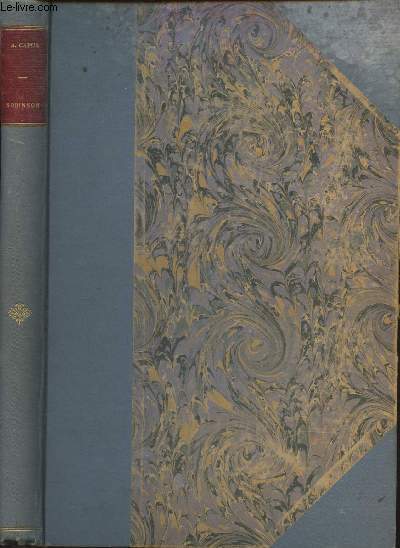
Chez l'auteur. Non daté. In-4. Relié. Bon état, Couv. convenable, Dos satisfaisant, Intérieur frais. 38 pages. Nombreuses illustrations en noir et blanc, hors texte. Plats jaspés. Filets, fleuron titre et auteur en doré au dos.. . . . Classification Dewey : 840-Littératures des langues romanes. Littérature française
Reference : RO30319666
Illustrations de Simont. Classification Dewey : 840-Littératures des langues romanes. Littérature française
Bookseller's contact details
Le-livre.fr / Le Village du Livre
ZI de Laubardemont
33910 Sablons
France
05 57 411 411
Payment mode


Sale conditions
Les ouvrages sont expédiés à réception du règlement, les cartes bleues, chèques , virements bancaires et mandats cash sont acceptés. Les frais de port pour la France métropolitaine sont forfaitaire : 6 euros pour le premier livre , 2 euros par livre supplémentaire , à partir de 49.50 euros les frais d'envoi sont de 8€ pour le premier livre et 2€ par livre supplémentaire . Pour le reste du monde, un forfait, selon le nombre d'ouvrages commandés sera appliqué. Tous nos envois sont effectués en courrier ou Colissimo suivi quotidiennement.
5 book(s) with the same title
loss of a minute is just so much loss of life': Edward Robinson and Eli Smith in the Holy Land
, Brepols, 2020 Paperback, xx + 339 pages, Size:156 x 234 mm, Illustrations:25 b/w, 8 col., 1 tables b/w., 2 maps color, Language: English. ISBN 9782503589138.
Summary Perhaps no other Palestine / Holy Land explorer has received as much attention as Edward Robinson, the American philologist, theologian, and historical geographer responsible for laying the foundations for the modern historic-geographical study of the Holy Land. Surprisingly, to date, almost no one has delved into Robinson's archive to illuminate his Holy Land expeditions, the writing of his monumental Biblical Researches, and the compilation of his fine maps. Similarly, no one has conducted a detailed study of the archive of Eli Smith, American Board of Commissioners of Foreign Missions Beirut missionary and Robinson's travel companion, for the same purposes. Fluent in Arabic and highly familiar with the region and its inhabitants, Smith's contribution to the expedition and to the Biblical Researches was considerable as his archive reveals. Investigating documents in both Robinson's and Smith's archives, the author of the present book became quickly convinced that much of the accepted narrative concerning Robinson's Holy Land studies should be re-evaluated and, consequently, rewritten. Several issues, for lack of relevant sources, have not yet been addressed by scholars. The story of Robinson and Smith's expedition and writing of the Biblical Researches that emerges from their extensive correspondence underscores the difficulties they overcame, and the accuracy and magnitude of their scholarship in an age bereft of modern technology. TABLE OF CONTENTS List of Illustrations Preface Acknowledgements Edward Robinson 1794-1863: A Short Biography 1. Introduction: The Archives of Edward Robinson and Eli Smith The introduction reviews the vast and different collections of archival materials consulted for this study. 2. The 1838 Expedition to the Holy Land: Origins and Preparations 2.1 Documenting the decision to embark and expedition preparations Robinson's decision-making process, beginning with his pivotal 1832 meeting with Smith in Andover, MA, until embarking on the expedition in Spring 1838. 2.2 Robinson's German period: Seeds of the Holy Land expedition Robinson's desire to embark on a scholarly expedition to the Holy Land was influenced by the example of leading German scholars he met while studying in Halle and Berlin from 1826 to 1830. 2.3 Developing a historical-geographic approach to the Scriptures. 'The father of Holy Land studies' developed a unique and innovative method for scholarly investigation of the land of the Scriptures. 2.4 Organizational and technical matters 3. The 1838 Expedition: Itinerary and Development 3.1 Financing the expedition 3.2 Robinson and Smith's descriptions and comments of events en route Based upon archival material, the story of their everyday life, contact with locals and dignitaries. 4. In Berlin and Halle: Writing the Biblical Researches 4.1 The post-expedition journey: Robinson and Smith to Germany Robinson's and Smith's travel decisions and their impact upon their subsequent research and the dramatic tale of Robinson's recovery and his wife Talvj's involvement. 4.2 Return to NY or stay in Berlin? Robinson and his UTS superiors Robinson initially planned to return to New York and begin teaching at UTS in Autumn 1838, but he actually returned only two years later. 4.3 The Biblical Researches: Planning, writing, and distribution 4.3.1 The preface: Explaining the underlying scientific approach 4.3.2 Origin of the manuscript: From inception to format 4.3.3 The writing begins in earnest 4.3.4 Attention to detail: Arabic place names and orthography 4.3.5 Publishing the manuscript The Biblical Researches, three volumes comprising more than 600 pages each, was published almost simultaneously in London and in Boston in English, and in Halle in German. 4.3.6 Biblical Researches 1841 - distribution 4.4 Robinson's secondary sources Robinson's amazing use of diverse sources to construct his arguments and the historical-geographic picture of the land and its sites. 5. Co-travelers and Companions 5.1 Eli Smith, the underacknowledged partner ABCFM missionary Eli Smith, responsible for construction of the Beirut Arabic printing press and the Arabic translation of the Bible, was Robinson's student and companion on the expedition. 5.1.1 Eli Smith and the German Orientalists Smith's contacts with some of the leading German Orientalists developed and strengthened during his nine months in Leipzig after the expedition. 5.2 Therese Albertine Luise von Jakob-Robinson, 'Mediator of the Balkan Slavs', and Holy Land Studies Talvj, Robinson's second wife whom he married in Halle in 1828, had, until his death, a crucial role not only in his personal and social, but in his academic life as well. 5.3 James Adger, the anonymous fellow traveler Although he accompanied Robinson and Smith for almost the entire expedition, James Adger of Charleston, SC, is barely mentioned in publications. 6. Epilogue: Whose Arch is It? Robinson and Smith's epoch-making publication, the Biblical Researches, has been the source of many scientific debates. Perhaps the most vigorous debate concerns attributing the discovery of 'Robinson's Arch' to its namesake. This chapter explores traveler Reverend Stephan Olin's contention that it should not have been named for Robinson since others discovered it earlier, Robinson claimed that he was the first to connect the arch to the bridge reported by Flavius. 7. Concluding Remarks Bibliography Archives Abbreviations for periodicals Short titles bibliography Indexes Names Places, Organizations and Events
Das Leben und die gantz ungemeine Begebenheiten des weltberuffenen Engellanders Robinson Crusoe, welcher durch Sturm und Schiffbruch (...).Die Zweyte Hamburgische Ausgabe. (+) Das Leben und die gantz ungemein merckwürdigen Begebenheiten Des Weltberühm... - [GERMAN ROBINSON CRUSOE AND RONBINSONADE]
Hamburg, Wierings Erben, 1721 (Part 1) Leipzig, Weidmann, 1721 (part 2) Leyden, Peter Robinson, 1721 (part III & IV). 8vo. Four parts uniformly bound in two contemporary full calf with four raised bands and gilt lettering to spine. Small paper-label to upper part of spines. Wear to extremities. Leather on spine cracked and scratches and soiling to bords. Front board on vol. 3/4 bended with outer margin partly broken off. Annotation in contemporary hand to front free end-paper in both volumes. Title-page and first leaves in vol. 1 soiled and with reapir. Folded plate closely trimmed with loss to lower margin, several tears, with some loss. Internally generally a good copy. [Vol. 1 & 2:] (14), 463, (1), (14), 448 pp. + frontispiece, 1 folded plate, 1 map and 5 plates (wanting 1)." [Vol. 3 & 4:] (6), 624 pp. + frontispiece and 2 plates.
The very rare second edition of the first German translation of Dafoe’s Robinson Crusoe and the equally rare first German translation of Tyssot’s “La Vie, Les avantures, & le Voyage de Groenland”. From a first glimpse the two works seemingly are unrelated whereas in reality they are a fine testament to the Robinson Crusoe-craze that swept through especially Germany in the first half of the 18th century, being one of the earliest, the first or second, example of the literary genre of Robinsonade - a genre that features stories with plots similar to that of Daniel Defoe's ""Robinson Crusoe"". These stories typically revolve around a character who is stranded in a remote or isolated location, often an uninhabited island, and must rely on their own ingenuity and resourcefulness to survive. Both works are rare in themselves. We have not been able to trace a single similar set at auction. ”Tyssot’s second novel (“La Vie, Les avantures…“ here offered) enjoyed a great success in its day. There was only one French edition and whatever attention it attracted probably resulted from the sudden and widespread demand for desert island literature occasioned by the enormous popularity of Defoe’s Robinson Crusoe which was first published in 1719 and immediately translated into French and Dutch and, in the following year, into German. Tyssot’s novel was published in 1720 and was translated into German in 1721. According to Briiggeman, the title of the German edition was originally intended to be Reise um den Nordpol… but this was hastily changed to Des Robinson Crusoe Dritter und Vierter Theil… Perhaps this catch-penny title caused some demand for the novel in Germany although copies are now hard to find.”(Rosenberg, The Voyage De Groenland). “The popularity of Robinson Crusoe in Germany is evidenced not only by the amazing number of editions of the work itself, some of which found in the collection have previously been commented upon but by the large number of imitations which almost immediately made their appearance. If, in attempting to define the term ""Robinsonade,"" one emphasizes particularly solitary isolation from man's companionship with its ""charm that has bewitched the world,"" as Charles Lamb describes the universal romantic appeal of the central theme of Robinson Crusoe then this genre is not large. Include, however, more than one person, and the growing colony of Crusoe easily becomes a Utopia. Transfer the realistic oceans, ships, islands, and cannibals of Defoe to the realm of the unreal, the simple scenery of Robinson Crusoe becoming the romance of the old wonder-filled travel and adventure stories (…).” (Some Imitations of Robinson Crusoe - Called Robinsonades, The Yale University Library Gazette, Vol. 11, No. 2, October 1936) “The first German edition of Defoe’s anti-novel novel appeared in 1720 in Hamburg, published by T. von Wiering’s heirs. The translation was probably done by Ludwig Friedrich Vischer"" “Vischer” signed the translator’s preface and dated it March 26, 1720—only eleven months after the book had first been published by W. Taylor in London. The year 1720 also saw translations of Crusoe into French and Dutch. ""While the exact order in which these editions appeared remains unclear, scholars commonly assume, correctly I believe, that the Amsterdam French edition predated the first German edition in Hamburg, which in turn preceded the Dutch. The Hamburg edition by Wiering’s heirs was immediately pirated in another German edition, perhaps by Jonathan Adam Felßecker, although the title page listed only the information “Frankfurt & Leipzig, 1720.” The second German edition stole even Vischer’s preface, reprinting it in its entirety and signing it simply “des hochgeneigten Lesers Geflissenster der Ubersetzer” (the gentle reader’s most devoted translator). While Vischer purported to rely solely on the English edition for his Hamburg translation, Felßecker’s pirated edition clearly also copied from the French edition published in Amsterdam. While the Hamburg edition featured an engraved frontispiece copied after the original English published by W. Taylor, the frontispiece of the pirated edition copied that in the French translation published by L’Honoré & Chatelain in Amsterdam (fig. 15). Like that edition, the pirated edition was also outfitted with six engravings, which it advertised prominently on its title page. All six were copied after those in the edition that L’Honoré & Chatelain had richly illustrated. Whether French or English, a novelty, after all, needed fashion plates. By September of 1720, yet another edition appeared. This one advertised itself, in the publisher’s informative preface, as the “fifth” German edition. Within six months then, five different German editions of the English anti-novel novel had appeared. This latest edition gave only the year 1720 and “Frankfurt & Leipzig” on its title page (fig. 16). In all likelihood, it had been undertaken by Moritz Georg Weidmann, whose circumspection here contrasts sharply with the engraved portrait done five years later announcing the publisher’s prominence."" (Wiggin: Novel Translations: The European Novel and the German Book, 1680 – 1730).

Reference : bd-aa96c18944fa739b
"Mael, Robinson and Robinson Robinson et Robinsonne: in French Pierre Mael; in P"
"Mael, Robinson and Robinson Robinson et Robinsonne: in French Pierre Mael; in Paris: Librairie Hachette et Cie, 1893.-315 p./Mael, Robinzon i Robinzonna Robinson et Robinsonne: na frants. yaz. Per Mael; il. A. Pari. Pari: Librairie Hachette et Cie, 1893.-315 s. Mael, Robinson and Robinson Robinson et Robinsonne: in French Pierre Mael; in Paris: Librairie Hachette et Cie, 1893.-315 We have thousands of titles and often several copies of each title may be available. Please feel free to contact us for a detailed description of the copies available. The delivery of this book might be delayed beyond the usual timeframe due to extended processing and preparation before shipment, and faster shipping options are not offered. Please inform us if you need the order by a certain date or have a deadline.SKUbd-aa96c18944fa739b"
Robinson
« Trois livres tiennent en face de la prison : Robinson, Don Quichotte et l’Idiot. » (Malraux). « Il existe un livre qui fournit, à mon gré, le plus heureux traité d’éducation naturelle. Ce livre sera le premier que lira mon Émile : seul il composera durant longtemps toute sa bibliothèque, et il y tiendra toujours une place distinguée. Quel est donc ce merveilleux livre ? C’est Robinson Crusoé. » (J.J. Rousseau). Superbe exemplaire relié en maroquin de l’époque de Mouillé. Amsterdam, 1754. Defoe, Daniel. La Vie et les Avantures surprenantes de Robinson Crusoe, Contenant, entres autres évènemens, le séjour qu’il a fait pendant vingt-huit ans dans une Ile déserte située sur la Côte de l’Amérique, près l’embouchure de la grande Rivière Oroonoque. Le tout écrit par lui-même. Traduit de l’Anglois. Cinquième édition. Leiden, E. Luzac Junior, Amsterdam, Z. Chatelain et fils, 1754. 3 volumes in-12 de 1 frontispice, xiv pp., 629 pp., 1 carte repliée et 6 figures hors texte; (1) f., viii pp., 562 pp., 7figures; xxx pp., (2), 603 pp., 7 figures. Maroquin rouge, dos lisse ornés aux petits fers, triple filet doré d’encadrement sur les plats, coupes décorées, tranches dorées. Reliure de l’époque. 164 x 95 mm. Première traduction française des Aventures de robinson Crusoé par Juste van Effen et Themiseul de Saint-Hyacinthe. Elle avait paru originellement en 1720-1721 dans une autre version. Cohen, 405 ; Sander, 711; Sabin, 72218 ; Catalogue Rothschild, II, n° 1759 ; PMM, 180. L’un des plus intéressants livres illustrés par Bernard Picart, « orné d’une carte pliée et de 21 figures par l’artiste, dont une seule signée. » (Cohen). « L’un des livres les plus célèbres de la littérature mondiale ; c’est l’aventure du marin Selkirk, qui avait été abandonné en 1705 dans l’île de Juan Fernandez au large du Chili. Après quatre ans de solitude, il était presque revenu à l’état sauvage. Robinson Crusoé s’enfuit de chez lui, s’embarque mais son vaisseau fait naufrage et, seul survivant, il échoue sur une île déserte. Avec une ingéniosité inouïe il organise son existence solitaire. Il rencontre Vendredi, « le bon sauvage ». Tout ce qui se rapporte aux voyages plut énormément dans Robinson Crusoé, au point de masquer le nœud du récit. Il fallut l’Émile de rousseau pour attirer l’attention sur ce qui est l’idée maîtresse de l’œuvre : la lutte de l’homme seul contre la nature. Une chose est sûre c’est que ce récit est une réussite incomparable. « C’est Defoe, observe Jean Prévost, qui prépara la prodigieuse éclosion des romans réalistes au XVIIIe siècle. » (Dictionnaire des Œuvres). « The special form of adventure that he chose and even the name of his hero have been adopted by countless imitators. At least equally relevant for the purpose is the figure of the lonely human being subduing the pitiless forces of nature; going back to nature and portraying the “noble savage” in a way that made the book required reading for Rousseau’s Emile. » (P.M.M.) Dans l’Émile, Jean-Jacques Rousseau imagine « un livre unique qui, seul mérite d’être sauvé, à l’exclusion de tous les autres. Robinson Crusoé occupe seul cette place convoitée. » (F. Gevrey). « Il existe un livre qui fournit, à mon gré, le plus heureux traité d’éducation naturelle. Ce livre sera le premier que lira mon Émile : seul il composera durant longtemps toute sa bibliothèque, et il y tiendra toujours une place distinguée. Tant que notre goût ne sera pas gâté sa lecture nous plaira toujours. Quel est donc ce merveilleux livre ? Est-ce Aristote ? Est-ce Pline ? Est-ce Buffon ? Non, c’est Robinson Crusoé. » (J.J. Rousseau). L’édition originale de ce livre, l’un des plus appréciés de la littérature occidentale, parut en anglais en 1720. Un exemplaire médiocre fut adjugé 200000 € il y a 22 ans. Le premier tirage date de 1720-1721. Devant le succès de l’illustrateur, d’autres éditions virent le jour en 1727, 1754, 1760, 1770 etc… Les exemplaires reliés en beau maroquin ancien sont rares et très recherchés. Cohen n’en cite aucun pour les éditions de 1720 et un seul, relié par Derôme, pour la présente édition de 1754. Il fut adjugé 25000 FF par Sotheby’s Monaco en 1981 et revendu 35000 FF (5300 €) en mai 1982 il y a 41 ans par Pierre Bérès (Cat 73 n° 114). Le 5 mai 2005, l’exemplaire de 1727 relié pareillement était vendu 18000 €. Très bel exemplaire en maroquin rouge du temps, attribuable à Mouillé «relieur à la production confidentielle» (Ramsden, French Bookbinders 1789-1848, p. 144). Actif à la fin du XVIIIesiècle jusqu’en 1803, ce relieur parisien affectionnait pour l’ornementation de ses reliures le style anglais alors en vogue. Mouillé s’installa, rue Saint Jacques, dans la même maison que Derome (Thoinan, Relieurs français, 1893, p. 353). Provenance: étiquette du libraire parisien Théophile Belin qui possédait une librairie au 48 rue Cambon de 1904 à 1921.

[LE PLESSIS-ROBINSON] Commune de Plessis-Piquet. Arrond.t de Sceaux. Canton de Sceaux.
1854-1870. 619 x 904 mm.
Très grand et beau plan de la commune du Plessis-Robinson en 1870, dressé par Onésime Théodore Lefèvre en 1854, puis révisé en 1870. Il a été lithographié par Avril Frères et Louis Wuhrer pour l'Atlas communal du département de la Seine, et finement aquarellé à l'époque. Nommée le Plessis-Liberté sous la Révolution, la commune reprend son nom d'origine de Plessis-Piquet en 1801, puis est baptisée Le Plessis-Robinson en 1909, du nom de la guinguette Au Grand Robinson, construite en 1845 par le restaurateur parisien Joseph Gueusquin. Avec ses cabanes dans les arbres comme dans Le Robinson suisse de Johann David Wyss, inspiré du Robinson Crusoé de Daniel Defoe, cette guinguette connut un tel succès que d'autres guinguettes firent leur apparition, et que le quartier finit par prendre le nom de Robinson. En 1870, la commune du Plessis-Robinson faisait partie du canton de Sceaux, ancienne division administrative créée en 1800, au sein de l'arrondissement de Sceaux et du département de la Seine. Le département de la Seine, nommé département de Paris à sa création en 1790, comprenait trois districts ou arrondissements, et seize cantons. Il fut dissous en 1968, pour former les départements de Paris, des Hauts-de-Seine, de la Seine-Saint-Denis et du Val-de-Marne. Issy fut officiellement renommée Issy-les-Moulineaux en 1893, lorsque le petit hameau des Moulineaux, qui appartenait à la commune de Meudon, fut rattaché à la commune d'Issy. Ce très grand plan figure Le Plessis-Robinson et les communes limitrophes de Fontenay-aux-Roses, Sceaux, Châtenay et Malabry (réunies en 1920). Une importante légende accompagne la commune du Plessis : liste des établissements communaux (mairie, écoles, cimetières, etc) ; route nationale de Versailles à Choisy-le-Roi ; cours d'eau (ru de la Fontaine du Moulin) ; route départementale de Choisy à Versailles ; chemins vicinaux ordinaires et ruraux ; nomenclature des rues ; signes conventionnels. Six teintes ont été utilisées : en rose, la route impériale de Versailles à Choisy-le-Roi ; en bleu, le ru de la Fontaine du Moulin (couleur non utilisée) ; en jaune, la route départementale de Versailles ; en violet, les chemins vicinaux ordinaires ; en bistre pâle, les chemins ruraux ; et en orange, les voies urbaines qui sont les rues de la Ferme et de l'Église. Plan intéressant pour l'histoire de cette commune, montrant des rues qui ont aujourd'hui disparu ou qui ont été renommées, comme la rue de l'Église renommée rue de la Mairie, ou les rues de l'Étang rouge et de Versailles, aujourd'hui disparues. Onésime Théodore Lefèvre était ingénieur, géomètre et cartographe du département de la Seine, installé à Villejuif. Il a également dressé en 1871 une carte du département de la Seine, et fut maire de Villejuif de 1856 à 1871. Bel exemplaire aquarellé à l'époque.

