 Write to the booksellers
SAKI
NOUVELLES 2
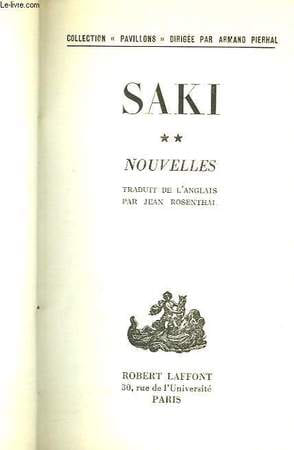
ROBERT LAFFONT. 1963. In-12. Relié. Bon état, Couv. convenable, Dos satisfaisant, Intérieur frais. 279 pages. Pièce de titre noire. Pièce d'auteur noire. Titre, auteur, filets dorés sur le dos vert. Premier plat broché conservé.. . . . Classification Dewey : 840.091-XX ème siècle
Reference : RO30066445
"Collection ""Pavillons"" dirigée par Armand Pierhal. Traduit de l'anglais par Jean Roenthal. Classification Dewey : 840.091-XX ème siècle"
Bookseller's contact details
Le-livre.fr / Le Village du Livre
ZI de Laubardemont
33910 Sablons
France
05 57 411 411
Payment mode


Sale conditions
Les ouvrages sont expédiés à réception du règlement, les cartes bleues, chèques , virements bancaires et mandats cash sont acceptés. Les frais de port pour la France métropolitaine sont forfaitaire : 6 euros pour le premier livre , 2 euros par livre supplémentaire , à partir de 49.50 euros les frais d'envoi sont de 8€ pour le premier livre et 2€ par livre supplémentaire . Pour le reste du monde, un forfait, selon le nombre d'ouvrages commandés sera appliqué. Tous nos envois sont effectués en courrier ou Colissimo suivi quotidiennement.
5 book(s) with the same title
Amours Nouvelles Inédites,
Les Amis de La Varende, au Château de Blanc Buisson, en Pays d'Ouche, 1 Volume broché, 230 x 180 mm. 179 pp. Couverture rempliée, Impression en deux couleurs,Couverture légèrement insolée, qq. rousseurs, du reste, bonne condition, sans l'emboîtage.
" Nouvelles Inédites, 1944, avec en Frontispice un portrait de Jean de La Varende par lui-même, gravé sur cuivre et tiré par Raymond Haasen, Couverture en 2 couleurs. Achevé d'imprimer le 15 juin 1944 par Daniel Luxe à Lille, Maximilien Vox, Editeur. Mention terminale : Le Chamblac : 1943."Bibliographie de La Varende, Michel Herbert, Tome II, 21,23.
Phone number : 02.31.77.03.74
Choix de Contes et Nouvelles,
1941 La Bibliothèque Précieuse, Paris, Editions Gründ, sans date, [1941],1 Volume relié, 175 x 120 mm. 220 pp. Reliure Editeur, Soleil encadré de Coquillages en angle, dos lisse décoré, second plat muet, Sous Jaquette illustrée, Frontispice. bon exemplaire.
Phone number : 02.31.77.03.74
Nouvelles Genevoises,
1860 Paris, Garnier Frères, sans date, [1860], 1 fort volume relié, 275 x 190 mm., 428 pp., tranches or, reliure percaline, plats muets, dos à 4 nerfs, daissons ornés, ouvrage illustré d'après les dessins de l'auteur, gravures par Best, Leloir, Hotelin et Regnier. Frontispice et 39 gravures hors texte. discrète étiquette de librairie en garde,inévitables rousseurs, sinon bel exemplaire.
Table :La Bibliothèque de mon Oncle : Les Deux Prisonniers, La Bibliothèque, Henriette, Les Deux Scheidegg, L'Héritage, Le Col d'Anterne, Elisa et Widmer, Le Lac de Gers, La Traversée, La Vallée de Trient, Le Grand Saint-Bernard, La Peur.
Phone number : 02.31.77.03.74
Collection de Décisions nouvelles et de Notions relatives à la Jurisprudence actuelle,
1766 A Paris, chez Denisart, 1766, 1 Volume relié, 265 x 205 mm. 329 pp. Reliure veau marbré, tranches rouges, dos à 5 nerfs, caissons décorés,usures d'usage, épidermures, coins frappés, fentes aux mors, pièces de titre et tomaison manquantes, en, l'état.
Phone number : 02.31.77.03.74
Cent Nouvelles nouvelles (Burgundy-Luxembourg-France, 1458 - c. 1550). Text and Paratext, Codex and Context
, Brepols, 2023 Hardback, 309 pages, Size:156 x 234 mm, Illustrations:21 b/w, 17 col., 4 tables b/w., 1 maps b/w, Language: English. ISBN 9782503585994.
Summary A collaborative investigation of one of the best-known works of late medieval European literature, the Franco-Burgundian collection of short stories known as the Cent Nouvelles nouvelles. Modelled loosely on Boccaccio's Decameron and incorporating elements from Old French fabliaux as well as Poggio Bracciolini's Liber Facetiarum, the anonymous collection attributes its morally challenging and frequently humorous tales to named narrators including Philip the Good, Duke of Burgundy and Louis of Luxembourg, Count of Saint Pol. The contribution of this new volume of essays is threefold: - empirical, in that it brings entirely new interdisciplinary insights into the study of the genesis and reception of the work; - methodological, in that it integrates study of the text within a 360-degree evaluation of the work's manuscript and early printed context; and - conceptual, in that it seeks to understand the social dimensions of textual production and consumption. These approaches unite ten principal contributions by specialists in the fields of art history, book history, court history and linguistics from France, the Netherlands, the USA and the UK. TABLE OF CONTENTS Introduction Graeme Small Part I - The manuscript witness Chapter 1. Les Cent Nouvelles nouvelles. The physical fabric of the fables Richard Gameson Chapter 2. MS Hunter 252: precursors, date and patronage Hanno Wijsman Part II - Reception in manuscript and print Chapter 3. Printing the Cent Nouvelles nouvelles. Anthoine V rard's 1486 edition and its sixteenth-century successors Mary Beth Winn Chapter 4. Opening and closing the Cent Nouvelles nouvelles. Paratext, context and reception, 1469- c. 1550 Graeme Small Part III - Reading text and image in manuscript form Chapter 5. Storytelling through architecture. The miniatures of the Cent Nouvelles nouvelles Maud Perez-Simon Chapter 6. Narratological readings of the Cent Nouvelles nouvelles (CNN3, 21, 27). Text and image in MS Hunter 252 Alexandra Velissariou ? Part IV - The text as a site of language use Chapter 7. Toward a scriptology of Middle French. The case of MS Hunter 252 Geoffrey Roger Chapter 8. Stylistic implications of linguistic archaism and contemporaneity in MS Hunter 252 Peter V. Davies ? Part V - Archives in the fiction Chapter 9. Locating storytelling in time and space (Hainaut-Brussels, 1458-59). A Decameronian moment Edgar de Blieck & Graeme Small Chapter 10. Tales from the chamber. The Cent Nouvelles nouvelles between Burgundy and Luxembourg Graeme Small Conclusions Graeme Small

