 Write to the booksellers
GOTTMANN JEAN
LES RELATIONS COMMERCIALES DE LA FRANCE
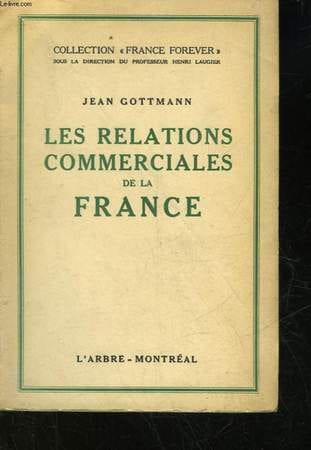
LES EDITIONS DE L'ARBRE. 1944. In-12. Broché. Bon état, Couv. convenable, Dos satisfaisant, Intérieur frais. 165 pages.. . . . Classification Dewey : 330-Economie
Reference : RO30061738
"Collection ""France Forever"", sous la direction du professeur Henri Laugier. Classification Dewey : 330-Economie"
Bookseller's contact details
Le-livre.fr / Le Village du Livre
ZI de Laubardemont
33910 Sablons
France
05 57 411 411
Payment mode


Sale conditions
Les ouvrages sont expédiés à réception du règlement, les cartes bleues, chèques , virements bancaires et mandats cash sont acceptés. Les frais de port pour la France métropolitaine sont forfaitaire : 6 euros pour le premier livre , 2 euros par livre supplémentaire , à partir de 49.50 euros les frais d'envoi sont de 8€ pour le premier livre et 2€ par livre supplémentaire . Pour le reste du monde, un forfait, selon le nombre d'ouvrages commandés sera appliqué. Tous nos envois sont effectués en courrier ou Colissimo suivi quotidiennement.
5 book(s) with the same title
Étude historique sur les Relations Commerciales entre la France et la Flandre au Moyen Age. ORIGINAL EDITION - EDITION ORIGINALE
Paris, Alphone Picard et Fils, 1894, in-8°, vii pp + 392 pp, Relié en demi-toile brun d'époque, dos lisse avec titre doré, couverture conservée. Bon exemplaire de l'édition originale de 1894.
Coup-d'oeil sur les avantages des relations commerciales entre la France et l'Angleterre. basées sur les vrais principes de l'éconopmie politique ; par un membre du Parlement d'Angleterre. Traduit de l'anglais
Paris, Hector Bossange [Imprimerie de Guiraudet], 1832 in-8, [2] ff. n. ch., 46 pp., dérelié. Rousseurs.
Un des nombreux opuscules économiques du premier baron Congleton (1776-1842), membre de la Chambre des Communes pour le Queen's county en Irlande. - - VENTE PAR CORRESPONDANCE UNIQUEMENT - LIEN DE PAIEMENT, NOUS CONSULTER.


Les Relations commerciales entre la France et l'Union des Républiques soviétiques socialistes. Thèse pour le Doctorat présentée et soutenue le 7 mars 1935
Paris, Librairie L. Rodstein, 1935 in-8, 126 pp., broché.
- - VENTE PAR CORRESPONDANCE UNIQUEMENT - LIEN DE PAIEMENT, NOUS CONSULTER.
A TRAVERS LE MONDE N° 40 - Coins de Tunisie : En Khroumirie, Les Aissaouas, Les relations commerciales de la France avec le Chili, Etat actuel du chemin de fer - Transsibérien, Récentes découvertes en Babylonie
LIBRAIRIE HACHETTE & CIE. 2 OCTOBRE 1897. In-12. Broché. Bon état, Livré sans Couverture, Dos satisfaisant, Intérieur frais. Paginé de 313 à 320. Quelques gravures en noir et blanc dans le texte.. . . . Classification Dewey : 70.49-Presse illustrée, magazines, revues
Classification Dewey : 70.49-Presse illustrée, magazines, revues
Recherches historiques sur les relations commerciales entre la France et la Suède
Féret et Fils. 1921. In-8. Broché. Etat d'usage, Tâchée, Dos satisfaisant, Intérieur frais. 69 pp., rousseurs sur les plats -. . . . Classification Dewey : 320-Science politique
Classification Dewey : 320-Science politique

