 Write to the booksellers
CARL SHERRELL.
RAUM.
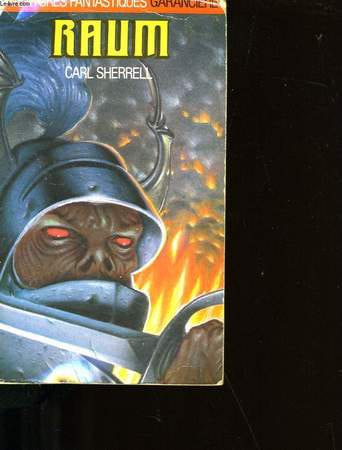
Garancière.. 1986.. In-8. Broché. Bon état, Couv. légèrement passée, Coiffe en tête abîmée, Intérieur acceptable. 188 pages. 1ère de couverture illustrée en couleurs.. . . . Classification Dewey : 840-Littératures des langues romanes. Littérature française
Reference : RO20074591
ISBN : 2734001322
Aventures fantastiques Garancière Collection dirigée par Richard D. Nolane. Classification Dewey : 840-Littératures des langues romanes. Littérature française
Bookseller's contact details
Le-livre.fr / Le Village du Livre
ZI de Laubardemont
33910 Sablons
France
05 57 411 411
Payment mode


Sale conditions
Les ouvrages sont expédiés à réception du règlement, les cartes bleues, chèques , virements bancaires et mandats cash sont acceptés. Les frais de port pour la France métropolitaine sont forfaitaire : 6 euros pour le premier livre , 2 euros par livre supplémentaire , à partir de 49.50 euros les frais d'envoi sont de 8€ pour le premier livre et 2€ par livre supplémentaire . Pour le reste du monde, un forfait, selon le nombre d'ouvrages commandés sera appliqué. Tous nos envois sont effectués en courrier ou Colissimo suivi quotidiennement.
5 book(s) with the same title
EDUCATION PHYSIQUE ET SPORT N°126 / MARS-AVRIL 1974 - Espace, sport et conduites motrices. II. Espace sociomoteur. Demi-fond et cross - escrime - aviron - volley-ball. Raum, Sport und motorisches Verhalten. - II. Sozialmotorischen Raum ETC.
COMITE D'ETUDES ET D'INFORMATIONS PEDAGOGIQUES DE L'EDUCATION PHYSIQUE ET DU SPORT. 1974. In-4. Broché. Bon état, Couv. convenable, Dos satisfaisant, Intérieur frais. 95 pages. Texte sur 2 colonnes. Nombreuses illustrations en noir et blanc dans et hors texte.. . . . Classification Dewey : 796.1-Sports divers
"SOMMAIRE : Espace, sport et conduites motrices. II. Espace sociomoteur. Demi-fond et cross - escrime - aviron - volley-ball. Raum, Sport und motorisches Verhalten. - II. Sozialmotorischen Raum Mittelstrecken-und Waldlauf - Fechten - Rudern - Volley-ball. - Space, sport and motory channels. - The socio-motory space. - Middle-distance and cross-country running - Fencing - Rowing - Volley-ball. -Espacio, déporté y conductas motrizes. - Espacio sociomotor. - Medio fondo y cross - esgrima -remo - volley-ball.L'école nationale de ski et d'alpinisme.Die Nationale Hochschule für ski und Alpinistik. - The ski and moutaineering national school. - Escuela nacional de Esqui e alpinismo.P. PARLEBAS C. GRAS C. FAUCHER T. TRACHEZF.WHITTINGTONG.QUINTILLAN S. GRANVORKADOSSIER POUR LE TIERS-TEMPS PEDAGOGIQUES. SORINUn savoir-faire : le grimper de corde.P. FAVREEine Fertigkeit : Seilklettern. - A "" know how "" : rope climbing. - Un saber-manejar : eltrepar a la cuerda.Cercle d'études Athlétisme. Course avec obstacles stables.ENSEPSLeichtathletik. Vom Lauf mit festen Hindernissen. - Athletics : races with stable obstacles. -Athletismo : Carrera con obstáculos estables.M. MASSONL'escalade en pays non montagneux.M. DEMELLIERKletterei im Flachland. - Climbing in a non-mountainous country. - La escalada en paísesJ. TEXEREAUno montañosos.Equipe CPD - CPCL'enseignement du ski aux enfants.Hautes-AlpesSkiunterricht bei Kindern. - Ski tuition to children. - La enseñanza de! esqui a losninos.Amicale des anciens Contribution à la rénovation de l'éducation physique.élèves de l'ENSEPS Zur Aktualisierung der Leibeserziehung. - A contribution to the renovation of physical Equipe nationale education. - Contribución a la renovación de la educación física.d'animation des stages de sports collectifs P. BOYERFootball : apprendre à regarder.P. ROBERTSehen lernen. - Learning to watch. - App render a mirar.J.-C. JOUBERT Rugby : jeu d'initiation à la passe.Vorhereitungspíele für Ballabgab. - A game of initiation into passing. - Juego de iniciación a éi pase.L. HERRBasket-ball : précisions et commentaires sur les nouvelles règles : le retour en zone.Erlaüterrungen zum neuen Regelwerk : die Rückkehr in die eigene Zone. - Precisions and comments about the new rules : back court play. - Precisiones y comentarios referente a la nuevas reglas : el retraso en zona.H. RAFFINAthlétisme : pédagogie du Fosbury-flop.PEYLOZLeichtathletik : An leitun zur Fosbury-Technik. - Athletics : the Fosbury flop pedagogy. -Athletismo : pedagogía del Fosburry flop.M. ALTHAUSNatation artistique : G.AUGEARD<| pour un enseignement scolaire. - 2. méthode d'entraînement et exercices de base pour l'initiation.Kunstschwimmen : Fur Schulunterricht. Trainingsmethode und Grundübungen zur Anleitung. - Fancy swimming: 1. for tuition in schools. 2. a training method and basic exercises for initiation. - Natación artística : 1. para una ensenanza escolar. 2. método de entrenamiento y ejercicios de base para la iniciación.S. SARKARLa danse indienne.Der indische Tanz. - Indian dancing. - La danza indiana.Informationen. - Information. - Informaciones. Bücher. - Books. - Libros.InformationsLivres Classification Dewey : 796.1-Sports divers"


Reference : alb8caac24bd29dc9f3
Pal Imre. Raum-Geometrie in der Technischen Praxis. Zum 25. Horst Sachs. In Ger
Pal Imre. Raum-Geometrie in der Technischen Praxis. Zum 25. Horst Sachs. In German /Pal Imre. Raum-Geometrie in der Technischen Praxis. Zum 25. Horst Sachs. In German, Berlin VEB Deutscher Verlag der Wissenchaften 1974. Contact us for details or to request photos of available books. Delivery of this book could take longer than normal due to additional handling time before shipping, and no rush delivery options are available. Please let us know if you have a specific date by which you need to receive your order.SKUalb8caac24bd29dc9f3
Reference : alb463207ec45228965
Henry Moore: John Hedgecoe. Energie im Raum. In English /Henry Moore: John Hedg
Henry Moore: John Hedgecoe. Energie im Raum. In English /Henry Moore: John Hedgecoe. Energie im Raum. Album in German, English and French Munich. Studio Bruckmann 1973. We have thousands of titles and often several copies of each title may be available. Please feel free to contact us for a detailed description of the copies available. SKUalb463207ec45228965.
Joseph Beuys, Raum in der Neuen Galerie,
Petersberg, Michael Imhof, 2012 Hardcover, 21 x 29,7 cm, 112 Seiten, 63 Farb- und 2 S/W-Abbildungen. ISBN 9783865688248.
Der von Joseph Beuys (1922-1986) eingerichtete Raum befindet sich seit 1976 in der Neuen Galerie der Museumsland?schaft Hessen Kassel. Zunachst als Dauerleihgabe aus Privatbesitz ausgestellt, konnte die gesamte Installation 1993 von der Hessischen Kulturstiftung und der Kulturstiftung der Lander erworben werden und gehort seitdem zum festen Bestand des Hauses. Die Installation umfasst das zentrale Hauptwerk 'The pack' (das Rudel) und daruber hinaus vier Vitrinen, sieben plastische Bilder und 29 Zeichnungen aus den Jahren 1951-1972. Diese Arbeiten bieten einen guten Einblick in das komplexe Werk des Kunstlers. Die vorliegende Publikation stellt den Raum mit allen Einzelwerken detailliert in Wort und Bild vor.
Der Raum. Ein Beitrag zur Wissenschaftslehre. - [SPACE - CARNAP'S FIRST PUBLICATION]
Berlin, Reuther & Reichard, 1922. 8vo. Uncut in the original grey printed wrappers w. very neat professional repairs to inner hinges and to capitals. Printing on spine nearly fully intact. A very faint waterstaining to upper corner throughout, otherwise a very good, nice and clean copy of a publication, which in itself is quite fragile. 87 pp.
First edition of Carnap's first publication, his doctoral dissertation. Printed in Kant-Studien, Ergänzungshefte, Nr. 56. Issued by H. Vaihinger, M. Frischeisen-Kähler and A Liebert. Rudolf Carnap (born 1891 in Ronsdorf, Germany, died 1970 in Santa Monica, California) was an immensely influential analytic philosopher, who has contributed decisively to the fields of logic, epistemology, semantics, philosophy of science, and philosophy of language. He was one of the leading figures of the Vienna Circle, and a prominent logical positivist. He studied philosophy, physics and mathematics at the universities of Berlin and Freiburg, and worked at the universities of Jena, Vienna and Prague until 1935, when he, due to the war, emigrated to the U.S., where he became an American citizen in 1941. In America he became professor of the University of Chicago. In Jena he was appointed Professor of Mathematics, though his main interest at that time was in physics. By 1913 he planned to write his dissertation on thermionic emission, but this was interrupted by World War I, where he served at the front until 1917. Afterwards he studied the theory of relativity under Einstein in Berlin, and he developed the theory for a new dissertation, namely on an axiomatic system for the physical theory of space and time. He thus ended up writing the important dissertation under the direction of Bouch on the theory of space (Raum) from a philosophical point of view. The dissertation was submitted in 1921, and, due to the clear influence from Kantian philosophy, it was published the following year in this supplement to the ""Kant-Studien"". After the publication of his first work, Carnap's involvement with the Vienna Circle began to develop. He met Reichenbach in 1923 and was introduced to Moritz Schlick in Vienna, where he then moved to become assistant professor at the university. He soon became one of the leading members of the Vienna Circle, and in 1929 he, Neurath, and Hahn wrote the manifest of the Circle.As the title indicates, ""Der Raum"" deals with the philosophy of space. Partly influenced by Husserl, under whom he studied at Freiburg, Carnap poses the question whether our knowledge of space is analytic, synthetic a priori or empirical. His answer is that it depends on what is meant by ""space"", and thus differentiates between three kinds of theories of space: Formal (which is analytic [a priori]), intuitive (which is synthetic a priori), and physical (which is empirical [or synthetic aposteriori]). He compares this division of space with that of geometry into: projective, metric and topological. This, of course, anticipates much of his later philosophy, and some of his theories developed in this paper became the official position of logical empiricism on the philosophy of space. In this work he also develops a formal system for space-time topology, which became quite influential.

