 Write to the booksellers
SERIGNY Alain de
Un procès
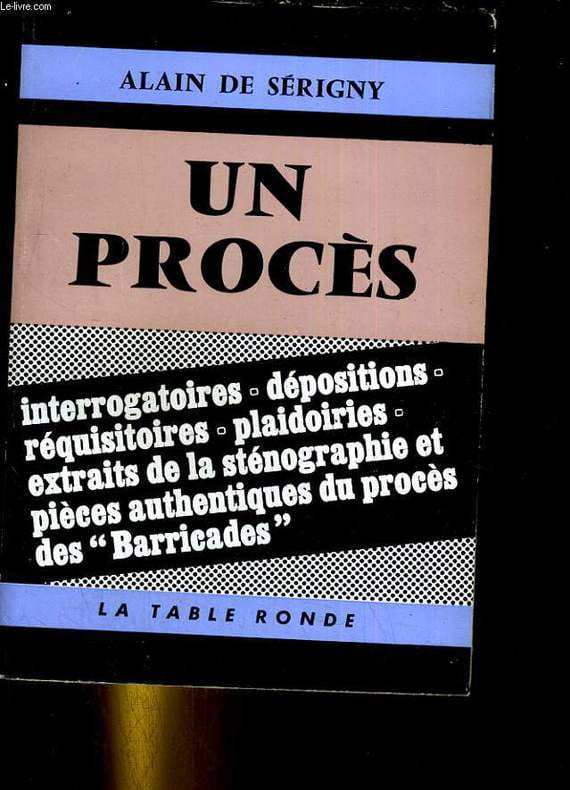
La table Ronde. 1961. In-8. Cartonné. Bon état, Couv. convenable, Dos satisfaisant, Papier jauni. 455 pages.. . . . Classification Dewey : 965-Algérie
Reference : RO20004428
Classification Dewey : 965-Algérie
Bookseller's contact details
Le-livre.fr / Le Village du Livre
ZI de Laubardemont
33910 Sablons
France
05 57 411 411
Payment mode


Sale conditions
Les ouvrages sont expédiés à réception du règlement, les cartes bleues, chèques , virements bancaires et mandats cash sont acceptés. Les frais de port pour la France métropolitaine sont forfaitaire : 6 euros pour le premier livre , 2 euros par livre supplémentaire , à partir de 49.50 euros les frais d'envoi sont de 8€ pour le premier livre et 2€ par livre supplémentaire . Pour le reste du monde, un forfait, selon le nombre d'ouvrages commandés sera appliqué. Tous nos envois sont effectués en courrier ou Colissimo suivi quotidiennement.
5 book(s) with the same title
Procès-verbal de la réunion des membres de la société des agriculteurs de France appartenant aux départements de la Bretagne et des membres de l'association bretonne pendant le congrès de Quimper, le mardi 8 octobre 1895
Société des agriculteurs de France, Association bretonne Brochure 1895 In-8 (16 x 24,4 cm), brochure, 44 pages, Procès-verbal de la réunion des membres de la société des agriculteurs de France appartenant aux départements de la Bretagne et des membres de l'association bretonne pendant le congrès de Quimper, le mardi 8 octobre 1895, compte-rendu de la sénce ; déchirures sur les bords des plats, par ailleurs intérieur bien conservé. Livraison a domicile (La Poste) ou en Mondial Relay sur simple demande.


Gouvernement général de l'Algérie. Direction des affaires indigènes. Procès-verbaux de la Commission chargée de l'étude de la validité des baux en terrain arch et des modifications à apporter à la loi du 16 février 1897
Imprimerie A. Imbert Broché 1923 In-8 (15,3 x 23,5 cm), broché, 117 pages ; titre manuscrit et pliure au dos, rousseurs aux plats, tache de mouillure au premier plat, par ailleurs assez bon état général. Livraison a domicile (La Poste) ou en Mondial Relay sur simple demande.
Etat du procès pendant en la jurisdiction de Brequigny, entre le Sieur L'Allemand, Défendeur, et Michel Thomas, se disant Maître Chirurgien, Demandeur
Brochure 1740 In-8 (18,8 x 24,6 cm), brochure, 24 pages, sans date [1740] ni lieu [Rennes], compte-rendu du procès opposant le Sieur L'Allemand et Michel Thomas concernant la charlatanerie de ce-dernier ; quelques rousseurs, bon état général. Livraison a domicile (La Poste) ou en Mondial Relay sur simple demande.
Procès et condamnation à mort de Pierre-Ignace de Fonrémis de la Mothe, conseiller du Roi, lieutenant particulier du Sénéchal au siège présidial de Saintes, guillotiné à Rochefort le 13 Germinal 1794
Imprimerie nouvelle A. Bellier et Cie Broché 1889 In-8 (16x25 cm), broché, 84 pages, procès collationné et mis en ordre par son arrière-petit-fils Marcel de Fonrémis ; dos absent, réparé avec du papier scotch, pliures et rousseurs sur les plats, petits manques papiers par endroits, état moyen. Livraison a domicile (La Poste) ou en Mondial Relay sur simple demande.
[H. Langlois Fils et Cie] - Collectif ; Une Société d'Avocats et de Publicistes
Reference : 64683
(1827)
Causes politiques célèbres du dix-neuvième siècle (4 Tomes - Complet) [ Contient : ] Tome I : Procès du Duc d'Enghien - Procès du Maréchal Ney - Procès du Général Moreau - Procès de Saint-Réjant, Carbon, Mlle de Cicé et autrs (machine infernale) - Procès du Général Berton(Conspiration de Saumur) ; Tome II : Procès du Général Malet - Procès de Louvel - Procès de Bories et autres (Conspiration de La Rochelle) - Procès de la Reine d'Angleterre ; Tome III : Procès de Murat (Joachim-Napoléon) Roi de Naples - Procès du Général Raphaël Riégo - Procès de Charles-Louis Sand (meurtre de Kotzebue) - Procès du Comte de Lavalette - Procès d'Arthur Thistlewood et autres ; Tome IV : Procès de Guindon, dit Roquefort (Assassinat du Maréchal Brune) - Procès des frères Faucher - Procès de Don Augustin Iturbide ex-Empereur du Mexique - Procès des Patriotes de 1816 - Procès de M. Le Comte Durand de Linois et de M. le Baron Boyer de Peyreleau - Procès de Béranger
4 vol. in-8 reliure de l'époque demi-veau caramel, dos à 4 nerfs, H. Langlois Fils et Cie, Paris, 1827-1828 : Causes politiques célèbres du dix-neuvième siècle (4 Tomes - Complet) [ Contient : ] Tome I : Procès du Duc d'Enghien - Procès du Maréchal Ney - Procès du Général Moreau - Procès de Saint-Réjant, Carbon, Mlle de Cicé et autrs (machine infernale) - Procès du Général Berton(Conspiration de Saumur) ; Tome II : Procès du Général Malet - Procès de Louvel - Procès de Bories et autres (Conspiration de La Rochelle) - Procès de la Reine d'Angleterre ; Tome III : Procès de Murat (Joachim-Napoléon) Roi de Naples - Procès du Général Raphaël Riégo - Procès de Charles-Louis Sand (meurtre de Kotzebue) - Procès du Comte de Lavalette - Procès d'Arthur Thistlewood et autres ; Tome IV : Procès de Guindon, dit Roquefort (Assassinat du Maréchal Brune) - Procès des frères Faucher - Procès de Don Augustin Iturbide ex-Empereur du Mexique - Procès des Patriotes de 1816 - Procès de M. Le Comte Durand de Linois et de M. le Baron Boyer de Peyreleau - Procès de Béranger
Passionnant recueil pour l'histoire politique de la Restauration. Etat très satisfaisant (dos fort. frotté et petits mq. en coiffes, bon état par ailleurs).

