 Write to the booksellers
Marx Karl & Engels Frederick
The Communist Manifesto.
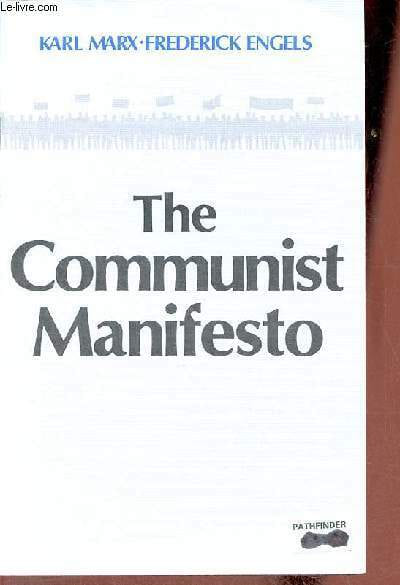
Pathfinder Press. 1987. In-8. Broché. Etat d'usage, Couv. convenable, Agrafes rouillées, Intérieur acceptable. 47 pages agrafées - fascicule en anglais - étiquette collée sur le 1er plat - quelques annotations au stylo noir à l'intérieur du fascicule sans conséquence sur la lecture.. . . . Classification Dewey : 420-Langue anglaise. Anglo-saxon
Reference : R320177465
ISBN : 0873481402
Fascicule en anglais. Classification Dewey : 420-Langue anglaise. Anglo-saxon
Bookseller's contact details
Le-livre.fr / Le Village du Livre
ZI de Laubardemont
33910 Sablons
France
05 57 411 411
Payment mode


Sale conditions
Les ouvrages sont expédiés à réception du règlement, les cartes bleues, chèques , virements bancaires et mandats cash sont acceptés. Les frais de port pour la France métropolitaine sont forfaitaire : 6 euros pour le premier livre , 2 euros par livre supplémentaire , à partir de 49.50 euros les frais d'envoi sont de 8€ pour le premier livre et 2€ par livre supplémentaire . Pour le reste du monde, un forfait, selon le nombre d'ouvrages commandés sera appliqué. Tous nos envois sont effectués en courrier ou Colissimo suivi quotidiennement.
5 book(s) with the same title
Komunisticni manifest. [i.e. ""The Communist Manifesto""]. - [EXCEEDINGLY RARE UNDERGROUND SLOVENIAN TRANSLATION OF THE COMMUNIST MANIFESTO]
[Slovene Littoral, Printed for Agitprop, Presumably 1944]. Small4to. In the original stapled printed grey wrappers. Previous owner's name in light pencil to front wrapper and title-page. A few brown spots to title-page, otherwise a very fine and clean copy. 52 pp.
Exceedingly rare Slovenian translation of the Communist Manifesto. This virtually unknown edition is not to be found in any bibliography nor on OCLC. The present edition of the Manifesto was printed and distributed by Agitprop, the Communist Party institution that controlled education, publishing, libraries and mass media from the end of World War II until 1952. Presumably the present publication was among the first publications made by Agitprop. Until the end of World War II Agitprop was essentially an underground movement whose goal was to pave the way for communism after the war. After the resistance in Slovenia started in summer 1941, Italian violence against the Slovene civilian population escalated and to counter the Communist-led insurgence, the Italians sponsored local anti-guerrilla units, formed mostly by the local conservative Catholic Slovene population that resented the revolutionary violence of the partisans. After the Italian armistice of September 1943, the Germans took over both the Province of Ljubljana and the Slovenian Littoral. They united the Slovene anti-Communist counter-insurgence into the Slovene Home Guard and appointed a puppet regime in the Province of Ljubljana. The anti-Nazi resistance however expanded, creating its own administrative structures as the basis for Slovene statehood within a new, federal and socialist Yugoslavia.In 1945, Yugoslavia was liberated by the underground resistance and soon became a socialist federation known as the People's Federal Republic of Yugoslavia. Slovenia joined the federation as a constituent republic, led by its own pro-Communist leadership and Agitprop became the official mass media institution.Not in OCLC

Komunistièni manifest. - [EXCEEDINGLY RARE UNDERGROUND SLOVENIAN TRANSLATION OF THE COMMUNIST MANIFESTO]
[Slovenia], Agit-Prop komisija centralnega komiteta komunistiène partije Slovenije [Agitprop Commiss Small4to (110x145 mm). In the original black/red printed stapled wrappers. With a few occassional blue underlignings. 31, (1) pp.
Rare Slovenian translation of the Communist Manifesto, printed by an undergorund partisan press. The present edition of the Manifesto was printed and distributed by Agitprop, the Communist Party institution that controlled education, publishing, libraries and mass media from the end of World War II until 1952. Presumably the present publication was, if not the very first, then among the first publications made by Agitprop. Until the end of World War II Agitprop was essentially an underground movement whose goal was to pave the way for communism after the war. After the resistance in Slovenia started in summer 1941, Italian violence against the Slovene civilian population escalated and to counter the Communist-led insurgence, the Italians sponsored local anti-guerrilla units, formed mostly by the local conservative Catholic Slovene population that resented the revolutionary violence of the partisans. After the Italian armistice of September 1943, the Germans took over both the Province of Ljubljana and the Slovenian Littoral. They united the Slovene anti-Communist counter-insurgence into the Slovene Home Guard and appointed a puppet regime in the Province of Ljubljana. The anti-Nazi resistance however expanded, creating its own administrative structures as the basis for Slovene statehood within a new, federal and socialist Yugoslavia.In 1945, Yugoslavia was liberated by the underground resistance and soon became a socialist federation known as the People's Federal Republic of Yugoslavia. Slovenia joined the federation as a constituent republic, led by its own pro-Communist leadership and Agitprop became the official mass media institution.
Kommúnistaávarpið [i.e. Icelandic: ""The Communist Manifesto""] - [FIRST ICELANDIC TRANSLATION OF THE COMMUNIST MANIFESTO]
Akureyri, Jafnaðarmannafélagið [i.e. Icelandic: ""the Socialist association""], 1924. 12mo. (105 x 167 mm). Original printed red wrappers, slightly sunned. Stapled block. No staining or spotting of any kind. Apart from the sunfading, mainly to back wrapper, in near mint condition. 75, (1) pp. + 1 f. (contents).
First edition of the scarce first Icelandic translation of The Communist Manifesto. Translated by Stefán Pjetursson (1898-1987) and Einar Olgeirsson (1902-1993), who were at the time studying in Berlin. Together with Brynjólfur Bjarnason (1898-1989), they were among the main leaders of Icelandic communists in the second and third decades of the 20th century. After returning to Iceland, Pjetursson worked as a journalist, and later as editor and archivist. In 1930, Pjetursson went to Moscow, where he was placed in the Inernational Lenin School, but he was expelled by the Comintern leadership, on the grounds that he was doing a poor job of retraining. He had been in contact with the Danish embassy and received a forged passport, which allowed him to return to Iceland throuh Finland. Upon his return to Akureyri, Olgeirsson worked as a teacher, writer, editor and later as a politician and member of Parliament. He was one of the co-founders of the Communist Party of Iceland in 1930 but was nearly expelled in the early 1930s for working closely with other political forces: he played the main role in the merger of the Communist Party of Iceland and another splinter group from the Social Democratic Party into the Socialist Party – of which he was chairman (1938–1968) – later merged into the People's Alliance. See: Gissurarson, Hannes Hólmsteinn. (2021). Communism in Iceland, 1918–1998. Reykjavik: Social Science Research Institute at the University of Iceland.
"Engels F., Marx K. The Principles of Communism; The Communist Manifesto. In Rus"
"Engels F., Marx K. The Principles of Communism; The Communist Manifesto. In Russian /Engels F., Marks K. Printsipy kommunizma; Manifest Kommunisticheskoy partii. Engels F., Marx K. The Principles of Communism; Communist Manifesto 2007. You are welcome to reach out to us for a detailed description of the copies currently available. Delivery of this book may take longer than usual including extended processing and pre-shipping time, no expedited shipping is available. Please advise us if you have a set date or a deadline to receive your order.SKUalb31089ef265f4f641"
Komunistički manifest [i.e. Croatian: ""Das Kommunistische Manifest""] - [RARE FIRST CROATIAN TRANSLATION OF THE COMMUNIST MANIFESTO]
Preveo M. Pijade (Belgrad), Biblioteka Marksizma-Lenjinizma, 1945. 8vo (195 x 145 mm). In the original printed wrappers. A few small nicks to wrappers and a few occassional light markings in margin. Otherwise a fine and clean copy. 64, (3) pp.
First Croatian translation of the Communist Manifesto, translated by Moša Pijade (1890 – 1957), a Yugoslav communist, politician and Tito’s close friends. Pijade also translated the introductions to previous translations to other languages, to help the reader to understand the importance of the work. Pijade, artist, art critic and author, was born in Belgrade and of Sephardic Jewish parentage. He joined the Communist party in the 1920s, in which he was active as a writer for various newspapers and magazines. After having translated ‘Das Kapital’ in 1924, Pijade was arrested and sentenced to 20 years in prison because of his ‘revolutionary activities’, a sentence, for which he served 14 years. In the prison Moša Pijade befriended Josip Bros-Tito, who was also imprisoned for his illegal communist activities, and the two men became good friends. During WWII, Pijade became one of the leaders of Tito’s partisans and after the war the President of the Yugoslavian Parliament between 1954 and 1955. In 1948, Pijade convinced Tito to allow the Yugoslav Jews to immigrate to Israel.

