 Write to the booksellers
J.Van den Berg & Lammers Han & Mulisch Harry
Zo is het.
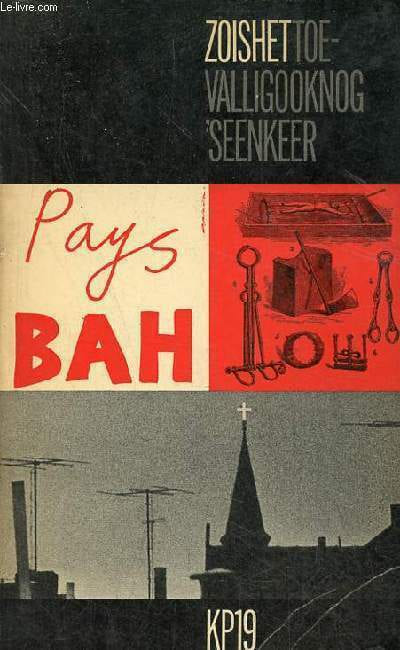
Uitgeverij de bezige bij Amsterdam. 1964. In-12. Broché. Etat d'usage, Coins frottés, Dos satisfaisant, Papier jauni. 80 pages - ouvrage en néerlandais.. . . . Classification Dewey : 430-Langues germaniques. Allemand
Reference : R320165415
Onder redaktie van J.Van den Berg Han Lammers Harry Mulisch - Ouvrage en néerlandais. Classification Dewey : 430-Langues germaniques. Allemand
Bookseller's contact details
Le-livre.fr / Le Village du Livre
ZI de Laubardemont
33910 Sablons
France
05 57 411 411
Payment mode


Sale conditions
Les ouvrages sont expédiés à réception du règlement, les cartes bleues, chèques , virements bancaires et mandats cash sont acceptés. Les frais de port pour la France métropolitaine sont forfaitaire : 6 euros pour le premier livre , 2 euros par livre supplémentaire , à partir de 49.50 euros les frais d'envoi sont de 8€ pour le premier livre et 2€ par livre supplémentaire . Pour le reste du monde, un forfait, selon le nombre d'ouvrages commandés sera appliqué. Tous nos envois sont effectués en courrier ou Colissimo suivi quotidiennement.
5 book(s) with the same title
ONS KONINGSHUIS, Nr. 1, SPECIALE UITGAVE (Inhoud: Zo Werd Prinses Irene Gelukkig. Dit is het Werk van Prins Claus. Daarom moet Koningin Juliana Zwijgen...)
Born N. V.. Non daté. In-4. Broché. Bon état, Couv. convenable, Dos satisfaisant, Intérieur acceptable. 30 pages. Illustré de nombreuses photos en noir et blanc et en couleur. Texte en néerlandais sur 2 colonnes.. . . . Classification Dewey : 490-Autres langues
Inhoud: Zo Werd Prinses Irene Gelukkig. Dit is het Werk van Prins Claus. Daarom moet Koningin Juliana Zwijgen... Classification Dewey : 490-Autres langues


ONS KONINGSHUIS, Nr. 4, SPECIALE UITGAVE (Inhoud: Waarom de olifant niet meer zo gelukkig is. Het sprookje van de Gouden Koets. Een dubieus geschenk voor de prins...)
Born N. V.. Non daté. In-4. Broché. Bon état, Couv. convenable, Dos satisfaisant, Intérieur acceptable. 25 pages. Illustré de nombreuses photos en noir et blanc et en couleur. Texte en néerlandais sur plusieurs colonnes.. . . . Classification Dewey : 490-Autres langues
Inhoud: Waarom de olifant niet meer zo gelukkig is. Het sprookje van de Gouden Koets. Een dubieus geschenk voor de prins... Classification Dewey : 490-Autres langues
VORSTEN, JUNI 1988 (Inhoud: Moeder en dochter naar het welzijnscongres. Eerherstel voor Leopold II. Ook Vorsten genieten van hun tuin. Christina van Zweden. Zo is Beatrix...)
Non précisé. 1988. In-4. Broché. Bon état, Couv. convenable, Dos satisfaisant, Intérieur frais. 39 pages. Illustré de nombreuses photos en noir et blanc et en couleur. Texte en néerlandais.. . . . Classification Dewey : 490-Autres langues
Inhoud: Moeder en dochter naar het welzijnscongres. Eerherstel voor Leopold II. Ook Vorsten genieten van hun tuin. Christina van Zweden. Zo is Beatrix... Classification Dewey : 490-Autres langues
WEEKEND ROYALTY SPECIAL (Inhoud: Zo gelukkig zag u Maxima nog nooit, Onthullende fotoreportage. Waarom Marilène een groot gezin wil. Hoe rijk is koningin Beatrix ? Het familie-fortuin van de Oranjes...)
Non précisé. Non daté. In-4. Broché. Bon état, Couv. convenable, Dos satisfaisant, Intérieur frais. 74 pages. Illustré de nombreuses photos en couleur. Texte en néerlandais. 2e plat manquant.. . . . Classification Dewey : 490-Autres langues
Inhoud: Zo gelukkig zag u Maxima nog nooit, Onthullende fotoreportage. Waarom Marilène een groot gezin wil. Hoe rijk is koningin Beatrix ? Het familie-fortuin van de Oranjes... Classification Dewey : 490-Autres langues
Het hernieuwde en verbeterde Acerra Philologica van P. Lauremberg. Dat is: zes honderd nutte en gedenkwaardige geschiedenissen, als ook zeer vermakelyke reden-kavelingen. Tot nut der lees-gierige jeugd, en een noodzakelyk onderwys tot bevordering der geleerdheid. Uit de beroemste zo Grieksche als Latynsche geschigtschryvers by een gesteld, en nu in beter order geschikt en uitgegeven door Joh. Hajenius S.S. Th.C.
Amsterdam, By Nicolaas ten Hoorn, 1701.
8vo. (XII),778 (recte 772),(28) p. Contemporary vellum 18 cm (Ref: STCN ppn 180126784; cf. Graesse 4,122) (Details: A frontispiece, designed by I. Goeree and executed by C. Huibertz, depicting some mythological figures. Woodcut printer's mark on the title, depicting a pedestal loaded with all kinds of symbols of the arts and sciences) (Condition: Vellum soiled, front joint partly split. Paper yellowing) (Note: 'Medieval education drew heavily from classical authors, for pagan learning was necessary for understanding the Scripture. The focus often was on memorizing sententiae and offering exempla and anecdotes that exemplified virtues.' (The Classical Tradition, Cambr. Mass. 2010, p. 294) Formal education in the classical tradition unfolded in the 16th/18th century 'on three levels. Instruction began in the elementary school, where boys at the age of 6 or 7 began to study reading, writing, arithmetic, and basic Christian doctrine. Latin was supposed to predominate, although the vernacular regularly crept in. Students remained here for 3 or 4 years, after which most quit to become servants, day laborers, or agricultural workers. The others went to the secondary school, whose curriculum was based on Latin grammar and the humanistic doctrines, (...) With this Latin base, students could proceed to a university'. (Op. cit. 295/95) A widely read and popular schoolbook for the secondary school in Germany and The Netherlands of that period was this 'Acerra Philologica'. An 'acerra' is an incense box, and this 'treasure box' contained a great variety of useful, funny, memorable and moralizing stories from ancient authorities. The German scholar Petrus Lauremberg is the excerptor of this encyclopedic collection of morally educating short stories. Peter Lauremberg, born in 1585, was since 1614 'Professor der Physik und Mathematik' at the newly established academic Gymnasium at Hamburg. In 1624 he went to Rostock to lecture as 'Professor der Poesie'. He died there in 1639. He wrote a great number of small works on medicin, mathematics, astronomy, but also on music, and rhetoric. (Allgemeine Deutsche Biographie 18,59) His 'Acerra Philologica' was first published in Rostock in 1635, and it started with 200 stories. It was a great commercial and educational success, for dozens of editions appeared until deep into the 18th century. The work gradually was expanded to 300 (1640), 400 (1646), 500 (1658), 600 (1658), and finally 700 (1688). The 'Acerra' was translated into Dutch in the 17th century by J.L. Blasius, and published in 1661 & 1682. In 1701 the Rector of the 'Schola Latina' at Nijmegen, Johannes Hajenius published a new, augmented and revised Dutch translation. It was repeated in 1717, 1734 and 1756. The 'exempla' and 'anecdotes' are concluded by 'Sententiae', where Hajenius packages the morale in a few catchy, sometimes rhyming, phrases. In the preface Hajenius does not use the metaphor of the incense box, he rather wants to present a tasty and appetizing meal, from which every one could take what he fancied. Hajenius published the collection not only for schoolboys, he says, but also for the illiterate, i.e. those who cannot read Latin. In this way they could learn in one hour a day, what a student learned on the university in many a year. Without knowledge of literature and history one could be considered to be an educated person. (p. *1 recto & verso of the preface) So the aim of this collections was also to spread a body of classical thought among the less educated, those who didnot visit or finish the 'Schola Latina'. Hajenius also inserted a chapter on tabacco. (No. 72) This is a funny chapter for more than one reason. It is not only anchronistic, but every educated Dutchman of a certain age associates the name Hajenius with the famous tobacco shop of P.G.C. Hajenius, 'the old master' of Dutch cigar stores since 1826. Since 1914, the store has been housed in a fine Art Déco building on the Amsterdam Rokin) (Collation: *6 (irregularly signed), A-3D8 (some irregular pagination)) (Photographs on request)

