 Write to the booksellers
Frank Leonhard
La Cause.
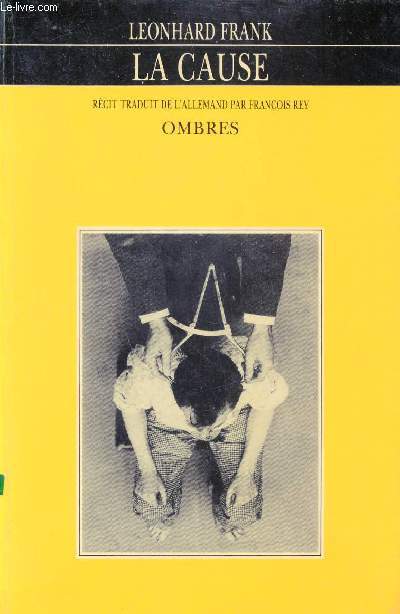
Ombres. 1988. In-8. Broché. Bon état, Couv. convenable, Dos satisfaisant, Intérieur frais. 122 pages - étiquette collée sur la coiffe en pied.. . . . Classification Dewey : 830-Littératures des langues germaniques
Reference : R320126545
ISBN : 2905964146
Récit traduit de l'allemand par François Rey. Classification Dewey : 830-Littératures des langues germaniques
Bookseller's contact details
Le-livre.fr / Le Village du Livre
ZI de Laubardemont
33910 Sablons
France
05 57 411 411
Payment mode


Sale conditions
Les ouvrages sont expédiés à réception du règlement, les cartes bleues, chèques , virements bancaires et mandats cash sont acceptés. Les frais de port pour la France métropolitaine sont forfaitaire : 6 euros pour le premier livre , 2 euros par livre supplémentaire , à partir de 49.50 euros les frais d'envoi sont de 8€ pour le premier livre et 2€ par livre supplémentaire . Pour le reste du monde, un forfait, selon le nombre d'ouvrages commandés sera appliqué. Tous nos envois sont effectués en courrier ou Colissimo suivi quotidiennement.
5 book(s) with the same title
"LEJEUNE, JÉRÔME + Mlle MARTHE GAUTHIER + M. RAYMOND TURPIN.
Reference : 50013
(1959)
Étude des chromosomes somatiques des neuf enfants mongoliens. [In: Comptes Rendus. Academies des Sciences (Paris), 1959, 248]. - [THE DISCOVERY OF TRISOMY-21 - THE CAUSE OF DOWN'S SYNDROME]
(Paris), 1959. 4to. No wrappers. Fine and clean. The paper: Pp. 1721-22. Entire issue offered pp.: (1597)-1732.
First printing of the seminal paper that first described the cause of Down's Syndrome, trisomy-21, or the presence of an extra copy of chromosome 21. ""Currently, Down syndrome (DS) is one of the most common birth defects, affecting about one in every 750 live births. John Langdon Down first described this condition in the medical literature in 1866, documenting the various symptoms associated with the syndrome but failing to determine their cause. In fact, the cause of DS remained unknown for nearly 100 years following Down's work. Then, in the 1950s [i.e. in the present paper], researchers finally determined the source of DS: the presence of an extra copy of chromosome 21, a condition often referred to as trisomy 21.Since the discovery of trisomy 21, scientists have made great strides in Down syndrome research."" (Clare O'Connor, in: Nature Education).""As previously mentioned, almost 100 years elapsed between Down's medical description of DS and the discovery of the cause of this condition. But why was this the case? It was certainly not for lack of trying. Many theories for the cause of DS were put forth in the century after Down's publication. Some physicians even made the key observation that older mothers had a higherfrequency of DS babies, and they postulated that the condition was caused by what they termed ""uterine exhaustion."" Gradually, researchers narrowed in on the real cause of DS: achromosomal abnormality. In fact, researchers now realize that older mothers have more babies with DS because the frequency of meiotic nondisjunction increases in women with age.The reason that cytologists in the early twentieth century failed to correctly diagnose DS is almost certainly due to technical limitations. Chromosome 21 is the smallest human chromosome, and procedures for examining human chromosomes were still being developed during the first part of the century. Many early cytologists had, in fact, studied chromosomes from DS patients, but none had been able to detect a supernumerary copy of chromosome 21. A breakthrough finally occurred in 1956, when Joe Hin Tjio and Albert Levan described a set of experimental conditions that allowed them to correctly identify the number of human chromosomes as 46. Within three years of the publication of this groundbreaking work, Jerome Lejeune in France and Patricia Jacobs in the United States were able to identify a supernumerary copy of chromosome 21 in karyotypes prepared from DS patients. Trisomy 21 is now accepted to be the major cause of DS, accounting for about 95% of cases."" (Clare O'Connor, in: Nature Education).Garrison & Morton: 4962.5

Echange et projets n°3 - 1974 - L'enrichissement sans cause - L'économie de marché et ses parasites - Où l'on cherche vainement le mérite individuel - Où l'on voit bien, en revanche, le coût collectif - Des moyens de réduire l'enrichissement sans cause -
Echange et projets. 1974. In-8. Broché. Etat d'usage, Couv. fraîche, Agrafes rouillées, Intérieur frais. 80 pages agrafées. Légères taches sur le 1er plat.. . . . Classification Dewey : 70.49-Presse illustrée, magazines, revues
Sommaire : L'enrichissement sans cause - L'économie de marché et ses parasites - Où l'on cherche vainement le mérite individuel - Où l'on voit bien, en revanche, le coût collectif - Des moyens de réduire l'enrichissement sans cause - Améliorer le fonctionnement du marché - Encadrer le marché - Substituer l'économie publique à l'économie de marché - Des moyens de redistribuer l'enrichissement sans cause - Le juge : Pour un juge plus serein et moins étranger - Pour un juge plus accessible - Pour un juge plus efficace - Pour l'autorité du juge - Pour des magistrats indépendants - Forum conjoncturel : Controverse autour de la politique des revenus et de l'indexation de l'épargne.. Classification Dewey : 70.49-Presse illustrée, magazines, revues

Carnet manuscrit du voyage en Italie en l'année 1869 de M. Lair, maire de Fréville : "1869. Départ de Barentin le 1er février [ ... ] A Chambéry Statue d'Antoine Favre ancien premier président du Sénat de Savoie. En face palais de justice qui a été construit il y a 10 ans - sans style [ ... ] De l'hôtel des princes on aperçoit à gauche de très hautes montagnes couvertes de neige [ ... ] Le théâtre est neuf et très confortable. Le directeur y faisait répéter un drame. La fontaine des éléphants et du plus mauvais style [ ... ] L'ancien château des Ducs de Savoie, construit sous les romains, a été incendié il y a 50 ans environ, il sert de préfecture [ ... ] Quelques ouvriers se plaignent de l'annexion à cause disent-ils des impôts qu'ils paient mais la généralité des habitants est satisfaite. Une particularité à noter c'est que dans le château les ducs de Savoie y ont reçu tous les princes de l'Europe & que lors de ces réceptions les domestiquesau nombre de 2 ou 4 étaient montés sur des chevaux costumés du stylke de l'époque mais avec une cravate blanche & gilet noir [ ... il évoque le trajet en train :] Ma chère Angèle a éprouvé le mal de mer. Quant à moi je n'ai souffert un peu que lorsque nous nous sommes trouvés dans un tunnel construit en planches pour éviter les avalanches de neige. La fumée de la locomotive étant entrée dans notre wagon quoique tout fut fermé un commencement d'asphyxie s'est emparé de nous. Impossible de renouveler l'air, car ayant essayé d'ouvrir, un nuage de vapeur est entré et nous a fait regretter cette action (ce parcours est vraiment merveilleux). Nous sommes arrivés à Turin à minuit où nous sommes descendus à l'hôtel Grombetta [ ... suite la visite de Milan dont : ] Assisté à la représentation des Huguenots au théâtre de la Scala, le plus grand de l'Italie. Forte chanteuse très bonne. autres acteurs médiocres. ensemble orchestre & choeurs bons [ ... Passage à Venise : ] Descendus hôtel de l'Europe sur le Grand Canal. Cet hôtel est princier, on y parle bien le français. A la table d'hôtel français surtout quelques anglais & peu d'italiens. beau service & excellente nourriture (maître d'hôtel de Marseille) [ ... ] Après dîner loué une gondole à deux rameurs & 20 chanteurs gondoliers pour une heure. 10 choeurs au moins nous ont été chantés. harmonie ensemble et précision admirable voix superbes surtout les basses. les trois choeurs chantés sous le pont Rialto nous ont produit un effet saisissant. L'on peut dire de ces chanteurs qu'ils sont des artistes improvisés mais qui ont le sentiment du beau. [Passage à Bologne puis Florence : ] Descendus à l'hôtel Royal de l'Arno. De plus en plus princier [ ... Arrivée à Rome : ] Descendus à l'hôtel de Russie. Vu Mgr Bastide gracieuse réception vu M. l'abbé Clerc place Lancellotti 4 [ ... Dimanche 21 : ] Diné chez Mr Hébert directeur de l'Académie, en compagnie d'un peintre & de pensionnaires. 10 à table. Mme Hébert mère était souffrante et n'est pas descendue. Reste à la soirée. Belle société. Causé au prince de Solms [ ... Dimanche 28 Février : ] Assisté à l'audience de N St Père le Pape. Assez nombreuse réunions réception fort paternelle ma chère Angèle a demandé & obtenu du St Père la bénédiction de son anneau nuptial et une bénédiction particulière pour nous deux. Le pape après avoir parlé à tous ceux qui le désiraient a fait une courte allocution & a pris pour sujet (comme il le fait toujours) l'évangile du jour (le possédé du démon aujourd'hui) & a donné avec la plus grande onction et la plus grande bonté & conviction qu'il soit possible d'exprimer la bénédictionà tous ceux qui étaient là. il a aussi béni les croix, les chapelets qui lui étaient présentés. Notre St Père est plein de santé et de la plus grande affabilité ... Son allocution a été fait en français [ ... ] Rencontré le Pape dans une voiture attelée de 4 chevaux. Figure toujours bonne. Tout le monde se découvre beaucoup se mettent à genoux pour recevoir sa bénédiction. Trois dragons à cheval distancés de chacun 60 pas au moins annoncent le passage du St Père. 2 autres voitures de Cardinaux le suivaient. Escorte d'une douzaine de Dragons [ ... mardi 2 mars ] Vu l'abbé Clerc qui m'a remis le bref par lequel Notre Saint Père Pie IX a accordé sur ma demande un autel privilégié (Grand Autel) pour l'Eglise de Duclair à perpétuité. Le bref relatif à l'indulgence plénière pour Chapelet est (illisible) mais M. l'Abbé Clerc n'a pas pu encore l'obtenir il me l'enverra à Epinay [ ... Retour pittoresque en France, passage par le Mont-Cenis le 6 mars :] Trajet extraordinaire, incroyable, très dangereux. Quantité de neige comme on en avait pas vu depuis des années. Notre traineau s'est renversé en route, chevaux et mules tombés. Voiture accrochée par d'autres venant en sens inverse ... à un certain endroit nous nous sommes trouvés à 4 mètres au-dessus de la route et au bord d'un précipice. Couché à l'hôtel de la poste où le maître est très bourru - fort cher
1 carnet de notes format in-12, contenant dont 33 p. relatant un voyage en Italie dont nous proposons quelques extraits : Carnet manuscrit du voyage en Italie en l'année 1869 de M. Lair, maire de Fréville : "1869. Départ de Barentin le 1er février [ ... ] A Chambéry Statue d'Antoine Favre ancien premier président du Sénat de Savoie. En face palais de justice qui a été construit il y a 10 ans - sans style [ ... ] De l'hôtel des princes on aperçoit à gauche de très hautes montagnes couvertes de neige [ ... ] Le théâtre est neuf et très confortable. Le directeur y faisait répéter un drame. La fontaine des éléphants et du plus mauvais style [ ... ] L'ancien château des Ducs de Savoie, construit sous les romains, a été incendié il y a 50 ans environ, il sert de préfecture [ ... ] Quelques ouvriers se plaignent de l'annexion à cause disent-ils des impôts qu'ils paient mais la généralité des habitants est satisfaite. Une particularité à noter c'est que dans le château les ducs de Savoie y ont reçu tous les princes de l'Europe & que lors de ces réceptions les domestiquesau nombre de 2 ou 4 étaient montés sur des chevaux costumés du stylke de l'époque mais avec une cravate blanche & gilet noir [ ... il évoque le trajet en train :] Ma chère Angèle a éprouvé le mal de mer. Quant à moi je n'ai souffert un peu que lorsque nous nous sommes trouvés dans un tunnel construit en planches pour éviter les avalanches de neige. La fumée de la locomotive étant entrée dans notre wagon quoique tout fut fermé un commencement d'asphyxie s'est emparé de nous. Impossible de renouveler l'air, car ayant essayé d'ouvrir, un nuage de vapeur est entré et nous a fait regretter cette action (ce parcours est vraiment merveilleux). Nous sommes arrivés à Turin à minuit où nous sommes descendus à l'hôtel Grombetta [ ... suite la visite de Milan dont : ] Assisté à la représentation des Huguenots au théâtre de la Scala, le plus grand de l'Italie. Forte chanteuse très bonne. autres acteurs médiocres. ensemble orchestre & choeurs bons [ ... Passage à Venise : ] Descendus hôtel de l'Europe sur le Grand Canal. Cet hôtel est princier, on y parle bien le français. A la table d'hôtel français surtout quelques anglais & peu d'italiens. beau service & excellente nourriture (maître d'hôtel de Marseille) [ ... ] Après dîner loué une gondole à deux rameurs & 20 chanteurs gondoliers pour une heure. 10 choeurs au moins nous ont été chantés. harmonie ensemble et précision admirable voix superbes surtout les basses. les trois choeurs chantés sous le pont Rialto nous ont produit un effet saisissant. L'on peut dire de ces chanteurs qu'ils sont des artistes improvisés mais qui ont le sentiment du beau. [Passage à Bologne puis Florence : ] Descendus à l'hôtel Royal de l'Arno. De plus en plus princier [ ... Arrivée à Rome : ] Descendus à l'hôtel de Russie. Vu Mgr Bastide gracieuse réception vu M. l'abbé Clerc place Lancellotti 4 [ ... Dimanche 21 : ] Diné chez Mr Hébert directeur de l'Académie, en compagnie d'un peintre & de pensionnaires. 10 à table. Mme Hébert mère était souffrante et n'est pas descendue. Reste à la soirée. Belle société. Causé au prince de Solms [ ... Dimanche 28 Février : ] Assisté à l'audience de N St Père le Pape. Assez nombreuse réunions réception fort paternelle ma chère Angèle a demandé & obtenu du St Père la bénédiction de son anneau nuptial et une bénédiction particulière pour nous deux. Le pape après avoir parlé à tous ceux qui le désiraient a fait une courte allocution & a pris pour sujet (comme il le fait toujours) l'évangile du jour (le possédé du démon aujourd'hui) & a donné avec la plus grande onction et la plus grande bonté & conviction qu'il soit possible d'exprimer la bénédictionà tous ceux qui étaient là. il a aussi béni les croix, les chapelets qui lui étaient présentés. Notre St Père est plein de santé et de la plus grande affabilité ... Son allocution a été fait en français [ ... ] Rencontré le Pape dans une voiture attelée de 4 chevaux. Figure toujours bonne. Tout le monde se découvre beaucoup se mettent à genoux pour recevoir sa bénédiction. Trois dragons à cheval distancés de chacun 60 pas au moins annoncent le passage du St Père. 2 autres voitures de Cardinaux le suivaient. Escorte d'une douzaine de Dragons [ ... mardi 2 mars ] Vu l'abbé Clerc qui m'a remis le bref par lequel Notre Saint Père Pie IX a accordé sur ma demande un autel privilégié (Grand Autel) pour l'Eglise de Duclair à perpétuité. Le bref relatif à l'indulgence plénière pour Chapelet est (illisible) mais M. l'Abbé Clerc n'a pas pu encore l'obtenir il me l'enverra à Epinay [ ... Retour pittoresque en France, passage par le Mont-Cenis le 6 mars :] Trajet extraordinaire, incroyable, très dangereux. Quantité de neige comme on en avait pas vu depuis des années. Notre traineau s'est renversé en route, chevaux et mules tombés. Voiture accrochée par d'autres venant en sens inverse ... à un certain endroit nous nous sommes trouvés à 4 mètres au-dessus de la route et au bord d'un précipice. Couché à l'hôtel de la poste où le maître est très bourru - fort cher
On joint une reproduction d'un tableau de la baie du Mont Saint Michel avec ex-dono "A Monsieur Lair maire de Fréville", Avranches, 5 avril 1875, par Augusta Dumonteil. Le carnet est en état modeste (fort frotté avec nombreuses traces d'usure)
[ Lettre de Ratification sur vélin, Maison située paroisse Saint Jean du Perrot, Généralité de La Rochelle, le 13 décembre 1787 ] "Louis par la Grace de Dieu, Roy de France et de Navarre, à tous ceux qui ces présentes Lettres verront Salut. Pierre Virens Peintre et Demoiselle Gabrielle Villiers son Epouse, et le Sieur Honoré Gourdain peintre demeurant à La Rochelle, nous ont fait exposer que par Contrat passé devant Bonnaud et son confrère Notaire à La Rochelle, le 29 août dernier ... dont l'extrait au terme de l'Edit du mois de Juin 1771 a été exposé l'espace de deux mois en l'auditoire de notre Sénéchaussée de La Rochelle suivant le certificat qu'en a donné Bonin commis de notre Greffier le onze du présent mois, ils ont acquis de Pierre Lachambre Etudiant Pierre Auguste Lachambre Marin et Demoiselle Marie Lachambre demeurant tous à Mauzé les trois quarts dans une petite Maison située à La Rochelle paroisse Saint Jean du Perrot Censive du Roy Moyennant Deux Mille cent livres pour en jouir en toute propriété ses hoirs et ayant-cause comme ... leur appartenant à la date du vingt neuf août dernier, lesquel (?) de maison appartenait auxdits Sieur et Demoiselle Lachambre, , ainsi qu'il est énoncé en le contrat devant (ex?) lesdits Sieur Virens, son epouse et Gourdain jouir dudit ..... et quoique les Privilèges et Hypothèques suivants et conformément à l'Edit du mois de Juin 1771 Nous ont très humblement fait supplier de vouloir bien leur accorder nos Lettres sur ce Nécessaires, aux considérations de notre Conseil qui a vu le contrat... le certificat de dépôt et autres pièces cy attachées, sous le contrescel de notre Chancellerie, nous avons ratifié ledit contrat du 29 août dernier, Voulons qu'il soit exécuté selon sa Teneur ; ce faisant que les Exposants, leurs hoirs et ayants-cause soient reconnus propriétaires incommutables dudit trois quart de maison, circonstances & dépendances, en jouissent et disposent comme de choses à eux appartenantes, purgées des privilèges et hypothèques conformément à notre arrêt du mois de juin 1771. Mandons à nos conseillers de notre Sénéchaussée de La Rochelle qu'ils aient à faire jouir l'exposant de l'effet des présentes, Car tel est notre plaisir : en témoin de quoi nous avons fait mettre notre scel en cesdites présentes. Données à La Rochelle treize décembre mil sept cens quatre vingt sept. Par le Conseil".
Document sur vélin (parchemin) format 45 x 27 cm : "Louis par la Grace de Dieu, Roy de France et de Navarre, à tous ceux qui ces présentes Lettres verront Salut. Pierre Virens Peintre et Demoiselle Gabrielle Villiers son Epouse, et le Sieur Honoré Gourdain peintre demeurant à La Rochelle, nous ont fait exposer que par Contrat passé devant Bonnaud et son confrère Notaire à La Rochelle, le 29 août dernier ... dont l'extrait au terme de l'Edit du mois de Juin 1771 a été exposé l'espace de deux mois en l'auditoire de notre Sénéchaussée de La Rochelle suivant le certificat qu'en a donné Bonin commis de notre Greffier le onze du présent mois, ils ont acquis de Pierre Lachambre Etudiant Pierre Auguste Lachambre Marin et Demoiselle Marie Lachambre demeurant tous à Mauzé les trois quarts dans une petite Maison située à La Rochelle paroisse Saint Jean du Perrot Censive du Roy Moyennant Deux Mille cent livres pour en jouir en toute propriété ses hoirs et ayant-cause comme ... leur appartenant à la date du vingt neuf août dernier, lesquel (?) de maison appartenait auxdits Sieur et Demoiselle Lachambre, , ainsi qu'il est énoncé en le contrat devant (ex?) lesdits Sieur Virens, son epouse et Gourdain jouir dudit ..... et quoique les Privilèges et Hypothèques suivants et conformément à l'Edit du mois de Juin 1771 Nous ont très humblement fait supplier de vouloir bien leur accorder nos Lettres sur ce Nécessaires, aux considérations de notre Conseil qui a vu le contrat... le certificat de dépôt et autres pièces cy attachées, sous le contrescel de notre Chancellerie, nous avons ratifié ledit contrat du 29 août dernier, Voulons qu'il soit exécuté selon sa Teneur ; ce faisant que les Exposants, leurs hoirs et ayants-cause soient reconnus propriétaires incommutables dudit trois quart de maison, circonstances & dépendances, en jouissent et disposent comme de choses à eux appartenantes, purgées des privilèges et hypothèques conformément à notre arrêt du mois de juin 1771. Mandons à nos conseillers de notre Sénéchaussée de La Rochelle qu'ils aient à faire jouir l'exposant de l'effet des présentes, Car tel est notre plaisir : en témoin de quoi nous avons fait mettre notre scel en cesdites présentes. Données à La Rochelle treize décembre mil sept cens quatre vingt sept. Par le Conseil".
Les Lettres de ratification purgent les hypothèques. Bon état
[ Lettre de Ratification sur vélin, Maison située rue des Allamandiers, Paroisse de Saint Michel, à Bordeaux, n 1792 ] "Louis par la Grace de Dieu, Roy de France et de Navarre, à tous ceux qui ces présentes Lettres verront Salut. Sieur Jean Pierre Sorbe Aîné, et Jacques Daniel Sorbe négociants associés demeurant rue des Allemandiers size Paroisse St Michel, Nous ont fait exposer que par contrat du dix sept mail 1792 devant Maître Hazera l'un de nos Notaires à Bordeaux, ils ont acquis pour une Somme de 14660 Livresdes Sieurs et Delles Pinon Frères Sieur et Tante une maison très vieille et en bien mauvais état située à Bordeaux rue des Allemandiere parroisse Saint Michel pour en jouir en toute propriété ses hoirs et ayant-cause comme de chose leur appartenant, à compter du jour 17 mai 1792, laquelle maison appartenoit aux Sd. et Delle Pinon... Nous ont très humblement fait supplier de vouloir bien leur accorder nos Lettres sur ce Nécessaires ; A ces causes de l'avis de notre Conseil qui a vu ledit contrat, nous avons ratifié ledit contrat d'Acquisition, Voulons qu'il soit exécuté selon sa Teneur ; ce faisant que les Exposants, leurs hoirs et ayants-cause soient et demeurent propriétaires incommutables dudit hôtel, circonstances & dépendances, en jouissent et disposent comme de choses à eux appartenantes, purgées des privilèges et hypothèques, suivant et conformément à notre arrêt du mois de juin 1771. Mandons à nos amés les juges de notre district de Bordeaux qu'ils ayent à faire jouir l'exposant de l'effet des présentes, Car tel est notre plaisir : en témoin de quoi nous avons fait mettre le Sceau de l'état à ces présentes. Données à Bordeaux l'an de Grace 1792"
Expédition (copie), en 1 pièce sur vélin (parchemin) format 42 x 31 cm, avec cachet de la Gironde. Rappel du titre complet : [ Lettre de Ratification sur vélin, Maison située rue des Allamandiers, Paroisse de Saint Michel, à Bordeaux, n 1792 ] "Louis par la Grace de Dieu, Roy de France et de Navarre, à tous ceux qui ces présentes Lettres verront Salut. Sieur Jean Pierre Sorbe Aîné, et Jacques Daniel Sorbe négociants associés demeurant rue des Allemandiers size Paroisse St Michel, Nous ont fait exposer que par contrat du dix sept mail 1792 devant Maître Hazera l'un de nos Notaires à Bordeaux, ils ont acquis pour une Somme de 14660 Livresdes Sieurs et Delles Pinon Frères Sieur et Tante une maison très vieille et en bien mauvais état située à Bordeaux rue des Allemandiere parroisse Saint Michel pour en jouir en toute propriété ses hoirs et ayant-cause comme de chose leur appartenant, à compter du jour 17 mai 1792, laquelle maison appartenoit aux Sd. et Delle Pinon... Nous ont très humblement fait supplier de vouloir bien leur accorder nos Lettres sur ce Nécessaires ; A ces causes de l'avis de notre Conseil qui a vu ledit contrat, nous avons ratifié ledit contrat d'Acquisition, Voulons qu'il soit exécuté selon sa Teneur ; ce faisant que les Exposants, leurs hoirs et ayants-cause soient et demeurent propriétaires incommutables dudit hôtel, circonstances & dépendances, en jouissent et disposent comme de choses à eux appartenantes, purgées des privilèges et hypothèques, suivant et conformément à notre arrêt du mois de juin 1771. Mandons à nos amés les juges de notre district de Bordeaux qu'ils ayent à faire jouir l'exposant de l'effet des présentes, Car tel est notre plaisir : en témoin de quoi nous avons fait mettre le Sceau de l'état à ces présentes. Données à Bordeaux l'an de Grace 1792"
Les Lettres de ratification purgent les hypothèques. Bon état. La rue des Allamandiers, jouxtant la Basilique Saint Michel, joint la place Saint Michel au Quai de la Grave. Jean-Pierre Sorbe demeurant encore au "10 rue des Almandiers" en 1819

