 Write to the booksellers
Gide André
Préfaces.
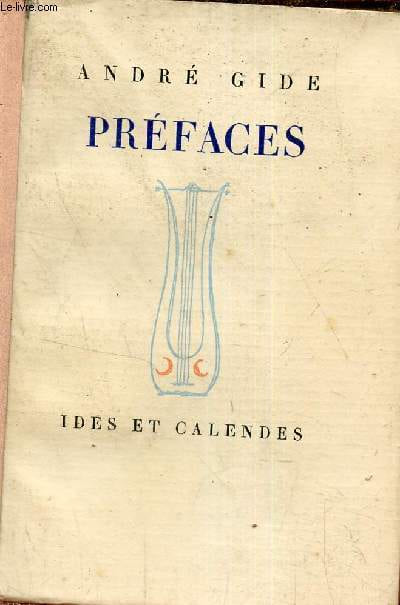
Ides et Calendes. 1948. In-12. Broché. Etat d'usage, Couv. convenable, Dos satisfaisant, Quelques rousseurs. 200 pages - couverture à 3 rabats - quelques tâches brunes sur les plats.. . . . Classification Dewey : 840.091-XX ème siècle
Reference : R320116685
Exemplaire n° 922/1500 sur vergé dauphin de France. Classification Dewey : 840.091-XX ème siècle
Bookseller's contact details
Le-livre.fr / Le Village du Livre
ZI de Laubardemont
33910 Sablons
France
05 57 411 411
Payment mode


Sale conditions
Les ouvrages sont expédiés à réception du règlement, les cartes bleues, chèques , virements bancaires et mandats cash sont acceptés. Les frais de port pour la France métropolitaine sont forfaitaire : 6 euros pour le premier livre , 2 euros par livre supplémentaire , à partir de 49.50 euros les frais d'envoi sont de 8€ pour le premier livre et 2€ par livre supplémentaire . Pour le reste du monde, un forfait, selon le nombre d'ouvrages commandés sera appliqué. Tous nos envois sont effectués en courrier ou Colissimo suivi quotidiennement.
5 book(s) with the same title
Œuvres complètes. Les Rougon-Macquart. Histoire naturelle et sociale d'une famille sous le Second Empire. Préfaces de Henri Guillemin.
Genève, Cercle du Bibliophile, s.d. (1967-1968), 20 vol. in-8°, environ 460 pages par volume, préfaces inédites par Henri Guillemin dans chaque, illustrations originales hors texte de Tim (pseud. de Louis Mittelberg, 1919-2002), arbre généalogique des Rougon-Macquart, reliures simili-cuir carmin de l'éditeur décorées or sur les dos et les 1er plats, signets, bon état
Volumes 1 à 20. Série complète des Rougon-Macquart : 1. La Fortune des Rougon ; 2. La Curée ; 3. Le Ventre de Paris ; 4. La Conquête de Plassans ; 5. La Faute de l'Abbé Mouret ; 6. Son Excellence Eugène Rougon ; 7. L'Assommoir ; 8. Une Page d'Amour ; 9. Nana ; 10. Pot-Bouille ; 11. Au Bonheur des Dames ; 12. La Joie de vivre ; 13. Germinal ; 14. L'Œuvre ; 15. La Terre ; 16. Le Rêve ; 17. La Bête humaine ; 18. L'Argent ; 19. La Débâcle ; 20. Le Docteur Pascal. — Bonne édition, sur papier de qualité, qui vaut en particulier pour les préfaces de Henri Guillemin (20 à 25 pages dans chaque volume), qui constituent une étude complète et nouvelle de l'oeuvre et de la vie de l’auteur. — Cette édition des Œuvres complètes a ensuite continué et publié 23 autres volumes de textes d'Emile Zola (contes, théâtre, poèmes lyriques, essais, Les Trois Villes, Les Quatre Evangiles, mélanges, préfaces et discours, lettres de jeunesse...) — "Zola se vend bien. Son oeuvre va tomber dans le domaine public en juin 67. Avec Henri Mitterand, le meilleur spécialiste de Zola, les héritiers directs, MM. Zola et Leblond, ont mis sur pied l'édition des « Œuvres complètes » qui commenceront à paraître le mois prochain. A tous les romans et essais – dont le célèbre « J'accuse » – qu'on connaît déjà, seront joints de nombreux articles et des lettres inédites. C'est Mittelberg (Tim) qui illustrera ce Zola complet." (Le Nouvel Observateur, 19 octobre 1966) Désormais les frais d'envoi sont de 6 € seulement pour les livres jusqu'à 1 kg (colissimo suivi), pour la France métropolitaine.
PAUL LEGRAND (1883-1915), Ecrivain de Nantes [préfaces par Joseph ANGOT et le Comte René de Cornulier-Lucinière]
Reference : 26090
(1931)
SOUVENIRS par PAUL LEGRAND (VENDÉE), préfaces par Joseph ANGOT et le Comte René de Cornulier-Lucinière
Nantes Imprimerie Saint-Clément 1931 -in-8 broché un volume, broché marron-clair in-octavo Editeur (paperback in-8 Editor ) (20,3 x 13,3 cm), dos muet, 1ère de couverture imprimée en noir, toutes tranches non-rognées, sans illustrations (no illustration), (XXXII + 179 + 1 p. de Tables) pages, sans date (1931) Nantes Imprimerie Saint-Clément Editeur,
Bel Exemplaire ..... RARE ..... en trés bon état (very good condition). en trés bon état
Byzantine Historiographical Prefaces (4th?15th Centuries) A Study on the Praxis and Culture of Writing History in Byzantium
, Brepols - Harvey Miller, 2025 Paperback, Pages: 268 pages, Size:156 x 234 mm, Illustrations:6 tables b/w., Language(s):English, Greek , *new . ISBN 9782503612515.
In recent years a lively debate has developed on the features of Byzantine historiography. The increasingly dominant tendency today is to treat historical texts more as pleasant literary narratives than as systematic historical accounts of the political and military history of Byzantium. The present study aims to contribute to this debate by revisiting the voices of the Byzantine authors themselves, focusing on the extant historical prefaces from the Early, Middle, and Late Byzantine eras. This seemed timely, more than a century after the publication of ?einrich Lieberich?s fundamental work on Byzantine historiographical proems. Obviously, not all prefaces are of equal interest: some serve a purely conventional function, while others are composed more thoughtfully and merit more careful attention. The book?s goal is twofold: firstly, to outline the details of the prefatory function of the Byzantine historiographical proems as microtexts; secondly, to detect and evaluate the theoretical views expressed by the authors of each period regarding the genre of Byzantine historiography. This will expand our knowledge of how the Byzantines wrote (praxis) and thought (culture) about historiography. TABLE OF CONTENTS Preface Chronological list of proems of Byzantine Historiography discussed in this book with the location of their main presentation Introduction 1. Current research in Byzantine historiography: a few necessary observations 2. The Byzantines and historiography 3. The proems of Byzantine historiography in modern bibliography 4. Significance and function of a proem 5. Why and How to treat proems of Byzantine historiography separately 6. The proems of classical Greek, Hellenistic, and Roman historical works: an introduction to the narrative patterns and ideas available to Byzantine authors Chapter 1: The prefatory communication situation in Byzantine historiography 1a. Length: from zero to over hundreds words 1b. Location: preludial and sometimes internal 1c. Time of composition 1d. Person(s) addressed: educated friends and scholars, the emperor himself 1e. Authorship: the writer himself 1f. Form: title and boundaries 1g. Special generic features: metrical, epistolary and rhetorical proems 1h. Writing methods: originality and mimesis Chapter 2: The content of the preserved proems of Byzantine historiography: eloquence in the service of the author?s specific expectations 2a. A few introductory remarks 2b. The elaborated proems of Byzantine historiography: a detailed overview 3c. The conventionally functional proems of Byzantine historiography: an overview Chapter 3: Theoretical aspects of Byzantine historiography: the evidence of the proems 3a. The profile of the author 3b. The essence / value of history writing 3c. The practices of history?writing 3d. The profile of the reader/listener 3e. Conclusion: Final remarks and answers to current research questions Bibliography Index
"L'ecole des lettres II - 15 mars 1989, N°10, 80e annee - Lecture dirigee: Jules Supervielle "" le voleur d'enfants"" de claude andre tabart- De l'interet des prefaces, avant propos, avertissements et notices de francoise cespedes- Le roman francais du..."
AU BUREAU DE LA REVUE. 1989. In-8. Broché. Bon état, Couv. convenable, Dos satisfaisant, Intérieur frais. 59 pages. . . . Classification Dewey : 70.49-Presse illustrée, magazines, revues
"SOMMAIRE : Lecture dirigee: Jules Supervielle "" le voleur d'enfants"" de claude andre tabart- De l'interet des prefaces, avant propos, avertissements et notices de francoise cespedes- Le roman francais du XIXe siecle a travers quelques prefaces de yves pihan- Le theme de l'angoisse dans ""la condition humaine"" ""le cheval de troie"" et ""la nausee"" de fabrice thumerel- L'enfant juif et les autres de yves stalloni- Le mythe du juif errant de marie france rouart, la force du rpejuge essai sur le racisme et ses doubles de pierre andre taguieff, laideurs de sartr d'alain buisine, les pythiques de pindare Classification Dewey : 70.49-Presse illustrée, magazines, revues"


[Jansénisme, Convulsions] Diacre François de Paris, abbé Nicole, Jean Hamon, Pasquier Quesnel, Le Sesne de Ménilles d'Etemare
Reference : 013364
7 ouvrages en un volume : Plan de la religion par le B.H. Diacre François de Paris ; Science du Vray qui contient les principaux mystères de la Foy par feu M. François de Paris ; Enchainement des vérités proposées dans l'écriture sous différens symboles ; Pensées diverses sur les avantages de la pauvreté par M. Hamon ; Extraits de plusieurs préfaces d'ouvrages particuliers composés par M. Nicole ; Lettre du R.P. Quesnel, prestre de l'oratoire, au révérend père de La Chaise jésuite ; Réponse à la lettre du P. de Goville ancienne missionnaire de la Chine, adressée aux R.P. Jésuites.
[Jansénisme, Convulsions] Diacre François de Paris, abbé Nicole, Jean Hamon, Pasquier Quesnel, Le Sesne de Ménilles d'Etemare, 7 ouvrages en un volume : Plan de la religion par le B.H. Diacre François de Paris ; Science du Vray qui contient les principaux mystères de la Foy par feu M. François de Paris ; Enchainement des vérités proposées dans l'écriture sous différens symboles ; Pensées diverses sur les avantages de la pauvreté par M. Hamon ; Extraits de plusieurs préfaces d'ouvrages particuliers composés par M. Nicole ; Lettre du R.P. Quesnel, prestre de l'oratoire, au révérend père de La Chaise jésuite ; Réponse à la lettre du P. de Goville ancienne missionnaire de la Chine, adressée aux R.P. Jésuites. [Divers lieux de publication entre 1733 et 1740], In-12. Très intéressante réunion d'ouvrages en édition originale. Le Plan de la religion (En France, sn, 1740. VI-132p) est un ouvrage écrit à la fin de sa vie et publié ici pour la première fois, 13 ans après sa mort. Il s'agit d'un ouvrage de philosophie religieuse sur la création de l'homme et le péché d'Adam et ses conséquences. La Science du Vray (En France, sn, 1733. [4]-55-[1]p) est un ensemble d'écrits sur différents sujets tels que l'infaillibilité de l'Eglise, la Grâce, la résurrections des morts, la communion, etc. destinés à l'instruction des fidèles. Le diacre Paris écrit chaque chapitre comme une conversation adressée à Dieu directement. L'Enchainement des vérités (Leerdam, Déniqué, 1733. 52p) est probablement en édition originale (seul la BM de Nîmes indique 1732, vraisemblablement par erreur). Le Siècle des Lumières : bibliographie chronologique nous donne l'auteur, Jean-Baptiste Le Sesne de Ménilles d'Étemare, janséniste lié aux convulsionnaires, tout en faisant erreur sur la collation. L'auteur y donne sept exemples de ce que symbolise le vase d'argile dans l'ancien testament. Les Pensées diverses sur les avantages de la pauvreté (Sl, sn, 1739. 66-[2]p) est ici dans une édition originale publiée par les convulsionnaires, comme le prouve la prière du B. diacre François de Paris avant d'entendre la sainte messe qui correspond aux 2 dernières pages, toujours présentes avec cette édition. Les Extraits de plusieurs préfaces (Liège, Bruncanz, 1739. 41p) est la première édition de cette réunion. La Lettre de Quesnel (France, Philothée, 1734. [8]-62-[1]p), ici dans sa seule publication à part, est vraisemblablement due aussi aux convulsionnaires qui ont eu de nombreuses disputes théologiques avec les jésuites. La réponse à la lettre de Goville (Paris, aux dépens de la société, 1736. [4]-104p) est un dialogue entre l'auteur, Michel Villermaules dit Villers (1667-1757), et le père de Goville. Villers est un ancien missionnaire jésuite devenu janséniste qui critiqua les méthodes d'évangélisation des jésuites. Il ne semble toutefois pas être lié aux convulsionnaires. A la fin du recueil se trouve la table des 6 volumes des anecdotes, autre ouvrage de Villers. Plein veau, dos à nerfs orné avec notamment un joli fer de chasse en pied de dos, pièce de titre maroquin, tranches rouges. Mors craquelés, mouillure en marge inférieure de l'ouvrage visible sur une petite moitié du volume. Réunion de textes rares autour des convulsions.

