 Write to the booksellers
Collectif
Les 5 as
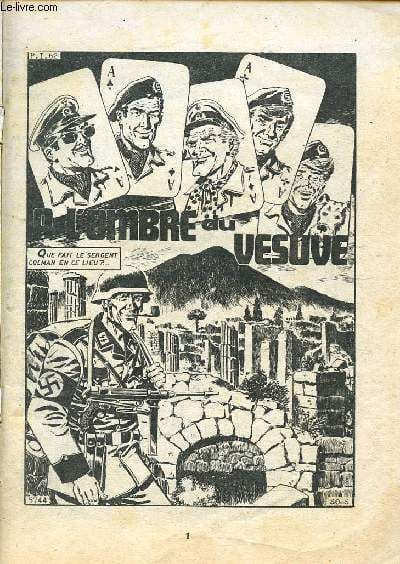
au bureau du journal. 1983. In-12. Broché. Etat d'usage, 1er plat abîmé, Dos satisfaisant, Intérieur frais. 128 pages augmentées de nombreux dessins en noir et blanc dans texte.. . . . Classification Dewey : 843.06-Bande dessinée
Reference : R260251699
Classification Dewey : 843.06-Bande dessinée
Bookseller's contact details
Le-livre.fr / Le Village du Livre
ZI de Laubardemont
33910 Sablons
France
05 57 411 411
Payment mode


Sale conditions
Les ouvrages sont expédiés à réception du règlement, les cartes bleues, chèques , virements bancaires et mandats cash sont acceptés. Les frais de port pour la France métropolitaine sont forfaitaire : 6 euros pour le premier livre , 2 euros par livre supplémentaire , à partir de 49.50 euros les frais d'envoi sont de 8€ pour le premier livre et 2€ par livre supplémentaire . Pour le reste du monde, un forfait, selon le nombre d'ouvrages commandés sera appliqué. Tous nos envois sont effectués en courrier ou Colissimo suivi quotidiennement.
5 book(s) with the same title
De divisione naturae [also known as the Periphyseon]. Libri quinque. Accedit appendix et ambiguis S. Maximi Graece & Latine. - [""WITH HIM TRUE PHILOSOPHY FIRST BEGINS"" (HEGEL)]
Oxford, E Theatro Sheldoniano, 1681. Folio. Nice contemporary full calf with five raised bands and single gilt line-decorations to spine. Gilt title-label and gilt lettering to spine. Double blindstamped borders to boards. All edges of boards gilt. A bit of wear to hinges and capitals, but overall very nice. Internally very clean and fresh with only minimal, light occasional browning. With the book-plate of Gaddesden Library to inside of front board. Engraved device to title-page. (14), 312"" (4), 88 pp.
Rare first edition of the founding work of Western medieval philosophy, the main work by ""the one important philosophical thinker to appear in Latin Christendom between Augustine... and Anselm."" (Encycl. of Phil.). This magnum opus of medieval thought is considered the ""final achievement"" of ancient philosophy (Burch: Early Medieval Philosophy, 1951) and is one of the few true defining moments of medieval philosophy. It not only marks the beginning of Western medieval philosophy, it also anticipates German idealism. Kolakowski identifies ""De divisione naturae"" as the archetype of Hegel's Phenomenology of Mind (see ""Main Currents of Marxism""), the Hegelians considered him the father of German idealism, and Hegel states that ""Scholastic philosophy is considered to begin with John Scotus Erigena who flourished about the year 860, and who must not be confused with the Duns Scotus of a later date... With him true philosophy first begins, and his philosophy in the main coincides with the idealism of the Neo-Platonists."" (From Hegel’s Lectures on the History of Philosophy: Part Two. Philosophy of the Middle Ages). As the dialectical reasoning in the “De divisione naturae” prefigures Hegel, its theory of place and time as defining structures of the mind anticipates Kant. As Gordon A. Leff also points out, Eriugena stands out as the one original thinker in the period from Boethius to Anselm. He is responsible for a revival of philosophical thought which had remained largely dormant in Western Europe after the death of Boethius and creates the only philosophical system to emerge in more than half a millenia. He is the forerunner to speculative idealism, considered a “Proclus of the West” (Hauréau, 1872) and the “Father of Speculative Philosophy” (Huber, 1861). According to The Stanford Encyclopaedia of Philosophy, Eriugena is ""the most significant Irish intellectual of the early monastic period. He is generally recognized to be both the outstanding philosopher (in terms of originality) of the Carolingian era and of the whole period of Latin philosophy stretching from Boethius to Anselm"""" Gersh praises his notion of structure, which places him amongst modern writers rather than medieval ones, stating also that ""(i)n some respects, Western medieval philosophy can be viewed as beginning with the brilliant and controversial ninth-century thinker JohnScotus Eriugena."" (Gersh, p. 125). His magnum opus ""synthesizes the philosophical accomplishments of fifteen centuries and appears as the final achievement of ancient philosophy"" (Burch). Eriugena became extremely influential throughout the later Middle Ages and directly influenced Bernard of Clairvaux, Hildegard van Bingen, and Nicolas of Cusa. He also anticipates Thomas Aquinas in saying that one cannot know and believe a thing at the same time, and exercised a direct influence on modern philosophy. After the rediscovery of his magnum opus, which was printed for the first time in 1681 (the present work), his astonishingly modern train of thought and his immensely important philosophical system came to directly influence some of the most important thinkers of the modern era, most significantly probably Hegel. Eriugena is often referred to as “the Hegel of the 9th century”, and he thus also became a primary influence upon Marx’ dialectical form. Schopenhauer stresses the importance of the rediscovery of Eriugena with the present publication and says in Parerga and Paralopomena (vol. I) “ After Scotus Erigena had been lost and forgotten for many centuries, he was again discovered at Oxford and in 1681, thus four years after Spinoza's death, his work first saw the light in print. This seems to prove that the insight of individuals cannot make itself felt so long as the spirit of the age is not ripe to receive it.” “In the later Middle Ages both Meister Eckhart of Hochheim (c.1260–c.1328) and Nicholas of Cusa (1401–64) were sympathetic to Eriugena and familiar with his “Periphyseon”. Cusanus owned a copy of the “Periphyseon”. Interest in Eriugena was revived by Thomas Gale’s first printed edition of 1687 (recte: 1681). However, soon afterwards, Thomas Gale’s first printed edition, the “Periphyseon”, was listed in the first edition of the “Index Librorum Prohibitorum”, and remained on it, until the Index itself was abolished in the 1960s. In the nineteenth century, Hegel and his followers, interested in the history of philosophy from a systematic point of view, read Eriugena rather uncritically as an absolute idealist and as the father of German idealism. The first critical editions of his major works were not produced until the twentieth century (Lutz, Jeauneau, Barbet) [...] Eriugena is an original philosopher who articulates the relation between God and creation in a manner which preserves both divine transcendence and omnipresence. His theory of human nature is rationalist and intellectualist but also apophatic. His theory of place and time as defining structures of the mind anticipates Kant, his dialectical reasoning prefigures Hegel. But above all, Eriugena is a mystic who emphasizes the ultimate unity of human nature and through it of the entire creation with God.” (SEP). Eriugena - who Bertrand Russel also considered ""the most astonishing person of the ninth century"" - had been commissioned by Charles the Bald to translate the writings that were then thought to be by Dionysius (the learned pagan converted by St. Paul). Eriugena had taught himself Greek and succeeded in an excellent translation. ""He went on to translate various other Greek Christian texts, by Gregory of Nyssa and the seventeenth-century Maximus the Confessor. All these influences along with his wide reading of the Latin fathers (especially Ambrose and Augustine) and his enthusiasm for logic.. are combined in his masterpiece ""Periphyseon (""About Nature"""" it is also sometimes known as ""De divisione naturae"", ""On the division of nature""), written in the 860s. The ""Periphyseon"" has been seen by some as continuing a tradition of Greek Neoplatonic thought, and by some as anticipating nineteenth-century German Idealist philosophy"". (Stephen Gersh, Johannes Scotus Eriugena and Anselm of Canterbury, p. 121. In: Marenbon, Medieval Philosophy, 2004). Although the beautiful Oxford-imprints from the second half of the seventeenth century are usually not rare in themselves, the present work is very scarce indeed. A reason for this might be that the book was placed on the “Index Librorum Prohibitorum” right after publication and remained on it, until the Index itself was abolished in the 1960s. This editio princeps of Eriugena’s main work also contains Eriugena’s translation of one of the works that influenced him the most, namely the “Scholia Maximi in Gregorium Theologium”, which also appears here in print for the first time. Johannes (c.800–c.877), who signed himself as “Eriugena” in one manuscript, and who was referred to by his contemporaries as “the Irishman” (scottus—in the ninth century Ireland was referred to as “Scotia Maior” and its inhabitants as “scotti”) is the most significant Irish intellectual of the early monastic period. He is generally recognized to be both the most outstanding philosopher (in terms of originality) of the Carolingian era and of the whole period of Latin philosophy stretching from Boethius to Anselm… Eriugena’s uniqueness lies in the fact that, quite remarkably for a scholar in Western Europe in the Carolingian era, he had considerable familiarity with the Greek language, affording him access to the Greek Christian theological tradition, from the Cappadocians to Gregory of Nyssa, hitherto almost entirely unknown in the Latin West… Eriugena’s thought is best understood as a sustained attempt to create a consistent, systematic, Christian Neoplatonism from diverse but primarily Christian sources. Eriugena had a unique gift for identifying the underlying intellectual framework, broadly Neoplatonic but also deeply Christian, assumed by the writers of the Christian East… Overall, Eriugena develops a Neoplatonic cosmology according to which the infinite, transcendent, and “unknown” God, who is beyond being and non-being, through a process of self-articulation, procession, or “self-creation”, proceeds from his divine “darkness” or “non-being” into the light of being, speaking the Word who is understood as Christ, and at the same timeless moment bringing forth the Primary Causes of all creation. These causes in turn proceed into their Created Effects and as such are creatures entirely dependent on, and will ultimately return to, their sources, which are the Causes or Ideas in God. These Causes, considered as diverse and infinite in themselves, are actually one single principle in the divine One. The whole of reality or nature, is involved in a dynamic process of outgoing (exitus) from and return (reditus) to the One. God is the One or the Good or the highest principle, which transcends all, and which therefore may be said to be “the non-being that transcends being”. In an original departure from traditional Neoplatonism, in his dialogue Periphyseon, this first and highest cosmic principle is called “nature” (natura) and is said to include both God and creation. Nature is defined as universitas rerum, the “totality of all things”, and includes both the things which are (ea quae sunt) as well as those which are not (ea quae non sunt). This divine nature may be divided into a set of four “species” or “divisions” (divisiones) which nevertheless retain their unity with their source. These four divisions of nature taken together are to be understood as God, presented as the “Beginning, Middle, and End of all things”.” (SEP).

Silva or, a discourse of forest-trees, and the propagation of timber in his Majesty's dominions: As It Was Delivered in the Royal Society on the 15th Day of October, 1662. Upon Occasion of certain queries propounded to that Illustrious Assembly, by th... - [SHAPING THE LANDSCAPE]
York, Printed by A. Ward for J. Dodsley T. Cadell J. Robson and T. Durham, London. W. Creech and J. Balfour, Edinburgh, 1776 Large4to. In contemporary full calf with black leather title-label with gilt lettering to spine. Gilt ornamentation to spine, forming 6 compartments. Front and back board loose. Overall wear and soiling to extremities. Two paper-labels with description of the work and two ex-libris [John Leigh Philips] pasted on to pasted down front end-paper. Waterstain affecting first 8 leaves, otherwise internally fine. [2 blanks], Frontiespiece, (54), 649, (10), [2 blanks] pp. + 40 copper-engraved plates by Johann Sebastian Muller, including one folding. [Keynes Evelyn 47 (calling for 39 plates) Henrey 137 (calls for 40 plates)" Nissen BBI 615 (calling for 41 plates though almost all copies have 40)].
First Hunter edition, sixth overall, of this landmark work on forestry, one of the most influential texts ever published on the subject. The work shaped both the knowledge and the landscape of an entire nation throughout centuries.""There can be no doubt that John Evelyn, both during his own lifetime and throughout the two centuries which have elapsed since his death in 1706, has exerted more individual influence, through his charming ""Sylva"", ... than can be ascribed to any other individual."" (Nisbet, in the preface to the 1908 reprint of the 1706-edition).Apart from its pivotal importance to forestry, reforestration, the history of planting in Europe and the direct benefits from that, the book is famously the first book to be printed by the Royal Society, which had been founded in 1664 (the second being Robert Hooke's ""Microscopia""). The book was a huge success and it became immensely influential, making Evelyn famous among his contemporaries - such as Pepys, Hooke, and Locke - as a horticultural pioneer . ""If you take a stroll through one of the nation's long-established woodlands, there is a good chance its management was inspired, influenced or even instructed by John Evelyn's Sylva.Widely recognised as the first comprehensive study of UK trees, Sylva, or - to give its full title - A Discourse of Forest Trees, and the Propagation of Timber in his Majesty's Dominions, made its first public appearance in 1662 as a paper submitted to the newly formed Royal Society. Two years later, it was published as the Royal Society's first book and went on to not only shape people's knowledge but the landscape itself.And it was an instant success, proving popular beyond its intended audience of wealthy aristocratic landowners, who were urged by Evelyn to plant trees in order to replenish the nation's depleted timber stock.Four editions were produced during Evelyn's lifetime, and the book is still widely quoted and remains in print and freely available online 350 years after its first publication....He designed his first garden when he was 22 years old, two decades before he penned Sylva.It was as a young man, after deciding fighting as a Royalist in the Civil War was not the best career choice, that he travelled across Europe and became fascinated by the formal gardens of France and the expansive grounds of Italy.On his return to England, he continued his work in the garden of his home at Sayes Court in Deptford, South-East London.Being located near the Royal Dockyard on the Thames allowed Evelyn to experiment with newly arrived botanical delights, testing how the flora fared in his English country garden.His attention to detail, and the careful recording of his observations reflected the appetite for empirical evidence among the early pioneers of modern science. ""He was one of the early fellows of the Royal Society, which was created in 1660 as a scientific organisation, and Evelyn had spoken with the fellows about his work in this area and it very much chimed with the Society's early objectives,"" explained Royal Society head librarian Keith Moore.What we do now will have a knock-on effect for generations to come Dr Gabriel Hemery, The New Sylva co-author:""Quite clearly, Evelyn's work in planting forest trees and harvesting the products from them - whether it was wood or apples - really hit the mark"" it was exactly what the Royal Society was interested in at that time.""And so the seeds of Sylva's success were planted, as landowners heeded Evelyn's advice.""Of course, you have to remember that this was after the Civil War so trees across the nation had been denuded as part of the war effort but, as Evelyn himself says in the book, as a result of industrial activities - such as glass making - people were chopping down trees, therefore they had to be replaced,"" he told BBC News. ""Also, he uses the phrase 'wooden walls' - [trees] were very important for the defence of the nation through ship building.""...The lasting legacy of Evelyn's vision to sustain the nation's timber supplies was highlighted in 1812 when the book was republished as a call to arms to the nation's landowners as the Napoleonic Wars took their toll on timber supplies.And there were echoes of Evelyn in 1919, the year in which the UK's Forestry Commission was established to increase tree cover, which had fallen to just 5% as a result of the demand for timber during World War One.Today, trees are back in the headlines and on the political agenda. To coincide with the original book's 350th anniversary, two authors have written The New Sylva, a timely updated version for the 21st Century to highlight the strategic, economic and ecological importance of trees."" (Mark Kinver, BBC News, Science & Environment: Trees: A personal and national legacy of Evelyn's Sylva. 2014)Graesse II, 535Pritzel, 2766.Kress 7209
De rebus gestis Antonj Caraphaei Libri Quatuor Excellentissimo Domino Hadriano Caraphaeo inscripti. - [HISTORY AS POLITICS - POLITICS AS HISTORY]
Napoli, Excudebat Felix Musca, 1716. 4to. Nice contemporary Italian full vellum binding with gilt title to back. A bit of soiling and averall wear. Internally occasional brownspotting, but overall a very nice copy. Title-page in red an black, full-page engraved portrait of Hadrianus Carafa, full-page engraved portrait of Antonius Carafa, six beautiful large engraved vignettes, and six beautiful large engraved initials. Tissue-guards inserted later. (2) ff. (being half-title and title-page), portrait, (12) ff. (dedication), portrait, 501 pp.
The very rare first edition of Vico's intriguing account of the deeds of Antonius Carafa, the historical biography which the highly influential Enlightenment philosopher, historian, and jurist was commissioned to write about the important seventeenth-century statesman. The work is more than a beautifully printed work by a highly influential thinker about an important Italian statesman, though it is a rich and enlightened reconstruction of many major historical events and aspects of the contemporary history of Vico, mixed with numerous of Vico's personal opinions. As such, the work is of the greatest interest to historians, philosophers, jurists and political historians, as well as anyone interested in early modern European history" it furthermore gives us a unique insight into the thought of a thinker, whose ideas and opinions, both philosophical and political, have greatly influenced the likes of Marx, Hegel, Goethe, etc. The commission of the work is also that which caused Vico to become interested in the question of the law of nations, and that which led him to discover Grotius' ""On the Law of War and Peace"" (1625), which came to influence him greatly. The biography of Antonio Carafa is the next major work that Vico writes after his magnum opus, the ""Scienza Nouva"". ""The life of Carafa was a commissioned work, undertaken at the request of Don Adriano Carafa, the nephew of the subject and a former pupil of Vico, and for its composition access to the family archives was given him. It appeared in 1716, in magnificent format, as Vico says ""in the Dutch style"", and won for its author the praise of Pope Clement XI as well as the friendship of the Italian scholar Gianvincenzo Gravina""."" (Camponigri, Time & Idea: The Theory of History in Giambattista Vico, p. 22). Vico later married one of Carafa's daughters, and he has himself said of the work that it was ""tempered by honour towards the subject, reverence towards the princes and the just claims of truth."" (The Autobiography). Antonio Carafa (1646-1693) was a Neapolitan statesman and diplomat, who immigrated to Vienna in 1662 to serve the Holy Roman Emperor Leopold I of Habsburg, in whose service he stayed throughout most of his life. Carafa spent years at the Viennese court, familiarizing himself with the intrigues and learning the secrets of the state and the art of governing here. He became a favourite of the emperor and the Habsburg princes (Charles of Lorraine and Maximillian of Bavaria ) and came to serve as a statesman and diplomat of Leopold I in Vienna, Poland and Hungary. He kept rising through the ranks, as his military experience grew, and he was known for his courage, wisdom, strategic skills and political diplomacy. Eventually he rose to the highest rank in the Austrian military and was appointed Military Governor of, first, Upper Hungary, then Transylvania as well as General Commissary of all imperial armies on all fronts, namely the Rhine, Danube, and Po"" he was integral in Leopold's wars against the Ottoman Empire. Towards the end of his career, he came to suffer from infamy, according to Vico due to the jealousy of his rivals, and he was dubbed the ""butcher of Eperjes"""" he was thus sent back to Vienna, where he died shortly after.The present text by Giambattista Vico (1668-1744) is a historiographical work which sets out to delineate the biography of Antonio Carafa, a statesman much admired by Vico. The work touches on numerous events, in which the important statesman and diplomat was involved, and Vico thus describes in detail, from a contemporary point of view, many highly interesting historical events. These events include THE ALLIANCE'S WAR AGAINST THE TURKS BETWEEN 1683 AND 1694, THE SECOND ENGLISH REVOLUTION OF 1688-1689, THE WAR OF THE AUGSBURG LEAGUE, etc., etc. These events are also valuably commented upon by Vico, for whom they were contemporary and vivid. For a modernist, the present work possesses a rare source of information on a number of important European events, presented in the most interesting manner, by one of modern Europe's great thinkers, and it is thus probably of greater interest to us today than it ever has been. ""In his own time, Vico was relatively unknown, but from the nineteenth century onwards his views found a wider audience and today his influence is widespread in the humanities and social sciences."" (SEP). In 2004 the first English translation of the work appeared, bearing witness to the renewed interest in this important and interesting work by one of the leading Enlightenment philosophers. ""Vico's next major work [after the ""Scienza Nuova""], ""The Life Of Antonio Carafa"" (1716), although somewhat of a by-way in the development of his general thought, contains one relevant point. Whereas, in ""On the Study Methods of our Time"", he had emphasised the importance of wisdom, virtue and eloquence in training the intellectual to guide the masses, in his biography of Carafa he attributes Carafa's success to his natural, rather than acquired, shrewdness and suggests that formal culture is likely to hinder rather than to promote effective action. This was not a view that he was to maintain in its generalised form, but it is indicative of decreasing confidence in the capacity of the intellectual to bring about political well-being by the methods advocated earlier. At this point it is necessary to turn to the importance of Grotius's influence on Vico, though this is a highly debated matter. Vico may have known something about Grotius's doctrines, probably through discussion, as early as 1708, but as part of his preparation for ""The Life of Antonio Carafa"", he had undertaken a thorough reading of ""The Law of War and Peace""."" (Introduction to Vico's ""The First New Science"" by Leon Pompa, p. XXIII).First editions by Vico are generally of great scarcity, and the present work is no exception, as it is almost impossible to find.
Camara Optica Folheto VIII onde as vistas ás avessas mostrão o mundo as direitas.
Lisboa Na officina de Simão Thaddeo Ferreira. 1808 Première édition. Une publication satirique rare, produite anonymement, mais par Da Costa. En portugais. Elle a été publiée en 12 parties entre 1807 et 1811. Cette partie a été imprimée en 1808. Non reliée, comme lors de sa publication initiale. Elle était destinée à être rassemblée, mais chaque partie est complète en soi. L'auteur raconte plusieurs contes moraux qui dépeignent la vie à l'envers ! C'était en effet le cas pour les Portugais à cette époque. La France, sous Napoléon, exigeait que le Portugal cesse tout commerce avec la Grande-Bretagne et rejoigne le système continental ; lorsque le Portugal a tardé à le faire, le général Junot a envahi le pays le 19 novembre 1807, avec le soutien de l'Espagne conformément au traité de Fontainebleau, occupant Lisbonne le 30 novembre alors que la famille royale portugaise s'enfuyait au Brésil. Plusieurs éléments de cet ouvrage sont rédigés sous forme de « lettres à un ami ». Bien qu'il ne précise pas qui est cet ami, il le désigne par « vos majestés ». Il fait également référence au « Boqueirao do Caes do Sodre », un jardin public récemment restauré à Rio de Janeiro (où se trouvait la famille royale). La dernière page contient une énigme en vers, dont la réponse sera donnée dans un prochain numéro. La réponse manuscrite à l'énigme se trouve sur la page. Le ton de l'ouvrage est anti-français, les qualifiant de « nos cruels protecteurs ». Le colophon se trouve sur la dernière page et, outre le nom de l'éditeur et la date, il indique que l'ouvrage a été imprimé avec l'autorisation de la Cour royale. 32 pages. 22 cm x 16 cm. L'uvre complète (12 parties) est référencée dans WorldCat / OCLC : 613411936, qui n'indique qu'une seule bibliothèque la possédant. En bon état, propre, avec seulement une légère usure des bords. La reliure cousue est solide. Légère décoloration de la couverture avant.
First edition. A rare satirical publication, produced anonymously, but by Da Costa. In Portuguese. This was published in 12 parts between 1807 and 1811. This part was printed in 1808. Disbound / unbound, as initially published. It was intended to be gathered together, but each part is complete in itself. The author tells several moral tales, which portray life upside down! It was indeed for the Portuguese at this time. France, under Napoleon, demanded Portugal halt trade with Britain and join the Continental System; when Portugal delayed, General Junot invaded on November 19, 1807, with Spanish support as per the Treaty of Fontainebleau, occupying Lisbon by November 30 as the Portuguese royal family fled to Brazil. Several of the items in this work are written as "letters to a friend." Although it doesn't say who the friend is, he refers to them as "your majesties." There are also references to "Boqueirao do Caes do Sodre" a recently restored public garden in Rio de Janeiro (where the Royal Family were). The last leaf has a verse riddle, the answer to which will be given in a later issue. There is a manuscript answer to the riddle on the page. The tone of the work is Anti-French, referring to them as "our cruel protectors." The colophon is to the last leaf, which as well as publisher and date, states that the work is printed with the permission of the Royal Court. 32 pages. 22cm x 16cm. The whole work (12 parts) is referenced in WorldCat / OCLC: 613411936 which states only one library holding. In good, clean condition with a touch of edge wear only. Sewn binding is firm. A touch of darkening to the front cover. .
Über den glatten Hai des Aristoteles, und über die Verschiedenheiten unter den Haifischen un Rochen in der Entwickelung des Eies. [In: Abhandlungen der Königlichen Akademie der Wissenschaften zu Berlin. Aus dem Jahr 1840]. - [ESTABLISHING ARISTOTLE AS THE FOUNDER OF BIOLOGICAL SCIENCE]
Berlin, 1842. 4to. Entire volume of ""Abhandlungen""... and ""Mathamatische Abhandlungen""... 1840 present. Contemporary yellow boards with a vellum-like spine. Handwritten title to spine. A bit of wear and soiling to extremities, and corners bent. Internally fine and clean. Stamp to title-page (Dom-Gymnasium Magdeburg, also stamped out). Pp. (187)- 257 + 6 plates, two of which are folded. Text very nice, bright, and clean, plates with a bit of brownspotting. [Entire volume: (6), XVII, (5), 400 pp. + 10 plates, 4 of which are coloured + (4), 137 pp.].
First printing of this foundational work, which established the acceptance, by the modern world, of Aristotle as the founder of biological science. It is due to the present work that modern encyclopaedias will now conclude that ""Aristotle is properly recognized as the originator of the scientific study of life."" (SEP). Apart from its importance to the modern view of Aristotle, the present paper was also central to Müller's construction of a natural system of the fishes. For centuries, the authority of Aristotle in matters of science and biology was unrivalled, but with modern science, the advancement of exact knowledge, and modern man's ability to investigate the smallest of details, Aristotle's scientific and zoological works increasingly came to be viewed as not properly belonging to the exact sciences. Many biologists would claim that his observations were fanciful and incorrect, not constituting any real scientific value. This view completely changed with the publication of the present paper, by the renowned zoologist Müller.In his ""Historia Animalium"", Aristotle had described a phenomenon in a shark, which no modern zoologist believed to be true. Had it been true, our classification among sharks and fish would need to be different, as this fanciful observation would completely alter our view of the shark as such. Müller, in the present treatise, was the first to actually prove Aristotle's observation to be true, thereby altering the modern conception of Aristotle, earning him the respect that he truly deserved as the first scientific biologist and as the originator of the scientific study of life. ""Müller placed the Cyclostomata among the fishes. He was thus led to study the sharks... A further product of this investigation was ""Über den glatten Hai des Aristoteles"" (1842). In ""Historia animalium"", Aristotle had reported that the embryos of the ""so-called smooth shark"" are attached to the uterus of the mother by a placenta, as is the case among mammals. Rondelet had described such a shark in 1555 and Steno had observed one in 1673 off the coast of Tuscany, but it had not been referred to in more recent times. Müller was the first who was able to corroborate the earlier testimony.In conjunction with the study of the shark, Müller constructed a natural system of the fishes based on work as painstaking as it was perceptive."" (DSB).Johannes Peter Müller (1801-58) was one of the most important physiologists and zoologists of the 19th century. He made a vast number of important discoveries, and his unusual and empirical approach to his subjects made him one of the most influential scientists of the century. ""Müller introduced a new era of biological research in Germany and pioneered the use of experimental methods in medicine. He overcame the inclination to natural-philosophical speculation widespread in German universities during his youth, and inculcated respect for careful observation and physiological experimentation. He required of empirical research that it be carried out ""with seriousness of purpose and thoughtfulness, with incorruptible love of truth and perseverance."" Anatomy and physiology, pathological anatomy and histology, embryology and zoology-in all these fields he made numerous fundamental discoveries. Almost all German scientists who achieved fame after the middle of the nineteenth century considered themselves his students or adopted his methods or views. Their remarks reveal his preeminent position in medical and biological research. Helmholtz, one of his most brilliant students, termed Müller a ""man of the first rank"" and stated that his acquaintance with him had ""definitively altered his intellectual standards""."" (DSB).

