 Write to the booksellers
Plus Raoul L.
La simplicité.
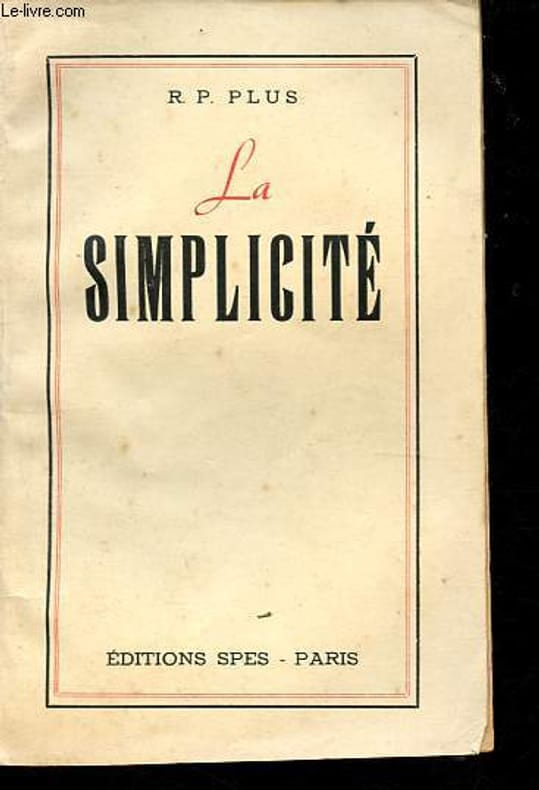
Spes. 1945. In-12. Broché. Etat d'usage, Coins frottés, Coiffe en pied abîmée, Quelques rousseurs. 109 pages - papier jauni, dos plié, rousseurs sur les plats et les pages.. . . . Classification Dewey : 240-Théologie morale et spirituelle
Reference : R200131896
Classification Dewey : 240-Théologie morale et spirituelle
Bookseller's contact details
Le-livre.fr / Le Village du Livre
ZI de Laubardemont
33910 Sablons
France
05 57 411 411
Payment mode


Sale conditions
Les ouvrages sont expédiés à réception du règlement, les cartes bleues, chèques , virements bancaires et mandats cash sont acceptés. Les frais de port pour la France métropolitaine sont forfaitaire : 6 euros pour le premier livre , 2 euros par livre supplémentaire , à partir de 49.50 euros les frais d'envoi sont de 8€ pour le premier livre et 2€ par livre supplémentaire . Pour le reste du monde, un forfait, selon le nombre d'ouvrages commandés sera appliqué. Tous nos envois sont effectués en courrier ou Colissimo suivi quotidiennement.
5 book(s) with the same title
La théorie harmonique. Logique de la simplicité -- EDITION ORIGINALE
P., Dunod, 1959, un volume in 8 relié en pleine toile éditeur, 14pp., 536pp., 21pp.
---- EDITION ORIGINALE ---- BEL EXEMPLAIRE ---- La logique cartésienne - La mathématique et la logique - La logique classique - Les logiques modernes - Rythme et simplicité (l'espace et le temps ; structure et fonction - Le rythme et le nombre - La notion de simplicité - Mathématique et simplicité - Logique et langage...) - Logique et méthode (causalité et probabilité - Raison et intuition - Expérience et réalité - Science et philosophie) - Le nombre et ses extensions**6564/Q4
La Mode Pratique n°10 10 mars 1917 - Petits chapeaux simples - le plus petit budget de toilette - du matin au soir la simplicité pratique - la simplicité chic - nos ouvrages - la guimpe la moins fragile et la meilleur marché - un jupon lavable etc.
Hachette et cie. 1917. In-4. En feuillets. Etat d'usage, Couv. légèrement passée, Dos satisfaisant, Papier jauni. 12 pages - 1er plat illustré en couleurs - quelques illustrations en noir et blanc dans le texte - papier jauni.. . . . Classification Dewey : 70.49-Presse illustrée, magazines, revues
Sommaire : Petits chapeaux simples - le plus petit budget de toilette - du matin au soir la simplicité pratique - la simplicité chic - nos ouvrages - la guimpe la moins fragile et la meilleur marché - un jupon lavable pour 5 francs - une gentille parure de tulle - patrons découpés série B - les secrets du métier enseignés par l'image - conseils utiles avant la venue du docteur - chroniques parisiennes . Classification Dewey : 70.49-Presse illustrée, magazines, revues


Photographie minimaliste. 50 techniques pour saisir la beauté en toute simplicité.
<p class="MsoNormal"><strong>Faites le choix de la simplicité pour un impact maximal.</strong></p><p class="MsoNormal">À une époque saturée d’images et de flux d’informations visuelles, la simplicité peut être un parti pris radical. Dans cet ouvrage, Antony Zacharias expose les principes fondamentaux de la photographie minimaliste.</p><p class="MsoNormal">De la composition d’une image équilibrée à la narration photographique, en passant par les techniques d’éclairage et de mise au point, toutes les étapes du processus photographique sont expliquées et analysées.</p><p class="MsoNormal">Que vous souhaitiez développer votre style artistique ou faire de votre compte Instagram un incontournable, ce guide didactique et inspirant sera votre compagnon de route idéal.</p> Paris, 2025 Pyramyd 144 p., broché 15,5 x 21
Neuf
Leçons de simplicité.
1988 Couverture souple Genève, La Dogana, 1988. In-8, broché, couverture à grands rabats, coiffes légèrement émoussées. 95 pages, non coupé. Un des 720 exemplaires numérotés. Bon exemplaire de cette édition originale.
Très bon
[Curiosa]. Le Cabinet de l'Amour, contenant Entr’autres jolis contes, Le Moignon des Invalides, La Simplicité rustique… orné de jolies figures en taille-douce.
Au Mont-Parnasse, , 1793. 2 tomes en un volume in-16, de 107-(1) pp., 107-(1) pp., 8 figures libres en taille-douce, demi-basane brune, dos lisse orné (reliure début XIXe).
Première et seule édition sous ce titre inconnu des bibliographies, en réalité édition révolutionnaire très augmentée de Les Heures de Paphos. Contes moraux, par un sacrificateur de Vénus (S.l. 1787).Recueil de quarante-cinq contes érotiques en vers dont huit sont illustrés d’une figure légendée et gravée, en rapport direct avec le sujet du récit ; cette illustration dans le goût de Desrais est reprise des Heures de Paphos. Contient :Épître dédicatoire à Vénus, le Tableau, le Moignon de l'invalide, l'Oreille d'or, le Stratagème, la Simplicité rustique, le pas difficile, Rosine et son chien, la Ressources des richesses, les Filles qui ont glissé, le Mari débonnaire, le bon Conseil, le Jardinier et sa femme, l'Historienne, la Métamorphose, Ce que les moines cherchent, la Tante dupée, la Perruque emmiellée, le Bâton de pommade, le Coffre, l'Escalade, le Mariage manqué ; [tome 2] la Messe de quatre heures, À qui la faute ? , le Commerce des baisers, la Fille érudite, la Grotte curieuse, la Paix ratifiée, la Souris qui n'a qu'un trou, la Jouissance de soi-même, les Nones malades, le Moine maraudeur, le Polisson, le Médiateur, la Confession équivoque, le Petit-Maître amoureux, Laïs patriote, l'Amour platonique, le Paradis terrestre, le Calme ou la Tempête, les Cerises, la Piqûre d'épingle, Lisette capucin, l'Amour oiseleur poëme pastoral, le Dévoiement, Maximes d'amour, questions, sentiments et préceptes.Charmant exemplaire d’un petit volume très rare. Collation des 8 planches conforme à l'« Avis au relieur » en fin d'exemplaire. Pâles rousseurs.Manque à la BnF et au Catalogue collectif de France ; 2 exemplaires recensés à Florence et Birmingham, 8 aux États-Unis et Canada (Worldcat).Manque aux bibliographies ; [Heures de Paphos] Pia, Enfer, 611 ; Cohen, 486-487 ; Dutel, A-496.

