 Write to the booksellers
WOODWARD BOB.
CHEFS DE GUERRE.
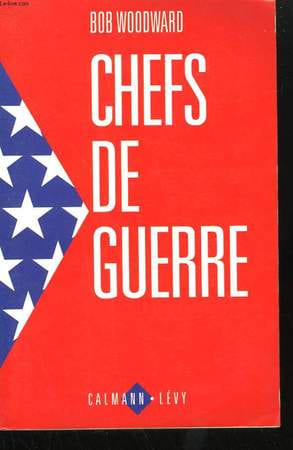
CALMANN LEVY.. 1991.. In-8. Broché. Bon état, Couv. convenable, Dos satisfaisant, Intérieur frais. 393 pages. 1ère et 4 ème de couverture illustrées en couleurs.. . . . Classification Dewey : 810-Littérature américaine
Reference : R150021798
ISBN : 2702120458
Traduit de l'américain par Corine Derblum. Classification Dewey : 810-Littérature américaine
Bookseller's contact details
Le-livre.fr / Le Village du Livre
ZI de Laubardemont
33910 Sablons
France
05 57 411 411
Payment mode


Sale conditions
Les ouvrages sont expédiés à réception du règlement, les cartes bleues, chèques , virements bancaires et mandats cash sont acceptés. Les frais de port pour la France métropolitaine sont forfaitaire : 6 euros pour le premier livre , 2 euros par livre supplémentaire , à partir de 49.50 euros les frais d'envoi sont de 8€ pour le premier livre et 2€ par livre supplémentaire . Pour le reste du monde, un forfait, selon le nombre d'ouvrages commandés sera appliqué. Tous nos envois sont effectués en courrier ou Colissimo suivi quotidiennement.
5 book(s) with the same title
LE MIROIR DES SPORTS N° 3 - Les quatre grands chefs, La guerre, La maitrise des mers, Flottes de guerre comparées de la Grande Bretagne, de l'Allemagne et de la France, Le Paris aux aspects multiples de septembre 1939, Le L-Z 130 a-t-il été détruit
BUREAU DE LA REVUE. 19 SEPTEMBRE 1939. In-12. Broché. Bon état, Couv. convenable, Dos satisfaisant, Intérieur frais. Non paginé. Nombreuses photographies en noir et blanc dans et hors texte.. . . . Classification Dewey : 940.53-Seconde Guerre mondiale 1939-1945
Sommaire : Les quatre grands chefs, La guerre, La maitrise des mers, Flottes de guerre comparées de la Grande Bretagne, de l'Allemagne et de la France, Le Paris aux aspects multiples de septembre 1939, Le L-Z 130 a-t-il été détruit par une explosion ?, Soldats de Pologne, de France et de Grande Bretagne Classification Dewey : 940.53-Seconde Guerre mondiale 1939-1945


[Estienne Roland Carroy] - PLUTARQUE ; (AMYOT, JAcques ; De l'ECLUSE, Charles ; Simon GOULART, Senlisien)
Reference : 35898
(1606)
Les Vies des Hommes Illustres Grecs et Romains (2 Tomes - Complet) Comparées l'une avec l'autre par Plutarque de Chéronée, translatée par M. Jacques Amyot Conseiller du Roy & par luy reveuës & corrigés, Avec les Vies d'Hannibal & de Scipion l'Africain, traduites du Latin en François par Charles de l'Ecluse. Plus les Vies d'Epaminondas, de Philippus de Macédoine, de Dionysius l'Aisné Tyran de Sicile, d'Auguste César, de Plutarque, & de Senecque. Item les Vies des nef excellens Chefs de Guerre, escrites par Aemilius Probus.
Avec amples sommaires sur chacune Vie : Annotations morales en marge, Chronologie, divers Indices & les viuës Effigies des Hommes illustres, Le tout recueilly & disposé par S.G.S. [ Simon Goulart, Senlisien ] 1 vol. fort in-4 (23,5 x 18 cm) rel. postérieure pleine basane marbrée, Tome I : Pour Estienne Roland, marchant Libraire demeurant à Lymogesn ruë Boucherie, Paris, 1606, 12 ff., 828 pp., 13 ff. (index) ; Tome II : Par Jean Du Carroy, Paris, 1606 : 894 pp., 8 ff. n. ch.. Rappel du titre complet : Les Vies des Hommes Illustres Grecs et Romains (2 Tomes - Complet) Comparées l'une avec l'autre par Plutarque de Chéronée, translatée par M. Jacques Amyot Conseiller du Roy & par luy reveuës & corrigés, Avec les Vies d'Hannibal & de Scipion l'Africain, traduites du Latin en François par Charles de l'Ecluse. Plus les Vies d'Epaminondas, de Philippus de Macédoine, de Dionysius l'Aisné Tyran de Sicile, d'Auguste César, de Plutarque, & de Senecque. Item les Vies des nef excellens Chefs de Guerre, escrites par Aemilius Probus.
Complet. L'édition Roland est citée dans l'édition critique de la traduction d'Amyot par Louis Clément (1906, pp. e) , qui cite également une édition de Carroy au format in-12 publiée en 1611. Le présent exemplaire révèle que l'édition Carroy a d'abord paru en complément, sinon concurremment de l'édition Roland. Etat moyen (nombreux médaillons maladroitement coloriés, comme souvent, reliure fort. frottée, faible et abîmée avec important accroc en coiffe sup., qq. petites restaurations marginals anciennes, ex-libris Saint-Yves d'Alveydre). Prix en l'état pour cette édition peu commune.
"Leclerc (Collection ""Les Grands Chefs de guerre"")"
Crémille. Non daté. In-8. Relié. Bon état, Couv. convenable, Dos satisfaisant, Intérieur frais. 252 pages. Nombreuses photos en noir et blanc hors texte. Un portrait en noir et blanc contre-collé sur le premier plat. Ornements rouge et doré sur le premier plat et au dos. Signet conservé. . . . Classification Dewey : 920-Biographie générale et généalogie
"Collection ""Les Grands Chefs de guerre"" Classification Dewey : 920-Biographie générale et généalogie"
Les vies des hommes illustres Grecs et Romains. Comparées l’une avec l’autre par Plutarque de Chaeronee - avec les vies d’Annibal & de Scipion l’Africain, traduites de Latin en François par Charles de l’Ecluse. Plus les vies d’Epaminondas, de Philippus de Macedoine, de Dionysius l’aisné tyran de Sicile, d’Auguste Caesar, de Plutarque & de Senecque, Item les vies des excellens Chefs de guerre, escrites par Aemylius Probus.
A Paris, chez François Gueffier, 1604. 2 forts volumes petit in/8 reliure plein veau , dos à nerfs à fleurons dorés, fer sur les plats ; vol.1 : 16 f., 1181 p., 23 f., 25 vignettes (profils de médaillons) in-texte - vol.2 : 1294 p., 25 vignettes. Belle typographie, et agréable reliure du temps habilement restaurée. Quelques erreurs de numérotation des feuillets, défaut de papier affectant une petite partie du texte p. 807 ; quelques rares manque de papier en bordure de feuillet ; quelques feuillets oxydés.
2 fat volumes 8vo in full calf, ribbed spine with small gilt flowerhead, gilt tool on boards, vol. 1 : [16], 1181 p., [23], 25 vignettes - vol. 2 : 1294 p., 25 vignettes. Very few flaws : a kind renovation of the binding, some errors of pagination as usual ; a small paper flaw affecting the text on p. 807 (vol.1) ; some oxydized sheets.
CHEFS DE GUERRE WOODWARD-B
Calmann-Lévy Edition de 1991. Aspect jauni, intérieur propre.
Merci de nous contacter à l'avance si vous souhaitez consulter une référence dans notre boutique à Authon-du-Perche.

