 Write to the booksellers
BUFFON,
De l'homme,
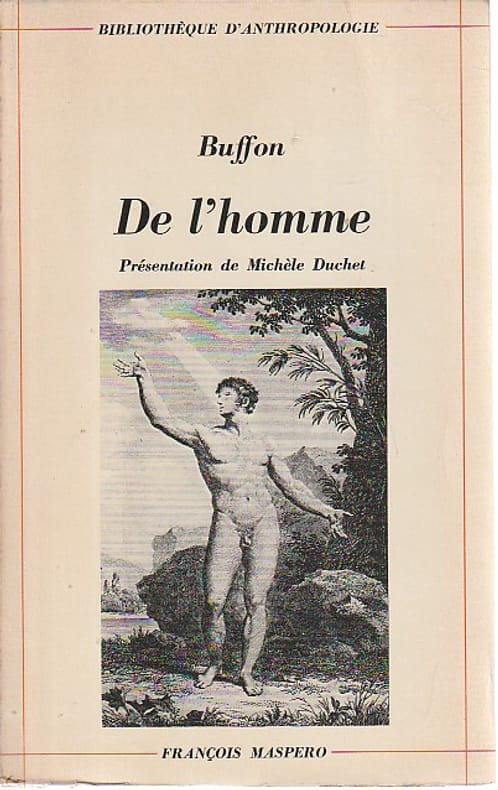
Présentation et notes de Michèle Duchet, François maspero, Bibliothèque d'Anthropologie, 1971, 407 pp., nom en première page, dos un peu en gouttière, traces d'usage, état correct.
Reference : 62984
Bookseller's contact details
L'odeur du book - Negri-Meary S.A.R.L.
60 rue Hermel
75018 Paris
France
0033 (0)1 42 23 30 39
Payment mode


Sale conditions
Vous pouvez passer vos commandes par e-mail, par téléphone ou par courrier. Nous vous donnerons confirmation de la disponibilité des ouvrages souhaités par téléphone ou par e-mail. Nous vous enverrons votre commande dès réception de votre règlement par chèque, carte bancaire, Paypal ou virement bancaire international à l'ordre de Negri-Meary SARL. Envoi par courrier suivi à votre charge. Vous pouvez également retirer les ouvrages commandés à la librairie aux heures d'ouverture.
5 book(s) with the same title
Synthèses - n°273/274 Mars/avril 1969 - Les droits de l'homme ? - Les droits et les devoirs de l'homme - Une bouteille à la mer - Déclaration des droits de l'homme et du citoyen (1793) - Déclaration universelle des droits de l'homme (1948) - Les droits d
Editions Synthèses. 1969. In-8. Broché. Bon état, Couv. convenable, Dos satisfaisant, Intérieur frais. 141 pages - quelques graphiques et photos en noir et blanc dans et hors texte. Texte sur deux colonnes.. . . . Classification Dewey : 70.49-Presse illustrée, magazines, revues
Sommaire : Les droits de l'homme ? - Les droits et les devoirs de l'homme - Une bouteille à la mer - Déclaration des droits de l'homme et du citoyen (1793) - Déclaration universelle des droits de l'homme (1948) - Les droits de quel homme ? - Au-delà des droits de l'homme - Les droits de l'homme, selon.. - Dossier : l'Afrique du Sud, pays exemplaire - Un rêve de liberté absolue : les Tsiganes parmi nous - Il y a des hommes et des femmes - A propos d'un génocide oublié - Le droit aux régions, ou l'urbanisme impossible - Les droits de l'homme, discours sur les peu de réalité - Les droits de l'homme et la presse - Droits de l'homme et églises - La protection des droits de l'homme dans les conflits armés - Intégration régionale et droits de l'homme : situation en Afrique et en Amérique.. Classification Dewey : 70.49-Presse illustrée, magazines, revues


[LITTERATURE] - COLLECTIF (Sous la direction scientifique de Pierre-Jean DUFIEF)
Reference : _202501133
(2005)
Travaux de Littérature.-Volume XVIII-2005. L'Écrivain et le Grand Homme.
Boulogne, A.D.I.R.E.L., 2005 ; in-8 (161 x 240 mm), 424 pp., broché. Sommaire: Pierre-Jean DUFIEF: Introduction, p. 7./ Dominique BOUTET: Charlemagne dans la littérature des XIIe et XIIIe siècles, p. 19./ Patricia MICHON: La vision du roi idéal: les «fictions de l'Aigle et du Lyon» d'Eustache Deschamps, p. 33./ Loris PETRIS: Le piédestal et la fange: la construction du «grand homme» Michel de L’Hospital, p. 47./ Edith KARAGIANNIS-MAZEAUD: Images d'un homme illustre: Charles de Guise, cardinal de Lorraine (1524-1574), p. 65./ François ROUGET: Ronsard, l'écrivain et le grand homme, p. 87./ Olivier MILLET: Exposition au malheur et politique-spectacle: les «grands hommes» dans la tragédie humaniste de la Renaissance, p. 105./ Pierre SERVET: «Ésope, ce grand homme». Évolution et subversion de la notion de «grand homme» chez Montaigne, p. 123./ Jean BALSAMO: «Ma fortune ne m'en a fait voir nul»: Montaigne et les grands hommes de son temps, p. 139./ Catherine DOUVIER: Henri IV vu par Bassompierre, note, p. 157./ Laurent AVEZOU: Richelieu vu par Mathieu de Morgues et Paul Hay du Chastelet. Le double miroir de Janus, p. 167./ Volker KAPP: Un jésuite à la recherche du «grand homme»: La Cour sainte de Nicolas Caussin, p. 179./ Béatrice GUION: L'aigle de Meaux, le cygne de Cambrai et Louis le Grand: Louis XIV devant Bossuet et Fénelon, p. 195./ Édouard GUITTON: Grand Dieu, grand roi, grand homme, p. 217./ Sylvain MENANT: «Ce lot de la nature» (Voltaire), p. 233./ Raymond TROUSSON: Le Panthéon de Jean-Jacques, p. 241./ Laurent VERSINI: Montesquieu et le grand homme, p. 255./ Robert KOPP: «Vivant il a manqué le monde, mort il le possède»: Chateaubriand face à Napoléon, p. 271./ Jean TULARD: Napoléon, les romantiques et le mythe du grand homme, p. 283./ Marie-Josette LE HAN: Léon Bloy et «l'Âme de Napoléon», p. 287./ Lise SABOURIN: Le grand homme selon Alfred de Vigny: de la célébrité au rayonnement de la pensée, p. 297./ Jean-Marc HOVASSE: «La Couronne poétique de Victor Hugo» (1902), p. 309./ Laurence RICHER: Jeanne d'Arc, un «grand homme» du XIXe siècle, p. 323./ Claire BOMPAIRE-EVESQUE: Barrès à la recherche du grand homme, p. 337./ Jean-Claude LARRAT: Malraux: le grand homme en question, p. 355./ Alain LARCAN: L'écrivain Charles de Gaulle et ses grands hommes, p. 365./ Index des noms de héros et grands hommes (personnages historiques), p. 393./ Index des noms d’auteurs, p. 397./ Nos auteurs, p. 409./ Les membres de l’ ADIREL publient, p. 413./ Table des matières, p. 421. Quelques illustrations en noir et blanc et en couleurs.
[LITTERATURE] - COLLECTIF (Sous la direction scientifique de Pierre-Jean DUFIEF)
Reference : _202000843
(2005)
Travaux de Littérature.-Volume XVIII-2005. L'écrivain et le grand homme.
Boulogne, A.D.I.R.E.L., 2005 ; in-8, (161 x 240 mm), 424 pp., broché. Sommaire: Pierre-Jean DUFIEF : Introduction ; Dominique BOUTET : Charlemagne dans la littérature des XIIe et XIIIe siècles ; Patricia MICHON : La vision du roi idéal : les « fictions de l'Aigle et du Lyon » d'Eustache Deschamps ; Loris PETRIS : Le piédestal et la fange. La construction du « grand homme » Michel de L'Hospital ; Edith KARAGIANNIS-MAZEAUD : Images d'un homme illustre : Charles de Guise, cardinal de Lorraine (1524-1574) ; François ROUGET : Ronsard, l'Écrivain et le Grand Homme ; Olivier MILLET : Exposition au malheur et politique-spectacle : les « grands hommes » dans la tragédie humaniste de la Renaissance ; Pierre SERVET : « Ésope, ce grand homme… ». Evolution et subversion de la notion de « grand homme » chez Montaigne ; Jean BALSAMO : « Ma fortune ne m'en a fait voir nul » : Montaigne et les grands hommes de son temps ; Catherine DOUVIER : Henri IV vu par Bassompierre, note ; Laurent AVEZOU : Richelieu vu par Mathieu de Morgues et Paul Hay du Chastelet. Le double miroir de Janus ; Volker KAPP : Un jésuite à la recherche du « grand homme » : La Cour sainte de Nicolas Caussin ; Béatrice GUION : L'aigle de Meaux, le cygne de Cambrai et Louis le Grand : Louis XIV devant Bossuet et Fénelon ; Édouard GUITTON : Grand Dieu, grand roi, grand homme ; Sylvain MENANT : « Ce lot de la nature » (Voltaire) ; Raymond TROUSSON : Le Panthéon de Jean-Jacques ; Laurent VERSINI : Montesquieu et le grand homme ; Robert KOPP : « Vivant il a manqué le monde, mort il le possède » : Chateaubriand face à Napoléon ; Jean TULARD : Napoléon, les romantiques et le mythe du grand homme ; Marie-Josette LE HAN : Léon Bloy et l'âme de Napoléon ; Lise SABOURIN : Le grand homme selon Alfred de Vigny : de la célébrité au rayonnement de la pensée ; Jean-Marc HOVASSE : La Couronne poétique de Victor Hugo (1902) ; Laurence RICHER : Jeanne d'Arc, un « grand homme » du XIXe siècle ; Claire BOMPAIRE-EVESQUE : Barrès à la recherche du grand homme ; Jean-Claude LARRAT : Malraux : le grand homme en question ; Alain LARCAN : L'écrivain Charles de Gaulle et ses grands hommes. Quelques illustrations en noir et blanc et en couleurs.
L'Humanité de l'Homme - A l'image et à la ressemblance de l'homme, Aux sources de l'humanisme, Présence de la parole, Le cheminement de la parole, Les naissances de l'homme, De l'hominisation à l'humanisation, J'ai inventé que demain existera, ...
CERCLE D'ART. 2001. In-8. Broché. Bon état, Couv. convenable, Dos satisfaisant, Intérieur frais. 189 PAGES - Nombreuses illustrations couleur et noir/blanc, dans et hors texte - Texte sur deux colonnes - Prologue d'Ilya Prigogine - Avec Yves Bonnefoy, Henri Cueco, André Delvaux, Roger-Pol Droit, Luc Ferry, Elisabeth de Fontenay, Albert Jacquard, Naïm Kattan, Axel Kahn, Abdelkébir Khatibi, Jannis Kounellis, Marcel Moreau, Edgar Morin, Jacqueline de Romilly, Danièle Sallenave, Philippe Sollers, Isabelle Stengers, Antoine Vergote. . . . Classification Dewey : 909.04-Ethnologie
"19 Auteurs pour un livre, qui pose une question infinie : qu'est-ce qui fait l'humanité de l'Homme ? Un chimiste, un biologiste, un généticien, un anthropologue-sociologue, un psychanalyste qui est aussi théologien, quatre philosophes, une historienne, cinq écrivains essayistes, un poète, un cinéaste, deux peintres. Cela donne un choeur de voix accordées et discordantes, une approche perspectiviste et pluridisciplinaire, où les savoirs et les fictions, les généalogies et les utopies se succèdent.Ce livre jette des ponts entre science et philosophie, nature et art. Il manifeste sans doute ce qu'Il y a Prigogine appelle ""une nouvelle rationalité"". Deux notions dues à l'auteur de La nouvelle alliance pourraient servir de fil d'Ariane à l'humanité de l'Homme : l'événement et la créativité."" Dans l'art, comme dans la nature, se réalisent à la fois des règles et des événements imprévus, des bifurcations, qui orientent le futur toujours incertain."" Ce sont les dernières lignes de la coda du volume. Les participants de ce choeur humaniste décrivent, sans s'être concertés, les bifurcations, cernent les événements qui ont conduit l'homme de "" l'hominisation à l'humanisation "" (Axel Kahn), de l'Homo erectus à l'Homo sapiens et enfin à l'homme de la Terre-Patrie (Edgar Morin). Cette odyssée échappe, en partie, à tout déterminisme. Des scénarios d'humanité et de barbarie sont toujours possibles. ""La liberté, dit Albert Jacquard, s'insère là où il y a imprévisibilité et complexité"" L'aventure du devenir humain est aussi l'histoire de sa liberté. Marcel Moreau parle du ""fabuleux gisement de tous les possibles."" Sur ce chemin se rencontrent, à chaque bifurcation, la violence et les stratégies artistes de sa sublimation, de sa transfiguration. La nature elle-même est artiste, selon Prigogine, et capable d'une autorégulation. En marge des textes, leur faisant écho ou simplement inspirée par ceux-ci, une iconographie - pour partie suggérée par les auteurs - a été sélectionnée par l'éditeur : de la paroi d'une grotte aborigène à une oeuvre de Kounellis, d'un kouros à un arbre de vie de Jeanclos, de l'écriture cunéiforme au geste de peintre de Jorn, d'un masque inuit à un visage de Basquiat, c'est un petit musée de l'humanité de l'Homme que le lecteur, le spectateur de sa propre histoire, pourra voir et réfléchir en lui. Ce livre apporte plus de questions, d'hypothèses, de paris théoriques et éthiques que des certitudes. Il reste ouvert à d'autres figures de l'humanité, car l'homme seul est capable de l'affirmation, provisoire et précaire, vitalisante ou réactive, de l'interprétation multiple et contradictoire de son passé et de son devenir.J. S.Sommaire : Avant-propos, Prologue, A l'image et à la ressemblance de l'homme, Aux sources de l'humanisme, Présence de la parole, Le cheminement de la parole, Les naissances de l'homme, De l'hominisation à l'humanisation, J'ai inventé que demain existera, L'arrachement à la nature, Faiblesse et barbarie, Apocalypse domestique, Le génie des instincts, La déprise, La grandiose invention de l'angle, Le plan incliné de Galilée, Archive et mie en scène, L'homme imaginaire, L'entre-deux, Le jazz, La nature créatrice, Dix-neuf auteurs, écrivains, artistes, philosophes, scientifiques ou théologiens ont tenté de répondre, à l'invitation de Jacques Sojcher, à la question de l'humanité de l'homme. Se penchant trop sur lui-même, celui-ci risque toujours de se perdre - d'où l'utilité du recours à des esprits éclairés, qui le retiendront de succomber au vertige, ou lui donneront un sens. Classification Dewey : 909.04-Ethnologie"
Revue Française de psychanalyse - Revue Bimestrielle - Organe officiel de la Société Psychanalytique de Paris
Reference : 18778
Revue Française de psychanalyse : A Propos De L'Homme Aux Loups : En supplément à "L'histoire d'une névrose infantile" de Freud (Ruth Mack Brunswick) - Scène primitive et complexe d'Oedipe (Dominique J. Geahchan) - Contribution à l'étude de la première topique; l'effet "après coup" dans L'Homme aux loups (Jacqueline Lubtchansky) - Le mot magique de l'Homme aux loups. Incorporation, hystérie interne, cryptonymie (Nicolas et Maria Abraham-Torok) - A propos des Mémoires de L'Homme aux loups (Barbro Sylwan) - Shèmes mnésiques héréditaures et événements vécus de l'enfance dans l'Homme aux loups (Claude Hollande) - La symbolisation et son achoppement (René Major) - Le pouvoir fantasmatique de Freud à l'oeuvre dans le texte de l'Homme aux loups (Jean Gillibert) / Traductions: Nouvel essai pour résoudre le "problème de l'angoisse" (Leo Rangell) - Nécrologie: Heinz Hartmann (S. Lebivici) - ...
N°1, Tome XXXV - janvier 1971 - Presse Universitaire de France - 200 pages
Assez bon état - Tache et accroc à la couverture - Petites marques d'usure à la couverture

