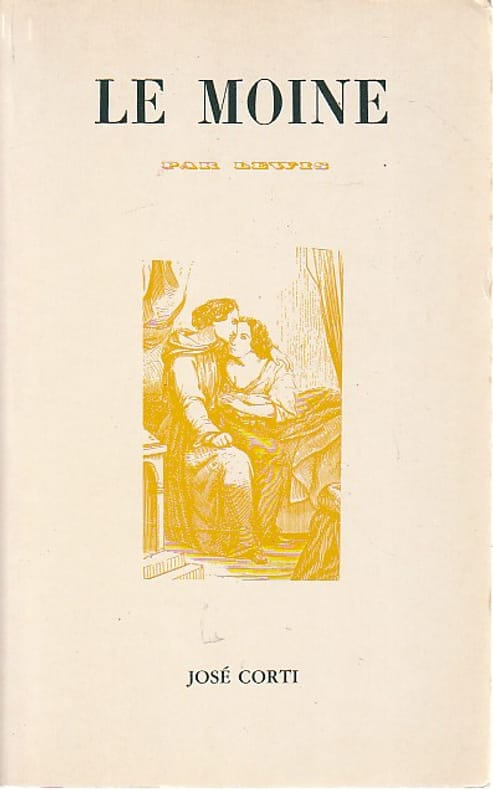
‎LEWIS Matthew Gregory,‎
‎Le moine,‎

‎José Corti, Les Massicotés, 2005, 378 pp., broché, légères traces d'usage, bon état.‎

Reference : 18214


‎‎

€12.00
Bookseller's contact details

L'odeur du book - Negri-Meary S.A.R.L.

60 rue Hermel
75018 Paris
France

librairie@odeurdubook.fr

0033 (0)1 42 23 30 39

Contact bookseller

Payment mode
Cheque
Others
Sale conditions

Vous pouvez passer vos commandes par e-mail, par téléphone ou par courrier. Nous vous donnerons confirmation de la disponibilité des ouvrages souhaités par téléphone ou par e-mail. Nous vous enverrons votre commande dès réception de votre règlement par chèque, carte bancaire, Paypal ou virement bancaire international à l'ordre de Negri-Meary SARL. Envoi par courrier suivi à votre charge. Vous pouvez également retirer les ouvrages commandés à la librairie aux heures d'ouverture.

Contact bookseller about this book

Enter these characters to validate your form.
*
Send

5 book(s) with the same title

‎[LE MOINE FOU] - VINK - ‎

Reference : 200809066

‎Le moine fou. ‎

‎Paris, Dargaud, 1984 ; in-4, 48 pp., cartonnage de l'éditeur. Eo éraflure sur les coinet bas de coiffe coter 25 / vendu 20.‎


‎Eo éraflure sur les coinet bas de coiffe coter 25 / vendu 20.‎

Phone number : 03 89 24 16 78

EUR20.00

‎MOINE BENEDICTIN‎

Reference : 99929079

(1982)

‎LA SAINTE LITURGIE PAR UN MOINE BENEDICTIN‎

‎ Ed. Sainte Madeleine 1982 Ed. Sainte Madeleine 1982, in-8 broché, 118 pages. Bon état.‎


‎ Toutes les expéditions sont faites en suivi au-dessus de 25 euros. Expédition quotidienne pour les envois simples, suivis, recommandés ou Colissimo. ‎

Phone number : 05 65 42 95 21

EUR5.00

‎[LE MOINE FOU] - VINK - ‎

Reference : 201005332

‎Le moine fou. ‎

‎Paris, Dargaud, 1995 ; in-4, 48 pp., cartonnage de l'éditeur. Reed.‎


‎Reed.‎

Phone number : 03 89 24 16 78

EUR12.00

‎CUPERUS,G. ‎

Reference : 151911

‎Gisb. Cuperi Harpocrates, sive Explicatio imagunculae argenteae perantiquae, quae in figuram Harpocratis formata representat Solem. Ejusdem Monumenta antiqua inedita. Multi auctorum loci, multae inscriptiones, marmora, nummi, gemmae, varii ritus, & antiquitates in utroque opusculo emendantur & illustrantur. Accedit Stephani Le Moine Epistola de Melanophoris. ‎

‎Utrecht (Trajecti ad Rhenum), Apud Franciscum Halma, Acad. Typogr., 1687. ‎


‎4to. (VIII),294,(14 index) p., frontispiece, 6 plates, of which 5 folding, text engravings. Vellum. 20.5 cm (Ref: STCN ppn 833724266; Brunet 6, no. 22603; Cicognara 3212; Ebert 5512; Graesse 2,308) (Details: 5 thongs laced through both joints. Engraved frontispiece, it depicts Harpocrates standing on a pedestal, around him gods like Apollo, Hermes, Serapis and Isis, and in the foreground Tempus, who shovels for Egyptian antiquities. Title printed in red and black. Woodcut printer's mark on the title, motto: 'vivitur in genio', 'only through his genius man survives'. 3 woodcut headpieces, 3 cul de lampe vignettes, text engravings on 39 pages, small woodcuts on 2 pages; 6 plates depicting ancient monuments) (Condition: Vellum soiled and slightly stained. Front flyleaf gone) (Note: This title of 1687 is a philological tour de force of the Dutch classical scholar Gisbertus Cuper, or Cuperus, in Dutch Gijsbert Kuiper, 1644-1716. He was professor of Latin and Greek literature at the 'Athenaeum Illustre' of Deventer from 1668 till 1681, and at the same time mayor of this old city, which once had been a member of the Hanseatic League. Cuper has his own lemma on Wikipedia, in Dutch only. In this title Cuper examines a deity of Egyptian origin, Harpocrates, who was imported into Rome in the second century B.C., and who was connected with the mystery cult of the Egyptian goddess Isis. Cuper's research began, he tells us in the preface, with a small silver statuette which he saw in the famous collection of his friend (and scholar) Johannes Smetius, whom he visited in 1674 in Nijmegen. The statuette was found in the ground of the collector's hometown Nijmegen. It is a sculpture of a small boy, almost naked, and with a lotus flower on his head. He is winged and wears a small quiver on his back; the boy holds the index finger of his right hand against his lips, as if to enjoin silence. (p. 1: 'manus dextrae digito indice premit vocem, & silentia suadet') From his right arm hangs a small bucket (situla), and around his left arm coils a snake. His left hand rests on a club, around which another snake coils, and to which a goose has been attached. At the boy's right foot sits a rabbit or hare. At his left foot a small bird of prey (accipiter vel alia avis). (p. 2) As soon as Cuper saw this aenigmatic figurine, he decided to examine it, for he could not imagine that all those attributes had been added without any intention. He recognized the boy from a Egyptian hieroglyph as Harpocration, whom Egyptian superstition brought to Rome. He immediately realized also that this boy did not ask for silence (non silentium tantum digito suadens), but that he represented the Sun (verum Solis imaginem referens). (p. 2) In the rest of the book Cuper closely examines all the relevant passages concerning Harpocrates' iconography in ancient authors, in mythology, on gemmae, coins, inscriptions, amulets etc., to prove his point, that Harpocrates's finger was misunderstood, from the Roman scholar Varro to Augustine, and that the boy was not a diety of Silence at all. The boy did not ask for silence, he argues, but was a representation of the rising sun, because the ancient Egyptians greeted and honoured it's appearance by pressing their index finger against their lips. The 'Harpocrates' was first published in 1676 in Amsterdam 'apud Theodorum Pluymer'. This 1687 edition is a reissue, considerably augmented with 'Gisberti Cuperi Monumenta antiqua inedita' (ca. 70 pages) in which Cuper discusses recent finds. He offers a description and image of the finds, and tries to explain matters with the help of ancient sources and the work of contemporary scholars. At the end has also been added 'Ad Gisb. Cuperum De Melanphoris epististola' (30 pages) written by the French orientalist Stephanus Le Moine, 1624-1689, who lectured in Leiden from 1676. His letter is a treatise on the black clothes (melamphoroi), which the members of the Isis fraternities wore when they lamented the fate of their goddess. This book of Cuper is tough reading, the Latin is difficult and it abounds in philological pedantry. The Latin text of the second part of the book, Cuper's 'Monumenta antiqua inedita', can be found on: stilus.nl/cuper/, where one can also download a translation of it into Dutch by Leo Nellissen, who is an expert on Smetius) (Collation: *4 (including frontispiece); A-Z4, Aa-Pp4, Qq2) (Photographs on request) ‎

Phone number : +31 20 418 55 65

EUR640.00

‎[ARTAUD (Antonin)]. LEWIS (Matthew Gregory)‎

Reference : 013805

‎Le Moine raconté par Antonin Artaud. ‎

‎ 0 Reliure Dédicacé par l'auteur‎


‎Edition originale de cette traduction française établie par Antonin Artaud, qui en signe l'avertissement liminaire. Exemplaire du tirage courant portant un ENVOI autographe signé d'Artaud « à Mr Marius Boisson hommage sympathique ». Reliure récente : bradel demi-chagrin noir, lettre or au dos lisse, couverture illustrée et dos conservés.>>>>Les exemplaires des tirages suivants sont habillés d'une couverture imprimée. Pour cette première émission, elle est illustrée d'une photographie montrant Cécile Brusson poignardant une femme maintenue par Antonin Artaud habillé en moine. Cette image fait partie d'une série de tableaux vivants imaginée par l'écrivain avec un double projet : celui d'une édition illustrée du MOINE et également une ébauche d'un film fantastique. Cette séance fut réalisée au studio Forest de Montmartre en compagnie de Cécile Brusson, femme de l'éditeur Robert Denoël et probablement maîtresse d'Artaud. Il dédicace ici le volume à ?Marius Boisson (1881-1959), qui fut l'ami et le secrétaire d'Hugues Rebell. Ecrivain protéiforme, il publie aussi bien des recueils de poésie que des ouvrages licencieux, fit tous les petits métiers, fut journaliste et fréquenta les bibliothèques. Il rencontra avant la Première guerre Guillaume Apollinaire, et fréquente ensuite la Bohème de Montmartre et de Montparnasse, où il dut croiser Artaud. Bon 0‎

Phone number : 01 42 66 38 10

EUR900.00
Get it on Google Play Get it on AppStore
The item was added to your cart
You have just added :

-

There are/is 0 item(s) in your cart.
Total : €0.00
(without shipping fees)
What can I do with a user account ?

What can I do with a user account ?

  • All your searches are memorised in your history which allows you to find and redo anterior searches.
  • You may manage a list of your favourite, regular searches.
  • Your preferences (language, search parameters, etc.) are memorised.
  • You may send your search results on your e-mail address without having to fill in each time you need it.
  • Get in touch with booksellers, order books and see previous orders.
  • Publish Events related to books.

And much more that you will discover browsing Livre Rare Book !