 Write to the booksellers
SALVY Gérard-Julien
Guido RENI.
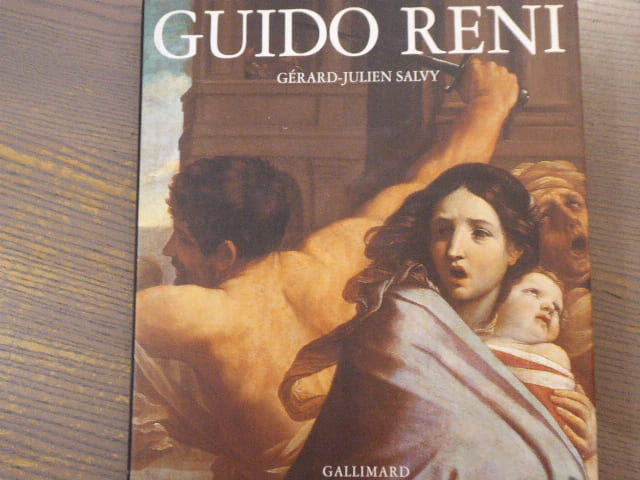
Gallimard Paris 2001 In-4 ( 280 X 250 mm ) de 161 pages, pleine toile sous jaquette illustrée. Illustrations dans et hors-texte. Très bel exemplaire.Peintre longtemps négligé, Guido Reni ( 1575-1642 ) est depuis une cinquantaine d'années restauré à son juste rang, celui d'artiste majeur de la Renaissance. C'est souscrire à l'opinion de ses contemporains, qui furent à la fois fascinés par la virtuosité mise au service d'un désir d'harmonie, et troublés par la mélancolie prégnante qui se dégage d'un grand nombre de ses oeuvres, ainsi que Stendhal, par exemple, le ressentit. Peintre à la recherche de l'idéal classique, il fut aussi, grâce notamment à la densité aux détours souvent inattendus de sa poétique, l'un des annonciateurs de l'âge baroque. Formé à Bologne dans l'atelier du peintre flamand Denys Calvaert avant de devenir un familier de l'académie des Carrache, sa carrière eut pour scènes sa ville natale et Rome, où il fit d'assez longs séjours. Marqué à jamais par la découverte de l'Antiquité, héritier de Raphaël et contemporain fasciné par Caravage, austère et sensuel, partagé entre sentiment religieux et recherche d'un idéal de beauté tendant vers le paganisme alors que la Contre-Réforme imposait son esthétique, parfois académique mais très souvent d'une grande liberté formelle, Guido Reni fut le peintre de la contradiction, d'une ambiguïté - ce qui, aujourd'hui, le fait apprécier mais déconcerta souvent les commanditaires et les collectionneurs de son temps.
Reference : 344860
Bookseller's contact details
Librairie Tiré à Part
M. Xavier Zimmer
64 boulevard de la Libération
13004 Marseille
France
04 91 42 63 17
Payment mode


Sale conditions
Nos conditions de vente sont conformes aux usages de la librairie ancienne et moderne et aux lois qui régissent le commerce en ligne. Tous les ouvrages présentés sont complets et en bon état, sauf indication contraire. Les prix indiqués sont nets, port et assurance à la charge du destinataire L'exécution des commandes téléphonées est garantie mais sans règle absolue, la disponibilité des livres n'étant pas toujours vérifiable lors de l'appel. Au delà de huit jours les livres réservés seront remis en vente. Les frais de port sont à la charge du destinataire. Les livres sont payables à la commande. Aucun livre ne sera expédié sans être réglé en totalité. Les retours sont admis sous 14 jours après notification préalable (Article L.221-13 du Code de la consommation).
5 book(s) with the same title
[Guido Reni] - Dury, Corentin. et al.
Reference : 124668
(2024)
ISBN : 9788836658176
Dans l'atelier de Guido Reni: La vie et lâatelier
Dury, Corentin. et al.: Dans l'atelier de Guido Reni: La vie et l'atelier. Exhibition: OrlÃans, MusÃe des Beaux-Arts, 2024. 304 pages, 120 colour illustrations. Hardback. 28 x 24cms. Five introductory essays explore the function of the 17th-century atelier and the challenges of discerning workshop pieces from autographs, Reni's redecoration of Pope Paul V's private chapel in 1609, and the 'double painting' praxis in Bologna at the time of Guercino. Eight essays are then dedicated to Reni's particular workshop practice, looking at his reprisal of old master techniques in the running of his studio, his etchings, his collaborations, the qualitative hierarchy in his workshop, his iconographic output and his 'The Rape of Europa' series. In the final section analyses the motif of David contemplating the head of Goliath, Reni's source material, the family typology of Crequy, La Vrilliere, Volponi, and Mazarin, as well as the historic impact of the atelier culture that Reni created. Inspired by the reattribution of the version held by the MusÃe des Beaux-Arts in OrlÃans, all known versions are re-examined. Text in French.
Five introductory essays explore the function of the 17th-century atelier and the challenges of discerning workshop pieces from autographs, Reni's redecoration of Pope Paul V's private chapel in 1609, and the 'double painting' praxis in Bologna at the time of Guercino. Eight essays are then dedicated to Reni's particular workshop practice, looking at his reprisal of old master techniques in the running of his studio, his etchings, his collaborations, the qualitative hierarchy in his workshop, his iconographic output and his 'The Rape of Europa' series. In the final section analyses the motif of David contemplating the head of Goliath, Reni's source material, the family typology of Crequy, La Vrilliere, Volponi, and Mazarin, as well as the historic impact of the atelier culture that Reni created. Inspired by the reattribution of the version held by the MusÃe des Beaux-Arts in OrlÃans, all known versions are re-examined. Text in French

The Divine Guido. Religion, Sex, Money, and Art in the World of Guido Reni
Spear, Richard E.: The Divine Guido. Religion, Sex, Money, and Art in the World of Guido Reni. London: Yale University Press, 1997. 408pp with 32 colour and 137 monochrome illustrations. Cloth. 25.6x19.2cms. An original study of the baroque master (1575-1642), focusing on his peculiar character: deeply religious, a misogynist, reportedly virginal, neurotically fearful of witches and addicted to gambling. The author draws on psychoanalytical, feminist and gay studies to reveal the effect of the artist's personality on his style and choice of subject matter.
An original study of the baroque master (1575-1642), focusing on his peculiar character: deeply religious, a misogynist, reportedly virginal, neurotically fearful of witches and addicted to gambling. The author draws on psychoanalytical, feminist and gay studies to reveal the effect of the artist's personality on his style and choice of subject matter. Text in English
[Guido Reni] - Ebert-Schifferer, Sybille et al
Reference : 039983
(1988)
ISBN : 8877790628
Guido Reni und Europa. Rhum und Nachruhm
Ebert-Schifferer, Sybille et al: Guido Reni und Europa. Rhum und Nachruhm. Exhibition: Frankfurt, Schirn Kunsthalle, 1988. 822pp with hundreds of colour and monochrome illustrations. Hardback. 28.5x23cms. Fully illustrated descriptive catalogue of 48 works by Reni and 84 by his contemporaries, arranged by area, with full-page colour reproductions, provenance and bibliography for each. With essays, select bibliography. Text in German.
Fully illustrated descriptive catalogue of 48 works by Reni and 84 by his contemporaries, arranged by area, with full-page colour reproductions, provenance and bibliography for each. With essays, select bibliography. Text in German
Guido Reni Opera Completa. Classici dell'Arte
Garboli, Cesare: Guido Reni Opera Completa. Milan: Rizzoli, 1971. Series: Classici dell'Arte. 120 pp., with 64 colour plates and c. 220 monochrome illustrations. Cloth. 31.5 x 24cms. Text in Italian.
Text in Italian
Guido Reni 1575-1642
Nuova Alfa Editoriale/Los Angeles County Museum of Art, 1988. In-4, reliure éditeur sous jaquette illustrée en couleur, titre doré sur le dos, xi-367 pp. Foreword - Io Guido Reni Bologna, Man and Artist, Scott Schaefer - The Life, Symbolism, and Fame of Guido Reni, Andrea Emiliani - Guido Reni in the Eyes of his Contemporaries, Charles Dempsey - Literature in Bologna in the Age ...
Figures en noir et blanc in texte et planches couleur en hors texte. --- Plus d'informations sur le site archivesdunord.com

