 Write to the booksellers
COLETTE ( Colette WILLY ) - LOBEL-RICHE
CHERI.
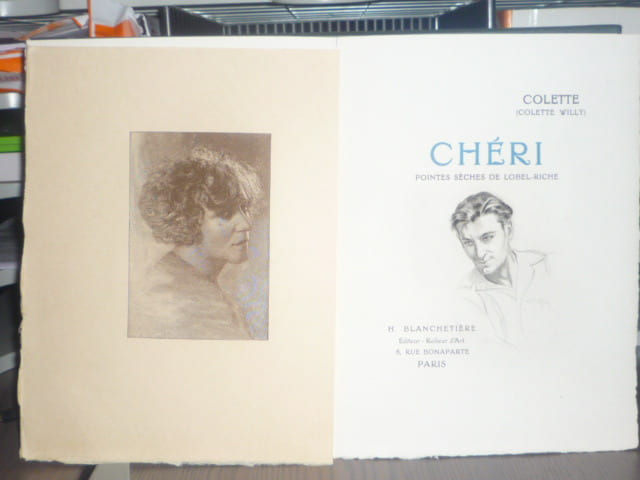
H. Blanchetière Paris 1925 Petit in-4 carré ( 260 X 200 mm ) de 202 pages, en feuilles sous couverture imprimée rempliée et étui cartonné. Premier livre illustré par LOBEL-RICHE, portrait de COLETTE gravé sur bois en frontispice et 21 fines pointes sèches dont 10 à pleine page. Tirage à 275 exemplaires, celui-ci numéroté sur papier vélin à la cuve de Fabriano avec dans une chemise cartonnée:1- Une suite à part en 2e état avec remarques tirées en sanguine des 21 planches gravées et utilisées dans l'ouvrage.2- Une épreuve en 1er état des 3 planches refusées.Très bel exemplaire. ( Carteret IV, 108 « Premier et bon ouvrage de Lobel-Riche ». )
Reference : 195064
Bookseller's contact details
Librairie Tiré à Part
M. Xavier Zimmer
64 boulevard de la Libération
13004 Marseille
France
04 91 42 63 17
Payment mode


Sale conditions
Nos conditions de vente sont conformes aux usages de la librairie ancienne et moderne et aux lois qui régissent le commerce en ligne. Tous les ouvrages présentés sont complets et en bon état, sauf indication contraire. Les prix indiqués sont nets, port et assurance à la charge du destinataire L'exécution des commandes téléphonées est garantie mais sans règle absolue, la disponibilité des livres n'étant pas toujours vérifiable lors de l'appel. Au delà de huit jours les livres réservés seront remis en vente. Les frais de port sont à la charge du destinataire. Les livres sont payables à la commande. Aucun livre ne sera expédié sans être réglé en totalité. Les retours sont admis sous 14 jours après notification préalable (Article L.221-13 du Code de la consommation).
5 book(s) with the same title
CHERI SAMBA [Samba wa Mbimba N'zingo Nuni Masi Ndo Mbasi] - André MAGNIN
Reference : 77461
(2004)
J'aime Chéri Samba
Fondation Cartier | Paris 2004 | 22.50 x 28.50 cm | reliure de l'éditeur
Edition originale bilingue publiée sous la direction d'André Magnin à l'occasion de l'exposition des toiles de Chéri Samba, important peintre de la République Démocratique du Congo, à la fondation Cartier en 2004. Reliure de l'éditeur, plats de cartonnage bleu, dos lisse de cartonnage jaune, premier plat illustré et en relief. Ouvrage illustré de reproductions d'oeuvres de Chéri Samba. Bel envoi autographe daté et signé de Chéri Samba à Jean Pierre Maury, dernier des grands artistes mouleurs-figuristes : "Pour un grand Jean Pierre Maury et pour nos grands rires!!! Chaque fois que l'on se rencontre, on s'éclate tjs sans trop savoir pourquoi. Je t'aime fort grand Maury. Chéri Samba. 21 Mai 2004" - Photographies et détails sur www.Edition-Originale.com -


[CHERI SAMBA] COLLECTIF
Reference : PEINTUREE9999999990324
(2023)
ISBN : 9782382031506
Chéri Samba
Paris, In Fine éditions d'art, 2023, 31 x 30, 143 pages sous cartonnage éditeur illustré. Iconographie couleurs. Ouvrage publié à l'occasion de l'exposition "Chéri Samba dans la collection Jean Pigozzi" présentée au Musée Maillol du 17 octobre 2023 au 7 avril 2024. "Peintre congolais, formé chez un peintre d'enseignes, Chéri Samba crée un oeuvre peint dans une palette chromatique riche, vive, contrastée et le plus souvent pailletée comme pour en dédramatiser le sujet. Ayant remarqué que les spectateurs passent devant les tableaux en ne regardant que d'un clin d'oeil, Chéri Samba met également des textes, ou commentaires, au sein de ses toiles. L'écriture attire ainsi l'attention et permet de mieux admirer et pénétrer l'oeuvre. L'artiste qualifie ce style de "griffe sambaïenne" . Pour lui l'art n'a pas de frontière. Les thèmes qu'il aborde sont universels : il met en scène les faits d'actualité, les moeurs, la sexualité, la maladie, les inégalités sociales, la corruption, etc. La peinture de Chéri Samba, emplie d'un humour corrosif, apparaît comme une critique féroce de la vie sociale et politique. Combinant différents styles, ses audacieuses prises de positions picturales se caractérisent par une grande maîtrise du métier, par leur technique et leurs innovations. Chéri Samba traite de la vie de tous les jours, des problèmes, plaisirs et paradoxes que l'on rencontre dans les cultures en mutation rapide, mais il montre aussi l'impact des événements internationaux sur les sociétés africaines."
Très bon état.
Chéri-Bibi en 3 volumes
Laffont - In-8 reliés avec leur jaquette illustrée - Très bon état 1. Premières aventures de Chéri-Bibi (1961) - 509 pages : Les cages flottantes/Chéri-Bibi et Cécily - 2. Nouvelles aventures de Chéri-Bibi (1962) - 460 pages : Palas et Chéri-Bibi/Fatalitas - 3. Dernières aventures de Chéri-Bibi (1963) - 632 pages : Le coup d'état de Chéri-Bibi/Mister Flow
"Les chefs-d'uvre (20 volumes); Rouletabille : 1. Le mystère de la chambre jaune; 2. Le parfum de la Dame en noir; 3. Rouletabille chez le Tsar; 4. Le Château noir; 5. Les étranges noces de Rouletabille; 6. Rouletabille chez les Bohémiens; 7. Rouletabille chez Krupp; Chéri-Bibi : 1. Les cages flottantes; 2. Chéri-Bibi et Cécily; 3. Palas et Chéri-Bibi, Fatalitas; 4. Le coup d'état de Chéri-Bibi; Romans d'aventures : 1. Mister Flow, Une histoire épouventable; 2. Les Mohicans de Babel; 3. La Reine du sabbat; 4. Le Roi mystère; 5. Balaoo; 6. L'épouse du soleil; Romans fantastiques : 1. Le fantôme de l'opéra; 2. L'homme qui revient de loin, Le fauteuil hanté; 3. L'homme qui a vu le diable, Le coeur cambriolé, La double vie de Théophraste Longuet."
Genève, Edito-Service/Le Cercle du Bibliophile, 1969. 12 x 18, 20 volumes, environ de 250 à 400 pages par livre, reliure d'édition skivertex rouge, dos et plats avant : riche décor blanc et or, 2 macarons illustrés, très bon état.
Très belle série, complète en 20 volumes.
Chéri - La Fin de Chéri
Grasset. Deux volumes in-12 (15 x 20 cm), reliure demi-peau, dos à 3 nerfs ornés de caissons dorés, têtes dorées, couvertures conservées, exemplaires sur vélin de "Chéri" (imprimé en 1928, 228 pages) et "La Fin de Chéri" (imprimé en 1928, 200 pages).
Dos insolés, par ailleurs bon état.

