 Write to the booksellers
CAII SALLUSTII CRISPI (86-34 BC),
QUAE EXSTANT OPERA,
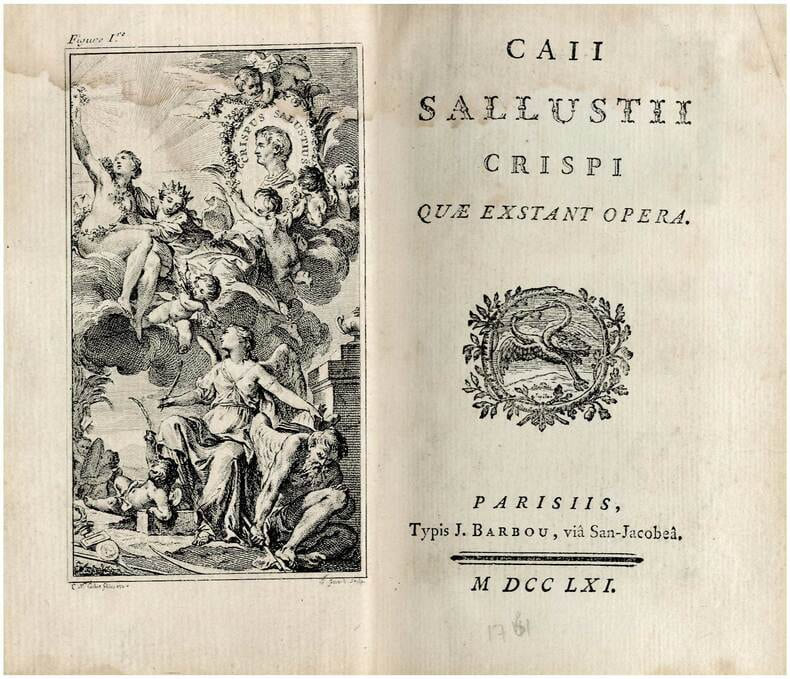
Typis J. Barbou, Paris, M.DCC.LXI (1761). In-16, p. xxxvi, 346. With engraved frontispiece and 2 more illustrations by Fessard, drawn by Cochin, along with engraved headings. Contemporary full calf binding with roulettes on spine and red title label with gilt lettering; rubbed and bumped mainly along edges. Marbled end papers, gilt edges, slight foxing and a few pencil underlinings, but tight througout.
Reference : HI511
Bookseller's contact details
Librairie Ancienne Cerat
M. Jean Cerat
Metamorfoseos 39
15234 Chalandri - Athènes
Greece
00 30 210 3616330
Payment mode


Sale conditions
reglement d'avance par transfert bancaire, PayPal ou en espece. Veuillez nous consulter pour le mode d'envoi et les frais. Envoi dans les deux jours des reception du reglement, retour dans la semaine apres reception des livres.
5 book(s) with the same title
CAII SALLUSTII CRISPI QUAE EXSTANT OPERA
Parisiis Typis J. Barbou 1761 1 vol. in-12 ( 9 x 15,5 cm ) ( poids = 250 g ) 7XXXVI (dont t. ) , 348 pp. . 3 planches HT et HP dont le frontispice , d' après Charles-Nicolas Cochin fils , gravées par Fessard . Comprend : Vita C. Sallustii Crispi e sinceris monumentis depromta , Veterum scriptorum et nonnullorum recentiorum de Sallustio judicia et testimonia , L. A. Flori Bellum Catilinarium , C. Sallustii Crispi Catilina seu bellum Catilinarium , Corollarium de Sallustio quaedam dissimulante in Catilinae historia , C. Sallustii Crispi Jugurtha seu bellum Jugurthinum , Epistolae duae ad C. Caesarem Sallustio adscriptae , C. Sallustii Crispi Historiarum fragmenta , C. Sallustii Crispi Declamatio in M. Tullium Ciceronem , In Sallustium declamatio quae Ciceroni falso tribuitur , Index rerum , Index verborum , Catalogus praecipuarum Crispi Sallustii editionum . Marque typographique aux deux cygognes par Papillon , au titre . 7 bandeaux dont 3 d' après et par Papillon , 2 par de La Fosse . Nombreux culs-de-lampe . Plein veau marbré de l' époque . Dos lisse cloisonné et fleuronné , p. de titre rouge . Triple filet doré encadrant les plats . Roulette dorée sur les coupes et les chasses .Toutes tranches dorées . Gardes papier marbré coquille . Manquent la coiffe inf. et du cuir à une coupe du premier plat . De légers frottés . Coins légèrement émoussés . Intérieur frais .
Oeuvre de SALLUSTE , dont la biographie est établie par Philippe de Prétot (1710 - 1787 ) , censeur royal chargé de surveiller la réimpression des classiques latins . Barbier ( Dictionaire des ouvrages anonymes et pseudonymes , 1824 , vol. 3 ) signale : " Les éditions de Barbou , 1761 et 1774 , ont été revues par de Wailly . "
Taciti opera quae exstant opera, tomus I recensuit J.N.Lallemand
1760 Parisis, Saillant , Desaint ,J. Barbou, 1760, In douze, xxiv-444 pp, reliure d'époque en plein veau marbré ,double filet d'encadrement sur les plats, coiffes légèrement émoussées, dos à cinq nerfs orné de fleurons,pièces de titre et de tomaison en cuir rouge,tranches dorées,ouvrage en bon état,
Tome I seul,avec un portrait en frontispice,.


Opera omnia quae exstant. Opera et studio domoni Juliani Garnier. Tomus seconda: - Homiliae de diversis. - Ascetica. - Homolia S. Basilii.
Paris, Gaume 1839, 270x180mm, XCI-2ff. 562pages, demi-cuir noir, dos muet. Texte en grec.
Pour un paiement via PayPal, veuillez nous en faire la demande et nous vous enverrons une facture PayPal
Opera omnia quae exstant. Opera et studio Domni Juliani Garnier. Tomus secundus. Par altera.
Paris, Gaume 1839, 270x180mm, 627pages, cartonnage percaline noire muet. Texte grecque et latin.
Pour un paiement via PayPal, veuillez nous en faire la demande et nous vous enverrons une facture PayPal
CAII SALLUSTII CRISPI QUAE EXSTANT OPERA
Parisiis Typis, J. Barbou 1801, nova editio expurgata, texte en latin. in/12, XLp, 352 pages, 4ff, 3 planches dont le frontispice, d'après Charles-Nicolas Cochin fils, gravées par Fessard. Bandeaux, culs-de-lampe, plein veau marbré, dos lisse orné, pièces de titre rouge, triple filet doré sur les plats, roulette dorée sur les coupes et les chasses, toutes tranches dorées, coins légèrement émoussés. Intérieur frais.

