 Write to the booksellers
ERASMUS (ERASME).
Des Erasmi Roterod. Colloquia. Nunc emendatiora.
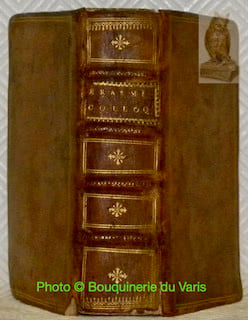
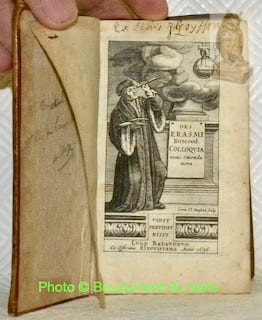
Lugd. Batavorum (Leiden), Ex Officina Elzeviriana 1636, 130x75mm, reliure veau de l’époque avec titre, auteur, fleurons, encadrements et filets dorés au dos à quatre nerfs, usures aux coiffes, autrement bon état. Tranches marbrées.
Reference : 98528
titre gravé, 11 ff - 672 + 44 pages, bandeaux, lettrines, culs-de-lampe, Pour un paiement via PayPal, veuillez nous en faire la demande et nous vous enverrons une facture PayPal
Bookseller's contact details
Bouquinerie du Varis
M. Jacquier Julien
Route de Léchelles 36
1773 Russy
Canton de Fribourg Switzerland
41 26 323 23 43
Payment mode


Sale conditions
Nous expédions les livres dès réception de votre paiement. Paiement sous facture PayPal. Virement bancaire ou Cartes de Crédits. Les chèques ne sont pas acceptés. Vous avez la possibilité de nous retourner les livres commandés. Aux conditions suivantes: • Si le titre ne correspond pas à votre commande. • Si l’état du livre ne correspond pas à la description que nous en avons faite. • Si le retour est fait dans les 15 jours. • Si le retour est fait dans le même emballage, comme vous l’avez reçu. • Si le retour est accompagné d’un écrit mentionnant les motifs. Ces conditions étant remplies, nous nous engageons à rembourser au client le prix des livres, sans les frais de port. Uniquement pour la Suisse, possibilité de payer sur facture sous 30 jours dès réception de la commande.
1 book(s) with the same title
Des. Erasmi Roterod. Colloquia, nunc emendatiora.
Amsterdam (Amstelodami), Ex officina Elzeviriana, 1662.
12mo. (XX),672 p. Overlapping vellum. 14 cm (Ref: Willems 1285: 'Réimpression ligne pour ligne de l'édition donnée par les Elzevier en 1655'; Berghman 1350; Rahir 1324; Brunet 2,1040) (Details: 5 thongs laced through the joints. Title engraved by Corn. Cl. Duysend, it depicts a standing Erasmus, who looks through a telescope into a clouded sky; from a cloud comes the hand of God, that bears the 'globus cruciger' (corss-bearing orb, in German Reichsapfel); the globe represents the earth, and he who holds the globe, owns the world. The motto on the title suits Erasmus: 'Vidit, pervidit, risit'. This engraved title was already used by Elsevier for the edition of the Colloquia of 1636. On the last of the preliminary pages a woodcut illustration, depicting both sides of a medal of Erasmus, on the recto his portrait, on the verso his motto: 'Concedo nulli'; around it the legend with Erasmus' interpretation of his motto: 'Mors ultima linea rerum') (Condition: Vellum age-tanned and somewhat soiled) (Note: 'The Colloquia, like the Adagia, were written over a period of years and constantly enlarged as edition succeeded edition. From their earliest form of short models of Latin conversation and formulae of etiquette (composed at Paris in 1497 for the use of some pupils and first printed in 1518) they grew into 'a rich and motley collection of dialogues, each a master piece of literary form, well-knit, spontaneous, convincing, unsurpassed in lightness, vivacity and fluent Latin, each one a finished one-act play' (Huizinga). The Colloquia, full of witty and penetrating observations on ordinary day-to-day happenings as well as on the basic weakness of Church and society, are an invaluable mine of information about 16th century customs, institutions and social problems. Besides, their success as a schoolbook was unrivaled and the stream of editions and translations flowed almost uninterruptedly down to modern times'. (Gilhofer & Ranschburg GmbH, Catalogue 50, Erasmus, published on the 500th anniversary of his birth', Luzern, ca. 1967, p. 34) The Colloquia are preceded by a short biography of Erasmus (last sentence: 'Discerptus est ab utraque, dum utrique studet consulere'), and a table of content) (Collation: *10, A-2E12) (Photographs on request)

