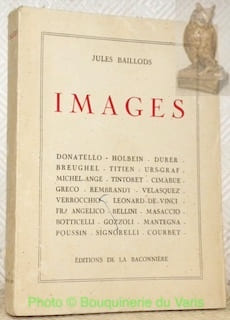
Neuchâtel, La Baconnière 1942, 190x145mm, 198pages, illustré, broché. Dédicacé.
Reference : 3220
Pour un paiement via PayPal, veuillez nous en faire la demande et nous vous enverrons une facture PayPal
Bouquinerie du Varis
M. Jacquier Julien
Route de Léchelles 36
1773 Russy
Canton de Fribourg Switzerland
41 26 323 23 43
Nous expédions les livres dès réception de votre paiement. Vous avez la possibilité de nous retourner les livres commandés. Aux conditions suivantes: • Si le titre ne correspond pas à votre commande. • Si l’état du livre ne correspond pas à la description que nous en avons faite. • Si le retour est fait dans les 15 jours. • Si le retour est fait dans le même emballage, comme vous l’avez reçu. • Si le retour est accompagné d’un écrit mentionnant les motifs. Ces conditions étant remplies, nous nous engageons à rembourser au client le prix des livres, sans les frais de port. Uniquement pour la Suisse, possibilité de payer sur facture sous 30 jours dès réception de la commande. Lieferkonditionen Wir versenden die Bücher nach Eingang Ihrer Zahlung. Sie können die Bücher zurückbeordert. Die folgenden Bedingungen: • Wenn der Titel nicht mit Ihrer Bestellung. • Wenn sich der Zustand des Buches nicht mit der Beschreibung entsprechen wir gemacht haben. • Wenn die Rückgabe innerhalb von 15 Tagen. • Wenn die Rückgabe im gleichen Paket gemacht wird , wie Sie haben es empfangen. • Wenn die Rückkehr erfolgt durch schriftliche Erwähnung der begleitet Gründen. Diese Bedingungen sind erfüllt, werden wir dem Kunden den Preis der Bücher erstatten, ohne Porto. Nur für die Schweiz können die Rechnung innerhalb von 30 Tagen nach Erhalt der Bestellung zu bezahlen. Terms of Delivery We ship the books upon receipt of your payment. You can return the books ordered. The following conditions: • If the title does not match your order. • If the book's condition does not match the description we have made. • If the return is made within 15 days. • If the return is made in the same package as you have received it. • If the return is accompanied by a written mentioning the reasons. These conditions are fulfilled, we will refund the customer the price of books, without postage. Only for Switzerland can pay the invoice within 30 days upon receipt of the order. Terminos de envio Enviamos los libros a la recepción de su pago. Puede devolver los libros ordenados. Segun las siguientes condiciones: • Si el título no se corresponde con su pedido. • Si la condición del libro no coincide con la descripción que hemos hecho. • Si la devolución se hace dentro de 15 días. • Si la devolución se hace en el mismo paquete que se ha recibido. • Si la devolución se acompaña de un escrito mencionando los motivos. Estas condiciones se cumplen, se reintegrará al cliente el precio de los libros, sin gastos de envío. Sólo para Suiza pueden pagar la factura dentro de los 30 días tras la recepción de la orden. Os termos de evnio Nós enviamos os livros após o recebimento do seu pagamento. Você pode devolver os livros encomendados. As seguintes condições: • Se o título não corresponde ao seu fim. • Se a condição do livro não corresponder à descrição que fizemos. • Se o retorno é feito no prazo de 15 dias. • Se o retorno é feito no mesmo pacote como você o recebeu. • Se o retorno é acompanhado por uma escrita mencionando as razões. Estas condições são cumpridas, iremos reembolsar o cliente o preço dos livros, sem portes. Apenas para a Suíça pode pagar a fatura no prazo de 30 dias após o recebimento da ordem.
1938 Album cartonné, demi-percaline Bordeaux muette, premier plat rouge à la carte Asie, 4e de couverture blanc muet ; daté 31/10/1938 ; (2), 28 et (2) pages de papier fort beige; 252 images illustrées en couleurs [5x7 cm]. Cartonnage défraîchi. Bon état général. RARE COMPLET DE SES 252 IMAGES. COMPLET DE TOUTES SES IMAGES,bon état.- Chocolat Pupier card album from France, travel in Asia edition, contains Chocolate cards from 20 countries in AsiaAfghanistan, China, Mandchoukuo, Japan, Indo-China, Laos, Cambodia, Philippines, Persia, Arabia,and Siam, including 28 pages, each page with 9 Chocolate cards. Total 252 cards/L'Asie, Album d' Images edite par le chocolat pupier, album, size 24 X 31,5 cm, made in 1938 in France, complete and in good condition, strong binding.
Album cartonné au format 24 X 31,5 cms de 30 pages - Différents pays de ce continent sont abordés dans cet album.- Détail :Afghanistan : Images N°01 à 09- Chine : Images N°10 à 27Tibet - Turkestan - Mongolie : Images N°28 à 36- Syrie - Liban - Alaouites : Images N°37 à 54- Cochinchine : Images N°55 à 63- Cambodge : Images N°64 à 72-Annam : Images N°73 à 81-Tonkin - Laos : Images N°82 à 90- Indes Anglaises : Images N°91 à 108- Ceylan - Birmanie - Andaman - Nepal : Images N°109 à 117- Indes Néerlandaises : Images N°118 à 126- Irak : Images N°127 à 135Japon : Images N°136 à 153- Mandchoukouo : Images N°154 à 162- Iran : Images N°163 à 171- Palestine : Images N°172 à 183- Arabie : Images N°184 à 189- Russie d'Asie : Images N°190 à 216Philippines - Malaisie Britannique : Images N°217 à 225- Turquie d'Asie : Images N°226 à 243- Siam : Images N°244 à 252 Remise de 20% pour toutes commandes supérieures à 200 €
, Brepols - Harvey Miller, 2005 Hardcover. X 546 p., 141 b/w ill. 19 colour ill., 160 x 240 mm, Languages: English, Latin, Fine copy. Including an index. ISBN 9782503514376.
The interactions between non-verbal and verbal forms of communication, more in particular the relations between visual symbols other than writing and the recording of speech in writing, are important for the evaluation of both images and texts.<br>In recent years the relations between images and texts have benefitted from an increase in scholarly attention. In medieval studies, art historians, historians, codicologists, philologists and others have applied their methods to the study of illuminated manuscripts and other works of art. These studies have shifted from a concern about the contents of the messages contained in the artefacts (e.g. in iconography) to an interest in the ways in which they were communicated to their intended audiences. The perception of texts and images, their reception by contemporaries and by later generations have become topics in their own right. The analysis of individual manuscripts and works of art remains the basis for any consideration of their transmission and uses. Yet the time has come for an evaluation of the results of recent work on medieval communication. The interactions between non-verbal and verbal forms of communication, more in particular the relations between visual symbols other than writing and the recording of speech in writing, are important for the evaluation of both images and texts.<br>According to some, medieval images may be ?read?. According to others, the perception of images is fundamentally different from that of texts. Do images have a morphology (colours, lines, planes), a syntax and semantics of their own? In other words: do both texts and images have a ?grammar?? Is it useful to speak of ?visual literacy?? Can texts be considered as images? How are texts and images perceived? Do they communicate different kinds of messages? Can an image?s message be put into words? In which social contexts does medieval man prefer the visual to the textual? What about the interplay of texts and images (e.g. in rituals and ceremonies)? Do we observe an evolution in the perception of images due to the development of a literate mentality? These are some of the questions discussed in the contributions to this volume.
, Brepols, 2022 Paperback, 378 pages, Size:156 x 234 mm, Illustrations:16 b/w, 5 col., 2 tables b/w., Language(s):English, German. ISBN 9782503598666.
Summary The leitmotif of this volume is the concept of ?author images?, which is used in modern literary studies to describe processes of production and reading of literary works and is here applied for the first time to the study of ancient works. As a means of analysing ancient literature, it captures the aspect of personification, which is characteristic of ancient author concepts, and at the same time points to the fact that there is a difference between ?image? and ?author? and that it is only an image and not the author himself that can be seen and grasped by readers. This makes the ?author image? particularly suitable for examining the intersections of material, rhetorical and mental representations of literary authorship that form the subject of this volume. Using selected examples from Latin and Greek literature, the contributors explore the fields of cultural experience that nourish authorial images. They discuss the manifold possibilities of visualising and representing a person's quality of being an author in general or being an author of specific works, be it physically through artworks or pictures, metaphorically through evoked authorial figures, through thematised representations of authors in a text, or through the combination of authorial images and texts. These issues are addressed in four overlapping sections, each focusing on different areas of the metaphor's application, namely material images in the form of artworks, knowledge about persons, textual images as authorial strategies and images in reception. TABLE OF CONTENTS ut pictura poeta. Author Images and the Reading of Ancient Literature / Autorbilder und die Lekt re antiker Literatur (Ute Tischer, Ursula G rtner & Alexandra Forst) The Cultural Imagination of Authorship (Wolfgang Hallett) I. Images of Authors and Author Images as Material Representations Pliny the Elder and the Portraits of Ancient Authors (Eva Falaschi) Menander daheim. Die pompejanische Casa del Menandro als Autorbild (Katharina Lorenz) sequens philosophos fecit. Abbildungen griechischer Philosophen und Dichter und deren Rezeption in der antiken Literatur (Margit Linder) II. Authorial Images between Text and Biography Symmachus als pagane Galionsfigur. Die dritte relatio und ihre Bedeutung f r ein wirkm chtiges Autorbild (Alexandra Forst) Servius velut latenti similis. Das Autorbild des Vergilkommentators Servius (Ute Tischer) III. Authorial Images as Created by Authors Medial Representation of the Author ?Naso?. Rhetorical Strategies of Self-dramatization in Ovid?s Epistulae ex Ponto (Therese Fuhrer) Aesopi ingenio statuam posuere Attici. The Author Image in Phaedrus's Fables (Ursula G rtner) Autorbild und Autorfiktion bei Babrios und Minoides Mynas (Lukas Spielhofer) Nobody's Home. Surrogacy, Substitution, and the Failed Search for ?Calpurnius Siculus? (Tom Geue) IV. Authorial Images from a Historical Perspective Author as Audience. Staging Virgil in Tacitus's Dialogus de oratoribus (Talitha Kearey) Virgil the Wise. Genesis of a Myth (Fabio Stok) Fathers and Sons - and Daughters. Genealogical Co-authorship, Offspring Metaphors and the Language of Legitimacy (Markus Hafner) Index locorum
1971 1 vol in-8 broché - 160 pages - 26ème année - N° 4 - 4ème trimestre 1971
Bon état de conservation
Munich, Braun et Schneider, Imprimerie de la cour royale de l’Université Dr. C. Wolf & fils, Lyon, Perreyon, (1884-1905). Titre et 50 planches en couleurs déreliées (34 x 43 cm).
Rarissime première et seule édition française des Münchener Bilderbogen publiée par l'imprimerie Perreyon à Lyon « seul dépositaire des images de Munich ».Collection complète inconnue de toutes les bibliographies. 50 planches numérotées et illustrées de 12 vignettes en couleurs chacune, légendées en français (« traduction et propriété de C. Fulpius à Genève Suisse ») dont de nombreuses planches signées par Wilhelm Busch (1832-1908) dessinateur et scénariste de bandes dessinées, l’humoriste le plus emblématique de l’Allemagne depuis le milieu du 19e siècle. Il publia d’abord des farces en images (Bilderpossen), puis collabora au journal Fliegende Blätter («les feuilles volantes») en 1859 avec des histoires courtes en images, accompagnées de brèves légendes (en vers ou en prose) ou sans le moindre texte ; des histoires que Busch donna ensuite également au Münchener Bilderbogen («feuilles illustrées de Munich»).Les Münchener Bilderbogen étaient une série de feuillets d'images satiriques publiés par la maison d'édition munichoise Braun & Schneider toutes les deux semaines entre 1848 et 1898 et regroupés chaque année. Entre 1900 et 1905, quelques feuilles d'images supplémentaires ont paru dans un ordre irrégulier. Au total, 1 230 planches d'images ont été publiées en allemand dans cinquante volumes annuels. L'éditeur Kaspar Braun a notamment décidé d'utiliser pour cette série la technique d'impression sur bois au lieu de la lithographie, qui était la norme pour les planches d'images.« Les Bilder ohne Worte ou histoires sans paroles apparaissent dans le périodique Fliegende Blätter – fondé en 1844 par Kaspar Braun et Friedrich Schneider – dans les années 1860, popularisées par Wilhelm Busch, Adolf Oberländer, Carl Reinhardt, Franz von Pocci ou Carl Stauber. « Fondamentalement, la conception de l’illustration qui prévalait chez Braun & Schneider accordait la primauté au trait, au dessin linéaire. » (Sackmann). Lorsque le genre de l’histoire sans paroles se développe en France, il est aussitôt identifié comme étant d’origine allemande. John Grand-Carteret (Les Mœurs et la caricature en France, 1888) évoque ainsi « ce genre popularisé par les maîtres des Fliegende Blätter » dont Caran d’Ache donne « une conception plus française » et les journalistes dans Le Livre et l’image (1893-1894) parlent d’un « genre Fliegende Blätter », de « l’humour germanique avec les histoires en images de Caran d’Ache. Reproduites dans la presse française, les histoires en images de ces « feuilles volantes » sont très populaires et à la source non seulement du développement de la séquence muette mais du style de nombreux artistes. » (topfferiana.fr).Manque à la BnF (édition française) ; aucun exemplaire dans les bibliothèques.Grand-Carteret, Les Moeurs et la caricature en Allemagne, en Autriche, en Suisse, p. 431, n°21 (Fliegende Blätter, Munich, 1845) ; E. Sackmann, « Braun & Schneider éditeurs. Le berceau de la BD allemande », 9e Art, n° 6, 2001 ; Töpfferiana Littératures graphiques des XIXe et début XXe siècles.