 Write to the booksellers
STÖCKL, Albert.
Grundzüge der Philosophie.
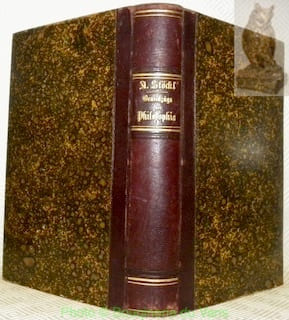
Mainz, Franz Kirchheim 1892, 230x145mm, 610Seiten, Basil-Halbledereinband. Titre au dos doré.
Reference : 29532
Pour un paiement via PayPal, veuillez nous en faire la demande et nous vous enverrons une facture PayPal
Bookseller's contact details
Bouquinerie du Varis
M. Jacquier Julien
Route de Léchelles 36
1773 Russy
Canton de Fribourg Switzerland
41 26 323 23 43
Payment mode


Sale conditions
Nous expédions les livres dès réception de votre paiement. Paiement sous facture PayPal. Virement bancaire ou Cartes de Crédits. Les chèques ne sont pas acceptés. Vous avez la possibilité de nous retourner les livres commandés. Aux conditions suivantes: • Si le titre ne correspond pas à votre commande. • Si l’état du livre ne correspond pas à la description que nous en avons faite. • Si le retour est fait dans les 15 jours. • Si le retour est fait dans le même emballage, comme vous l’avez reçu. • Si le retour est accompagné d’un écrit mentionnant les motifs. Ces conditions étant remplies, nous nous engageons à rembourser au client le prix des livres, sans les frais de port. Uniquement pour la Suisse, possibilité de payer sur facture sous 30 jours dès réception de la commande.
5 book(s) with the same title
Grundzüge der Philosophie, 2. Band: 2. und 3. Teil: Lehre vom Menschen / Lehre vom Bürger. [Hardcover] Hobbes, Thomas
Relié cartonnage de l'éditeur. Dos toilé. Papier jauni.
Merci de nous contacter à l'avance si vous souhaitez consulter une référence dans notre boutique à Authon-du-Perche.
Geschichte der deutschen philosophie seit Kant. Dictate aus den Vorlesungen. Leipzig, Hirzel, 1882, (2), 111pp. --- Grundzüge der praktischen Philosophie. Dictate aus den Vorlesungen. Leipzig, Hirzel, 1882, 84pp. --- Grundzüge der Religionsphilosophie.Dictate aus den Vorlesungen. Leipzig, Hirzel, 1882, 102pp. --- Grundzüge der Naturphilosophie. Dictate aus den vorlesungen. Leipzig, Hirzel, 1882, 112pp. --- Grundzüge der Metaphysik. Dictate aus den vorlesungen. Leipzig, Hirzel, 1883, 94pp.---- SOIT CINQ MEMOIRES ORIGINAUX par Hermann LOTZE reliés en un volume
Leipzig, Hirzel, 1882/1883, un volume in 8 relié en demi-basane noire, dos orné de filets dorés (reliure de l'époque)
---- CINQ MEMOIRES ORIGINAUX PAR H. LOTZE ---- "H. Lotze studied philosophy and natural science at the University of Leipzig. He earned his M.D. in 1838 with the dissertation De futuris biologiae principiis philosophicis. This youthful work contained the essence of his later philosophical system : Philosophy take careful account of scientific knowledge and reciprocally physics and the life sciences subject their basic principles to the purifying scrutiny of contemporary philosophical analysis. In particular, he ruled out explanations that resorted to the concept of a life force, although the validity of this principle was then largely unquestioned, and he resolved the mind-body problem by a combination of Leibnizian monadology with the older occasionalism... He practiced medicine in Zittau. In 1839, he qualified at Leipzig to lecture in medicine and in philosophy in 1840. He lectured on a broad field of subjects - general pathology, anthropology, philosophy of medicine, psychology, logic and theological medicine - which he attempted to unify in his later works. In 1843 he became an assistant professor of philosophy in Leipzig and in 1844 he obtained a full professorship in philosophy in Göttingen, there succeeding the famous Herbart... Lotze sought to classify nature, soul, mind, history and culture in a great unifying concept, and to do so, moreover, with careful consideration of the great advances in the inorganic sciences, biology and medicine, as well as in psychology... The anti-materialists of the nineteenth century saw in him the defender of a view of the world nobler and more beautiful than that offered by Carl Vogt, Moleschott, Büchner and the monists. Lotze saw his goal as uniting in a consistent fashion the results of scientific research with an ethical and religious world view, and in demonstrating a harmony between natural laws and the world of values. Hence his philosophy bordered on theosophy. A. Krohn said in his article on Lotze : "He sought in that wich should be, the basis of that which is". (DSB VIII pp. 513/515)**3373/K2
Philosophie des Möglichen - Grundzüge einer Erkenntniskritik
, Leipzig, S.Hirzel 1913, x + 240pp., 1st ed., linen cover (bit soiled), text VG
Der Geist des Menschen in seinen Verhältnissen zum physischen Leben, oder Grundzüge zu einer Philosophie des Denkens. Für ärtze, Philosophen und Menschen im höhern Sinne des Wortes
Wien, Carl Gerold 1832 xxix + 365pp., 2nd edition (Zweite vom Verfasser selbst vermehrte Auflage), modern cloth, stamp on titlepage, bit used, G
Kleine Schriften I, II, III und IV. 1) Philosophie. Hermeneutik. 2., unveränderte Auflage. 2) Interpretationen. 3) Idee und Sprache. Platon, Husserl, Heidegger. 4) Variationen. 5) Wahrheit und Methode. Grundzüge einer philosophischen Hermeneutik. 4. Auflage. Unveränderter Nachdruck der 3., erweiterten Auflage.
Tübingen, J. C. B. Mohr (Paul Siebeck), 1967-76, in-8vo, ca. 1400 S., Original-Leinenband.

(SLACES, NVVA)
Phone number : 41 (0)26 3223808

