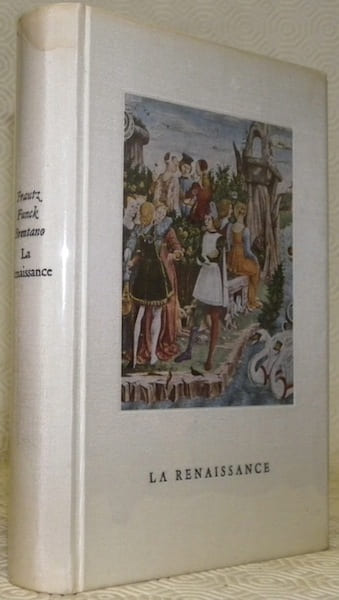
‎FUNCK-BRENTANO, Frantz.‎
‎La Renaissance.‎

‎ Paris, Club des libraires de France 1961, 200x130mm, 411pages, reliure d'éditeur. Exemplaire sur vélin blanc, numéroté, no 1541/3500. Bon état. ‎

Reference : 22219


‎ 40 illustrations en n/b, Pour un paiement via PayPal, veuillez nous en faire la demande et nous vous enverrons une facture PayPal‎

€21.47 (€21.47 )
Bookseller's contact details

Bouquinerie du Varis
M. Jacquier Julien
Route de Léchelles 36
1773 Russy
Canton de Fribourg Switzerland

bouquin@bouquin.ch

41 26 323 23 43

Contact bookseller

Payment mode
Transfer
Others cards
Others
Sale conditions

Nous expédions les livres dès réception de votre paiement. Vous avez la possibilité de nous retourner les livres commandés. Aux conditions suivantes: • Si le titre ne correspond pas à votre commande. • Si l’état du livre ne correspond pas à la description que nous en avons faite. • Si le retour est fait dans les 15 jours. • Si le retour est fait dans le même emballage, comme vous l’avez reçu. • Si le retour est accompagné d’un écrit mentionnant les motifs. Ces conditions étant remplies, nous nous engageons à rembourser au client le prix des livres, sans les frais de port. Uniquement pour la Suisse, possibilité de payer sur facture sous 30 jours dès réception de la commande. Lieferkonditionen Wir versenden die Bücher nach Eingang Ihrer Zahlung. Sie können die Bücher zurückbeordert. Die folgenden Bedingungen: • Wenn der Titel nicht mit Ihrer Bestellung. • Wenn sich der Zustand des Buches nicht mit der Beschreibung entsprechen wir gemacht haben. • Wenn die Rückgabe innerhalb von 15 Tagen. • Wenn die Rückgabe im gleichen Paket gemacht wird , wie Sie haben es empfangen. • Wenn die Rückkehr erfolgt durch schriftliche Erwähnung der begleitet Gründen. Diese Bedingungen sind erfüllt, werden wir dem Kunden den Preis der Bücher erstatten, ohne Porto. Nur für die Schweiz können die Rechnung innerhalb von 30 Tagen nach Erhalt der Bestellung zu bezahlen. Terms of Delivery We ship the books upon receipt of your payment. You can return the books ordered. The following conditions: • If the title does not match your order. • If the book's condition does not match the description we have made. • If the return is made within 15 days. • If the return is made in the same package as you have received it. • If the return is accompanied by a written mentioning the reasons. These conditions are fulfilled, we will refund the customer the price of books, without postage. Only for Switzerland can pay the invoice within 30 days upon receipt of the order. Terminos de envio Enviamos los libros a la recepción de su pago. Puede devolver los libros ordenados. Segun las siguientes condiciones: • Si el título no se corresponde con su pedido. • Si la condición del libro no coincide con la descripción que hemos hecho. • Si la devolución se hace dentro de 15 días. • Si la devolución se hace en el mismo paquete que se ha recibido. • Si la devolución se acompaña de un escrito mencionando los motivos. Estas condiciones se cumplen, se reintegrará al cliente el precio de los libros, sin gastos de envío. Sólo para Suiza pueden pagar la factura dentro de los 30 días tras la recepción de la orden. Os termos de evnio Nós enviamos os livros após o recebimento do seu pagamento. Você pode devolver os livros encomendados. As seguintes condições: • Se o título não corresponde ao seu fim. • Se a condição do livro não corresponder à descrição que fizemos. • Se o retorno é feito no prazo de 15 dias. • Se o retorno é feito no mesmo pacote como você o recebeu. • Se o retorno é acompanhado por uma escrita mencionando as razões. Estas condições são cumpridas, iremos reembolsar o cliente o preço dos livros, sem portes. Apenas para a Suíça pode pagar a fatura no prazo de 30 dias após o recebimento da ordem.

Contact bookseller about this book

Enter these characters to validate your form.
*
Send

5 book(s) with the same title

‎Kugel, Alexis‎

Reference : 071826

(2000)

ISBN : NOISBN

‎Joyaux Renaissance. Une Splendeur RetrouvÃe‎

‎Kugel, Alexis: Joyaux Renaissance. Une Splendeur RetrouvÃe. Exhibition: Paris, Galerie Kugel, 2000. 230 pages (unpaginated) with 2 colour fold-out plates, 59 colour and 41 monochrome plates, 3 colour and 6 monochrome illustrations. Hardback. 31x22cms. A fundamental contribution to the scholarship of Renaissance jewellery, cataloguing a rich selection of pendants, cameos, necklaces, amulets and other accessories, dating from the 14th to 17th centuries, providing provenance where available. This work is of particular importance as it publishes plaster models of original pieces of jewellery, which were used by the workshop of the celebrated restorer Alfred Andrà (1839-1919), who specialised in the period of the Middle Ages and Renaissance. Text in French.‎


‎A fundamental contribution to the scholarship of Renaissance jewellery, cataloguing a rich selection of pendants, cameos, necklaces, amulets and other accessories, dating from the 14th to 17th centuries, providing provenance where available. This work is of particular importance as it publishes plaster models of original pieces of jewellery, which were used by the workshop of the celebrated restorer Alfred Andrà (1839-1919), who specialised in the period of the Middle Ages and Renaissance. Text in French‎

Logo ILAB

Phone number : +44(0)20 7930 9223

GBP30.00 (€34.57 )

‎Rohou, Julie‎

Reference : 125047

(2025)

ISBN : 9782382032152

‎D'Or et d'Ãclat. Le bijou à la Renaissance‎

‎Rohou, Julie: D'Or et d'Ãclat. Le bijou à la Renaissance. 2025. 240 pages, 171 illustrations. Hardback. 28 x 24cms. A catalogue of 122 pieces of 16th-century European jewelry. 7 essays discuss its history, the incorporation of gems and enamel, portraits of goldsmiths and representations of workshops, the jewelry trade, lead and paper jewelry, the crown of Christian IV of Denmark, and the jewelry chest of Margaret of Valois, Queen of France. The catalogue is split into 5 parts: in the master goldsmith's workshops, the renaissance of adornment, jewelry and power, devotional and amulet jewelry, and the 19th-century Renaissance. Text in French.‎


‎A catalogue of 122 pieces of 16th-century European jewelry. 7 essays discuss its history, the incorporation of gems and enamel, portraits of goldsmiths and representations of workshops, the jewelry trade, lead and paper jewelry, the crown of Christian IV of Denmark, and the jewelry chest of Margaret of Valois, Queen of France. The catalogue is split into 5 parts: in the master goldsmith's workshops, the renaissance of adornment, jewelry and power, devotional and amulet jewelry, and the 19th-century Renaissance. Text in French‎

Logo ILAB

Phone number : +44(0)20 7930 9223

GBP52.00 (€59.93 )

‎Auld, Sylvia‎

Reference : 079676

(2004)

ISBN : 1901435113

‎Renaissance Venice, Islam and Mahmud the Kurd a metalworking enigma‎

‎Auld, Sylvia: Renaissance Venice, Islam and Mahmud the Kurd a metalworking enigma. London: Altajir World of Islam Trust, 2004. 350pp with 210 monochrome illustrations. Cloth. 26.8x20.7cms. The name of Mahmud the Kurd (probably an itinerant master craftsman working in the second half of the 15th century) has been found on ten small, domestic objects of brass. All are exquisitely worked with intricate arabesques. On one, his signature appears in two forms in Arabic (or Persian), and in transliterated Roman script. Why? For whom was he working, and where? These are the questions which this book tries to answer. The widespread links between Renaissance Europe and Islam, which emerge as part of the trail, may come as a surprise to some readers. The objects listed in this book are not only fascinating in themselves but can be seen as a microcosm of the international exchanges and excursions of the period. Later, in 19th-century Europe, it was even assumed that Mahmud (and others working in the same style) were employed in Venice . This seems improbable following research in the archives, but so far no satisfactory explanation has been offered for Mahmud's double-language signature. Close examination of the objects shows that there are in fact three distinct styles. In the 15th century, against a backdrop of diplomatic intrigue in the face of Ottoman victories, Venice promoted links with their rivals, the Turcoman 'White Sheep' dynasty, whose capital then was at Tabriz . This explains a Persian element in the decorative detail of the first stylistic group. Some of the objects of a second group include a European shield as part of their decoration. Despite renewed papal bans, European trade with Islam continued unabated in the Eastern Mediterranean; Venice was the prime port for this commercial activity, and this accounts for the appearance of this second, Mamluk, group. The admiration in Europe and more particularly in Italy for the high quality of Islamic inlaid work explains the details of a third, western, group. Men like Benvenuto Cellini not only set out to emulate this technique, which they called 'azzimina, but to prove that they could do better.‎


‎The name of Mahmud the Kurd (probably an itinerant master craftsman working in the second half of the 15th century) has been found on ten small, domestic objects of brass. All are exquisitely worked with intricate arabesques. On one, his signature appears in two forms in Arabic (or Persian), and in transliterated Roman script. Why? For whom was he working, and where? These are the questions which this book tries to answer. The widespread links between Renaissance Europe and Islam, which emerge as part of the trail, may come as a surprise to some readers. The objects listed in this book are not only fascinating in themselves but can be seen as a microcosm of the international exchanges and excursions of the period. Later, in 19th-century Europe, it was even assumed that Mahmud (and others working in the same style) were employed in Venice . This seems improbable following research in the archives, but so far no satisfactory explanation has been offered for Mahmudâs double-language signature. Close examination of the objects shows that there are in fact three distinct styles. In the 15th century, against a backdrop of diplomatic intrigue in the face of Ottoman victories, Venice promoted links with their rivals, the Turcoman âWhite Sheepâ dynasty, whose capital then was at Tabriz . This explains a Persian element in the decorative detail of the first stylistic group. Some of the objects of a second group include a European shield as part of their decoration. Despite renewed papal bans, European trade with Islam continued unabated in the Eastern Mediterranean; Venice was the prime port for this commercial activity, and this accounts for the appearance of this second, Mamluk, group. The admiration in Europe and more particularly in Italy for the high quality of Islamic inlaid work explains the details of a third, western, group. Men like Benvenuto Cellini not only set out to emulate this technique, which they called âazzimina, but to prove that they could do better. Text in English‎

Logo ILAB

Phone number : +44(0)20 7930 9223

GBP75.00 (€86.44 )

‎McCray, Patrick‎

Reference : 069665

(1999)

ISBN : 0754600505

‎Glassmaking in Renaissance Venice: The Fragile Craft‎

‎McCray, Patrick: Glassmaking in Renaissance Venice: The Fragile Craft. Aldershot: Ashgate, 1999. 272pp with 20 monochrome illustrations and 3 maps. Cloth. 23.4x15.6cms. This study examines the demand, production and distribution of glass and glassmaking technology during the Renaissance era.‎


‎This study examines the demand, production and distribution of glass and glassmaking technology during the Renaissance era. Text in English‎

Logo ILAB

Phone number : +44(0)20 7930 9223

GBP100.00 (€115.25 )

‎Davies, Glyn and Kirstin Kennedy (eds)‎

Reference : 091555

(2009)

ISBN : 9781851775798

‎Medieval and Renaissance Art: People and Possessions‎

‎Davies, Glyn and Kirstin Kennedy (eds): Medieval and Renaissance Art: People and Possessions. London: 2009. 320 pages, 350 colour illustrations. Hardback. 29cms. Published to accompany the opening of the Medieval and Renaissance galleries at the Victoria and Albert Museum this book provides the background and context for the objects that will be on display. Ornament, religious art and the body are looked at in relation to the makers, workshops, patrons and the prevailing links to and influence of the classical past.‎


‎Published to accompany the opening of the Medieval and Renaissance galleries at the Victoria and Albert Museum this book provides the background and context for the objects that will be on display. Ornament, religious art and the body are looked at in relation to the makers, workshops, patrons and the prevailing links to and influence of the classical past. Text in English‎

Logo ILAB

Phone number : +44(0)20 7930 9223

GBP25.00 (€28.81 )
Get it on Google Play Get it on AppStore
The item was added to your cart
You have just added :

-

There are/is 0 item(s) in your cart.
Total : €0.00
(without shipping fees)
What can I do with a user account ?

What can I do with a user account ?

  • All your searches are memorised in your history which allows you to find and redo anterior searches.
  • You may manage a list of your favourite, regular searches.
  • Your preferences (language, search parameters, etc.) are memorised.
  • You may send your search results on your e-mail address without having to fill in each time you need it.
  • Get in touch with booksellers, order books and see previous orders.
  • Publish Events related to books.

And much more that you will discover browsing Livre Rare Book !