 Write to the booksellers
ARISTAENETUS. Aristenète. (Mercier de Bordes, Josias).
Aristaeneti epistolae graecae. Cum latina & notis. Altera editio emendatior & auctior.
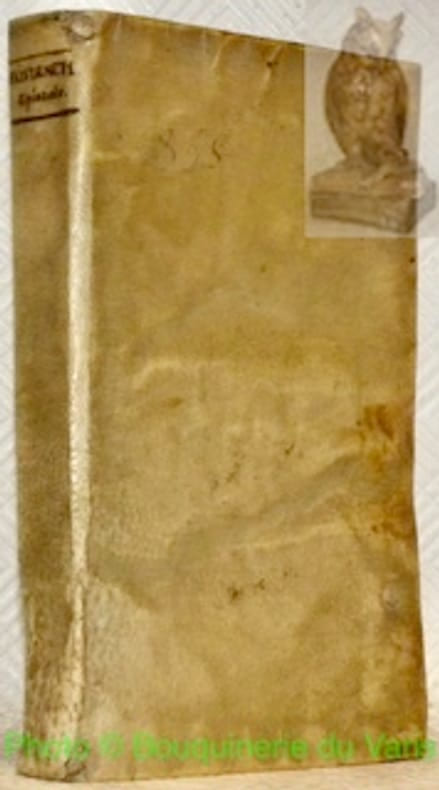
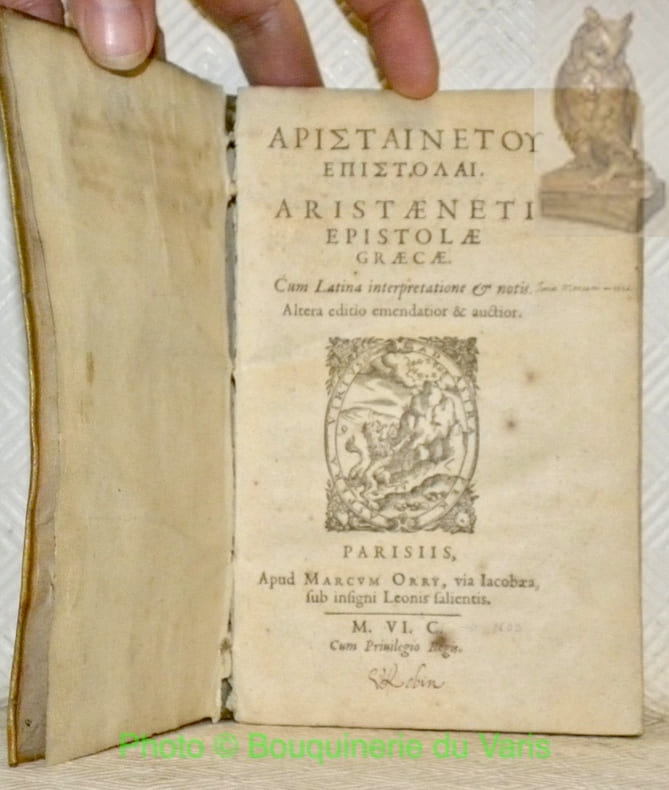
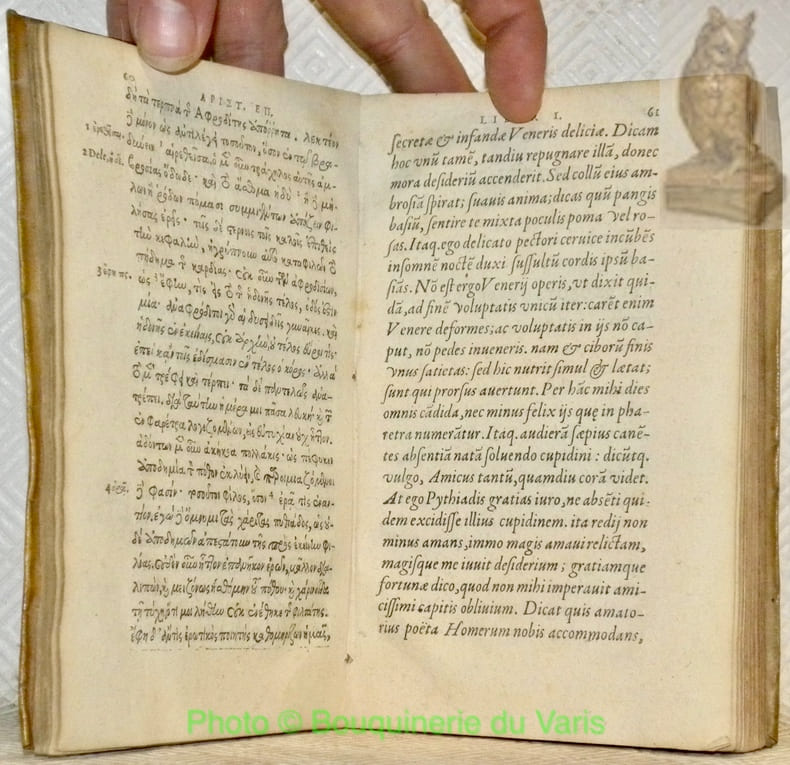
Parisiis (Paris), Apud Marcum Orry 1600, 175x105mm, texte en grec ancien et latin, lettrines, bandeaux, 3 ff. + 282 pages + 1 ff., reliure parchemin de l’époque avec titre manuscrit sur le haut du dos. Edition avec annotations de Josias Mercier de Bordes, la première édition de ce roman épistolaire à paru à Anvers chez Plantin en 1566.
Reference : 104684
Pour un paiement via PayPal, veuillez nous en faire la demande et nous vous enverrons une facture PayPal
Bookseller's contact details
Bouquinerie du Varis
M. Jacquier Julien
Route de Léchelles 36
1773 Russy
Canton de Fribourg Switzerland
41 26 323 23 43
Payment mode


Sale conditions
Nous expédions les livres dès réception de votre paiement. Paiement sous facture PayPal. Virement bancaire ou Cartes de Crédits. Les chèques ne sont pas acceptés. Vous avez la possibilité de nous retourner les livres commandés. Aux conditions suivantes: • Si le titre ne correspond pas à votre commande. • Si l’état du livre ne correspond pas à la description que nous en avons faite. • Si le retour est fait dans les 15 jours. • Si le retour est fait dans le même emballage, comme vous l’avez reçu. • Si le retour est accompagné d’un écrit mentionnant les motifs. Ces conditions étant remplies, nous nous engageons à rembourser au client le prix des livres, sans les frais de port. Uniquement pour la Suisse, possibilité de payer sur facture sous 30 jours dès réception de la commande.
1 book(s) with the same title
ARISTAINETOU EPISTOLAI. Aristaeneti Epistolae graecae. Cum latina interpretatione & notis. Altera editio emendatior & auctior.
Paris (Parisiis), Apud Marcum Orry, via Iacobaea, sub signo leonis salientis, 1600.
8vo. (VIII),282,(2 animadvertenda),(4 blank) p. Limp vellum 18 cm (Ref: Hoffmann 1,239; Graesse 1,204; Ebert 1065) (Details: Among bibliographers and librarians there is confusion about the date of this book. The date on the title of this second edition of the letters of Aristaenetus is indicated as MVIC. We found in KVK (Karlsruher Virtueller Katalog) records of this title dated 1594, 1596 and 1600. 1594 is definitely wrong, for the Parisian printer Orry published the first edition of this title in 1595, indicated by him as MDLXXXXV, and he repeated it the next year, now with MDXXXXVI. The third edition was published in 1610, with the date MCX. As the second edition cannot preceed the first edition of 1595 (and its repetition of 1596), this second edition comes between 1596 and 1610, so these very unusual Roman numerals MVID (1000, 6, 500) might well mean 1600. 2 thongs laced through the joints. The boards and the back have blind-tooled double fillet borders. All 3 edges gilt. On the title the printer's mark of Orry, depicting a jumping lion on his way to the top of a steep mountain, where a crown of stars awaits him; the motto is: 'Virtus ad astra per aspera'. Greek text with facing Latin translation) (Condition: Vellum age-tanned and slightly spotted. All 4 ties gone. 1 very tiny hole in the upper board. Small bookplate on the front pastedown. Inscription on the front flyleaf. Small strip of the upper margin of the title, with an owner's inscription, torn off, and repaired. Two other old owner's inscriptions on the title, and an owner once added in ink the name of the editor of Aristaenetus '(Josiae) Mercerii Des Bordes'. Lower margin stained in places. Some old annotations & underlinings. A small wormhole in the blank lower margin of the last gathering) (Note: Aristaenetus is the established name of the author of a collection of love letters in two books, probably from the beginning of the 6th century AD. It survives only in one Codex, of which the first folio with the name of the real author is lacking. Aristaenetus (Bestpraiseworthy) is only applied to the sender of the first letter. This is clearly a case of an imaginary letter-writer. The sources used are Plato, Menander, Lucianus, Alciphron, Philostratus, the ancient novels, and love elegies of Callimachus. Aristaenetus draws however in a conventional way a veil over too explicit love-making. The collection is a kind of survey of erotic motives in the literature of Greece and Rome. Everyting erotic however is covered with a veil of prudery. Aristaenetus ends after some cuddling before the bedroom is entered. (Neue Pauly, 1,1087) The collection was allready attributed to Aristaenetus in the 'editio princeps' of Antwerp 1566, edited by J. Sambucus. An (first) edition with a Latin translation was published in 1595 in Paris by Josias Mercier des Bordes. Sometimes this edition and the second edition of 1600 is erroneously attributed to the French scholar Jacques Bongars, 1554-1612. This cannot be correct, for the editor dedicates his Aristaenetus in the 'dedicatio', dated 1595, to Jacobus Bongarsius, whom he thanks for his great support. ('Aristaenetum mitto te tandem, ut liberem fidem dudum obligatam tibi, qui mihi edendi auctor praecipuus.' (p. â2 recto) Mercier was the first to observe that the first letter of the collection was imagined to have been written by one Aristaenetus, and that the collection belonged to the genre of imaginative epistolography. (See p. 198/99 of this edition of 1600) This book on offer is the second revised and augmented edition. Besides the text and translation it offers ca. 90 pages commentary. (Much more on this French calvinist nobleman and scholar, who died in 1626, in 'L'Histoire de La Norville' by l'abbé A.E. Genty (1885), online available at the 'Cercle Généalogique Norvillois')(Provenance: On the front pastedown the bookplate of the Dutch Jewish physican and famous bookcollector Bob Luza, 1893-1980, who survived Bergen-Belsen, and whose library was auctioned in 1981 by Van Gendt. Depicted is a book with the initials 'B.L.' on the upper board, together with the wellknown symbol of the rod of Asclepius, in the background a burning sun. (See for Luza, P.J. Buijnsters, 'Geschiedenis van de Nederlandse bibliofilie', Nijmegen 2010, p. 274-76) On the title the traces of a name at the upper edge. Below the imprint: 'Radulphi Fornerii J.U.D. Aurelii'. Raoul Fornier, or latinized Radulphus Fornerius, 1562-1627, sieur de Rondau, and 'Juris Utriusque Doctor' at Orléans, was like his father Guillielmus Fornerius, professor of law at the University of Orléans at the end of the 16th century. His best known work is 'Rerum quotidianarum libri sex. Quorum tres posteriores nunc primum in lucem prodeunt. In quibus plerique tum juris utriusque, tum variorum auctorum loci vel illustrantur, vel emendantur, multa etiam ad antiquitatis studium pertinentia tractantur. Auctore Radulpho Fornerio Gul. F. antecessore Aurelio'. It was first published in Paris in 1600. The 4th edition dates from 1644. This work is a proof of his excellent knowledge of Latin. He suggested a number of sound emendations and elucidated obscure passages) (Collation: a4; A-R8, S4, T4 (last 2 leaves blank) (Photographs on request)

