 Write to the booksellers
Gonzalo Torrente Ballester
Don Juan
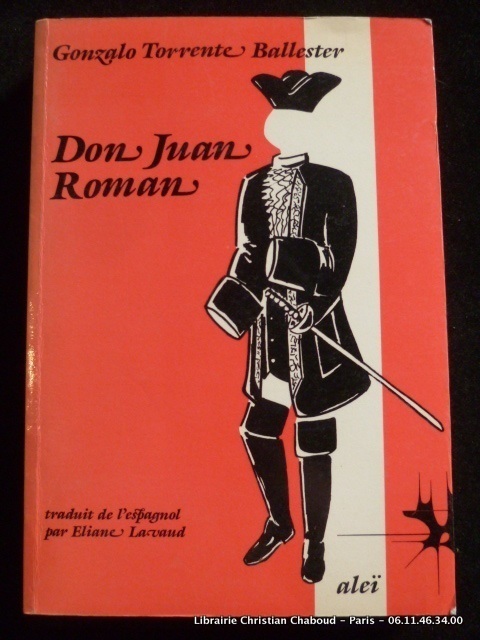
Paris, Alei, 1988, in-8, Broché., 378 pages. Très bon état. Traduit de l'expagnol par Eliane Lavaud.
Reference : 50464
ISBN : 2904614427
Bookseller's contact details
Librairie Christian Chaboud
M. Christian Chaboud
Avenue du Mont Kemmel 32
1060 Bruxelles
Belgium
librairie.christianchaboud@gmail.com
(+32) 470 87 87 88
Payment mode

Sale conditions
La Librairie Christian Chaboud vous propose un vaste choix de livres anciens et modernes. Les ouvrages peuvent être consultés et retirés sur rendez-vous à Bruxelles ou à Paris (5e arr.); prévoir quelques jours de délai. Merci de nous contacter. Le prix indiqué ne comprend pas les frais de port qui vous seront communiqués par mail ou téléphone. Les envois vers la France se font au tarif de la poste française. L'envoi des ouvrages se fait à réception de paiement. Tout renseignement peut être demandé par messagerie et téléphone. Le paiement est possible par carte, virement bancaire, Paypal et espèces. Le livre est réservé pendant 8 jours après confirmation de sa disponibilité.
5 book(s) with the same title
LA TABLE RONDE N° 119 - DON JUAN. THÈME DE L’ART UNIVERSEL. HENRY DE MONTHERLANT : Don Juan (Acte I).ORTEGA Y GASSET : La figure de Don Juan.ESTHER VAN LOO : La conversion et la mon du Don Juan historique.JEAN DORESSE : Don Juan
LIBRAIRIE PLON. NOVEMBRE 1957. In-12. Broché. Bon état, Couv. convenable, Dos satisfaisant, Intérieur frais. 199 pages.. . . . Classification Dewey : 70.49-Presse illustrée, magazines, revues
Sommaire : DON JUAN. THÈME DE L’ART UNIVERSEL. HENRY DE MONTHERLANT : Don Juan (Acte I).ORTEGA Y GASSET : La figure de Don Juan.ESTHER VAN LOO : La conversion et la mon du Don Juan historique.JEAN DORESSE : Don Juan, figure d’un siècle ou de toujours ? RENÉ DUPUIS : De la naissance espagnole de Don Juan à sa maturité française (1630-1665).HENRI GOUHIER : L’inhumain Don Juan.RENÉ POMEAU : Beaumarchais, ou le mariage de Don Juan. HENRI GUILLEMIN : Clartés sur le mystère Byron. ANDRÉ MEYNIEUX : Pouchkine et Don Juan. MICHELINE SAUVAGE : L’ombre du séducteur, Kierkegaard et Don Juan.MAURICE PRADINES : Les méprises de l’affectivité. JOSEPH PALAU : Idées pour un Don Juan.SUZANNE LILAR : Deux mythes de l’amour : Tristan et Don Juan.ANDRÉ LE GALL : Don Juan n’est pas l’homme.MARIA LE HARDOUIN : Passage de Don Juan.HENRI D’AMFREVILLE : Don Juan et la démocratisation de l’amour.ROBERT POULET : Un Don Juan en prose.MICHEL DÉON : La postérité de Don Juan.CHRONIQUES parCLAUDE ELSEN — CHRISTIAN CAPRIER ARMAND LUNEL — ALAIN BOSQUET ROGER GRENIER — JEAN ANGLADE JACQUES DE RICAUMONTVérités littéraires, par ANDRÉ THÉRIVE Journal d’un écrivain, par EMMANUEL BERL Classification Dewey : 70.49-Presse illustrée, magazines, revues
DON JUAN : Analyse d'un mythe. Volume 1. Analyse d'un mythe. Bibliographie, filmographie, mythologique, le Don Juan de Molière, le Don Giovanni de Mozart, Bérard Cassandre. 2) Volume 2. Analyse d'un mythe. Les autres Don Juan, un tombeau pour Don Juan, Masson, Quiroga.
Obliques, 1974, Revue OBLIQUES n° 4 & 5 DON JUAN Analyse d'un mythe. Complet en 2 volumes. - T. I. Bibliographie - Filmographie - Mythologique - Le Dom Juan de Molière - Le Don Giovanni de Mozart - T. II. Les Autres Don Juan - Un Tombeau pour Don Juan. In-4 brochés (27,5 x 21 cm), couvertures illustrées, 160 + 160 p. Riche iconographie. Textes de M. Butor, G. Perros, M. Vachey, M. Sauvage, M. Frisch, J. Rousset, R. Micha, J. Pfeiffer, O. Y Gasset, G. Flaubert, C. Reichler, C. Baudelaire, J.-C. Powys, Lord Byron, Apollinaire, G. Bataille, M. Leiris etc. Très bon état.
DIAPASON N° 244 - Le dossier Don Juan, Mozart et le cinéma, Pour le Don Giovanni de Losey, un personnage de plus : le clavecin, Quelques Don Juan a l'écran, Losey s'explique, Sept personnages en quête d'identité, Don Juan dans le Don Giovanni de Mozart
DIAPASON. NOVEMBRE 1979. In-12. Broché. Bon état, Couv. convenable, Dos satisfaisant, Intérieur frais. 180 pages. Nombreuses illustrations en noir et blanc dans et hors texte.. . . . Classification Dewey : 780-Musique
Sommaire :Le dossier Don Juan, Mozart et le cinéma, Pour le Don Giovanni de Losey, un personnage de plus : le clavecin, Quelques Don Juan a l'écran, Losey s'explique, Sept personnages en quête d'identité, Don Juan dans le Don Giovanni de Mozart, Don Juan et les Dons Juans, Don Giovanni, au disque Classification Dewey : 780-Musique
Revue OBLIQUE, numéro spécial consacré à DON JUAN.
1er et 2e volumes 1981, brochés en un volulme in 4°, 150 et 136 pages ; couverture illustrée.
Introduction - Mythologique - Le Don Juan de Molière - Le Don Giovanni de Mozart - Les autres Don Juan - Un tombeau pour Don Juan - Masson - Quiroga - etc... Orné de nombreuses illustrations. PHOTOS sur DEMANDE. Fermeture du 1er au 23 Août


Phone number : 04 77 32 63 69
Obliques N° 4 et N° 5 : Don Juan - Analyse d'un mythe - Bibliographie - Filmographie - Mythologique - Le Dom Juan de Molière - Le Don Giovanni de Mozart - Bérard - Cassandre - Les autres Don Juan - Un tombeau pour Don Juan - Masson - Quiroga - ... (2 volumes)
1974 N° 4 et N° 5 - 1974 - 2 volumes in-8, brochés couvertures illustrées - 138 + 147 pages - Illustrations et reproductions photographiques en N&B in et hors texte
Bon état - Menus frottements sur les couvertures

