 Write to the booksellers
SUETONE.
Histoire des douze Césars de Suétone, traduite par Henri Ophellot de la Pause; avec des mélanges philosophiques & des notes.
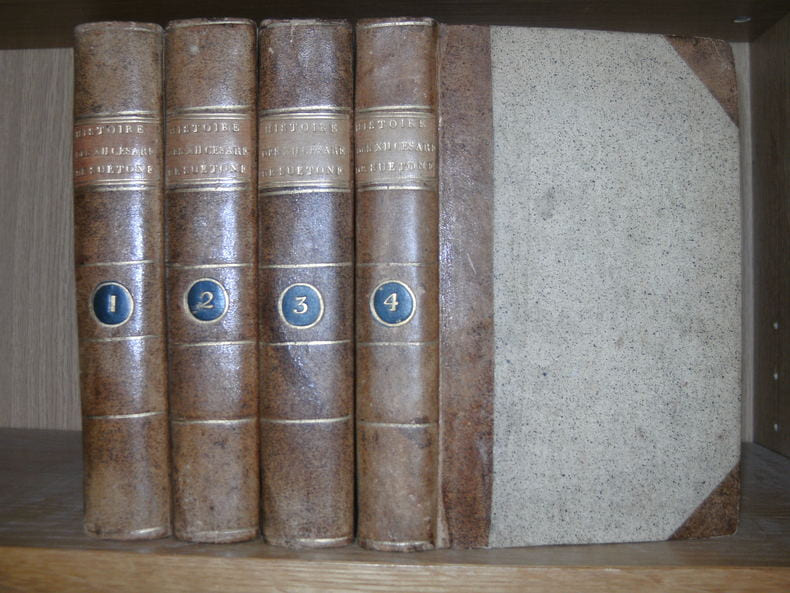
Paris, Saillant & Nyon, 1771. 125 X 205 mm. 4 tomes reliés demi-basane fauve à coins, dos lisse avec faux-nerfs dorés, pièces de titre chaudron et de tomaison noir, tr. jaunes (rel. de l'ép.). CXXI-390, 522, 528 et 383-86 pp. Texte bilingue latin-français. Minimes traces de lecture, les pp. XXIX à XLIV de la vie de Suétone sont reliées à double.
Reference : 25601
Bookseller's contact details
Serge Paratte, Livres anciens et modernes
M. Serge Paratte
chemin du Couvent 5
1822 Chernex s. Montreux
Switzerland
41 021 964 60 10
Payment mode


Sale conditions
Prix nets établis en francs suisses. Frais de port et d'assurance éventuelle en sus. Tous les livres sont en bon état sauf indications contraires. Les ouvrages ne correspondant pas à la description donnée seront repris à nos frais dans les 10 jours. Lors de la commande, prière de nous faire connaître les coordonnées de votre carte de crédit- Eurocard, Mastercard.
2 book(s) with the same title
Histoire des douze Césars de Suétone, traduite par Henri Ophellot de la Pause. Avec des Mêlanges philosophiques & des notes.
Paris, Chez Saillant & Nyon, Libraires, 1771.
8vo. 4 volumes: CXXI,(1 blank),390,(4); (VIII),522; (IV),528; (VIII),383,(1 blank), 86,(2 blank) p. Half calf. 22 cm (Ref: Schweiger 2,984/85; Moss 2,638; Brunet 5,584; Graesse 6/1,525; Ebert 21957; Cioranescu 22813) (Details: Back with 5 raised bands. Title pages in red and black. Latin text with parallel French translation, with notes and 'mélanges philosophique') (Condition: Bindings scuffed. Backs rubbed and slightly damaged at the head and foot of the spine. Shields on the backs partly gone. Boards scratches. Tiny wormhole in the blank lower margin of the first 140 pages of the second volume only) (Note: The Roman historian Suetonius, born c. 69 A.D, is the most influential and best known biographer in the Latin language. He was appointed under the emperors Hadrian and Trajan to the secretarial posts of 'a studiis', 'a bibliothecis', and 'ab epistulis' of the palace administration, jobs that gave him access to the imperial archives. His Lives of the Emperors 'De vita Caesarum' gives the biographies of 12 emperors, from Caesar, the founder of the imperial line, to Domitian. 'Suetonius, like Plutarch, believed that a person's character could be revealed in small and insignificant details'. (The Classical Tradition, Cambr. Mass. 2010, p. 912/13) Beyond simplicity he has no stylistic pretentions. He quotes verbatim from documents he knew, and shows critical ability. 'The great number of scurrilous anecdotes in most of the lives may be due to the nature of his sources'. (OCD, 2nd ed. p. 1020/1) Suetonius was read in the Middle Ages. Einhard wrote a biography of Charlemagne along the lines of a Life of Suetonius. From the Renaissance onward he was neglected, until the edition of the French scholar Isaac Casaubon, Geneva 1595, who did pioneering work on the text of Suetonius. The great edition of 1672 of the Dutch scholar J.G. Graevius and its later revisions became the foundation for the widespread interest and study of Suetonius in the 18th century. Important for the reception of Suetonius is the article that the French philosopher Pierre Bayle wrote about him in his 'Dictionnaire Historique et Critique'. 'Bayle adopted a view of Suetonius that became commonplace in subsequent decades. He presented Suetonius as a model of candor, sincerity and impartiality. Suetonius reports without judgment, he tells what he knows without fear, and he flatters no one'. (G.W. Bowersock, 'From Gibbon to Auden: Essays on the Classical Tradition', Oxford 2009, p. 55) The English historian Gibbon also praised the Roman historian for his strict dedication to historical truth, and for composing the 'Lives' truthfully, without or prejudice. This view of Suetonius was also dominant in 18th century France. Apart from the scholarly works, two translations appeared in that century, one made by De la Harpe in 1770, and one in 1771, translated under the pseudonym Henri Ophellot de la Pause, an alias of the writer and philosopher of the Enlightenment, Jean-Baptiste-Claude Delisle de Sales, 1741-1816. He is best known for his 'De la Philosophie de la Nature' of 1770, which caused a scandal for professing atheism. 'Beginning in 1776, a faction in the French court began a campaign against De Sales, as a way of attacking the French philosophical movement more generally. Voltaire championed his defense, but De Sales was imprisoned in March 1777 for publishing a book deemed to be anti-royalist, an event that brought his works out of obscurity'. (Wikipedia, Delisle de Sales) The trial became a cause célébre in Europe and made him an international celebrity. The apparant parallel between the Roman and French court may explain De Sales' interest in the biographer Suetonius, who did not shrink from recording the dark sides and sordid details in the lives of the royals) (Collation: pi2, a-g8,ch2; A-2A8, 2B6 (minus blank leaf 2B6); pi4, A-2G8, 2H4, 2I-2K8,2L1; pi2, A-2F8, 2G4, 2H-2K8, 2L4; pi4, A-2A8 (leaf 2A8 verso blank), A-E8, 2F4 (leaf 2F4 blank)) (Photographs on request)
HISTOIRE DES DOUZE CESARS DE SUETONE - TOME 4 SEUL - TRADUITE PAR HENRI OPHELLOT DE LA PAUSE AVEC DES MELANGES PHILOSOPHIQUES ET DES NOTES.
CHEZ SAILLANT & NYON. 1771. In-8. Relié plein cuir. Etat d'usage, 1er plat abîmé, Dos abîmé, Intérieur frais. 383 pages + 86 pages - contre plats et tranches jaspés - petit manque de cuir en pied sur le 1er plat - titre,tomaison et ornements dorés sur le dos partiellement manquant (fané) - 2 photos disponibles.. . . . Classification Dewey : 840.05-XVIII ème siècle
Sommaire : Exploits de Germanicus père de Caligula - mort funeste de ce héros - punition de Pison qui l'empoisonna - portrait de Germanicus - eloge de sa modération - il gagne la bienveillance universelle - deuil général à sa mort - famille de ce prince - naissance de Caligula et discussion sur sa patrie - il se fait aimer des soldats - sa dissimulation à la cour de Tibère - pont construit sur la mer - etc.. Classification Dewey : 840.05-XVIII ème siècle



