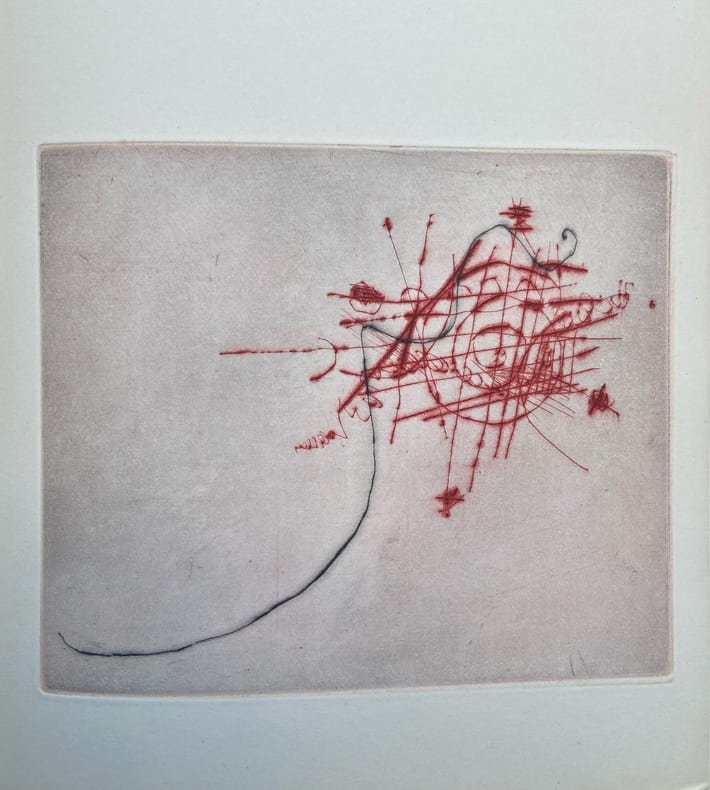
‎[MUMPRECHT Rudolf] - ‎ ‎GOETHE, TOBLER VON ERMATINGEN Georg Christoph, MUMPRECHT Rudolf‎
‎La nature.‎

‎Paris-Versailles, s.n., 1963. In-4°, couverture beige neutre. Traduction d'André Prudhommeaux. Illustré de 4 pointes sèches originales de Rudolf Mumprecht. Tirage à 50 exemplaires sur vélin d'Arches, celui-ci le numéro 37. Envoi autographe de l'illustrateur. ‎

Reference : EXE-695


‎Parfait état.‎

€324.64 (€324.64 )
Bookseller's contact details

Librairie L'Exemplaire
Catherine Tabatabay-Schmitt & Eliott Cardet
Grand Rue 25
1204 Genève
Switzerland

llexemplaire@gmail.com

+ 41 22 310 32 10

Contact bookseller

Payment mode
Others
Cheque
Others cards
Sale conditions

Conformes aux usages de la librairie ancienne et moderne, tous les ouvrages sont complets et en bon état, sauf mention contraire. Les prix indiqués sont nets, les frais d’expédition sont à la charge du destinataire et seront précisés au moment de la commande. Les commandes peuvent être transmises par téléphone, par correspondance et par mail.

Contact bookseller about this book

Enter these characters to validate your form.
*
Send

5 book(s) with the same title

‎BINET, Etienne [François RENÉ, pseudonyme]‎

Reference : 11301

(1621)

‎Essay des merveilles de nature et des plus nobles artifices pièce très nécessaire à tous ceux qui font profession d'éloquence.‎

‎ 1621 1 Titre allégorique gravé (signatures anciennement et proprement noircies !) 6 ff.n.ch. (2 dédicace, 2 épistre, indice des matières, advertissement) 569 pp. (au verso, privilège du 16 janvier 1621 pour dix ans). Manque la page de titre. Ex-libris armorié "Gualterius Young" (Trip Coll Dub, en pied) à la devise : Robori - Prudentia - Praestat. Rouen, Romain de Beauvais et Jean Osmont, 1621, petit in-4° reliure moderne plein maroquin bordeaux, titre or sur dos 5 nerfs à élégant décor géométrique aux caissons dans double filets d'encadrement, roulette sur les nerfs, plats à la Du Seuil, triple filets à petits écoinçons avec fer extérieur dans un triple filet d'encadrement, tranches rouges, roulettes sur les coupes, dentelle intérieure, contreplats peignés, gardes mobiles blanches ; deux éraflures au premier plat ; minime galerie de vers en pied du petit fond des 40 premières pages ; petit trou en I et en I3 avec atteinte à une lettre p. 63 et p. 68 ; manque en pied sans atteinte au texte p. 341. ‎


‎ Édition originale fort rare. Elle est remarquablement imprimée (notamment avec une magnifique italique), contrairement à toutes les éditions examinées par Brémond, « fort mal imprimées ». Lettres ornées, bandeaux, culs-de-lampe et figures dans le texte, gravés sur bois.Thiébaud précise que deux chapitres traitent de chasse : la vénerie, et la chasse des bêtes, des pages 1 à 22 ; la fauconnerie française est page 23 à 43. À signaler également les pages 208 à 234 : les oyseaux ; pour parler du vol des oiseaux en général.L'ouvrage connut un très grand succès et fut réédité plus de vingt fois jusqu'en 1657. « Un des plus extraordinaires livres baroques français. Cest une véritable encyclopédie poétique dont il faudrait tout citer » selon Oberlé. Le jésuite Étienne Binet (1569-1639), recteur des collèges de Rouen et de Paris, puis Provincial de France, est lauteur de nombreux ouvrages théologiques. Brémond, qui le classe parmi les « encyclopédistes dévôts » dans son Histoire du sentiment religieux en France, consacre de nombreuses pages à louvrage, « un vrai trésor () Théophile Gautier qui raffolait de ce genre douvrages, aurait fait de lEssay des merveilles un de ses livres de chevet. Romanciers, historiens, simples amateurs le liraient avec délices. Malgré sa jolie patine archaïque, cette encyclopédie est conçue dans un esprit déjà tout moderne. Très différent sur ce point des compilateurs qui lont précédé et de la plupart de ses contemporains, Binet nemprunte pas son érudition à lautorité des anciens. Merveilles de la nature, des métiers et des arts, il semble avoir tout observé de ses yeux. Il sest fait jardinier, médecin, chasseur, astronome et que sais-je encore » Dans sa préface, Binet manifeste un souci fondamental pour la lexicologie et affiche un but pédagogique précis : il est « composé pour lusage des jeunes esprits qui apprennent lart de parler, à dessein que les mots et par suite les choses ne leur manquent jamais et quils puissent toujours paraître à leur avantage. » Selon Ilana Zinguer, lenchaînement apparemment insolite des sujets répond à un ordre déterminé : « LEssay des Merveilles offre soixante-deux entrées, qui font chacune lobjet dun chapitre, ensuite regroupé en séries et précédé dun texte liminaire, le tout sous légide dune « épître nécessaire au lecteur judicieux », de caractère général. La disposition relève de celle dun palais de curiosités « littéraire », pour encyclopédiste, et obéit à la loi associative des « glissements par contiguïté » (G. Genette) ainsi lon passe du vin à lart dimprimerie par le biais de la presse. () Aux créations naturelles merveilleuses, (le moucheron, leau, les poissons, dont le mystérieux rémora, la tempeste), succèdent les accomplissements de la civilisation (le jardinage, limprimerie, la peinture, la médecine, larchitecture, les mathématiques, léloquence, la musique, etc.). Une dernière série comprend plusieurs chapitres entièrement consacrés aux merveilles des plus extraordinaires et des plus inexplicables : de lhomme, des vers à soie, du ciel, du feu et de lair, de la rosée et surtout de larc-en-ciel. Lhomme, merveille des Merveilles, gouverne tout lEssay de Binet : « Ce chef-duvre de la main toute puissante de Dieu est le miracle du monde, et la merveille des merveilles. Son corps est labrégé de toutes les éminentes perfections de lUnivers, son esprit un épitomé des grandeurs de Dieu et des Anges ; son entendement un thresor des sciences, sa mémoire un vray prodige qui conserve dix millions de choses rares, sa volonté un vray paradis de vertus, [] je vous donne piece a piece toute leconomie de ce petit monde qui est a la vérité du tout miraculeux. » (De lhomme, Au lecteur, p. 544) « La nature macrocosme et microcosme est une machine créée par un divin créateur ; les uvres humaines sont limitation, la prolongation, le perfectionnement de cette création divine. Les conquêtes spirituelles et esthétiques de lhomme, le triomphe de son intelligence témoignent dune conception nouvelle de la relation entre la nature et les artifices. Au lieu dune coupure entre le monde de la nature et le monde de la culture se sont instaurés accord et continuité : le cantique des créatures trouve un écho naturel dans les inventions, et les triomphes de lart nont rien dhérétique. « Le projet encyclopédique de Binet saccomplit en ces termes, systématiquement répétés : à lintention des virtualités projetées des préfaces, succède la description technique pointilleuse du texte ; lobjet visé est exploré sous tous ses aspects linguistiques, dilué, ramifié, diffusé à partir dune précision et dune richesse de termes exceptionnelles. Les deux parties ne pouvant être séparées, cest leur ensemble qui produit lEssay. Le regard, lintention de Binet cherchent une pleine réalisation et satisfont la curiosité de tous en fournissant un maximum dinformations sous la forme condensée de la liste, de lénumération, de lellipse. Ce qui lui permet de faire face à toutes les exigences du genre encyclopédique et pédagogique, du collectionneur de curiosités. » (Ilana Zinguer : D'une vanité à l'autre, du Palais des Curieux à l'Essay des Merveilles de nature (Dans Littératures classiques, 2005/1 (n° 56), pp. 219 à 231). Le privilège fut accordé conjointement aux deux libraires rouennais Romain de Beauvais et Jean Osmont. Outre la présente édition originale, il existe la même année des exemplaires au seul nom de l'un ou l'autre libraire, également rares.« Romain de Beauvais est lun des plus actifs éditeurs rouennais des trois premières décennies du XVIIe siècle. De 1597 à 1637, ce sont plus de cent éditions ou rééditions qui portent seul ou en société restreinte (Jean Osmont et Théodore Reinsart) le nom du libraire de la cathédrale. () Le gros de sa production consiste en ouvrages religieux ; sy ressent aussi linfluence de la Compagnie de Jésus. Romain de Beauvais nest pas absent du répertoire profane, nombre de ses confrères du Palais lui offrant plus dune fois de prendre part, avec des titres divers. () Le rayonnement éditorial de Jean Osmont I saffirme dès 1597. Ce libraire réalise très tôt, seul ou en association, un nombre considérable déditions. () Il participe, par exemple, à la reprise rouennaise, en deux éditions partagées, des Essais de Montaigne. » J.-D. Mellot, Lédition rouennaise et ses marchés (vers 1600 vers 1730), pp. 83-85, 68 & 96.LEssay des Merveilles de nature porte bien son titre, lémerveillement et la jubilation de Binet à établir ce formidable inventaire étant communicatifs Cioranescu I, 11280 - Oberlé (dithyrambique), Fastes de Bacchus et de Comus, 371 - Thiébaud, col. 93 - J.-D. Mellot, Lédition rouennaise et ses marchés (vers 1600 vers 1730), pp. 83-85, 68 & 96. ‎

Logo SLAM Logo ILAB

Phone number : 02 35 98 63 06

EUR2,800.00 (€2,800.00 )

‎Génot (Jean-Claude)‎

Reference : 21155

ISBN : 2869851928

‎La nature malade de la gestion. La gestion de la biodiversité ou la domination de la nature.‎

‎ Sang De La Terre, 16 Octobre 2008. In-8° dense, broché, couverture ill., 239 pp., très bon état. Préface de Marie-Claude Terrasson. Epuisé.‎


‎A travers son expérience professionnelle et ses voyages naturalistes, Jean-Claude Génot nous révèle l'ambiguïté de notre relation à la nature. Il nous montre comment et pourquoi la gestion de la biodiversité parachève la domination de la nature par l'homme, comment sa protection est victime de la société technicienne. Une biodiversité écologiquement correcte, acceptée et jardinée. L'intervention dans la nature dite " protégée " est un tel dogme, que laisser faire la nature semble désormais une utopie. Pourtant l'urgence n'est pas de conserver la nature du passé, en créant des milieux ouverts faciles à entretenir. Il faut penser la nature de demain, celle des friches et des milieux boisés spontanés qui ont tant à nous apprendre sur la dynamique naturelle, celle des milieux forestiers anciens, très menacés, qui se récréent difficilement car il leur faut du temps, ce que nous avons oublié ! En fait, ce n'est pas la nature qui est véritablement malade mais l'homme, atteint par son obsession de contrôle, qui fait de la nature sa victime. Il ne faudra donc pas soigner la nature mais guérir l'homme de sa maladie obsessionnelle qui envisage la nature comme un milieu hostile à dominer et non comme un monde à part entière à respecter. Jean-Claude Génot est un écologue français né en 1956, ingénieur et docteur en écologie, connu pour son travail pionnier sur la naturalité des forêts et la protection de la nature sauvage. Il a été chargé de la protection de la nature au Syndicat mixte du Parc naturel régional des Vosges du Nord (Sycoparc) de 1982 jusqu'à sa retraite récente, où il a promu une gestion forestière non interventionniste favorisant la "libre évolution" des écosystèmes. Membre des Jeunes Naturalistes et Écologistes (JNE), vice-président de l'association Forêts Sauvages et conseiller scientifique pour l'association Francis Hallé (forêt primaire), il milite contre l'industrialisation des forêts françaises.Auteur de nombreux ouvrages sur la biodiversité vosgienne, Aldo Leopold ou François Terrasson (dont une biographie), il intervient en conférences sur le lynx, les forêts matures et la "loi forêt du plus fort". Exemples : Vosges-du-Nord grandeur nature (1995), Aldo Leopold, un pionnier de l'écologie (2019). Passionné par Robert Hainard, il défend une écologie radicale inspirée de penseurs comme Leopold. Franco de port France jusqu'à 29 euros iclus. PAYPAL immédiat. MONDIAL RELAY pour : FRANCE, Portugal, Pologne, Espagne, Allemagne, Autriche, Pays Bas, Luxembourg, Italie, Belgique. Toutes les étapes sont accompagnées. Achat, estimations et listages (Papiers, Archives, monographies, arts et métiers, sciences humaines et bibliophilie) France / Suisse (sur rdv). ‎

Artlink - Saint-Haon-le-Vieux

Phone number : +33 47 78 70 476

EUR30.00 (€30.00 )

‎"MIRABAUD, M. ‎

Reference : 60650

(1774)

‎Systeme de la Nature ou Des Loix du Monde Physique & du Monde Moral. 2 vols. - [""MAN IS OF ALL BEINGS THE MOST NECESSARY TO MAN""]‎

‎London, 1774. 8vo. 2 volumes uniformly bound in contemporary half calf with gilt ornamentation to spine. Spines with wear of boards miscoloured. Internally fine and clean. (16) 397 pp."" (4), 500, (3) pp. Wanting the frontispiece.‎


‎Later edition, published four years after the original, comprising ""The System of Nature"" - one of the most important works of natural philosophy ever written and the work that is considered the main work of materialism - and ""The Social System"", being d'Holbach's seminal ""social"" and political continuation of that groundbreaking work. D'Holbach (1723-1789), who was raised by a wealthy uncle, whom he inherited, together with his title of Baron, in 1753, maintained one of the most famous salons in Paris. This salon became the social and intellectual centre for the Encyclopédie, which was edited by Diderot and d'Alembert, whom he became closely connected with. D'Holbach himself also contributed decisively to the Encyclopédie, with at least 400 signed contributions, and probably as many unsigned, between 1752 and 1765. The ""Côterie holbachique"" or ""the café of Europe"", as the salon was known, attracted the most brilliant scientists, philosophers, writers and artists of the time (e.g. Diderot, d'Alembert, Helvetius, Voltaire, Hume, Sterne etc, etc.), and it became one of the most important gathering-places for the exchange of philosophical, scientific and political views under the ""ancient régime"". Apart from developing several foundational theories of seminal scientific and philosophical value, D'Holbach became known as one of the most skilled propagators and popularizers of scientific and philosophical ideas, promoting scientific progress and spreading philosophical ideas in a new and highly effective manner. As the theories of d'Holbach's two systematic works were at least as anticlerical and unaccepted as those of his smaller tracts, and on top of that so well presented and so convincing, it would have been dangerous for him to print any of them under his own name, and even under the name of the city or printer. Thus, ""Systême de la Nature"" appeared pseudonomously under the name of the secretary of the Académie Francaise, J.B. Mirabaud, who had died 10 years earlier, and under a fictive place of printing, namely London instead of Amsterdam. ""He could not publish safely under his own name, but had the ingenious idea of using the names of recently dead French authors. Thus, in 1770, his most famous book, ""The System of Nature"", appeared under the name Jean-Baptiste Mirabaud"" (PMM 215), and so the next ""System"" also appeared in the same manner three years later. D'Holbach was himself the most audacious philosophe of this circle. During the 1760's he caused numerous anticlerical tracts (written in large, but not entirely, by himself) to be clandestinely printed abroad and illegally circulated in France. His philosophical masterpiece, the ""Système de la nature, ou des lois du monde physique et du monde moral"", a methodological and intransigent affirmation of materialism and atheism, appeared anonymously in 1770"" (D.S.B. VI:468), as did the social and political follow-up of it, the famous ""Systême social"" in 1773. That is to say, Mirabeau whom he had used as the author on the ""System of Nature"" in 1770 is not mentioned in the ""Social System"", on the title-page of which is merely stated ""By the Author of ""Systême de la Nature"". In his main work, the monumental ""Système de la Nature"", d'Holbach presented that which was to become one of the most influential philosophical theories of the time, combined with and based on a complex of advanced scientific thought. He postulated materialism, and that on the basis of science and empiricism, on the basis of his elaborate picture of the universe as a self-created and self-creating entity that is constituted by material elements that each possess specific energies. He concludes, on the basis of empiricism and the positive truths that the science of his time had attained, that ideas such as God, immortality, creation etc. must be either contradictory or futile, and as such, his materialism naturally also propounded atheism"" his theory of the universe showed that nature is the product of matter (eternally in motion and arranged in accordance with mechanical laws), and that reality is nothing but nature. Thus, having in his ""Systême de la Nature"" presented philosophical materialism in an actual system for the first time and having created a work that dared unite the essence of all the essential material of the English and French Enlightenment and incorporate it into a closed materialistic system, d'Holbach had provided the modern world with a moral and ethic philosophy, the effects of which were tremendous. It is this materialism and atheism that he continues three years later in his next systematic work ""Systême social"", through which politics, morality, and sociology are also incorporated into his system and take the place of the Christianity that he had so fiercely attacked earlier on. In this great work he extends his ethical views to the state and continues the description of human interest from ""Systême de la Nature"" by developing a notion of the just state (by d'Holbach called ""ethocracy"") that is to secure general welfare. ""Système social (1773"" ""Social System"") placed morality and politics in a utilitarian framework wherein duty became prudent self-interest."" (Encyclopaedia Brittanica). ""Holbach's foundational view is that the most valuable thing a person seeking self-preservation can do is to unite with another person: ""Man is of all beings the most necessary to man"" (Sysème social, 76"" cf. Spinoza's Ethics IVP35C1, C2, and S). Society, when it is just, unites for the common purpose of preservation and the securing of welfare, and society contracts with government for this purpose."" (SEP). Both works had a sensational impact. For the first time, philosophical materialism is presented in an actual system, and with the second of them, this system also comprised politics and sociology, a fact which became essential to the influence and spreading of this atheistic scientific-philosophical strand. The effects of the works were tremendous, and the consequences of their success were immeasurable, thus, already in the years of publication, both works were confiscated. The ""Système de la Nature"" was condemned to burning by the Parisian parliament in the year of its publication"" the ""Système social"" was on the list of books to be confiscated already in 1773, and it was placed on the Index of the Church in August 1775. Both works are thus scarce. In spite of their condemnation, and in spite of the reluctance of contemporary writers to acknowledge the works as dangerous (as Goethe said in ""Dichtung und Wahrheit"": ""Wir begriffen nicht, wie ein solches Buch gefährlich sein könnte. Es kam uns so grau, so todtenhaft vor""), the ""Systems"" and d'Holbach's materialism continued its influence on philosophic, political and scientific thought. In fact, it was this materialism that for Marx became the social basis of communism. ""In the ""Système"" Holbach rejected the Cartesian mind-body dualism and attempted to explain all phenomena, physical and mental, in terms of matter in motion. He derived the moral and intellectual faculties from man's sensibility to impressions made by the external world, and saw human actions as entirely determined by pleasure and pain. He continued his direct attack on religion by attempting to show that it derived entirely from habit and custom. But the Systeme was not a negative or destructive book: Holbach rejected religion because he saw it as a wholly harmful influence, and he tried to supply a more desirable alternative. ""(Printing and the Mind of Man, 215). ""In keeping with such a naturalistic conception of tings, d'Holbach outlined an anticreationalist cosmology and a nondiluvian geology. He proposed a transformistic hypothesis regarding the origins of the animal species, including man, and described the successive changes, or new emergences, of organic beings as a function of ecology, that is, of the geological transformation of the earth itself and of its life-sustaining environment. While all this remained admittedly on the level of vague conjecture, the relative originality and long-term promise of such a hypothesis -which had previously been broached only by maillet, Maupertuis, and Diderot- were of genuine importance to the history of science. Furthermore, inasmuch as the principles of d'Holbach's mechanistic philosophy ruled out any fundamental distinction between living an nonliving aggregates of matter, his biology took basic issue with both the animism and the vitalism current among his contemporaries...This closely knit scheme of theories and hypotheses served not merely to liberate eighteenth-century science from various theological and metaphysical empediments, but it also anticipated several of the major directions in which more than one science was later to evolve. Notwithstanding suchprecursors as Hobbes, La Mttrie, and Diderot, d'Holbach was perhaps the first to argue unequivocally and uncompromisingly that the only philosophical attitude consistent with modern science must be at once naturalistic and antisupernatural."" (D.S.B. VI:469).‎

Logo ILAB

Phone number : +45 33 155 335

DKK2,000.00 (€267.64 )

‎[HOLBACH, PAUL HENRY THIRY, BARON D'].‎

Reference : 40375

(1773)

‎Système social, ou principes naturels de la morale et de la politique, avec un examen de l'influence du gouvernement sur les moeurs. Par l'Auteur du Systême de la Nature [Mirabaud]. 3 Tomes. - [THE SYSTEM OF NATURE CONTINUED... THE SOCIAL SYSTEM]‎

‎London [recte: Amsterdam, M.M. Rey], 1773. 8vo. Bound in one beautiful contemporary full mottled calf binding with five raised bands to richly gilt spine triple gilt line-borders to boards and inner gilt dentelles. Edges of boards with single gilt line. All edges gilt. Corners abit bumped and a bit of overall wear. Inner hinges a bit weak. Internally very fine and clean. All in all a very fine copy indeed. (4), 210176" 167 pp. With all three half-titles, all three title-pages and all three indexes, as well as the introduction.‎


‎The rare first edition, first issue (though Tchermerzine mentions an unknown 2-volume-edition form the same year - this edition has never been verified), of one of d'Holbach's most important works, his influential ""social"" and political continuation of his seminal main work ""Systeme de la nature"" - the bible of materialism. D'Holbach (1723-1789), who was raised by a wealthy uncle, whom he inherited, together with his title of Baron, in 1753, maintained one of the most famous salons in Paris. This salon became the social and intellectual centre for the Encyclopédie, which was edited by Diderot and d'Alembert, whom he became closely connected with. D'Holbach himself also contributed decisively to the Encyclopédie, with at least 400 signed contributions, and probably as many unsigned, between 1752 and 1765. The ""Côterie holbachique"" or ""the café of Europe"", as the salon was known, attracted the most brilliant scientists, philosophers, writers and artists of the time (e.g. Diderot, d'Alembert, Helvetius, Voltaire, Hume, Sterne etc, etc.), and it became one of the most important gathering-places for the exchange of philosophical, scientific and political views under the ""ancient régime"". Apart from developing several foundational theories of seminal scientific and philosophical value, D'Holbach became known as one of the most skilled propagators and popularizers of scientific and philosophical ideas, promoting scientific progress and spreading philosophical ideas in a new and highly effective manner. D'Holbach was himself the most audacious philosophe of this circle. During the 1760's he caused numerous anticlerical tracts (written in large, but not entirely, by himself) to be clandestinely printed abroad and illegally circulated in France. His philosophical masterpiece, the ""Système de la nature, ou des lois du monde physique et du monde moral"", a methodological and intransigent affirmation of materialism and atheism, appeared anonymously in 1770"" (D.S.B. VI:468), as did the social and political follow-up of it, the famous ""Systême social"" in 1773. That is to say, Mirabeau whom he had used as the author on the ""System of Nature"" in 1770 is not mentioned in the ""Social System"", on the title-page of which is merely stated ""By the Author of ""Systême de la Nature"". As the theories of d'Holbach's two systematic works were at least as anticlerical and unaccepted as those of his smaller tracts, and on top of that so well presented and so convincing, it would have been dangerous for him to print any of them under his own name, and even under the name of the city or printer. Thus, ""Systême de la Nature"" appeared pseudonomously under the name of the secretary of the Académie Francaise, J.B. Mirabaud, who had died 10 years earlier, and under a fictive place of printing, namely London instead of Amsterdam. ""He could not publish safely under his own name, but had the ingenious idea of using the names of recently dead French authors. Thus, in 1770, his most famous book, ""The System of Nature"", appeared under the name Jean-Baptiste Mirabaud."" (PMM 215), and so the next ""System"" also appeared in the same manner three years later.In his ""Systême de la Nature"", d'Holbach had presented philosophical materialism in an actual system for the first time and had created a work that dared unite the essence of all the essential material of the English and French Enlightenment and incorporate it into a closed materialistic system"" on the basis of a completely materialistic and atheistic foundation, he provided the modern world with a moral and ethic philosophy, the effects of which were tremendous. It is this materialism and atheism that he continues three years later in his next systematic work ""Systême social"", through which politics, morality, and sociology are also incorporated into his system and take the place of the Christianity that he had so fiercely attacked earlier on. In this great work he extends his ethical views to the state and continues the description of human interest from ""Systême de la Nature"" by developing a notion of the just state (by d'Holbach calle ""ethocracy"") that is to secure general welfare. ""Système social (1773"" ""Social System"") placed morality and politics in a utilitarian framework wherein duty became prudent self-interest."" (Encyclopaedia Brittanica). ""Holbach's foundational view is that the most valuable thing a person seeking self-preservation can do is to unite with another person: ""Man is of all beings the most necessary to man"" (Sysème social, 76"" cf. Spinoza's Ethics IVP35C1, C2, and S). Society, when it is just, unites for the common purpose of preservation and the securing of welfare, and society contracts with government for this purpose."" (SEP).As the ""Systême de la Nature"" had been condemned to burning in the year of its publication, so the ""Systême social"" was on the list of books to be confiscated already in 1773, and it was placed on the Index of the Church in August 1775. As the ""Systême de la Nature"", the ""Systême social"" is thus also of great scarcity. Another edition of the work appeared later the same year, in 12mo. Tchermerzine says that ""Il ya une édition, que nous ne connaissons pas, en 2 vol. in-8. C'est sans doute l'originale."" The present edition was reprinted the following year, in 1774.Tschermerzine VI:246" Graesse III:317 Barbier IV:622 (only listing later editions).‎

Logo ILAB

Phone number : +45 33 155 335

DKK26,000.00 (€3,479.33 )

‎"SCHELLING, F.W.G.‎

Reference : 36118

(1799)

‎Erster Entwurf eines Systems der Naturphilosophie. Zum Behuf seiner Vorlesungen + Einleitung zu seinem Entwurf eines Systems der Naturphilosophie. Oder: Ueber den Begriff der speculativen Physik und die innere Organisation eines Systems dieser Wissens... - [THE PHILOSOPHY OF NATURE]‎

‎Jena und Leipzig, Christian Ernst Gabler, 1799. 8vo. Bound in one cont. marbled cardboardbdg. Spine soiled and worn at hinges and capitals, w. a bit of loss. Cont annotations to fly leaf. Old discrete owner's name to title-page, dated 1809. Four leaves w. cont. marginal annotations and underlinings. Internally well-preserved. (2), 83, (1, errata), (2, -blank) + (4), 321, (1, -Verbesserungen) pp.‎


‎Scarce first editions of these two fundamental works of Shelling's philosophy of nature. In his early works (1795-1800), Schelling sets out to give a new account of nature, and his ""Erster Entwurf..."" together with the ""Einleitung..."" for it are placed at the centre of this attempt. At the basis of his philosophy of nature is the status that Kant had given nature, but Schelling tries to avoid some of the consequences that come with Kant's notion. He is also largely inspired by Fichte's transcendental philosophy, and in the last five years of the 19th century, Schelling is thus occupied with the relationship of the subject to the object world, -a theme that comes to found the basis for his so famous philosophy of nature. At first Fichte and Schelling stood on good terms, but as their different conceptions of nature became evident, the divergences between them became too great. As Fichte regarded nature as Not-Self, this could not be a valid subject of philosophy, and he refused to understand Schelling's philosophy of nature as complementary to his own transcendental philosophy.Schelling's philosophy of nature presents us with a modern hermeneutic view of nature, allowing nature to be of significance beyond what can be scientifically established about it. Along with J.G. Fichte and Hegel, Schelling ranks as the most influential thinker of German Idealism. He stands in the centre of this most important and influential of philosophical traditions, and with his philosophy of nature, his anti-Cartesian view of subjectivity and his later critique of Hegelian Idealism, Schelling continues to be of the utmost importance to the development of continental philosophy to this day. ‎

Logo ILAB

Phone number : +45 33 155 335

DKK4,500.00 (€602.19 )
Get it on Google Play Get it on AppStore
The item was added to your cart
You have just added :

-

There are/is 0 item(s) in your cart.
Total : €0.00
(without shipping fees)
What can I do with a user account ?

What can I do with a user account ?

  • All your searches are memorised in your history which allows you to find and redo anterior searches.
  • You may manage a list of your favourite, regular searches.
  • Your preferences (language, search parameters, etc.) are memorised.
  • You may send your search results on your e-mail address without having to fill in each time you need it.
  • Get in touch with booksellers, order books and see previous orders.
  • Publish Events related to books.

And much more that you will discover browsing Livre Rare Book !