 Write to the booksellers
MOORE Henry
Sculpture
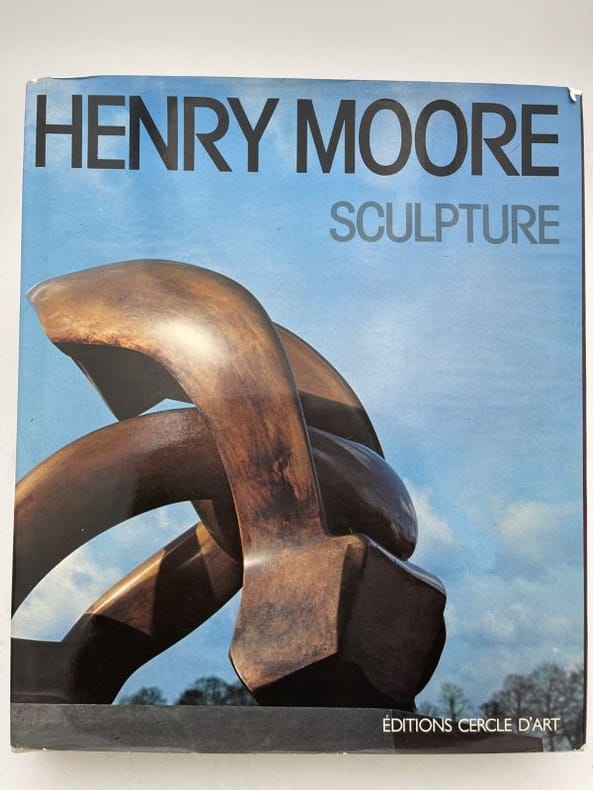
Cercle d'Art Cercle d'Art, 1984. In-folio relié pleine toile grège éditeur sous jaquette illustrée. 315 pages. Commentaires de l'artiste, préface de Franco Russoli, Maître d'oeuvre David Mitchinson. Très petite déchirure à la jaquette au deuxième plat sans manque ni gravité, corps de l'ouvrage en très bon état
Reference : 189876
Toutes les expéditions sont faites en suivi au-dessus de 25 euros. Expédition quotidienne pour les envois simples, suivis, recommandés ou Colissimo.
Bookseller's contact details
Librairie Gil - Artgil SARL
Catherine et Caroline Gil
24 Bld Denys Puech
12000 Rodez
France
05 65 42 95 21
Payment mode


Sale conditions
Conformes aux usages de la librairie ancienne. Les prix sont nets. Frais de port en sus. Emballage gratuit. Les livres sont expédiés après réception du règlement en colis poste ou recommandé. <br />
5 book(s) with the same title
AFRICAN SCULPTURE SPEAKS ( ou la Sculpture africaine parle). Livre en langue anglaise
Hill and Wang , New-york, 1961.
Un volume in-4°, reliure éditeur rigide toilée de couleur marron clir, avec le titre et dessin d’un masque africain sur le 1er plat , dos avec le titre également. Les contreplats sont ornés de détails du continent africain. L’ouvrage compte 264 pages avec un grand nombre de reproductions in et hors texte d’objets d’art africains en noir (on compte 276 figures). Le plan de l’ouvrage comprend 3 grandes parties. Part 1: THE MEANING AND SOURCES OF AFRICAN ART. Part 2: THE CONTENT OF AFRICAN ART. Appendix: STYLE REGIONS. Il s’agit d’une étude très complète qui se termine par une Bibliographie, Une LISTE DES ILLUSTRATIONS et un important INDEX. Exemplaire sans jaquette mais en TRES BON ETAT


PAÏNI Dominique, FRIZOT Michel, HAMELUNXEN Hubertus Von- PINET Hélène, GABORIT Jean-René, DUCROS Françoise, DURAND Régis.
Reference : 50260
PHOTOGRAPHIE/SCULPTURE, un bilan de proximité.
Centre national de la Photographie, Paris, 1991.
Un volume in-4°, format oblong (27 x 29 cm), couverture rigide éditeur, toilée et de couleur brique, avec une photo en noir contrecollée sur le premier plat, lequel est protégé par une jaquette en plastique transparent à large rabat. L’ouvrage compte 157 pages. Un ouvrage passionnant sur les relations entre la photographie et la sculpture, illustré par les oeuvres de grands photographes. Exemplaire en PARFAIT ETAT.
Emerging Naturalism: Contexts and Narratives in European Sculpture 1140-1220
, Brepols - Harvey Miller, 2020 Hardcover, 436 pages, 156 b/w ill. + 18 colour ill., 220 x 280 mm, Languages: English. ISBN 9782503574486.
For many decades, specialists in Romanesque and Early Gothic art and architecture have questioned the usefulness of traditional stylistic terminology. It is regarded as having limited relevance insofar as it fails to reflect the complexity and plurality of the period under discussion. Nor does it embrace functional, formal or iconographic specificities. Despite these deficiencies, we still have no better way of referring to the art of the period than Romanesque, Late Romanesque or Early Gothic which we make yet more cumbersome by adding a geographical or political term. Of the various media which were affected by artistic innovation in Europe during the second half of the 12th century, particular attention has been paid to stained glass, manuscript illumination, metalwork and enamel. Monumental sculpture was equally subject to profound change during the period, in addition to developing in directions that were largely independent of other media. As a result, late Romanesque sculpture extends across the period from 1140 to 1220, from Saxony to Galicia, though it is still impossible to encapsulate in a single statement what this complex network represented. However, the attainment of a compelling naturalism does seem to have been a shared aspiration among Latin European sculptors. Emerging Naturalism: Contexts and Narratives in European Sculpture 1140?1220 offers a panoramic analysis of this artistic landscape, focused on a central issue in medieval European artistic production. To narrow this field of study, the book concentrates on the innovations and solutions adopted in the great church workshops of western Europe. Gerardo Boto Varela teaches art history at the Universitat de Girona (Spain), is leader of the international research group Templa, and scientific editor of the journal Codex Aquilarensis. Revista de Arte Medieval. His research concentrates on spatial, pictorial, and liturgical aspects of Spanish ecclesiastical architecture from the tenth to thirteenth centuries, as well as on dynastic tombs and memorial culture in Medieval Iberia. Marta Serrano Coll teaches art history at the Universitat Rovira i Virgili in Tarragona (Spain) and specializes in Medieval architecture and sculpture, particularly in Catalonia. Her research interests include the display of power through artworks and royal patronage in the Iberian Peninsula during the Middle Ages. In addition, she has published in the field of Romanesque sculpture and hagiographical studies. John McNeill teaches at Oxford University?s Department of Continuing Education, and is Honorary Secretary of the British Archaeological Association, for whom he has edited and contributed to volumes on Anjou, King?s Lynn and the Fens, the medieval cloister, and English medieval chantries. He was instrumental in establishing a biennial International Romanesque Conference Series and has a particular interest in the design of medieval monastic precincts. Table of Contents Emerging Naturalism and a New Medieval Morphology ? Herbert L. Kessler I.Shaping Late Romanesque Sculpture. Balance and Perspective The Attainment of a Compelling Naturalism in Sculpture c. 1200 ? Gerardo Boto Varela What is So-Called Late Romanesque Sculpture? ? Xavier Barral i Altet II. Late Romanesque / Early Gothic Sculpture in European Cathedrals (1140?1220) The Role of Burgundy in the Development of the First Column-Statues ? Marcello Angheben Late Romanesque Sculpture and the Cathedrals of South-Western France ? Quitterie Cazes An Enigma Put Aside. The Origin and Interpretation of a Decontextualized Capital from Saint Trophime at Arles ? Juan Antonio Ola eta Around and After 1200. Old and New Concepts of Monumental Sculpture in the German Territories of the Holy Roman Empire ? Claudia R ckert Sculpture and Liturgy: Monuments and Art Histories of Southern Italy (c. 1150?1250 and Beyond) ? Elisabetta Scirocco Old Testament Sacrifice and Thirteenth-Century Tithe: Cain and Abel in the Architectural Sculpture of the Holy Roman Empire ? Stephanie Luther Late Romanesque Sculpture in England. How Far Can the Evidence Take Us? ? John McNeill The Gothic Last Judgment Portal c. 1210. Visual Strategies and Communicative Function ? Bruno Boerner Aesthetics and the Imitation of Antiquity in Early Gothic Sculpture ? Laurence Terrier Aliferis III. Sculptural Visualisations in the Cathedrals of the Iberian Kingdoms (1160?1220) The Reception of Burgundian Models in the Second Half of the Twelfth Century and the Naturalist Redefinition of Romanesque Sculpture in Castile ? Marta Poza Yag e Master Mateo and the Cathedral of Santiago at the End of the Twelfth Century ? Ram n Yzquierdo Peir Late Romanesque Sculpture in the Kingdoms of Leon and Castile: Continuity or Change? ? Jos Luis Hernando Garrido & Antonio Ledesma Romanesque Sculpture in Portuguese Cathedrals: Models, Continuity and Adaptation ? Carla Varela Fernandes & Paulo Almeida Fernandes The Meaning of the Romanesque Sculpture in the C mara Santa at the Cathedral of Oviedo ? C sar Garc a de Castro Vald s Images and Stories: The Transformation of Space in the Cathedrals of the Ebro Valley ? Esther Lozano L pez The Vault Corbels in the Cloister of Tarragona Cathedral: Shaping a New Pictorial Corporeality that Goes Beyond the Late Romanesque ? Gerardo Boto Varela & Marta Serrano Coll
Drill in Sculpture From Ancient Egypt to Modernism
, Brepols - Harvey Miller, 2025 Hardback, Pages: 341 pages, Size:180 x 265 mm, Illustrations:5 b/w, 233 col. , Language(s):English, Italian. ISBN 9782503600253.
Summary The story of the use of the drill in European sculpture has not yet been written, although it should be fascinating.? So argued Rudolf Wittkower in one of the lectures on the processes and principles of sculpture that he gave as Slade Professor of Fine Arts at Cambridge in 1970. In agreement with Wittkower?s view, this volume presents a series of case studies on the use of the drill ranging from ancient Egypt to the beginning of the twentieth century. Conceived as a catalogue for an ideal exhibition, the book illustrates, in chronological order, various works of art whose creation significantly depended on this tool: not only statues and bas-reliefs, but also architectural decoration, vases in precious stone and utilitarian objects, made in a range of materials including marble, wood, clay, ivory and more. This variety highlights the extraordinary challenge faced over millennia by the drill in its numerous forms (bow drills, gimlets, pump drills, to name but a few), which did not undergo significant technological transformation until the advent of electricity. This tool directly confronted, to a greater extent than others, the hardness of the sculptural materials, piercing them, splitting them and manipulating them beyond any apparent limitation set by nature. In its tussle with the drill, the very affordance of the material was threatened, defeated by the expressive will of the sculptors, their visual cultures, their frames of reference and their notions of nature and art. This volume is devoted to the exploration and understanding of this challenge. Published with the support of the Henry Moore Foundation. TABLE OF CONTENTS Editors? Preface Introductory Essays Nicholas Penny, Traces of the Drill in Ancient and Modern Sculpture: A Survey Lucia Simonato, The Ill-famed Drill. The Anti-Hero of Sculpture from Winckelmann to Modernism Atlas Sante Guido and Lucia Simonato, Rotational Drilling Instruments Works and Tools Enrico Ferraris, Notes on the Drill and Perforation in Ancient Egypt Enrico Ferraris, In the Workshops of Egyptian Carpenters Rapha l Jacob, The Drill in Archaic and Classical Marble Sculptures of the Acropolis Carmela Capaldi, The Running Drill as a Signature Motif in Roman Art Fabio Guidetti, Between Nature and Artifice: The Portraits of the Roman Imperial Period Sarah Gu rin and Francesca Pistone, A Late Antique Inheritance and Carolingian Taste Martina Rugiadi, Notes on Absences: Towards Charting the Use of the Drill in Medieval Islamic Stonework and its Modern Investigation Julien Chapuis, Expediency and Effect: The Drill in Medieval Sculpture North of the Alps Laura Cavazzini, Tuscan Sculpture in the Mid-Thirteenth Century, Between East and West Marco Collareta, The Drill Serving the Chisel in a Fourteenth-Century Monumental Sculpture Group in Pisa Luca Palozzi, The Pump Drill in Late Medieval and Early Modern Tuscany: Metal Bits and Deer Leather Straps Marco Scansani, The ?fictitious Drill? in Fictile Renaissance Sculpture Francesca Maria Bacci, The Ornament Technique in Florentine Workshops of the Fifteenth Century Matteo Ceriana, The ?rosicante trepano? of the Venetian Renaissance Luca Annibali, Drilling Marble to Restore the Antique Gr goire Extermann, Porphyry in Cosimo I?s Florence: Carving Versus Abrading Riccardo Gennaioli, The Secrets of Mannerist Wheels for Engraving Fine Semi-Precious Stones Sante Guido, From Father to Son: Pietro Bermini in Early Seventeenth-Century Rome Lucia Simonato, Gian Lorenzo Bermini and his Masters in the Art of Drilling Jennifer Montagu, Of Grooves and Holes: Drilled Outlines in Roman Baroque Sculpture Vittoria Brunetti, Late Seventeenth-Century Sculptural Practice Between Style and Fascination with the Antique Milena Maria Dean, Boxwood and Stone Pine in the Venetian Baroque Valeria Rotili, Traces of Pointing and of Other Drill Uses in Eighteenth-Century Sculpture, Between Rome, Paris and Turin Elena Catra, Canova?s ?finishing touches? Omar Cucciniello, The Bravura of the Milan School in the Nineteenth Century Margherita d?Ayala Valva, Wildt?s ?great virtue of shadow? Giovanni Casini, ?My great adventure?: Epstein?s The Rock Drill Bibliography Index of Names and Places compiled by Chiara Pazzaglia
Taking Shape. Sculpture of the Low Countries, c. 1400-1600
, Brepols, 2024 Hardback, 350 pages, Size:216 x 280 mm, Illustrations:5 b/w, 139 col., Language: English.* NEW ISBN 9782503611235.
Summary This book examines the production, patronage, and use of sculptures made in the Low Countries between 1400 and 1600. Two questions frame the book: 'Why did Sculpture from the Low countries matter' and 'Why will Sculpture from the Low Countries matter for future research'. Answers to these questions will be offered in a coherent and richly illustrated study which considers Sculpture as a pivotal subject field within Art Historical discourse. TABLE OF CONTENTS Preface Julie Beckers and Hannah De Moor Introduction Ethan Matt Kavaler Chapter 1: Use and Function of Sculpture Accommodating Altarpieces: The Impact of Circumstantial Factors on the Design of Altar Decorations in Medieval Churches Justin Kroesen Working Sculpture: The Forms and Functions of Netherlandish Brass Lecterns Douglas Brine The Church's a Stage: Late Medieval Altarpieces as Part of an Ever-Changing Environment Wendy Wauters The Stem of a Once Ornate Fountain: The Use of a Table Fountain Fragment at Museum Mayer Van den Bergh in Antwerp Julie Beckers Chapter 2: Patronage of Sculpture Patronage Jeffrey Chipps Smith Noble Expectations of Memorial Sculpture: Commissioning the Jauche Monuments in Brugelette (c. 1527-1573) Ruben Suykerbuyk The Chapel Space and Interiority in the Ringsaker Altarpiece Lynn F. Jacobs Prestige and Display: Noble Patronage of Sculpture in the Low Countries Elizabeth Rice Mattison Chapter 3: Production and Workshop Continuity and Discontinuity in the Sculpture Workshop Practice Aleksandra Lipi?ska The Leuven Connection: A New Look at the Social and Artisanal Network of Leuven Late Gothic Sculptors (c. 1475-1525) Marjan Debaene Te maken ende te leveren: The Transport of Netherlandish Carved Altarpieces Hannah De Moor Epilogue: Seeing Sculpture Stephanie Porras

