 Write to the booksellers
VAN HAMME - TENG
Le télescope
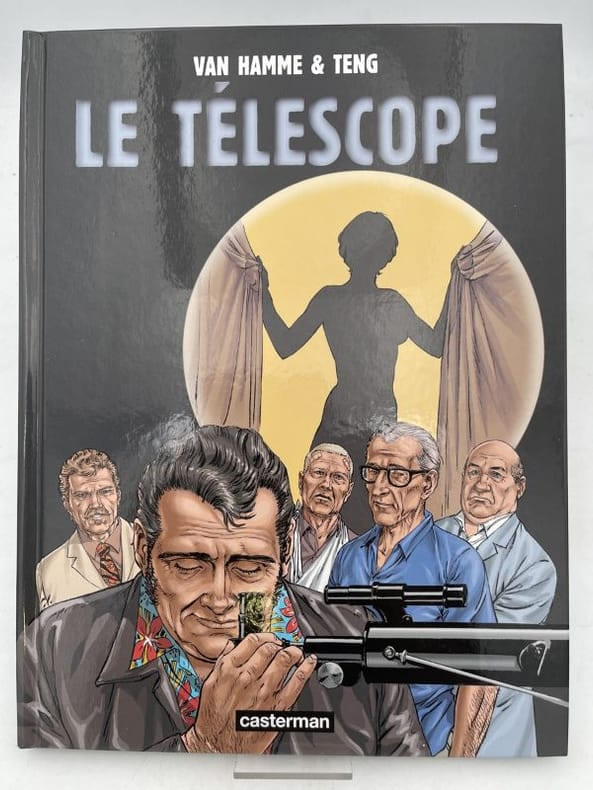
Casterman Casterman, 2009. In-4 relié plein cartonnage éditeur. Très bon état
Reference : 188754
ISBN : 2203013052
Toutes les expéditions sont faites en suivi au-dessus de 25 euros. Expédition quotidienne pour les envois simples, suivis, recommandés ou Colissimo.
Bookseller's contact details
Librairie Gil - Artgil SARL
Catherine et Caroline Gil
24 Bld Denys Puech
12000 Rodez
France
05 65 42 95 21
Payment mode


Sale conditions
Conformes aux usages de la librairie ancienne. Les prix sont nets. Frais de port en sus. Emballage gratuit. Les livres sont expédiés après réception du règlement en colis poste ou recommandé. <br />
5 book(s) with the same title
"ROBINSON, THOMAS RODNEY & THOMAS GRUBB. - THE GREAT MELBOURNE TELESCOPE.
Reference : 42671
(1870)
Description of the Great Melbourne Telescope.
(London, Taylor and Francis, 1870). 4to. No wrappers as extracted from ""Philosophical Transactions"" 1869 - Vol. 159 - Part I. Pp. 127-161 and 10 lithographed plates, showing the telescope and its parts. A few small weak brownspots to top of some plates.
First printing of the detailled description of the Great Melbourne Telescope, by Robinson, member of the commitee and Thomas Grubb, the constructor. With it a number of importent observations of Nebulae were carried out. For 20 years it was the largest in the world, and it was the first instrument to document gravitational lens light refraction. The telescope was destroyed during the bush fires of January 2003.""The construction of the grand instrument was entrusted to Mr. Grubb, F.R.S., of Dublin, Ireland. At the Commencement of the year 1868 the telescope was completed, and examined by the Commitee of the Royal Society, made up of Lord Rosse, Dr. Robinson and Warren de la Rue. Intheir report they expressed their opinion that the equatorial was a masterpiece of astronomical mechanism.""

Description of a Forty-Feet Reflecting Telescope. - [HERSCHEL'S FAMOUS 40-FOOT TELESCOPE]
London, Peter Elmsly, 1795. 4to. In recent marbled paper wrappers. Extracted from ""Philosophical Transactions"". Including title-page of volume. Leaves reinforced in margin. Light offsetting from folded plates as usual. Plate depicting the full telescope with professional repair to lower right corner. (4), 347-410 pp. + 19 folded plates.
First appearance of William Herschel account of his great 40-foot telescope. It was the largest telescope in the world for 50 years and it was possibly used to discover Enceladus and Mimas, the 6th and 7th moons of Saturn. The plate of the 40-foot telescope fully assembled remains as one of the great icons of astronomy. ""It is well known that King George III granted £2,000 for the construction of the 40-foot reflector, and that this was supplemented by a further £2,000 plus other expenses. Only recently has it become evident that the second grant was made in the context of a serious row between monarch and astronomer. Herschel was of course in uncharted territory in attempting the construction of such a monster. The king had understood that the first £2,000 was the total required, and when this proved not to be the case he may well have suspected Herschel of deliberately underestimating the costs involved when making his original application. Although the king acceded-reluctantly-to the second request, from then on Herschel was required to account for every last penny of expenditure, and was told in no uncertain terms that no further grant would be forthcoming.The 40-foot reflector proved cumbersome and its results did not justify the labor and cost of its construction. What has only recently been appreciated is the extent to which it became a millstone around its creator's neck. From Herschel's point of view, it lost its principal raison d'être in 1790 when an observation with the 20-foot convinced him of the existence of ""true nebulosity."" But to the king it was an enduring symbol of his patronage of science, and visitors to Windsor Castle were invited to make the short journey to Slough to see the world's biggest telescope."" (DSB)
An Account of the Construction of a Fluid Lens Refracting Telescope of eight inches aperture, and eight feet and three quarters in lenght, made for the Royal Society by george Dolland. Read November 22, 1832.
(London, Richard Taylor, 1833).
First printing of the paper in which he describes the 8 inch-telescope with the fluid lens - the so-called second Barlow-lens - required by the Royal Society for testing.""Barlow’s next major contribution makes his name still well known by amateur astronomers today. He invented the Barlow lens, a telescope lens consisting of a colourless liquid between two pieces of glass. The ""Barlow lens"", a modification of this telescope lens, is a negative achromatic combination of flint glass and crown glass. It is a negative lens used to extend the effective focal length of a telescope objective.""""His optical experiments began about 1827. There were several experiments to correct a single lens for chromatic aberration with concave lenses. These correctors were first placed near the first lens, but some opticians moved the concave lens further down the tube. This arrangement was described 1828 by Rogers in a paper to the Astronomical Society. By this a 3 inch concave flint lens was sufficient to correct a 9 inch crown glass. Smaller lenses near the focus would do the colour correction, but have to have steeper curves which would introduce spherical aberration.""
Ciel et espace n°134 28e année mai-juin 1973 - Les éclipses - j'ai analysé les pierres de lune - télescope équatorial à fourche - choix de la poix pour miroir - télescope Schmidt - éclipse solaire du 30 juin (projet concorde).
Imp.Mantaise. 1973. In-4. Broché. Bon état, Couv. convenable, Dos satisfaisant, Intérieur frais. 34 pages agrafées - quelques illustrations en noir et blanc dans le texte.. . . . Classification Dewey : 70.49-Presse illustrée, magazines, revues
Sommaire : Les éclipses - j'ai analysé les pierres de lune - télescope équatorial à fourche - choix de la poix pour miroir - télescope Schmidt - éclipse solaire du 30 juin (projet concorde). Classification Dewey : 70.49-Presse illustrée, magazines, revues

The construction of large telescopes Symposium N°27 International astronomical union held in Tucson, Arizona, pasadena and Mount Hamilton, california, USA, 5-12 april 1965 Sommaire: Optical systems; Mirrors; Telescope design; Telescope driving; Problem of
Academic press. 1966. In-8. Relié. Très bon état, Couv. convenable, Dos satisfaisant, Intérieur frais. 234 pages augmentées de quelques graphiques en noir et blanc dans texte.. . . . Classification Dewey : 420-Langue anglaise. Anglo-saxon
Texte écrit en anglais. Etiquette sur coiffe en pied. Sommaire: Optical systems; Mirrors; Telescope design; Telescope driving; Problem of logistics ... Classification Dewey : 420-Langue anglaise. Anglo-saxon

