 Write to the booksellers
STEINMANN J
Daniel
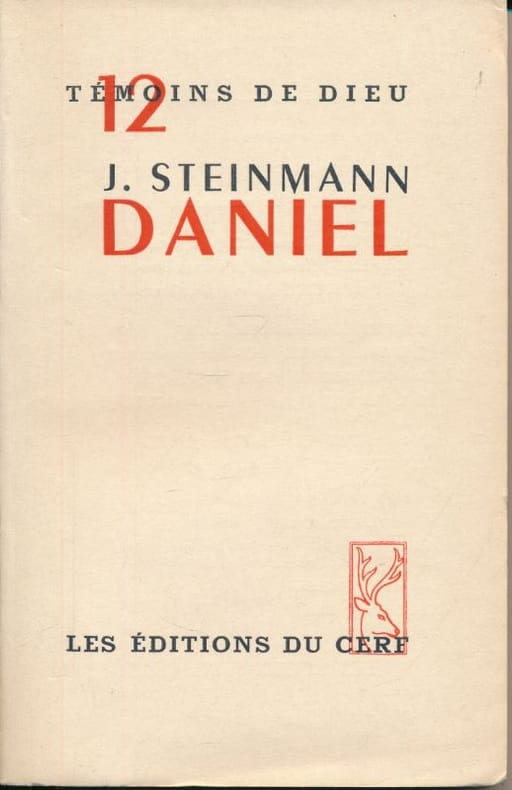
Cerf Cerf, 1950. In-12 broché, 182 pages. Très bon état
Reference : 171690
Toutes les expéditions sont faites en suivi au-dessus de 25 euros. Expédition quotidienne pour les envois simples, suivis, recommandés ou Colissimo.
Bookseller's contact details
Librairie Gil - Artgil SARL
Catherine et Caroline Gil
24 Bld Denys Puech
12000 Rodez
France
05 65 42 95 21
Payment mode


Sale conditions
Conformes aux usages de la librairie ancienne. Les prix sont nets. Frais de port en sus. Emballage gratuit. Les livres sont expédiés après réception du règlement en colis poste ou recommandé. <br />
5 book(s) with the same title
Daniel Boone. Historic Adventures of an American Hunter among the Indians. Lithographs in colour by Fedor Rojankovsky.
P., Domino Press, Esther Averill and Lila Stanley, 1931, In-4, album cartonné éditeur, dos toilé bleu, [16 pp.].
Edition originale . "Daniel Bonne ne trouvant pas d'éditeur aux Etats-Unis, Esther Averill, jeune journaliste américaine séjournant à Paris, fonda sa propre maison d'édition, Domino Press et publia simultanément Daniel Boone en français à Paris et en anglais à Londres et à New York (1931). " Petits Français illustrés de Cl.-A. Parmegiani. 30 superbes lithographies de Rojankovsky tirées chez Mourlot ornent cet ouvrage; une belle réalisation artistique. Le texte, imprimé par Coulouma, relate l'existence aventureuse de l'éclaireur Daniel Boone, fondateur du premier établissement permanent au Kentucky.
Daniel Boone. Les Aventures d'un Chasseur Américain parmi les Peaux-Rouges. Lithographies en couleurs par Fedor Rojankovsky.
P., Domino Press, Esther Averill and Lila Stanley, 1931, In-4, album cartonné éditeur, dos toilé bleu, [16 pp.].
Edition originale . "Daniel Bonne ne trouvant pas d'éditeur aux Etats-Unis, Esther Averill, jeune journaliste américaine séjournant à Paris, fonda sa propre maison d'édition, Domino Press et publia simultanément Daniel Boone en français à Paris et en anglais à Londres et à New York (1931). " Petits Français illustrés de Cl.-A. Parmegiani. 30 superbes lithographies de Rojankovsky tirées chez Mourlot ornent cet ouvrage; une belle réalisation artistique. Le texte, imprimé par Coulouma, relate l'existence aventureuse de l'éclaireur Daniel Boone, fondateur du premier établissement permanent au Kentucky.
KOLOUTHOU HARPAGÊ HELENÊS. Coluthi raptus Helenae. Recensuit ad fidem codicum MSS. ac variantes lectiones et notas adiecit Joannes Daniel a Lennep. Accedunt eiusdem animadversionum libri tres tum in Coluthum tum in nonnullos alios auctores.
Leeuwarden, (Leovardiae), Ex officina Guilielmi Coulon, Illustr. Frisiae Ordd. & Acad. Typographi, (colophon: Typis J. Brouwer, Franequerae), 1747.
8vo. XXVI,127,(1 blank);215,(1 colophon) p. Vellum 20 cm (Ref: STCN ppn 156632918; Hoffmann I,471; Brunet 2,173/74; Ebert 5018; Graesse 2,231) (Details: 6 thongs laced through both joints. Title in red & black. Greek text with facing Latin translation, and critical notes on the lower part of the page. The second part of the work consists of 2 books with a commentary on Coluthus, and a third on several other Greek authors) (Condition: Vellum showing the patina of its age. Free endpapers gone. Edges of first leaves thumbed. Paper yellowing, the title page somewhat browning) (Note: The second edition of the OCD (1970) is rather negative about the Greek epic poet of Egyptian origin Coluthus (or Colluthus), ca. 5th cent. A.D. His only surviving work, the 'Rape of Helena', an epyllion of 392 hexameters, is deemed uninspired and clearly influenced by Nonnus. Dibdin, in his famous bibliography, and much later H.J. Rose, in his 'A Handbook of Greek literature' did not take the trouble of mentioning him at all. The 11th edition of the Encyclopeda Brittanica of 1910, volume VI, finds the poem 'dull and tasteless, devoid of imagination, a poor imitation of Homer, and (it) has little to recommend it except its harmonious versification, based upon the technical rules of Nonnus'. The RE, volume XI of 1922, col. 1099, s.v. 'Kolluthos' is harsh, and finds his poetry 'Machwerk, sprachliche und sachliche Stümperei'. Nowadays Coluthus' poetry is rehabilitated. Der 'Neue Pauly', volume 3 of 1999, is positive. Coluthus is called 'ein vollendeter Künstler', who imitates Homer. 'Der Tradition hellenistischer Dichtung folgend, wendet er die stilistischen Regeln der 'imitatio', der 'variatio', und der 'oppositio in imitando' an'. (NP s.v. Kolluthos) In 2010 Coluthus' poem was upgraded to 'a short and charming miniature epic'. (Griffin,J., 'The Cambridge Companion to the Epic', Cambr. 2010, p. 28) The 'Rape of Helena' tells the story of the Trojan prince Paris and Helena, the wife of the Spartan king Menelaus, from the wedding of Peleus and Thetis, the judgement of Paris, the elopement of Helena from Sparta, till the arrival of Paris and Helena in Troy, and as we all know 'Helenae raptus belli Trojani causa habendus'. The young Dutch scholar Johannes Daniël van Lennep, born in Leeuwarden in 1724, chose to produce this edition of Coluthus to finish his studies under Valckenaer and Schrader at the University of Franeker. He did not edit Coluthus to rehabilitate him, or because he liked his poetry, it has nothing to recommend itself, he says in the preface. His edition is proof of his competence as a scholar on the threshold of a scholarly career. (Praefatio, page V) The professor of Greek at Leyden University, Tiberius Hemsterhuis, who Van Lennep much admired, and under whom he wanted to continue his studies, once called the work of Coluthus 'corruptissimum simul et mutilum'. (Idem, p. VI) Van Lennep produced his Coluthus to show him that he was able to amend this corrupt text. (Idem, p. VII) He thanks his professor Valckenaer for giving him his collation of an important manuscript, the Vossianus. He thanks also Jacobus Philippus d'Orville, 1696-1775, since 1730 professor Greek of the 'Athenaeum Illustre' of Amsterdam, and the young scholar David Ruhnkenius, 1723-1798, for their collations of important manuscripts, which they consulted in the libraries of Florence, Paris, Milan and Hamburg. (Idem, p. XI & XIII). On stylistic grounds he dates the poem not long after Nonnus and Tryphiodorus. (Idem, p. XX) (See for Van Lennep, J.G. Gerretzen's dissertation, 'Schola Hemsterhusiana', Nijmegen-Utrecht, 1940, p. 312-329) Van Lennep studied under Hemsterhuis another 5 years. In 1752 he was appointed professor of Greek and Latin at the University of Groningen. He died in 1771 in Franeker) (Collation: *8, 2*4 (+ 1 leaf signed 2*5); A-H8 (leaf H8 verso blank); 2A-N8, 2O4) (Photographs on request)
HÊSIODOU ASKRAIOU ta heuriskomena. Hesiodi Ascraei quae extant. Daniel Heinsius interpretationem infinitis locis emendavit. Introductionem in Opera & Dies, in qua Hesiodi philosophia nunc primum exponitur, item notas, addidit.
Leiden (Lugduni Batavorum), Ex Officina Ioannis Patij, Iurati & Ordinarii Academiae Typographi, Prostant in Bibliopolio Commeliniano, 1613.
8vo. 2 parts in 1. (XXXVIII),(2 blank),1-204,(2, second title),205-312,(3),(3 blank) p. Vellum 18.5 cm (Ref: STCN ppn 059312521; Hoffmann 2,249; Graesse 3,263; Ebert 9599) (Details: 6 thongs laced through both joints. First title in red and black. Woodcut printer's mark on the title, it depicts Pallas Athena standing in an archway, at her feet the coat of arms of Leiden. Greek text with opposing Latin translation. The second part contains Heinsius' 'Introductio' and his 'notae, emendationes & observationes in Hesiodum') (Condition: Vellum soiled and scratched. Small wormhole in lower margin not affecting the text. Paper yellowing) (Note: Hesiodus from Askra, a small town in Boiotia, born ca. 775 BC, is one of Greek's oldest poets. His poems are in Homeric hexameters and show his interest in ethics and systematization. His work was known throughout antiquity to rhapsodes, scholars and schoolboys. The Byzantines compiled scholia from ancient commentaries for elucidation. The Renaissance did not quite appreciate him. Until 1667 ca. 18 editions of his 'opera omnia' were published, not much. Hesiod's reception chiefly concerns myths and the motifs that he provides, and these motifs certainly appealed to mythographers, historians of religion, poets and painters. 'Hesiodic details of myth saturate European epic and mythopoeic writings, perhaps most spectacular in Dante, Milton, Blake (...) who make much of Hesiod's infernal regions, his Titans and primordial monsters, his giant battles'. (The Classical Tradition, N.Y, 2010, p. 435) Of Hesiod survives his 'Theogonia' or 'Theogony', which 'deals with the origin and genealogy of the gods (...) and the events that led to the kingship of Zeus: the castration of Uranos by Kronos and the overthrow of Kronos and the Titans by the Olympians' (OCD, 2nd ed., p. 510) The 'Works and Days' or 'Erga kai Hêmerai' of Hesiod, which was always most read, has been called a 'gospel of labour'. The poet recommends the hard and honest life of a farmer. He 'inveighs against dishonesty and idleness by turns, using myth (...) parable, allegory and threads of divine anger. (...) The poem as a whole is a unique source for social conditions in early archaic Greece.' (OCD, 2nd ed. p. 511) The third poem that has survived is the 'Shield', or 'Aspis', a short narrative poem on Heracles' fight with Cycnus, a bloodthirsty son of the god Ares. It derives its name from the long description of Heracles' shield. 'Artists have never abandoned a fascination with Hesiod on the Muses. In the 19th century the artist Gustave Moreau created many visual representations of their initiation of the poet. Both Rubens and Goya painted famous and harrowing pictures of Kronos (Saturn) devouring one of his children, a motif from the Theogony; William Blake engraved a series after drawings by his friend John Flaxman (...). Georges Braque chose the 'Theogony' as the subject of 20 etchings'. (The Classical Tradition, N.Y., 2010, p. 436) This edition of Hesiod is a kind of 'editio minor' of the 'editio maior' that was produced by the Dutch classical scholar of Flemish origin Daniel Heinsius, 1580-1655, and which was published ten years earlier in 1603. For this edition in a smaller form he left out the Byzantine scholia (sine veterum interpretatione), and made some corrections in the text and the translation. 'The text is not formed altogether on the preceding editions: where it differs from them, the reason of such difference is given in the notes'. (Dibdin 2,33) Heinsius, who enjoyed an international reputation as an editor of classical texts, theorist of literary criticism, historian and neolatin poet, was professor of Poetics at the University of Leiden from 1603, extraordinarius Greek since 1605. After the death of J.J. Scaliger, to whose inner circle he belonged, he held the chair of Greek, from 1609 till 1647. His activities have been obscured to later generations by the very bulk and variety of his activities. He is still remembered for his neolatin poetry, and for his edition of Aristotle's treatise on poetry (1610), which he studied in connection with the Ars Poetica of Horace. In his pamphlet De tragoediae Constitutione, published in 1611, he deals with all the essential points in Aristotle's treatise, giving proof that he has thoroughly imbibed the author's spirit'. (J.E. Sandys, 'A history of classical scholarship, N.Y. 1964, vol. 2, p. 314)) (Provenance: On the front pastedown in pencil: '25 maart 1958', written by the Flemish linguist Walter Couvreur, 1914-1996, who was an Orientalist, and professor of Indoeuropean linguistics at the University of Gent. It indicates the date of aquisition. The place of acquisition he wrote on the flyleaf at the end: 'Leipzig, Deutsche Buch Export und Import') (Collation: ):( - 2):(8, 3):(4 (leaf 3):( blank); A-V8 (leaf V8 blank)) (Photographs on request)
Caii Plinii Caecilii Secundi Epistolarum libros decem, cum notis selectis Jo. Mariae Catanaei, Jac. Schegkii, Jac. Sirmondi, Is. Casauboni, Henrici Stephani, Conradi Rittershusii, Cl. Minois, Casparis Barthii, Aug. Buchneri, Jo. Schefferi, Jo. Frid. Gronovii, Christophori Cellarii aliorumque, recensuerunt suisque animadversionibus illustrarunt Gottlieb Cortius et Paullus Daniel Longolius, qui etiam universum opus indicibus locupletissimis instruxit.
Amsterdam (Amstelaedami), Apud Janssonio-Waesbergios, 1734.
4to. Frontispiece, (LII),92,(4);846,(119),(1 blank) p. Contemporary mottled calf 26 cm (Ref: STCN ppn 186700156; Schweiger 2,809/10; Brunet 4,722: 'bonne édition'; Dibdin 2,332; Graesse 5,343; Ebert 17356; Fabricius/Ernesti 2,416) (Details: Back with 5 raised bands, and panelled in gilt with floral motives. Frontispiece, it depicts Pliny writing a letter. Title in red & black. Engraved printer's mark on title; a mole, with the motto: 'Vulgo caeca vocor. Video sed acutius ipso') (Condition: Binding rather worn and scratched. Head & tail of the spine damaged. Back rubbed, shield in the second compartment gone. Corners bumped. Endpapers chipping and loosening. Right margin of the frontispiece chipped. Title soiled and with a small hole and a small tear in the outer margin. Small tear in the outer margin of the first 5 leaves. Outer margin of last 6 leaves chipping. Some foxing) (Note: The Roman civilian administrator Gaius Plinius Caecilius Secundus, 61-112 A.D, published 9 books of literary letters, consisting of short essays, character sketches and sensible observations. The letters paint the high society of the young Roman empire. The tenth book contains Pliny's correspondence with the emperor Trajan. Pliny is famous for his description of the eruption of the Vesuvius in 79 A.D. The German classical scholar Gotlieb Cortius, or Kortte, 1698-1731, made his name producing editions of Latin authors, whose works were provided with very extensive commentaries, in the manner of the Dutch scholar Petrus Burmannus, to whom this edition is actually dedicated. Dibdin admires the work of Cortius: 'this', he says, 'is a very critical and elaborate edition, calculated for those who wish to enter minutely into all the niceties of grammatical construction and historical illustration'. Ernesti says that this is a work 'quae est sane luculenta, et ut nunc est, optima editio'. Cortius died before he could finish the job. Most remaining work was done by a pupil of Cortius, the young German philologist Paul Daniel Longolius, 1704-1779, from 1735 Rector of the Gymnasium in Hof (Saale). He published 3 ancient authors in an exemplary manner, the Letters of Pliny the Younger, and the works of Diogenes Laertius (1739) and Gellius (1741). (ADB 19,156/7) The edition of the letters and the commentary is preceded by a 70 pages long biography of Pliny by J. Masson, which was first published in Amsterdam in 1709) (Collation: pi1, *4 (minus *4), 2*-7*4 (minus 7*4); (a)-(m)4; A-5O4, a-p4 (leaf p4 verso blank)) (Photographs on request) (Heavy book, may require extra shipping costs)

