 Write to the booksellers
BOYLESVE René ]
Varia
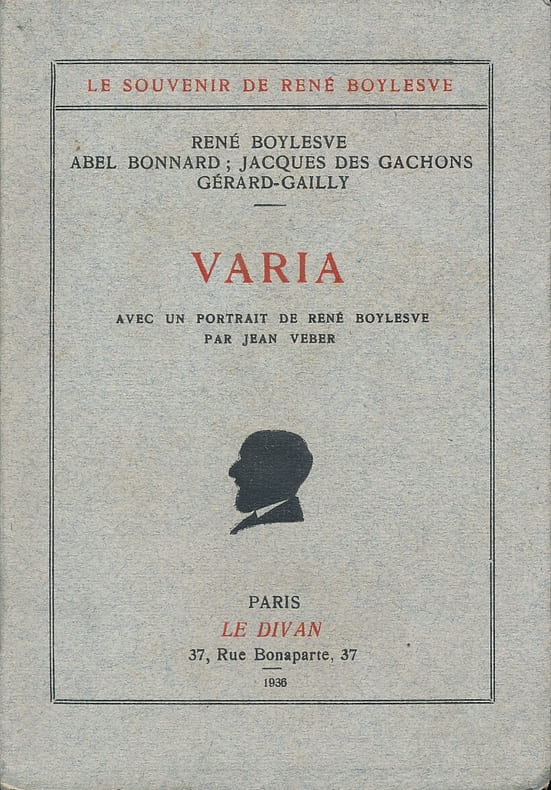
Le divan Paris, Le Divan, 1936. In-12 broché, couverture rempliée bleue - grise, imprimée en rouge et noir. Portrait de R. Boylesve par Jean Veber en frontispice, 99 pages. Edition originale, tirée sur papier pur fil Lafuma à 500 exemplaires, celui-cin °170. 8ème et dernier volume de la collection Le Souvenir de René Boylesve. Notes sur Pascal de René Boylesve, René Boylesve par Abel Bonnard, Souvenirs de la trentième année par Jacques des Gachons. René Boylesve, Alphonse Daudet et le premier prix Goncourt, par Gérard-Gailly. Bon étt
Reference : 140742
Toutes les expéditions sont faites en suivi au-dessus de 25 euros. Expédition quotidienne pour les envois simples, suivis, recommandés ou Colissimo.
Bookseller's contact details
Librairie Gil - Artgil SARL
Catherine et Caroline Gil
24 Bld Denys Puech
12000 Rodez
France
05 65 42 95 21
Payment mode


Sale conditions
Conformes aux usages de la librairie ancienne. Les prix sont nets. Frais de port en sus. Emballage gratuit. Les livres sont expédiés après réception du règlement en colis poste ou recommandé. <br />
5 book(s) with the same title
Oeuvres complètes publiées par Marc Chouet. I: Les recueils poétiques - II: Proses d'ici - III: Théâtre - IV: Théâtre -V: Varia.
Genève, Slatkine, 1982. 5 forts volumes in-8, titres et filets dorés, chaque volume comporte un frontispice. Infimes frottements aux reliures, belle condition générale.
LOT DE 4 CATALOGUES DE LA LIBRAIRIE LES DEUX MONDES - N°1 REGIONALISME 1984 + N°2 1985 VARIA + N°8 1987 VARIA + N°9 VARIA 1987.
LIBRAIRIE LES DEUX MONDES. 1984-1985-1987. In-8. Broché. Etat d'usage, Livré sans Couverture, Agraffes rouillées, Intérieur acceptable. 43 + 63 + environ 55 pages + environ 45 pages - textes sur deux colonnes.. . . . Classification Dewey : 56-Catalogue
N°1 REGIONALISME 1984 + N°2 1985 VARIA + N°8 1987 VARIA + N°9 VARIA 1987. Classification Dewey : 56-Catalogue


Varia Philippi Beroaldi opuscula in hoc Codice contenta. * Orationes: praelectiones; & Praefationes: & quaedam mithicae Historiae Philippi Beroaldi. * Item Plusculae Angeli Politiani; Hermolai Barbari atque una Iasonis Maini ad serenissimum Maximilianum invictissimum Rhomanorum imperatorem Oratio. * Epigrammata ac ludicra quaedam facilioris musae carmina eruditissimi viri Philippi Beroaldi ab Ascensio nuper eludicata: nunc demum coimpressa & eo ordine disposita, ut maxime moralia sint omnium prima. * L. Coelii Lactantii Firmiani pia Nenia verbis Christi domini crucifixi, sua in nos beneficia commemorantis. * Item Phi. Beroaldi de septem sapientium sententiis Libellus. * Eiusdem Symbola Pythagorae moraliter explicata. * De optimo statu, & de foelicitate. * Declamatio Philosophi medici & oratoris. * Declamatio ebriosi, scortatoris & aleatoris. * Oratio autem proverbialis caeteris apposita est.
N.pl. (Basel), n.d. (1513) (Colophon at the end: 'Orationes & Opuscula Philippi Beroaldi Bononien(sis) oratoris & poetae disertissimi finiu(n)t foeliciter Basileae exarata, Anno a partu Virginis salutifero, 1513)
8vo. 162 leaves. Modern half pigskin over wooden boards. 21 cm (Ref: VD16 B 2135; Renouard, Bibliographie des impressions et des oeuvres de Josse Badius Ascensius, II, p. 169 (Philippus Beroaldus, Varia Opuscula no. 6) (Details: Modern binding, antique style. On the upper board has been preserved an old (original?) strip of vellum, which bears a pattern of blindstamped 5 lozenges filled with doubleheaded aegles, above their heads a crown. 3 raised bands on the back. 2 clasps & catches. 2 small contemporary inscriptions of one hand on the title, both references to passages in the book: 'Asinus Asinius Pollio : 90' and ' Oeconomia : 123'; most capitals at the beginning of sentences are carefully rubricated; in the margins of the first 123 pages are written many short notes, mostly catchwords, with the same contemporary red ink. At the end in the same hand a kind of table of content in black ink. Occasional underlinings in red ink. According to VD16 is the printer of this book Gregor Barthelomaeus, a rather obscure printer) (Condition: title somewhat soiled; the blank verso of the last leaf has been pasted on a blank leaf, probably the flyleaf of the original. On the verso of this blank leaf is written the above mentioned table of content; faint waterstain in the upper margin of the last 18 leaves) (Note: This edition of smaller works of Beroaldus is a reissue of an edition of his 'Varia Opuscula', published in Basel in 1509 by Gregor Bartholomaeus and Wolfgang Lachner. This supports the assumption of VD16, that Gregor Bartholomaeus is (also) the publisher of this 1513 edition. In 1513 the publisher added at the end to the collection an interesting letter which Beroaldus wrote in 1505 to Erasmus Vitellius (Erasmus Ciolek), bishop of Plozk in Poland: 'Opusculum de terraemotu & pestilentia'. (Folia 146-162) In this letter Beroaldus describes the earthquake that hit his hometown Bologna on the first of January of 1505 (ea nocte quam subsecutus est dies divo Silvestro dicatus), its violent aftershocks and its consequences, e.g. the destruction of his own house, people gone mad, etc. (Hora circiter undecima, subitarius terraemotus cum sono terrifico factus, concussit urbem nostram. (f. 147 verso)) This editon of 1513 consists of a collection of speeches, treatises and Neolatin poetry of the Italian humanist classical scholar Filippo Beroaldo (Philippus Beroaldus), 1453-1505. It contains for the greater part prose, i.e. speeches on classical topics, and examples of oratory, including some pieces of Polizziano and Ermelao Barbaro. It contains also an essay on the sentences, or sayings of the Seven Wise Philosophers, and an important essay on the symbolism in the doctrine of Pythagoras. We find also some declamations, e.g. a witty conversation of a drunk and his friends, a whore-hopper and a gambler. There is also poetry, e.g 'Paeanes Beatae Mariae Virginis', which is a Latin adaptation of a number of poems of Petrarca, epigrams, but also verse in a lighter vein (facilioris musae). All poems are surrounded by commentary. Beroaldus was professor of literature of the University of Bologna, his native city, from 1472 till his death. He was widely known for his erudition. His most important contribution to scholarship are his good editions of Latin Classics. He published texts and excellent commentaries of Plinius Maior, Apuleius, Gellius, Suetonius, Catullus, Propertius and Plautus, editions in which he proved is vast knowledge and command of Latin literature, from the patristic authors to contemporary scholars. He was one of the founders a 'of new annotative, miscellanistic commentary style' His latinity was rebuked because his style resembled more that of Apuleius than of Cicero. Beroaldus compiled this collection and had it printed on the request (te impulsore) of 'Martinus Boemus', whom he calls in the short 'praefatio' on the verso of the title his pupil. This pupil is also known as Martin(us) Mares Martinus Crumloviensis. He studied 6 years under Beroaldus, from 1487 till 1493. Thereupon he returned home, to Krumlow in Bohemia. ('Filippo Beroaldo l'Ancien', S. Fabrizio-Coast & F. La Brasca, Bern, Lang, 2005, p. 8). The first edition of these speeches, called 'varia opuscula' was published in 1491 in Bologna, and was reproduced several times by the Parisian printer Badius Ascensius. The first editions produced by Ascensius from 1505 contained only the orations of Beroaldus, mostly on topics of classical philology, some on contemporary history. They fill the first 61 leaves of our 1513 edition. The second part of this book begins with the collection of verse. The unknown printer (probably Gregor Bartholomaeus) repeats on the verso of leaf 61 (in the edition of 1509 leaf 62) at the beginning of this second part simply (and shamelessly?) the title under which Ascensius had recently published (nuper) the poetry in Paris. The rest (the last 70 leaves) of the book is filled with philosophical letters, declamations and treatises of Beroaldus in Latin, which were likewise borrowed from previous editions of Ascensius, e.g. a declamation 'an orator sit philosopho & medico anteponendus', and other usefull subjects for humanist school education. At the very end have been added 11 p. with 'Annotationes in Galenum', because, so explains Beroaldus, much mention was made of Galenus in the preceding chapter on 'pestilentia'. Beroaldus must have been very popular in his time. The bibliography of Renouard on Ascensius numbers 74 different editions, of which 12 with the title 'varia opuscula', of his orations, declamations, letters and poetry in the first 20 years of the 16th century) (Provenance: The writer of the numerous red marginalia is unknown) (Collation: A-T8, V4, Y6 ) (Photographs on request)
Varia linguistica, Textes de Maupertuis, Turgot, Condillac, Du Marsais, Adam Smith rassemblés et annotés par Charles Porset, avec une préface de Michele Duchet.
Bordeaux, Ducros, 1970, pt in-8°, 356 pp, biblio, index, broché, bon état (Collection Ducros. Série Maior)
"La linguistique, comme d'autres disciplines humaines, ne s'est véritablement établie en science autonome qu'au XIXe siècle, dans le sillage de la grammaire comparée et de la grammaire historique. Auparavant – de Panini et d'Aristote à l'Encyclopédie –, les réflexions sur le langage avaient toujours été subordonnées à des préoccupations extérieures : religieuses, esthétiques, surtout philosophiques. Toute cette période « pré-scientifique » ou « métaphysique » de la linguistique a souffert au XXe siècle d'un long discrédit. Depuis quelques années, le vent tourne : la thèse de Chomsky sur la linguistique cartésienne, celles de Michel Foucault sur la grammaire générale et de Jean-Claude Chevalier sur l'histoire de la syntaxe ont ramené l'attention des spécialistes contemporains vers les efforts de leurs prédécesseurs. Le recueil de 'Varia linguistica' a le double avantage de répondre à une curiosité récente en facilitant la consultation de textes éparpillés et difficilement accessibles. A parcourir seulement le volume, on s'aperçoit que le problème majeur pour les philosophes-linguistes du siècle, leur véritable hantise, touchait l'origine du langage humain. Ils partagèrent l'illusion que l'étude des langues « primitives » devait conduire infailliblement à la solution, sans s'aviser que ces langues sont éloignées des parlers originels par des centaines, voire des milliers de millénaires. On aurait cependant mauvaise grâce à ironiser, car, sur ce chapitre, les linguistes, comme les profanes, en sont encore réduits aux hypothèses et aux spéculations, plus ou moins plausibles. En filigrane des 'Varia linguistica' se dessinent aussi la croyance, naïve assurément (Voltaire, dans 'L'Ingénu', en fit déjà bonne et malicieuse justice), à la supériorité obligée des langues occidentales, principalement du français, et la nostalgie d'un idiome parfaitement logique dans ses constructions, méritant donc un statut universel. L'honnête homme d'aujourd'hui découvrira enfin, dans des pages trop négligées, plusieurs prémonitions saisissantes, par exemple de Schleicher et de Humboldt (p. 139), de Bergson (p. 65, xxxi), même de Saussure (p. 151-152)..." (Marc Wilmet, Dix-Huitième Siècle, 1972) Désormais les frais d'envoi sont de 6 € seulement pour les livres jusqu'à 1 kg (colissimo suivi), pour la France métropolitaine.
Reference : alb34b693ccc1cc6815
Lifschitz M. Varia. In Russian (ask us if in doubt)/Lifshits M. Varia.
Lifschitz M. Varia. In Russian (ask us if in doubt)/Lifshits M. Varia.. M. Grundrisse 2010. 172s. SKUalb34b693ccc1cc6815.

