 Write to the booksellers
THUCYDIDIS
Historiae
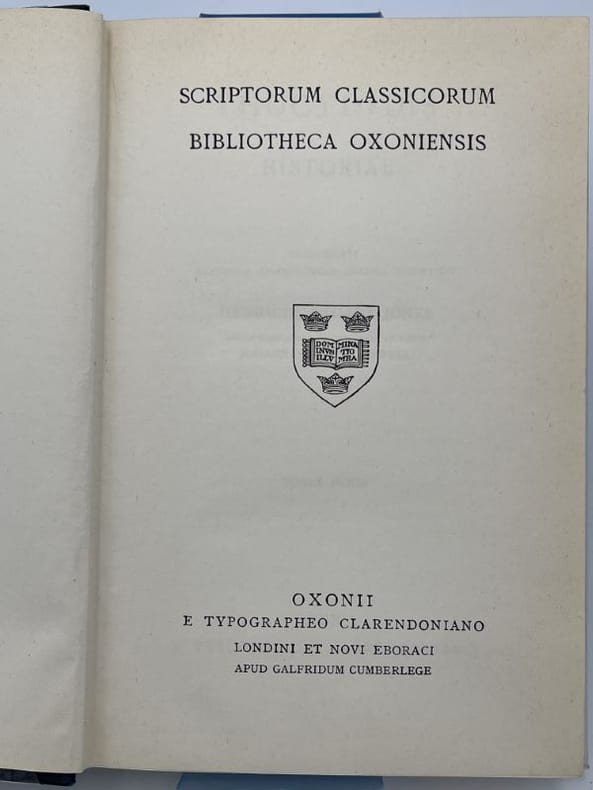
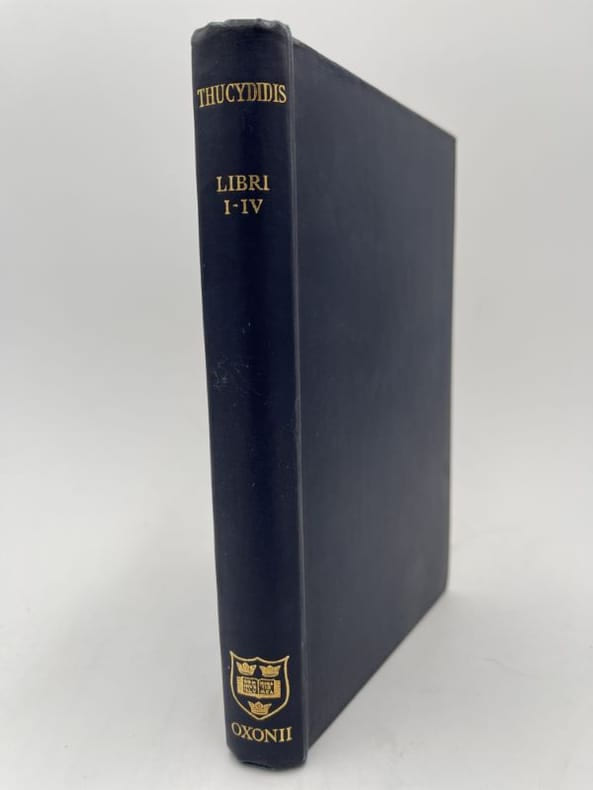
typographeo Clarendoniano Oxonii, typographeo Clarendoniano, 1948. In-12 relié cartonnage éditeur bleu. Texte en grec. Très bon état
Reference : 120627
Toutes les expéditions sont faites en suivi au-dessus de 25 euros. Expédition quotidienne pour les envois simples, suivis, recommandés ou Colissimo.
Bookseller's contact details
Librairie Gil - Artgil SARL
Catherine et Caroline Gil
24 Bld Denys Puech
12000 Rodez
France
05 65 42 95 21
Payment mode


Sale conditions
Conformes aux usages de la librairie ancienne. Les prix sont nets. Frais de port en sus. Emballage gratuit. Les livres sont expédiés après réception du règlement en colis poste ou recommandé. <br />
5 book(s) with the same title
Eusebii Pamphili, Ruffini, Socratis, Theodoreti, Sozomeni, Theodori, Euagrij, & Dorothei Ecclesiastica Historia. Sex prope seculorum res gestas complectens; Latine olim a doctissimis viris partim scripta, partim e Graeco a clarissimis viris, Vuolfgango Musculo, Ioachimo Camerario & Iohanne Christophersono Britanno, eleganter conversa; et nunc ex fide Graecorum codicum, sic ut novum opus videri possit, per Ioan. Iacobum Grynaeum locis obscuris innumeris illustrata, dubijs explicata, mutilis restituta; Chronographia insuper Abrahami Bucholceri, ad Annum Epochae Christianae 1598. & lectionis sacrae historiae luculenta Methodo exornata. Cum continuatione in praesentem annum 1611. Et indicibus rerum verborumque locupletiss.
Basel (Basileae), Per Sebastianum Henricpetri, n.d. (1611)
Folio. (LXXX),807,(1 blank),(23 index),(1) p. Overlapping vellum 34 cm (Ref: VD17 23:297069D; Hoffmann 2,107) (Details: Latin translation only. Woodcut printer's mark on the title; 'From 1496 until the seventeenth century, the Petris printed in Basel, and for three generations--Adam Petri, Heinrich Petri, and Sebastian Henripetri--the printers mark alluded to the family name: a stone being smashed by a godlike hammer over which fire is blown by a heavenly face. The symbolism is explained by the biblical motto (Hieremias Propheta, 23,29) printed in Greek, Latin, and Hebrew in some books, 'numquid non verba mea sunt quasi ignis ait Dominus, et quasi malleus conterens petram', 'Is not my Word like fire, like a hammer that shatters stone?' (Source: University Library Illinois, webpage 'Windows Printers' Marks') The printer's mark is repeated on the last page. One woodcut headpiece. Some woodcut initials) (Condition: Vellum soiled, some small brown stains on the upper board. Paper somewhat yellowing. Bookplate on front flyleaf. Short title in ink on the back) (Note: The church father Eusebius Caesariensis, ca. 260-339, was elected to the see of Caesarea in Asia Minor, nowadays Kayseri, in 313 A.D. He had an impressive ecclesiastial career, but his literary achievements made him immortal. His important 'Historia Ecclesiastica' (History of the Church) runs up to 324; The object of this work was to present the apostolic 'succession' of the 4 great episcopal thrones, Rome, Alexandria, Antioch and Jerusalem, and to describe the intellectual, spiritual and institutional life of the Church, the persecutions and the heresies. 'It cannot be too strongly emphasised that Eusebius, like all early church historians, can be understood only if it be recognized that whereas modern writers try to trace the development, growth and change of doctrines and institutions, their predecessors were trying to prove that nothing of the kind ever happened. According to them the Church had had one and only one teaching from the beginning. It had been preserved by the 'succession', and heresy was the attempt of the devil to change it'. (Eusebius, the Ecclesiastical History, With an English transl. by K. Lake, Cambr. Mass., 2001, vol.1, p.XXXIV) The Latin West came to know this Greek work through the translation of 403 by Rufinus of Aquileia. The 'Historia Ecclesiastica' was first published, together with the works of the later church historians Socrates Scholasticus, Sozomenus and Theodoretus in Paris in 1544 by Robertus Stephanus. The editor of our Latin edition of 1611 is the Swiss theologian and classical scholar Joannes Jacobus Grynaeus, 1540-1617, professor at the University of Basel. He was more a theologian than a philologist. In 1570 he had already published for Henricpetri a Latin translation of the 'Opera Omnia' of Eusebius. (GG 421) In the same year, 1570, a separate edition of Grynaeus' Latin translation of the 'Historia Ecclesiastica' was published by the Basler printer Episcopius. (GG 416) Hoffmann says that our 1611 edition is a repetition of the 'Historia Ecclesiastica' edition of 1570. This cannot be correct. The titles are different, and the edition of 1611 has a preface dated 1587. We found in VD16 an edition (not mentioned by Hoffmann), with exact the same title as the one of 1611, and published in 1587 in Basel by Episcopius ( VD16 ZV 5530, also BL shelfmark 3627.ff.4). The only difference being that the 'Chronographia' at the end of the book has been continued till 1611). So this edition of 1611 is a reissue of the Basel edition of 1587, which was brought on the market by Eusebius Episcopius. This title contains Eusebius' 'Historiae Ecclesiasticae libri X', and 'De vita Constantini Magni', translated by Johannes Christophorsonus (John Christopherson), and the 'Oratio Constantini Imperatoris', and Rufinus' 'Historiae Ecclesiasticae libri II', and a Latin translation of Socrates Scholasticus' 'Ecclesiasticae Historiae libri VII', and Theodoretus' 'Historiae Ecclesiasticae libri V', translated by Joachim Camerarius, and a Latin translation of Sozomenus' 'Ecclesiasticae Historiae libri IX', and Euagrius Scholasticus' 'Historiae Sacrae libri VI', and Dorotheus Lector's 'Quomodo apostoli et prophetae vixerint ac mortui sint', translated by Wolfgang Musculus. At the end (p. 625/807) has been added the 'Chronologia' or 'Index Chronologicus' of the German historian and theologian Abraham Buch(h)olzer up to 1611) (Provenance: A modern bookplate with the text: 'Ex libris Henn Wolfram Riedesel Freiherr zu Eisenbach'. At the top a part of the coat of arms of the Riedesel family, the head of a donkey, with 3 reed leaves in its mouth. The Riedesel Freiherren zu Eisenbach family belongs to the ancient nobility in Hesse, Germany) (Collation: alpha8, alpha6, beta6, gamma6, delta6, epsilon8; a-z6 A-Z6 Aa-Vv6 Xx8, Yy-Zz6) (Photographs on request) (Heavy book, may require extra shipping costs)
Sulpitii Severi Aquitani Sacrae Historiae a mundi exordio ad sua usq; tempora deductae, libri duo; item Dorothei Episcopi Tyri, qui sub Constantino Magno vixit, De vita Prophetarum & Apostolorum, Synopsis. Quibus accessit rerum & verborum index copiosus.
Paris (Parisiis), Apud Gulielmum Guillard & Almaricum Warencore, 1560.
Small 8vo. (XXXII),156,(2 blank);(24 index) p. Modern hardbound binding. 13.5 cm 'A universal chronicle which is an important source for the history of 4th-century events' (Ref: USTC 153005; Ebert 22005; Schoenemann 2,378/79) (Details: Back with 4 raised bands, and with a gilt short title in the second 'compartment') (Condition: Old inscriptions on the front flyleaf. Front flyleaf worn, thumbed and dustsoiled. Title also thumbed and dustsoiled, and with an old ownership entry and shelf number) (Note: The Latin historian Sulpicius (or Sulpitius) Severus was born in Aquitania ca. 360 A.D. He organized under the influence of Bishop Martinus of Tours a sort of monastic life on his own estate for himself and his friends. His extant works are a 'vita S. Martini Turonensis', and this 'Sacrae Historiae', a kind of universal chronicle to A.D. 402, 'which is an important source for the history of 4th-century events, (...). The whole book is an interesting attempt to present a 'breviarium' of history from the Christian point of view: it uses Christian chronographers, especially St. Jerome, but also Pagan writers. J. Bernays suggested that for the destruction of Jerusalem in A.D 70 Sulpicius followed the lost account of Tacitus. Sallust and Tacitus are his models in the matter of style'. (OCD, 2nd 3d. p. 983) The 'Sacrae Historiae' were first published in Basel in 1556 by the Ilyrian protestant scholar Mat(t)hias Flacius, the latinized slavic name Vlacich, from a old manuscript found in a library in Hildesheim. Flacius, 1520-1575, who taught Hebrew in Wittenberg and the New Testament in Jena, was a pupil and lifelong supporter of Luther. Flacius dedicated his book to the Polish duke Nicolaus Radziuilius, who was a great patron of the Lutherans. (Neue Deutsche Biographie 5 (1961), p. 220-222) Schoenemann's opinion is that Flacius 'accurata fide hos libros exprimendos curavit'. (Schoenemann p. 378) The next edition of the 'Sacrae Historiae', this edition, appeared a few years later, in Paris in 1560. In the 32 page 'praefatio' to this edition, which is in fact a ferocious attack against Lutheranism, that brought nothing but 'latrocinia, furta, praedationes, adulteria, usurae, homicidia & id genus alia flagitia' (p. 2* recto), written by one 'Iacobus Faber doctor theologus, Sorbonicus' we are told that he (Faber) published this work to strengthen the spirit of the Catholics against the heresy of the Reformation, that was raging through Europe, and especially Germany. (p. *3 recto) Faber suggests that he found and edited the text of the 'Sacrae Historiae' himself. ('cuius sacram historiam cum in publicum omnium catholicorum commodum evulgare ex mediis antiquorum seculorum abditissimis scriniis erutam cogitaremus', p. 2*3 recto & verso) Schoeneman explains that the catholic professor of the Sorbonne was a common thief, who misappropriated the edition of his protestant precursor Flacius, without any acknowledgment. ('partam Matthiae Flacio gloriam suffurari non erubuit', Schoenemann p. 379). Schoenemann calls the praefatio of Faber nothing but 'emendicatus pannus', 'begged for rags' (pun for 'emendicatus panis'?) (Provenance: On the title: 'Conv.s ff. erem. s. Aug.ni Bruxell. 1610', indicating that the book once belonged to the convent of the Order of the Eremites of St. Augustine in Brussels. On the front flyleaf the old names: 'Van den Boom', and 'P. v(an)d(en) Hoogen ex Horsten, 18/12/'25') (Collation: *-2*8, A-T8, V4 (last leaf V4 blank), +8, 2+4)(Photographs on request)
SCHEUCHZER, Johann Jacob 1672-1733 / Le Long, Jacques, (1665-1721):
Reference : 50315aaf
Bibliotheca scriptorum historiae naturalis omnium terrae regionum inservientum. Historiae naturalis Helvetiae prodromus. Accessit ... Jacobi Le Long, ... de scriptoribus historiae naturalis Galliae. Collegit Joh. Jacobus Scheuchzer.
Tiguri (Zürich), typs Heideggeri, 1751, in-8vo, 7 Bl. + 241 S. (S. 213 bis 230: Jacobi Le Long, ... de scriptoribus historiae naturalis Galliae; S. 231 bis 241: Index authorum), teils etwas gebräunt, späterer Ganzlederband auf Bünden im Stil der Zeit, vergold. Titel a.d. Rücken, marmorierter Schnitt. Schönes Exemplar.
Zweite Ausgabe. Die erste Bibliographie, die Bücher der ganzen Welt auf dem Gebiet der Naturgeschichte auflistet. Index titulorum: - Hispania. Portugallia. - Gallia. Sabaudia. - Germania. - Belgium foederatum. - Helvetia. - Italia. - Pannonia. - Carinthia Carniola. - Hungaria. - Polonia. - Dania. Suedia. - Britannia .- Sicilia. Melita. Corsica. Sardinia. - Asia. Africa. America. Die Erstausgabe erschien 1716.“In Switzerland, the Gesnerian tradition for natural history was maintained through the work of his fellow-Zürcher Johann Jakob Scheuchzer. Scheuchzer's key published contribution was «Bibliotheca scriptorum historiae naturalis» (1716; reissued 1751), written preliminary to a fuller study of Swiss natural history. Its primary arrangement was therefore geographical; titles were arranged chronologically under authors in each section. As such, it was the first worldwide geographical guide to natural history works - including floras” (David G. Frodin, Guide to Standard Floras of the World, page 4).

(SLACES, NVVA)
Phone number : 41 (0)26 3223808
Historiae ecclesiasticae scriptores graeci. Graecolatine nunc primum editi, ex interpretatione Iannis Christophorsoni Angli Cicestrensis quondam Episcopi, & recognitione Suffridi Petri I clarissimi, una cum variis lectionibus & additionibus codicum, quibus hic interpres usus est, suis locis insertis: aliis item variis lectionibus ex doctissimorum nostrae aetatis virorum exemplaribus, ad oram cuiusque pagine fideliter relatis, adeo ut quicquid siue in dictionibus, sine in sententiis universae historiae Graecae obscurum, deprauatum, mancum atque imperfectum hactenus suit, nunc illustratum, restitutum,& omnibus suis numeris ac partibus abselutum, adiecto rerum memorabilium Indice locupletissimo, prodeat. Relié avec: Theodoriti episcopi Cyri ecclesiasticae historiae Libri Quinque.
Coloniae Allobrogum (Genève), Excudebat Petrus de la Rouiere 1612, 355x235mm, Scriptores graeci, Nempe, Eusebii, cognomento Pamphili, Caesareae Palaestinae Episcopi, historiae Ecclesisticae, libri X. Eiusdem de vita Constantini Magne, lib. IIII. Constantini Magni oratio ad fanctorum coetum, Eiusdem Eusebii oratio in laudem Constantini Magni, ad trigesimum illius Imperii annum, ex Bibliotheca Palatina nunc primum Graece in lucem missa. Socratis Scholastici Constantinopolitani historiae Eccles., lib. VII. Theodori ti Cyrensis Episcopi, lib. V. Theodori Lectoris collectaneorum, lib. II. Hermiae Sozomeni Salaminii, lib. IX. Euagrii Scholastici Epiphanensis, lib. VI. Edition bilingue: grec ancien et latin, bandeaux, lettrines, 6ff. + 768 pages + 629 pages + 13 ff., reliure demi-parchemin à coins. Pièce de titre doré au dos. Plats papier marbré. Quelques très petits trous au dos. Quelques pages brunis.
Pour un paiement via PayPal, veuillez nous en faire la demande et nous vous enverrons une facture PayPal
FLORUS Lucius Annaeus , VELL(EIUS) PATERCULUS C(aius) , AUR(ELIUS) VICTOR Sex(tus) , RUFUS FESTUS Sextus , MESSALA CORVINUS , EUTROPIUS , PAULUS DIACONUS , CASSIODORUS M(agnus) Aur(elius) , JORNANDES , EXUPERANTIUS Julius
Reference : 600
HISTORIAE ROMANAE EPITOMAE Lucii Julii Flori , C. Vell. Paterculi , Sex. Aur. Victoris , Sexti Rufi Festi , Messalae Corvini , Eutropii , Paulli Diaconi , M. Aur. Cassiodori Iornandis & Julii Exuperantii.
Amsterodami apud Ioam Ianssenium 1647 1 vol. 501 pp. dont titre-frontispice . En latin . Contient : L. Julii Flori Historiae Romanae libri quatuor ; Caii Velleii Paterculi Historiae Romanae ad M. Vinicium cos. libri duo ; Sex. Aurelii Victoris Historiae Romanae Breviarium avec Origo gentis Romanae , De viris illustribus urbis Romae , Additamentvm , De Caesaribus , et Epitome de vita et moribus imperatorum Romanorvm ; Sexti Rufi Festi v. c. breviarium rerum gestarum Populi Romani ; Messalae Corvini ad Octavianum Augustum de progenie sua libellvs ; Eutropii v. c. breviarium historiae Romanae ab urbe condita ad annum ejusdem urbis MCIX (...) per Eliam Vinetum Santonem livres I à X ; Pauli Diaconi de gestis Romanorum ad Eutropii Historiam additus livres XI à XVIII ; Ex Magni Aurelii Cassidori chronico ad Theodoricum regem ; Regni Romanorum successio ex Iornandis libro I de regnorum ac temporum successione ; Ivlii Exvperantii opusculum de Marii , Lepidi ac Sertorii bellis civilibus ; De mensuris et ponderibus . Frontispice gravé représentant un empereur portant l' orbe et un roi ( ostrogoth ? ) surmonté d' une série de petits médaillons et de l' aigle romaine .

