 Write to the booksellers
FUNCK-BRENTANO (Frantz).
La Renaissance.
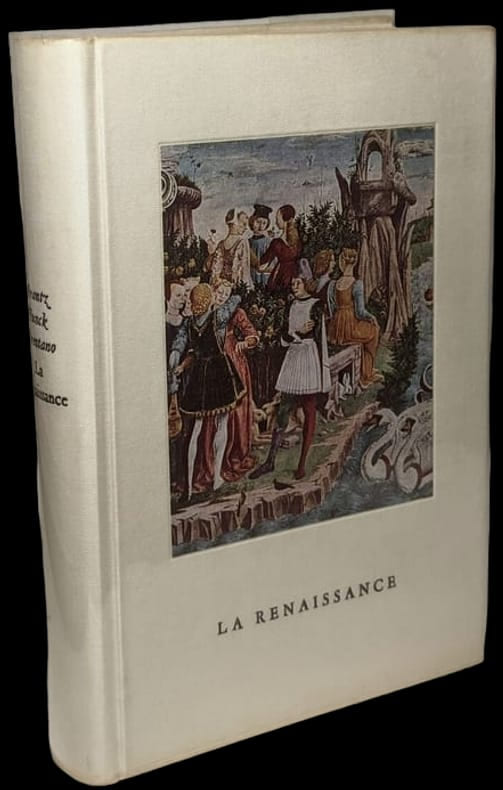
Club des Libraires de France, 1961, in-8°, 422 pp, 40 pl. de gravures et fac-similés hors texte (certaines dépliantes), biblio, tirage numéroté sur vélin blanc, reliure pleine soie blanche de l’éditeur, une vignette en couleurs au premier plat (maquette de Pierre Faucheux), rhodoïd, signet, bon état. Jolie édition
Reference : 55523
Edition illustrée de portraits, de scènes et de documents empruntés à l'art italien et à l'art français de la Renaissance. — "Admirateur de l'art spontané et puissant du Moyen Age, M. Funck-Brentano ne s'enthousiasme pas pour la Renaissance, « cette immense réaction contre la vie sociale, politique, intellectuelle et artistique du Moyen Age ». Le triomphe du rationalisme, caractéristique essentielle de cette réaction, comme de la Révolution française, lui semble comporter au moins autant d'inconvénients que d'avantages. Il affirme sa conviction qu'un peuple « fait une bêtise » en reniant ses traditions naturelles, concrètes, pour s'attacher à une tradition factice et abstraite, – ce qui ne l'empêche pas, avec beaucoup de liberté d'esprit, de défendre la politique italienne de François Ier, de goûter fort la docte sagesse d'Erasme, et d'aller jusqu'à témoigner de l'indulgence pour Alexandre VI. (...) Le chapitre consacré au Concordat se range parmi les meilleurs. (...) Le livre repose sur une lecture étendue, il témoigne d'un sens aigu du passé, il fait réfléchir, il est écrit d'une plume personnelle et vivante. Il mérite d'être lu." (H. Waquet, Revue d'histoire de l'Eglise de France) Désormais les frais d'envoi sont de 6 € seulement pour les livres jusqu'à 1 kg (colissimo suivi), pour la France métropolitaine.
Bookseller's contact details
Pages d'Histoire - Librairie Clio
Clio Histoire
8, rue Bréa
75006 Paris
France
01 43 54 43 61
Payment mode


Sale conditions
Conditions de vente conformes aux usages du Syndicat de la Librairie Ancienne et Moderne. Les livres sont garantis complets et en bon état sauf mention contraire. Les prix sont nets et payables en euros. L'envoi des ouvrages par la Poste est en sus. Un envoi prioritaire sous enveloppe matelassée ou étui carton rigide (colissimo suivi) est de 3 euros pour la France (colissimo suivi), 14 euros pour la communauté européenne, 16 euros pour le reste de l'Europe et 30 euros pour le Canada et les USA. Ce tarif est basé sur celui d'un livre pesant 1 kilogramme. Si le livre commandé dépasse ce poids, il peut être un peu plus élevé. Les expéditions se font après réception du règlement, par Carte Bancaire (Eurocard, Mastercard, Visa, par Chèque sur une banque française, ou par Virement bancaire. SARL F. BLAYO - PAGES D'HISTOIRE LIBRAIRIE CLIO 8 rue BREA 75006 PARIS Etablissement : 20041, Guichet : 01012, N° de compte : 4322878W033, clé RIB : 45 IBAN Identifiant international de compte : FR94 2004 1010 1243 2287 8W03 345 Bank Identifier Code (BIC) : PSSTFRPPSCE Domiciliation : LA BANQUE POSTALE -- CENTRE FINANCIER DE LA SOURCE Il est bien sûr toujours possible de passer chercher le livre à la librairie. Il est recommandé de téléphoner ou de nous envoyer un email pour vérifier la disponibilité du ou des livres demandés. L'exécution des commandes téléphonées est garantie mais sans règle absolue, la disponibilité des livres n'étant pas toujours vérifiable lors de l'appel. Au delà de huit jours sans règlement effectué les livres réservés seront remis en vente.
5 book(s) with the same title
D'Or et d'Ãclat. Le bijou à la Renaissance
Rohou, Julie: D'Or et d'Ãclat. Le bijou à la Renaissance. 2025. 240 pages, 171 illustrations. Hardback. 28 x 24cms. A catalogue of 122 pieces of 16th-century European jewelry. 7 essays discuss its history, the incorporation of gems and enamel, portraits of goldsmiths and representations of workshops, the jewelry trade, lead and paper jewelry, the crown of Christian IV of Denmark, and the jewelry chest of Margaret of Valois, Queen of France. The catalogue is split into 5 parts: in the master goldsmith's workshops, the renaissance of adornment, jewelry and power, devotional and amulet jewelry, and the 19th-century Renaissance. Text in French.
A catalogue of 122 pieces of 16th-century European jewelry. 7 essays discuss its history, the incorporation of gems and enamel, portraits of goldsmiths and representations of workshops, the jewelry trade, lead and paper jewelry, the crown of Christian IV of Denmark, and the jewelry chest of Margaret of Valois, Queen of France. The catalogue is split into 5 parts: in the master goldsmith's workshops, the renaissance of adornment, jewelry and power, devotional and amulet jewelry, and the 19th-century Renaissance. Text in French

Renaissance Venice, Islam and Mahmud the Kurd: a metalworking enigma
Auld, Sylvia: Renaissance Venice, Islam and Mahmud the Kurd: a metalworking enigma. London: Altajir World of Islam Trust, 2004. 350pp with 210 monochrome illustrations. Cloth. 26.8x20.7cms. The name of Mahmud the Kurd (probably an itinerant master craftsman working in the second half of the 15th century) has been found on ten small, domestic objects of brass. All are exquisitely worked with intricate arabesques. On one, his signature appears in two forms in Arabic (or Persian), and in transliterated Roman script. Why? For whom was he working, and where? These are the questions which this book tries to answer. The widespread links between Renaissance Europe and Islam, which emerge as part of the trail, may come as a surprise to some readers. The objects listed in this book are not only fascinating in themselves but can be seen as a microcosm of the international exchanges and excursions of the period. Later, in 19th-century Europe, it was even assumed that Mahmud (and others working in the same style) were employed in Venice . This seems improbable following research in the archives, but so far no satisfactory explanation has been offered for Mahmud's double-language signature. Close examination of the objects shows that there are in fact three distinct styles. In the 15th century, against a backdrop of diplomatic intrigue in the face of Ottoman victories, Venice promoted links with their rivals, the Turcoman 'White Sheep' dynasty, whose capital then was at Tabriz . This explains a Persian element in the decorative detail of the first stylistic group. Some of the objects of a second group include a European shield as part of their decoration. Despite renewed papal bans, European trade with Islam continued unabated in the Eastern Mediterranean; Venice was the prime port for this commercial activity, and this accounts for the appearance of this second, Mamluk, group. The admiration in Europe and more particularly in Italy for the high quality of Islamic inlaid work explains the details of a third, western, group. Men like Benvenuto Cellini not only set out to emulate this technique, which they called 'azzimina, but to prove that they could do better.
The name of Mahmud the Kurd (probably an itinerant master craftsman working in the second half of the 15th century) has been found on ten small, domestic objects of brass. All are exquisitely worked with intricate arabesques. On one, his signature appears in two forms in Arabic (or Persian), and in transliterated Roman script. Why? For whom was he working, and where? These are the questions which this book tries to answer. The widespread links between Renaissance Europe and Islam, which emerge as part of the trail, may come as a surprise to some readers. The objects listed in this book are not only fascinating in themselves but can be seen as a microcosm of the international exchanges and excursions of the period. Later, in 19th-century Europe, it was even assumed that Mahmud (and others working in the same style) were employed in Venice . This seems improbable following research in the archives, but so far no satisfactory explanation has been offered for Mahmudâs double-language signature. Close examination of the objects shows that there are in fact three distinct styles. In the 15th century, against a backdrop of diplomatic intrigue in the face of Ottoman victories, Venice promoted links with their rivals, the Turcoman âWhite Sheepâ dynasty, whose capital then was at Tabriz . This explains a Persian element in the decorative detail of the first stylistic group. Some of the objects of a second group include a European shield as part of their decoration. Despite renewed papal bans, European trade with Islam continued unabated in the Eastern Mediterranean; Venice was the prime port for this commercial activity, and this accounts for the appearance of this second, Mamluk, group. The admiration in Europe and more particularly in Italy for the high quality of Islamic inlaid work explains the details of a third, western, group. Men like Benvenuto Cellini not only set out to emulate this technique, which they called âazzimina, but to prove that they could do better. Text in English
Davies, Glyn and Kirstin Kennedy (eds)
Reference : 091555
(2009)
ISBN : 9781851775798
Medieval and Renaissance Art: People and Possessions
Davies, Glyn and Kirstin Kennedy (eds): Medieval and Renaissance Art: People and Possessions. London: 2009. 320 pages, 350 colour illustrations. Hardback. 29cms. Published to accompany the opening of the Medieval and Renaissance galleries at the Victoria and Albert Museum this book provides the background and context for the objects that will be on display. Ornament, religious art and the body are looked at in relation to the makers, workshops, patrons and the prevailing links to and influence of the classical past.
Published to accompany the opening of the Medieval and Renaissance galleries at the Victoria and Albert Museum this book provides the background and context for the objects that will be on display. Ornament, religious art and the body are looked at in relation to the makers, workshops, patrons and the prevailing links to and influence of the classical past. Text in English
The Cabinet of Eros. Renaissance Mythological Painting and the Studiolo of Isabella d'Este
Campbell, Stephen J.: The Cabinet of Eros. Renaissance Mythological Painting and the Studiolo of Isabella d'Este. London and New Haven: 2006. 240pp with 30 colour and 100 monochrome illustrations. Cloth. 25.4x19cms. Re-examines the function of the mythological image, and in particular the accommodation of Eros as a central concern, within the Renaissance culture of readers and collectors, as exemplified by the seven paintings in the Studiolo of Isabella d' Este (1474-1539) in Mantua, which contained masterpieces by Correggio, Mantegna and Perugino amongst others.
Re-examines the function of the mythological image, and in particular the accommodation of Eros as a central concern, within the Renaissance culture of readers and collectors, as exemplified by the seven paintings in the Studiolo of Isabella d' Este (1474-1539) in Mantua, which contained masterpieces by Correggio, Mantegna and Perugino amongst others. Text in English
The Wyvern Collection. Medieval and Renaissance Enamels and Other Works of Art
Williamson, Paul: The Wyvern Collection. Medieval and Renaissance Enamels and Other Works of Art. London: 2021. 512 pages, 400 illustrations in colour. Hardback. 23 x 28cms. Fourth volume of the Wyvern Collection, focused on European enamels from the twelfth to the sixteenth centuries. With a catalogue of 120 entries divided in early medieval works of art, romanesque enamels, Limoges enamels, gothic and renaissance works of art, stained and painted glass, Limoges painted enamels, ceramics, textiles and tapestry, later works of art. An appendix covers works that were omitted from the first two catalogues..
Fourth volume of the Wyvern Collection, focused on European enamels from the twelfth to the sixteenth centuries. With a catalogue of 120 entries divided in early medieval works of art, romanesque enamels, Limoges enamels, gothic and renaissance works of art, stained and painted glass, Limoges painted enamels, ceramics, textiles and tapestry, later works of art. An appendix covers works that were omitted from the first two catalogues.. Text in English

