 Write to the booksellers
ARNAUD (René).
Le 2 décembre.
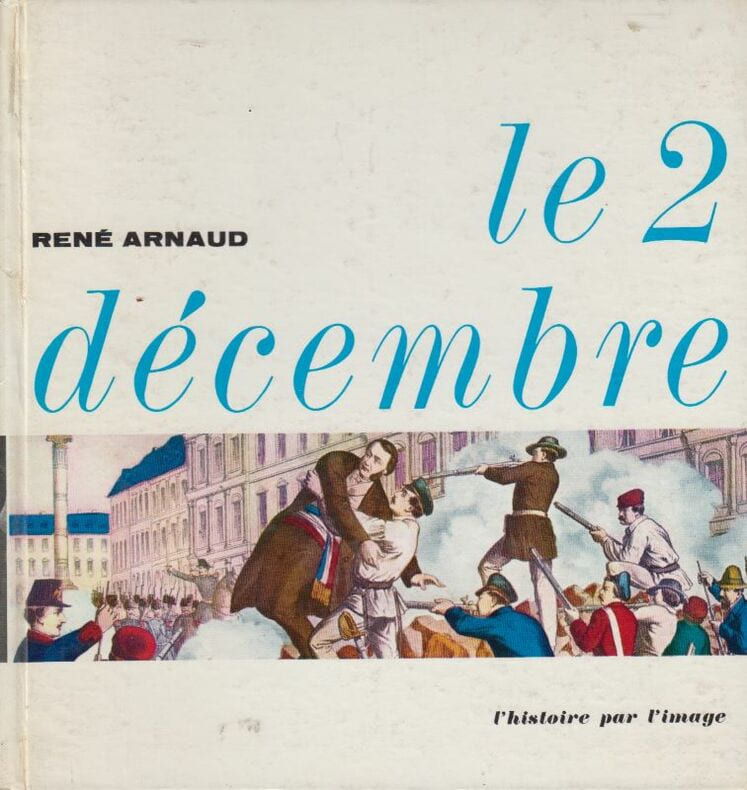
Hachette, 1967, in-8° carré, 155 pp, abondamment illustré de 94 gravures et reproductions d'affiches dans le texte et à pleine page, cart. illustré de l'éditeur, bon état (Coll. L'histoire par l'image)
Reference : 5079
Le coup d'Etat du 2 décembre 1851 est l’acte par lequel, en violation de la légitimité constitutionnelle, Louis-Napoléon Bonaparte, Président de la République française depuis trois ans, conserve le pouvoir à quelques mois de la fin de son mandat, alors que la Constitution de la Deuxième République lui interdisait de se représenter. — Table : A l'Elysée, le soir du 1er décembre 1851 – L'exécution du coup d'Etat – L'Assemblée contre le Président – Paris se soulève – La fusillade du boulevard – Les soulèvements en province – La répression – Le plébiscite approuve le coup d'Etat. Désormais les frais d'envoi sont de 6 € seulement pour les livres jusqu'à 1 kg (colissimo suivi), pour la France métropolitaine.
Bookseller's contact details
Pages d'Histoire - Librairie Clio
Clio Histoire
8, rue Bréa
75006 Paris
France
01 43 54 43 61
Payment mode


Sale conditions
Conditions de vente conformes aux usages du Syndicat de la Librairie Ancienne et Moderne. Les livres sont garantis complets et en bon état sauf mention contraire. Les prix sont nets et payables en euros. L'envoi des ouvrages par la Poste est en sus. Un envoi prioritaire sous enveloppe matelassée ou étui carton rigide (colissimo suivi) est de 3 euros pour la France (colissimo suivi), 14 euros pour la communauté européenne, 16 euros pour le reste de l'Europe et 30 euros pour le Canada et les USA. Ce tarif est basé sur celui d'un livre pesant 1 kilogramme. Si le livre commandé dépasse ce poids, il peut être un peu plus élevé. Les expéditions se font après réception du règlement, par Carte Bancaire (Eurocard, Mastercard, Visa, par Chèque sur une banque française, ou par Virement bancaire. SARL F. BLAYO - PAGES D'HISTOIRE LIBRAIRIE CLIO 8 rue BREA 75006 PARIS Etablissement : 20041, Guichet : 01012, N° de compte : 4322878W033, clé RIB : 45 IBAN Identifiant international de compte : FR94 2004 1010 1243 2287 8W03 345 Bank Identifier Code (BIC) : PSSTFRPPSCE Domiciliation : LA BANQUE POSTALE -- CENTRE FINANCIER DE LA SOURCE Il est bien sûr toujours possible de passer chercher le livre à la librairie. Il est recommandé de téléphoner ou de nous envoyer un email pour vérifier la disponibilité du ou des livres demandés. L'exécution des commandes téléphonées est garantie mais sans règle absolue, la disponibilité des livres n'étant pas toujours vérifiable lors de l'appel. Au delà de huit jours sans règlement effectué les livres réservés seront remis en vente.
5 book(s) with the same title
Le bombardement de Scarborough (16 décembre 1914). Le combat du Dogger-Bank (24 janvier 1915)
État : Bon état - Année : 1931 - Format : in 8° - Pages : 233pp - Editeur : Payot - Lieu d'édition : Paris - Type : Broché-cousu - Divers : Couv très légèrement frottée. Un mors fendu en pied sur 1cm. Une signature en travers de la page de titre. Ouvrage solide et intérieur propre. - Collection : Mémoires, études et documents pour servir à l'Histoire de la Guerre mondiale. - Commander rapidement : https://www.bons-livres.fr/livre/anonyme/7571-le-bombardement-de-scarborough-16-decembre-1914-le-combat-du-dogger-bank-24-janvier-1915?lrb
La guerre navale 1914 - 1918 d'après le Service Historique de la Marine allemande. Traduit et présenté par R. Jouan, Capitaine de Corvette. Avec 16 croquis. Lors d'une opération navale au début de la Grande Guerre, en décembre 1914, il apparaît que les Allemands parviennent à bombarder les ports de la cote est du Royaume-Uni avec une certaine facilité. Cette opération fait l'objet de la première partie de cet ouvrage établie à partir des archives allemandes. Mais les Britanniques vont réagir lorsqu'ils apprennent que l'Amiral Hipper entreprend un autre raid en janvier 1915: C'est la bataille de Dogger-Bank, dans cet ouvrage, vue par les Allemands.
Les Saints. Nos frères. Tome 4. Octobre - Décembre
État : Très bon état - Année : 1971 - Format : in 8° - Pages : 215pp - Editeur : Beauchesne - Lieu d'édition : Paris - Type : Broché - Commander rapidement : https://www.bons-livres.fr/livre/frere-severin-georges-couneson/4759-les-saints-nos-freres-tome-4-octobre-decembre?lrb
Le nouveau calendrier romain a surpris plus d'un lors de sa première diffusion au prinptemps 1969. Pourtant, l'auteur nous montre que ce sont les mêmes saints qui sont honorés par l'Eglise catholique romaine mais à des jours parfois différents. Pour nous aider à nous y retrouver l'auteur nous donne un calendrier pour chaque jour avec une courte biographie des saint fêtés ce jour. Tome 4. Calendrier octobre - décembre.
Mes cahiers. Tomes 9. Février 1911 à décembre 1912
État : Bon état - Année : 1944 - Format : in 12° - Pages : 478pp - Editeur : Plon - Lieu d'édition : Paris - Type : Reliure demi-cuir - Divers : Voir description ci-dessus. Mention 5° mile. - Commander rapidement : https://www.bons-livres.fr/livre/maurice-barres/8242-mes-cahiers-tomes-9-fevrier-1911-a-decembre-1912?lrb
ˮMes cahiersˮsont un miroir le long de la vie et l'oeuvre de Maurice Barrès, le Lorrain. C'est aussi la matrice de ses romans. L'un des derniers grands documents jamais édités sur le monde littéraire et politique de la IIIème République. On y croise tous les figurants d'un théâtre lyrique sur lequel roulent le feu de la vie, l'obsession de la mort, la vulnérabilité des hommes. Notices biographique et notes en fin de volume de Philippe Barrès. Edition de 1944 (la première est de 1935) établie dans une agréable reliure en demi-veau brun marbré (plats de couv conservés), dos à quatre nerfs, en bon état (légers frottements aux coiffes et aux coins du cartonnage); intérieur bien propre, solide et frais.
Décembre 1997, les Russes arrivent. Un officier d'active raconte...
État : Très bon état - Année : 1988 - Format : in 8° - Pages : 191pp - Editeur : Albin Michel - Lieu d'édition : Paris - Type : Broché - Commander rapidement : https://www.bons-livres.fr/livre/emmanuel-de-richoufftz/2486-decembre-1997-les-russes-arrivent-un-officier-d-active-raconte?lrb
Dans cette fiction tout est vrai et permet d'ouvrir un vrai débat qui reste d'actualité même si les conditions d'engament et la forme de la guerre a pu changé: la dissuasion nucléaire française n'offrirait-elle une protection aussi illusoire que la ligne maginot? le débat reste ouvert même s'il ne semble plus intéresser les Français. Toute idée d'invasion peut paraître aujourd'hui illusoire et pourtant, le monde est aux portes de l'occident encore riche et prospère. Si elle devait se produire par voie terrestre, quelque soit sa forme, elle ne peut venir que de l'Est et le scénario pourrait très bien ressembler à celui décrit dans ce livre. Quant bien même il serait très différent, les réflexions sur l'emploi de l'arme de l'ultime défense demeurent pertinentes.
Le Passe-Temps. Romans et Biographies. Nouvelles, Contes, Voyages, Histoire [ Collection suivie des 24 premières années du Journal "Le Passe-Temps" du n°1 du 3 mai 1856 au n°1764 du 31 décembre 1879 en 21 volumes en reliure uniforme ]
21 vol. in-4 reliure de l'époque demi-percaline bleue, Le Passe-Temps, Paris, 1856-1879, Volume 1 : du numéro 1 de mai 1856 au numéro 104 du 30 avril 1857Volume 2 : du 105 du 1er mai 1858 au 192 du 31 décembre 1859Volume 3 : du 193 du 7 janvier 1860 au 283 du 29 décembre 1860Volume 4 : du 284 du 2 janvier 1861 au 387 du 28 décembre 1861Volume 5 : du 388 du 1er janvier 1862 au 492 du 31 décembre 1862Volume 6 : du 493 du 3 janvier 1863 au 596 du 30 décembre 1863Volume 7 : du 597 du 2 janvier 1864 au 701 du 31 décembre 1864Volume 8 : du 702 du 4 janvier 1865 au 805 du 30 décembre 1865Volume 9 : du 806 du 5 janvier 1866 au 909 du 29 décembre 1866Volume 10 : du 910 du 2 janvier 1867 au 1013 du 28 décembre 1867Volume 11 : du 1014 du 1er janvier 1868 au 1118 du 30 décembre 1868Volume 12 : du 1119 du 2 janvier 1869 (Gorilles enlevant des femmes, illustrant un roman de Louis Noir) au 1222 du 29 décembre 1869Volume 13 : du 1223 du 1er janvier 1870 au 1346 du 27 décembre 1871Volume 14 : du 1347 du 3 janvier 1872 au 1398 du 26 décembre 1872Volume 15 : du 1399 du 1er janvier 1873 au 1451 du 31 décembre 1873Volume 16 : du 1452 du 7 janvier 1874 au 1503 du 30 décembre 1874Volume 17 : du 1504 du 6 janvier 1875 au 1555 du 29 décembre 1875Volume 18 : du 1556 du 5 janvier 1876 au 1607 du 27 décembre 1876Volume 19 : du 1608 du 3 janvier 1877 au 159 du 26 décembre 1877Volume 20 : du 1660 du 2 janvier 1878 au 1711 du 25 décembre 1878Volume 21 : du 1712 du 1er janvier 1879 au 1764 du 31 décembre 1879
Impressionnante et très rare tête de série bien complète des 24 premières années du Journal hebdomadaire "Le Passe-Temps" du n°1 du 3 mai 1856 au n°1764 du 31 décembre 1879. Le journal se poursuivra encore jusqu'à son absorption en avril 1893 par le "Journal du Dimanche". Durant ces 24 premières années, publiera un nombre considérable d'écrivains et feuilletonnistes, dont Alexandre Dumas ("Le Page du Duc de Savoie" et "Mémoires d'un policeman"), Paul de Kock, Henri de Kock, Gustave Aimard, A. de Gondrecourt, Paul Duplessis, Xavier de Montépin, Ernest Capendu, Madame Ancelot, Ponson du Terrail ("Un crime de jeunesse"), Louis Noir, Alphonse De Launay ("le Banquier des Voleurs"), Chardall, Ernest Raulet ("Le Souterrain du Trocadéro"), etc..., de nombreux romans et nouvelles, une galerie théâtrale, et des biographies inédites ("les Contemporains en pantoufles") etc. Bon et rare ensemble suivi, en bon état (qq. rouss. et qq. frott., avec qq. restaurations anciennes à qq. ff., 1 f. détaché, très bon état par ailleurs)

