 Write to the booksellers
MELLEN AYER (Josephine).
Memoir.
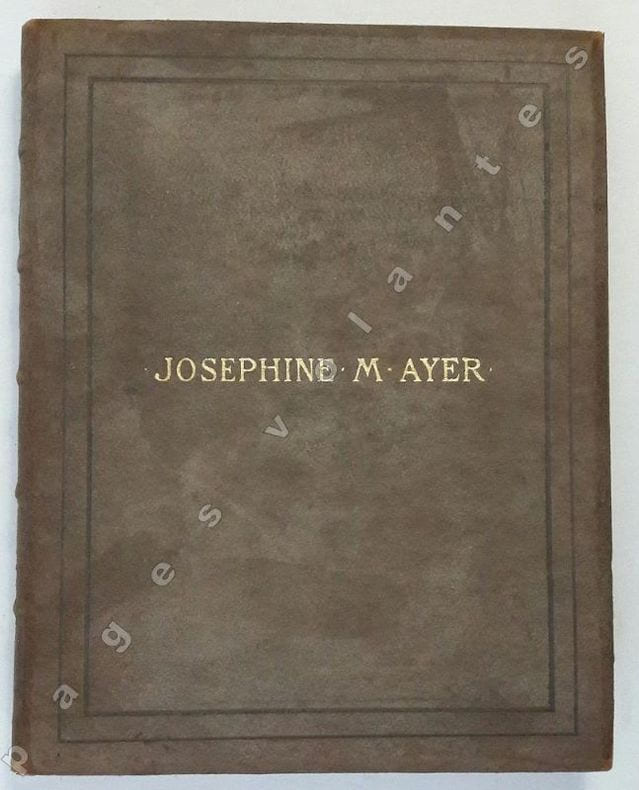
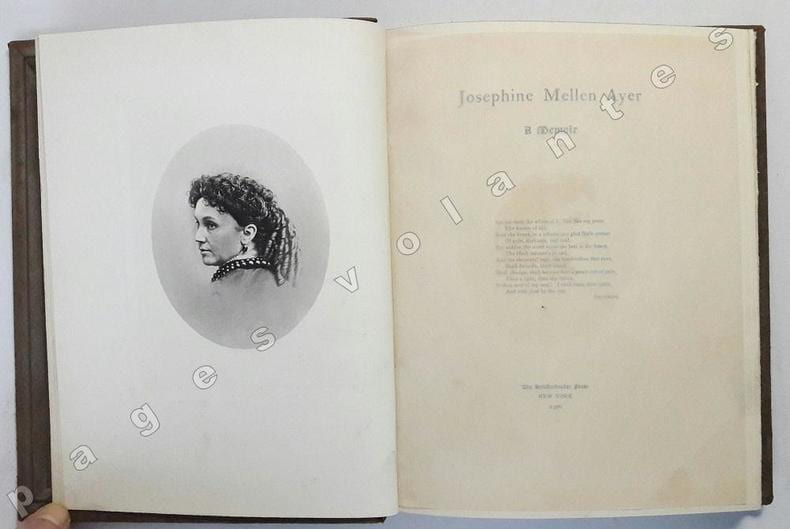
New York, The Knickerbocker press, 1900, In-8, pleine suedine souris, 107 pp., portrait en frontispice.
Reference : 15885
Bookseller's contact details
Librairie Pages Volantes
Pascale Celereau et Liliane Ruetsch
7 rue Auguste Bartholdi
75015 Paris
France
contact@librairiepagesvolantes.fr
06 11 48 86 05
Payment mode

Sale conditions
Envoi dès votre règlement par - Virement bancaire IBAN FR76 1751 5900 0008 8901 0112 677 - PAYPAL (en direct sur paypal ou nous demander le formulaire de paiement). -SUMUP ( nous demander le formulaire de paiement). Frais d'envoi sur demande.
5 book(s) with the same title
"FRESNEL, A. (AUGUSTIN). - THE ""SECOND MEMOIR"" OF 1827, FIRST ENGLISH EDITION.
Reference : 47019
(1852)
Memoir on Double Refraction. (From the Mémoires de l'Academie Royale des Sciences d l'Institut de France, tome vii. 1827).
London, Taylor and Francis, 1852. 8vo. Without wrappers. In: ""Scientific Memoirs, selected from Transactions of Foreign Academies of Science... Edited by Richard Taylor."", Vol. V, Part XVIII. With titlepage to Vol. V. Pp. (151-) 352 (entire part offered). Fresnel's paper: pp. 238-333. Clean and fine. Titlepage with a small faint stamp.
First appearance in English of Fresnel's famous memoir - the memoir of 1827, his so-called second memoir - in which some of his groundbreaking discoveries concerning light is stated. He applies the concept of transverse waves to double refraction and representing the final construction, in the form of an equation of the fourth degree.In the paper Fresnel also explained the fact,that in some cases of quartz the rotation of polarization is from left to right and in other cases from right to left.. He proposed the term 'helical' to denote the property of rotating the plane of polarization, exhibited by such bodies as quartz. The term 'natural rotatory polarisation' is however, generally used.This memoir contains the first printing of three unpublished memoirs from 1821 and 1822 (Mémoire sur la double refraction.Extrait Read 26. Nov., 1821 - Supplement, presented 22 January 1822 - Second Supplement, presented April 1, 1822. - Explication de la réfraction dans le système des Ondes from ""Bulletin Soc. Philom."", 1821. See Jed. Z. Buchwald ""The Rise of the Wave Theory of Light"", pp. 461-63.

Nun's Cell as Mirror, Memoir, and Metaphor in Convent Life. Study of the Models of Nuns' Cells from the Collection of the Trésors de Ferveur
, Brepols, 2023 Hardback, 242 pages, Size:178 x 254 mm, Illustrations:124 col., Language: English.* NEW ISBN 9782503601939.
Summary In the eighteenth through the early twentieth century, French nuns from various orders created miniature simulacra of the cells in which they slept, studied, and performed their devotions. Each diorama contains an effigy of the nun, a prie-Dieu, devotional objects such as a crucifix, handiwork, and artifacts to foster study and contemplation. This book examines the lives of the brides of Christ as depicted in these dioramas, proposing that the material objects found in the chambers trace the contours of the collective and individual identities of the nuns who created these cells. Viewed as a type of memoir, the cells furnish the sisters a stage upon which to rehearse the meaning of their lives. The dioramas create a tension between the private and public presentations of the self, between verisimilitude and self-fashioning, and between reality and representation. The book contextualizes the miniature cells within the larger discourse of gender, identity, self-representation, monastic devotion, and the power wielded by the aesthetics of scale. TABLE OF CONTENTS Table of Contents List of Illustrations Acknowledgements Introduction: The Nun's Cell: Mirror, Memoir and Metaphor in Convent Art Chapter 1: In Clausura Chapter 2: The Language of the Cells Chapter 3: Objects in Miniature Chapter 4: Memoir - Traces of a Nun's Life Chapter 5: Conclusion Bibliography
"FRESNEL, AUGUSTIN. - OVERTHROWING THE CORPUSCULAR THEORY OF LIGHT.
Reference : 43910
(1816)
Mémoire Sur la Diffraction de la lumière, où l'on examine particulièrement le phénomène des franges colorées que présentent les ombres des corps éclairés par un point lumineux. (Memoir on the Diffraction of Light....)
(Paris, Crochard, 1816) No wrappers. In: 'Annales de Chimie et de Physique', Tome I, Sec. Series, Cahier Mars 1816. With htitle to vol. I. Pp. 225-336 and 1 folded engraved plate. (The entire issue offered). Fresnel's paper: pp. 239-281. The plate shows the diffraction patterns.
First appearance of Fresnel's landmark mémoir - this mémoir was his first paper on diffraction, and was later given the prize of the French Academy and published in Memoires de l'Academie in 1826 in full, together with his further developments of his light theory - in which he for the first time explained the causes of the diffraction effects as the mutual interference of the secondary waves emitted by those portions of the original wave-front which have not been obstructed by the diffraction screen. His methods of calculation utilized the principles of both Huygens and Young and he summed the effects due to different portions of the same primary wave-front. The memoir records also Fresnel's famous mirror-experiment.""In broad context Fresnel's work can be viewed as the first successfull assault on the theory of imponderables and a major influence on the development of nineteenth-centurty energetics."" (DSB V, p. 171).""Augustin Fresnel seems to have adopted a wave theory of light from the very beginning of his studies. His first paper, presented to the Academy...in October 1815, and entitled ""La Diffraction de la Lumiere"" (the paper offered), was written after a long correspondance with Arago, who had promised Fresnel his full support. ""The wave theory"" Fresnel wrote, ""is well suited to explaining the complicated propagation of light phenomena, and since, as we know from the case of sound, waves can surcomvent obstacles, I decided to make a study of shadows.....It is because they cross in regions common to them both that two pencils of rays can produce fringes. hence it follows that the vibrations of rays which cross at very small angles can cancel out whenever crests of one correspond to the throughs of the other.""
"CAYLEY, ARTHUR. - THE CAYLEY-HAMILTON THEOREM ANNOUNCED - THE MATHEMATICS OF QUANTUM MECHANICS.
Reference : 42295
(1858)
A Memoir on the Theory of Matrices. Received December 10, 1857, - Read January 14, 1858. (+) A Supplementary Memoir on the Theory of Matrices. Received October 24, - Read December 7, 1865.
(London, Richard Taylor and William Francis, 1858 and Taylor and Francis, 1866. 4to. No wrappers as extracted from ""Philosophical Transactions"" Vol. 148 - Part I. Pp. 17-37, and Vol. 156 - Part I, Pp. 25-35. Clean and fine.
First appearance of this outstanding contribution to mathematics, announcing his invention and developments of the ALGEBRA OF MATRICES, what is now called the Cayley-Hamilton theorem for square matrices of any order. ""The subject originated in a memoir of 1858 (the paper offered) and grew directly out of simple observations on the way in which the transformations (linear) of the theory of algebraic invariants are combined...a distinctive feature of these rules is that multiplication is not commutative...we get different results according to the order in which we do the multiplication... (it) seems about as far from anything of scientific or practical use as anything could possible be. Yet sixty seven years after Cayley's invented it, HEISENBERG in 1925 recognized in the algebra of matrices exactly the tool which he neede for his revolutionary work in QUANTUM MECHANICS.""(Bell, Men of Mathematics).""It was in connection with the study of invariants under linear transformation that Cayley first introduced matrices to simplify the notation involved. Here he gave some basic notions. This was followed by his first major paper on the subject ""A Memoir on the Theory of Matrices."", the paper offered here. (Kline, Mathematical Thought...p. 806).
LA MEMOIRE - COMMENT L'ACQUERIR, COMMENT LA CONSERVER / I. Qu'est-ce que la mémoire ?, II. Les aliments qui favorisent la mémoir et en général le travail intellectuel, III. L'amélioration de la mémoir et de l'énergie psychique grâce la respiration ...
JULLIARD. 1967. In-8. Broché. Etat d'usage, Coins frottés, Coiffe en pied abîmée, Quelques rousseurs. 242 pages - Rousseurs naturelles - Tranches, dos et coins très frottés. . . . Classification Dewey : 120-Epistémologie, causalité, genre humain
Table : I. Qu'est-ce que la mémoire ?, II. Les aliments qui favorisent la mémoir et en général le travail intellectuel, III. L'amélioration de la mémoir et de l'énergie psychique grâce la respiration ... Classification Dewey : 120-Epistémologie, causalité, genre humain


