 Write to the booksellers
[QUIGNARD] - LYCOPHRON
Alexandra.
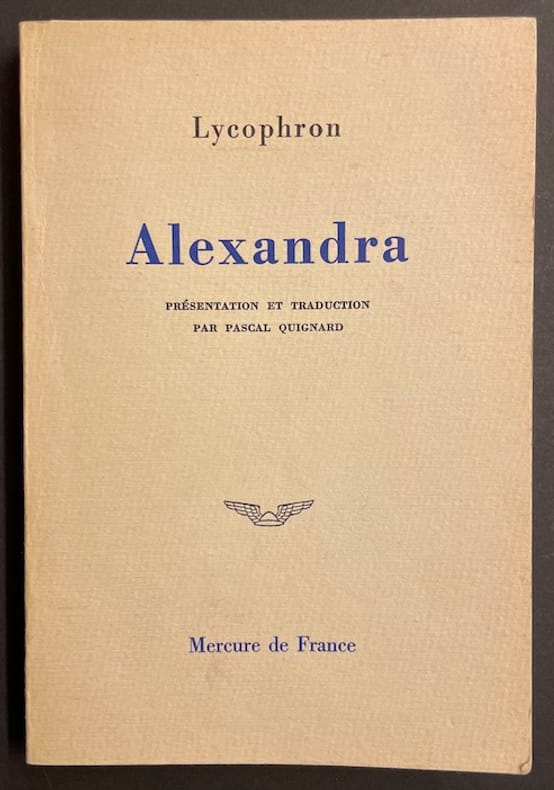
Paris, Mercure de France, 1971. In-8°, 174p. Broché.
Reference : 43209
Édition originale de la présentation et de la traduction faite par Pascal Quignard. Ouvrage à l'état de neuf.
Bookseller's contact details
Le Cabinet d'Amateur
M. Marc Mettler
2, Escalier du Château
2000 Neuchâtel
Switzerland
0041 32 724 73 65
Payment mode


Sale conditions
Conformes aux usage de la librairie ancienne. Prix nets en francs suisses. Paiement par virement bancaire ou via PAYPAL. Frais d'envoi à la charge du destinataire. Tous nos livres sont garantis en bon état, sauf mention contraire. Toute réclamation devra se faire dans les 10 jours qui suivent la réception de la marchandise.
5 book(s) with the same title
Reference : lom-MS000245
Nadgrobnyj pamyatnik Aleksandry Pavlovny./Tombstone of Alexandra Pavlovna. 1860
"In Russian. Short description: [Ortenburg, H.] Ortenburg, H. [Uro?m and the Chapel-Burial Vault of Her Royal Highness Archduchess Alexandra Pavlovna, built by His Royal Highness Archduke Joseph, Ruler of Hungary / compiled by Heinrich von Ortenburg]. U?ro?m and the Burial Chapel, the final resting place of Her Imperial Highness the late Archduchess Grand Duchess Alexandra Pavlovna, Consort of His Imperial Highness Archduke Joseph Palatine of Hungary. Published by Heinrich Ortenburg. Along with the portrait and 6 lithographic oil paintings. - Pest: H. Geibel, 1860. - [4], 19, [1] p., [1] frontispiece (portrait), [6] plates; 35.3x30 cm. The book is dedicated to the burial place of the daughter of Paul I - the Grand Duchess Archduchess of Austria Alexandra Pavlovna (1783-1801), the spouse of Archduke Joseph Habsburg, the ruler of Hungary. She was buried in the suburb of Budapest, in the town of Uro?m. Above her grave, an Orthodox church was built in the name of the martyr Tsarina Alexandra. The text is in the German language. The frontispiece with the portrait of Alexandra Pavlovna and six illustrations on separate sheets are done in the lithographic technique. Bound in period half-leather with gold embossing on the spine. Triple gilt edges. Small tear at the top of the spine; the paper on the binding covers and endpapers has been restored. Please feel free to contact us for a detailed description of the copies available. SKUMS000245"
(First title:) LUKOPHRONOS TOU CHALKIDEÔS ALEXANDRA, to skoteinon poiêma, kai eis auto touto ISAAKIOU, mallon de IÔANNOU, tou TZETZOU EXÊGÊMA. (Second title:) Lycophronis Chalcidensis Alexandra, obscurum poema. Cum graeco Isaacii, seu potius Johannis Tzetzae commentario. Versiones, variantes lectiones, emendationes, adnotationes, & indices necessarios adjecit Johannes Potterus, A.M. & Collegii Lincolniensis Socius. Editio secunda, priori auctior.
Oxford (Oxonii), E Theatro Sheldoniano, impensis Joannis Oweni, 1702.
Folio. (XVIII, including a frontispiece & a title in Greek):183,(1 blank),(28 index),(2),(4),174,(17 index),(1 blank) p. Vellum 33 cm (Ref: ESTC Citation No. T107442; Hoffmann 2,569; Dibdin 2,209/210; Brunet 3,1248; Sandys 2,356; Graesse 4,309; Ebert 12546: 'This 2nd edition is particularly scarce') (Details: 8 thongs laced through the joints. Red morocco shield on the back. The frontispiece, an engraving of 'M. Burghers', depicts Alexandra, she points at Troy in fire in the background. Burghers was one of the leading engravers of England during that period. The book has 2 titles, the first one is in Greek, and is adorned with an big engraving of the Sheldonian Theatre, also made by Burghers. The second title is in Latin, and has a woodcut printer's mark, which shows the wellknown coat of arms of the University of Oxford) (Condition: Vellum soiled. Boards somewhat outstanding) (Note: Lycophron, 3rd cent. BC, was called to Alexandria by King Ptolemaeus Philadelphos. There he wrote his Alexandra (or Cassandra), ca. 1474 iambic trimeters in which Kassandra (=Alexandra) tells about the fall of Troy, and the fates of the Greek and Trojan Heroes. Dibdin calls this edition 'beautiful' and the 'editio optima'. He cites Harwood, who declares this work to be 'an everlasting monument of the learning of the illustrious editor'. The illustrious editor was the learned cleric John Potter, 1674-1747, who later in life, in 1737, was appointed bishop of Canterbury. Young Potter corrected in this edition the commentaries of Tzetzes using 3 new manuscripts; he added indices, and annotations of himself. At the age of 14 Potter was sent to Oxford, University College. There he distinguished himself by his knowledge of Greek. Still a young man, in 1697, he produced his first edition of Lycophron. In 1698 Potter published his greatest success, the 'Archaeologia Graeca', which long remained a standard book for Greek students in Britain. In 1715 Potter produced his splendid edition of Clemens Alexandrinus. (Chalmers' Biography, 25,231) The first 146 p. of this 1702 edition contain the Greek text, with iuxtaposed the Latin prose translation of the Dutch classical scholar Willlem Canter (1545-1572), dating from 1566. The scholia are printed on the lower half of the page, together with the 'variantes lectiones' and the 'emendationes'. After the Greek text follows the metrical (iambico carmine) translation into smooth Latin made by J.J. Scaliger (1540-1609), which was published toghether with Canter's translation in 1566 in Basel. The second half of the book contains the notes (annotationes) of Canter and a specimen of Canter's versatility in Greek and Latin verse, the 'Epitome Cassandrae graeco-Latina, versibus Anacreontiis conscripta'. Added is also the commentary of the Dutch classical scholar Johannes Meursius (1579-1639), published in 1597 & 1599. At the end we find the commentary of John Potter himself) (Provenance: Small bookplate of the Swiss politician Karl Zeerleder, 1780-1851, on the front pastedown. Small blind stamped owner's mark of Mark Pattison, 1813-1884, in the right margin of the title. Pattison was like Potter a tutor at Lincoln College. In 1861 Pattison was elected rector. He is best known for his biography of the French classical scholar Isaac Casaubon, and for being Mr. Casaubon, a chief character in Middlemarch, the famous novel of George Eliot) (Collation: Frontispiece, pi2, a-b2, A-D2 E-2C4, 2D-2I2, chi1; *A-*Z4, *Aa4, *Bb2) (Photographs on request) (Heavy book, may require extra shipping costs)
Reference : alba7eb9dcf300a7aee
Alexandra David-Neel. My Journey to Lhasa. In English /Alexandra David-Neel.
Alexandra David-Neel. My Journey to Lhasa. In English /Alexandra David-Neel. My Journey to Lhasa. Alexandra David-Neel. A Parisian Womans Journey to Lhasa. In English. New Delhi. Time Books International. 1991. 310p. We have thousands of titles and often several copies of each title may be available. Please feel free to contact us for a detailed description of the copies available. SKUalba7eb9dcf300a7aee.
Alexandra ripley Pour tout l'or du sud
Le Livre de Poche 1997 1997. Alexandra Ripley: Pour tout l'or du Sud/ Le Livre de Poche 1997 . Alexandra Ripley: Pour tout l'or du Sud/ Le Livre de Poche 1997
Bon état
Lycophronis Chalcidensis Alexandra. Poëma obscurum. Ioannes Meursius recensuit, & libro commentario illustravit. Altera editio aucta & innovata. Accessit Iosephi Scaligeri Iulii Caes. F. versio centum locis emendatior.
Leiden (Lugduni Batavorum), Ex officina Ludovici Elzevirii. 1599.
8vo. (XVI),350,(18 index) p. Calf (19th century) 16 cm (Ref: STCN ppn 15153098; Willems 39; Rahir 25; Berghman 835; Hoffmann 2,569; cf. Smitskamp, The Scaliger collection, no.93 for the first edition of 1597; Brunet 3,1247-1248; Ebert 12543; Graesse 4,309) (Details: Greek text and Latin translation. Back elaborately gilt with four ornamental lozenges. Brown letter label. Boards with a triple gilt fillet border, and gilt edges. Edges of the book block sprinkled. Marbled endpapers. The colophon on the last page reads: 'Lugduni Batavorum. Excudebat Ioannes Balduini. VIII. Kal. Maias. anno 1599') (Condition: Nice copy, some slight wear to the extremities, just a bit of rubbing to the joints. Some small, old ink marginalia. Last gathering slightly browning, otherwise a clean and fresh copy) (Note: Lycophron, 3rd cent. BC, was called to Alexandria in Egypt by King Ptolemaeus Philadelphos. There this tragedian wrote his 'Alexandra' (or Kassandra), ca. 1474 iambic trimeters, in which Kassandra tells about the fall of Troy, and the fates of the Greek and Trojan Heroes. It is his only surviving work, which is full of the extreme and designed obscurity that the Alexandrians, who were fond of a style full of learned allusions and playful riddles, loved. Rose calls the 'Alexandra' a monstruous riddle. 'In form it is the speech of a messenger, a servant of Priam, (...), coming to tell his master that Kassandra (= Alexandra) has just delivered a mysterious oracle. (...) The prophecy concerns the whole history of Troy, the Trojans and their descendants, together with the fates of the Greeks for many generations to come, and from beginning to end it calls nothing and no one by any wellknown name, personal or geographical'. (H.J. Rose, A handbook of Greek literature', London 1964, p. 336). For instance, Lycophron calls the mythical hero Heracles the 'Lion of the triple evening', expecting the reader to know that Heracles, when he was begotten, the night was thrice its normal length. This edition of 1599 is a revised and improved second edition. The first edition was produced two years earlier, in 1597, by the then 18 years old Dutchman Joannes Meursius, or in Dutch 'Jan van Meurs', 1579-1639. He was a student of the genius Joseph Justus Scaliger, born in 1540, who lectured since 1593 in Leiden, till his death in 1609. Scaliger helped and encouraged his pupil in the production of this edition. In the preface Meursius tells us that he wouldnot have dared to edit such a dark and difficult text without the help of Scaliger. Scaliger helped him with the commentary and gave him permission to reprint his verse translation, with corrections. This metrical and smooth Latin translation had been published previously in Basel in 1566. The last 251 pages of the book contain the commentary of Meursius, 'quod sine interprete vix est ut quisquam intellegat'. (preface, leaf A8 recto) Meursius was later appointed professor of History, and of Greek (1610/13) at his own university. He is best known for his editions of byzantine authors, and for the books he wrote on the history of ancient Greece, for example on festivals, Eleusis, and the antiquities of Athens and Attica. His work was widely used as source by later ancient historians. (Sandys 2,310/11)) (Collation: A-Z8 a8) (Photographs on request)

