 Write to the booksellers
GOETHE Johann Wolfgang
FAUST.
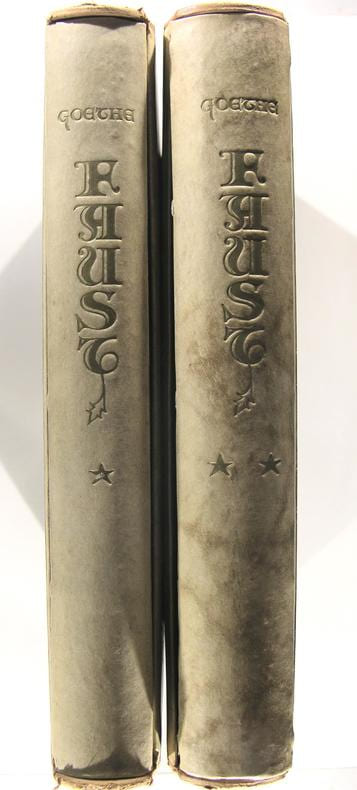
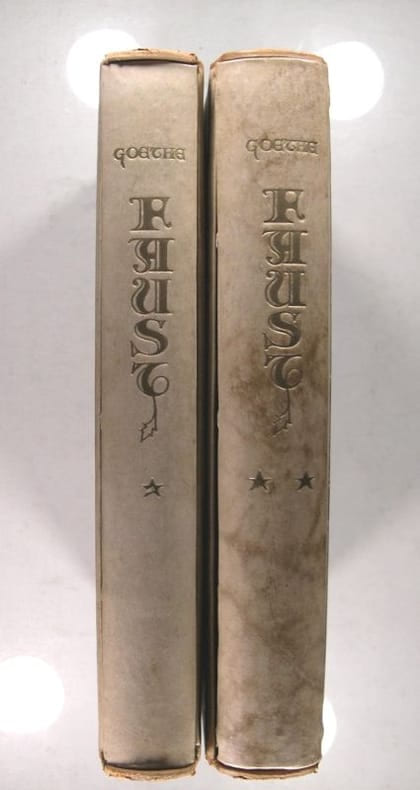
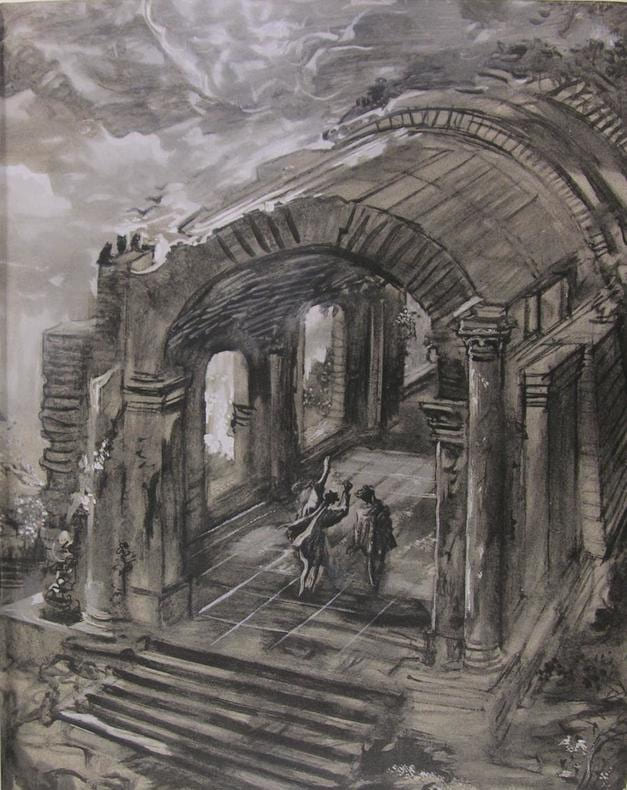
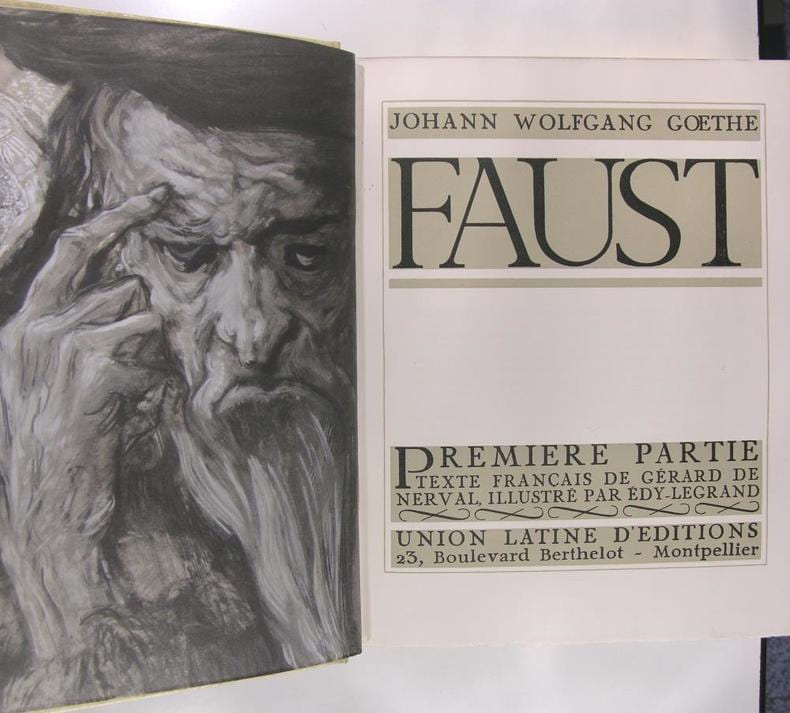
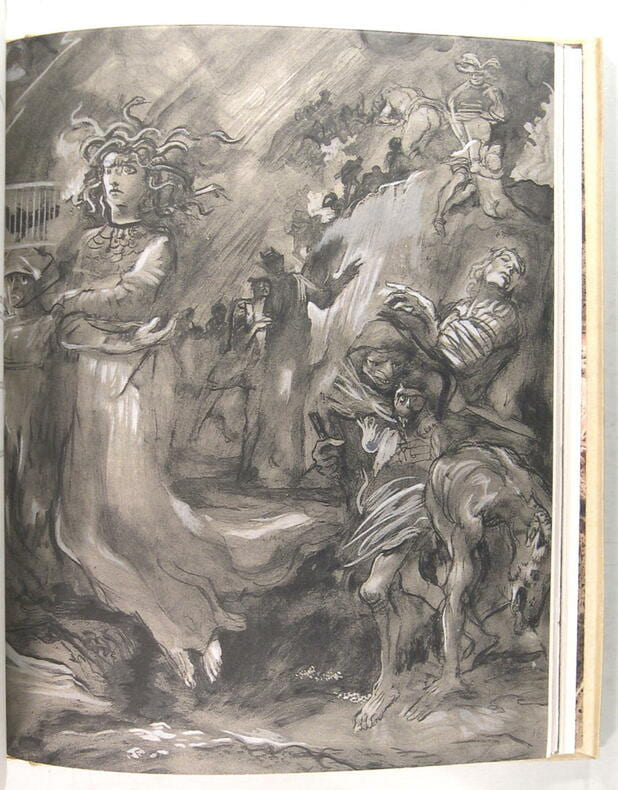
Union Latine d’Editions, Montpellier, 1942. 2 volumes grand In/8, reliure façon velin, sous emboîtage, illustrations hors-texte d’Edy Legrand, volume 1 : 200 pages, 31 dessins et 1 frontispice - volume 2 : 259 pages, 29 dessins. Exemplaire sur pur fil.
Reference : 27849
Monod 5512.Edy-Legrand, de son vrai nom Édouard Léon Louis Warschawsky : 1892-1970, illustrateur et peintre français. Il a réalisé la première partie de son parcours dans l'illustration publicitaire et littéraire. Il est né à Bordeaux de mère française et de père juif russe. En 1919, ce jeune peintre réalise le premier livre pour enfants de la NRF, Macao et Cosmage ou l'expérience du bonheur. Les compositions en sont coloriées à la main par Jean Saudé. Cet album aux dimensions exceptionnelles est salué depuis les années 1980 comme un des jalons de l'histoire de l'album illustré pour enfants. Il a été découvert par Marie Steiner, directrice de la galerie newyorkaise Knoedler, les présentations ont été faites par Pierre Bonnard en 1928. Il participé à la première exposition universelle d'œuvres gravées de l'Art Institute of Chicago en 1932 où il représente la France. Exposé avec Picasso, Matisse et Derain, il a été le seul à recevoir la mention honorable. Par la suite, il s'installe à Rabat, au Maroc. Il y vit environ vingt ans où il est très lié à Jacques Majorelle.
Bookseller's contact details
Librairie ancienne Philippe Lucas
M. Philippe Lucas
9 Quai de la Pêcherie
69001 Lyon
France
04 78 30 94 84
Payment mode


Sale conditions
Pour nous commander un livre : Notez le numéro de référence. Pour 1kg 5€ en fréquenceo, 2kg 8€ RIB : Sur demande.
5 book(s) with the same title
Faust et le second Faust - numéroté 4316/5000
Ambassade du livre 1961 341 pages in8. 1961. reliure editeur sous rodhoid avec boitier. 341 pages. Le Second Faust est la suite de l'œuvre majeure de Goethe publiée après sa mort en 1832. Elle met en scène Faust un génie vieillissant qui déçu par la science contracte un pacte avec le diable Méphistophélès pour redécouvrir l'amour humain et la puissance créatrice. L'œuvre est une parabole de l'Humanité souffrante tiraillée entre pensée et action et aborde des polarités comme les temps modernes face à l'Antiquité ou la tradition face au progrès
Bon état
Faust opéra en cinq actes - musique de ch. Gounot
Choudens 116 pages in8. Sans date. broché. 116 pages. Faust est un opéra en cinq actes de Charles Gounod composé sur un livret de Jules Barbier et Michel Carré inspiré de la légende de Faust et de la pièce de Goethe. L'œuvre se concentre sur une histoire d'amour et simplifie certains aspects philosophiques de l'original en en faisant une tragédie romantique adaptée aux exigences de l'opéra de son temps. C'est l'œuvre la plus connue du compositeur et elle a connu un grand succès dès sa création
Etat correct reliure fragilisée intérieur propre
Faust en France et autres études
Calmann-Levy Editeurs 1929 234 pages in8. 1929. broché. 234 pages. Ouvrage de Pierre Lasserre publié en 1929 qui analyse la réception et l'interprétation du personnage de Faust dans la culture et la pensée française. Le livre retrace les fluctuations de l'opinion française face à la signification de cette figure légendaire
Bon état couverture avec rousseurs et légères salissures
Faust. Ein Fragment. - [PMM 298 - THE FAUST LEGEND]
Leipzig, Göschen, 1790. Orange cardboard binding (presumably the original!) with gilt title-labet to top of spine. Corners bumped, and wear along hinges and capitals. Overall a very nice and charming copy, tight, and completely unrestored. Some brownspotting throughout, but overall very nice. With the famous engraved frontispiece depicting Faust in his study, by Lips, after Rembrandt (loose) and the tittle-page stating ""Goethe's Schriften. Siebenter Band."", with the large engraved vignette by Lips, picturing Bätely bandaging Jery's hand (different from the ones in the seven other volumes), and the half-title stating ""Faust. Ein Fragment"" with ""Goethe's W. 7. B."" to the foot (repeated on all quires). Old owner's name to verso of frontispiece, otherwise no markings or annotations of any kind.
The scarce first printing, in the corrected variant Hagen So, of one of the peaks of world literature, the main work by the greatest German poet ever, and one of the all-times greatest writers of the world, Johann Wolfgang von Goethe. ""Faust"" was first printed, as it is here, as volume seven of Goethe's Schriften in eight volumes from 1787-1790, and was also published separately, likewise under the title ""Faust. Ein Fragment"". The printing of Faust in the seventh volume of Goethe's works is the original printing after the manuscript of the poet. There are two printings of this volume, between which there is traditionally said to be no precedency, although So has been corrected, which Sm has not. The present copy is Hagen variant So, without the misprints (see Hagen 11:7, So), which can be identified by eg. the lack of the repetition of the three lines in pp. 144-145, which appear in Sm (see Hagen, p. 12). Few other writers have been as influential as Goethe, and his works were an immense source of inspiration to everything from drama and music to science and philosophy. He is generally accepted as one of the most important thinkers within Western culture, and his main work, Faust, is considered one of the most important and influential works of world literature. ""If Goethe may justly be called the last representative of the renaissance ideal of the ""oumo universale"", his ""Faust"" embodies the sum total of his poetical growth."" (Printing and the Mind of Man: 298).""Faust"" is arguably the work for which Goethe is most famous, and this is not without reason. The novel emphasizes the strength of the individual and the right to freely investigate aspects of human and divine character. The novel also fights for man's right to determine his own destiny, and is thus considered the first great literary work in the spirit of modern individualism. Faust is also considered highly relevant to science and scientific thought, as Goethe here offers a holistic and non-analytic approach to these areas. The present volume 7 from 1790 has two vignettes: ""Bätely verbindet dem Jery die Hand"", H. Lips fec."" and ""Faust im Studierzimmer, ein am Fenster erscheinendes magisches Zeichen betrachtend"", H. Lips sc. (nach Rembrandt) (see Hagen 11:7). On the last page is written ""Leipzig, gedruckt bey Christian Friedrich Solbrig"" (see Hagen 11). It also includes the separate texts ""Jery und Bätely"" (pp. 169-224) and ""Scherz, List und Rache"" (pp. 225-320). PMM 298 (being the 1834 ed., not the real first)" Hagen 11,7 - So.


