 Write to the booksellers
SULPITII SEVERI (Sulpice Sévère)
Sacrae Historiae
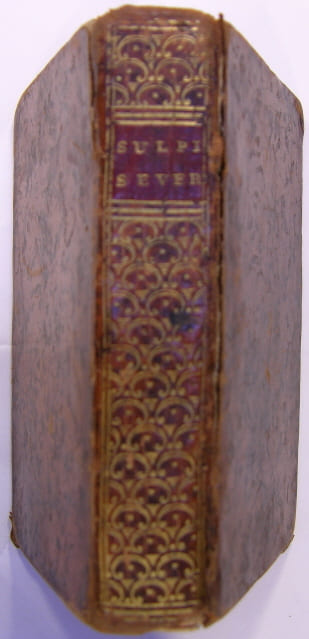
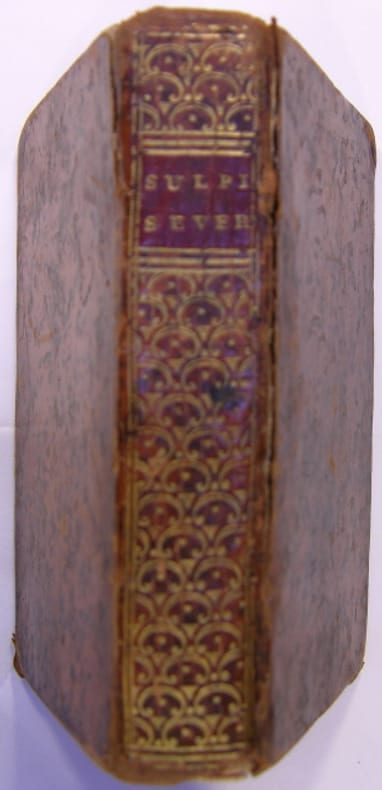
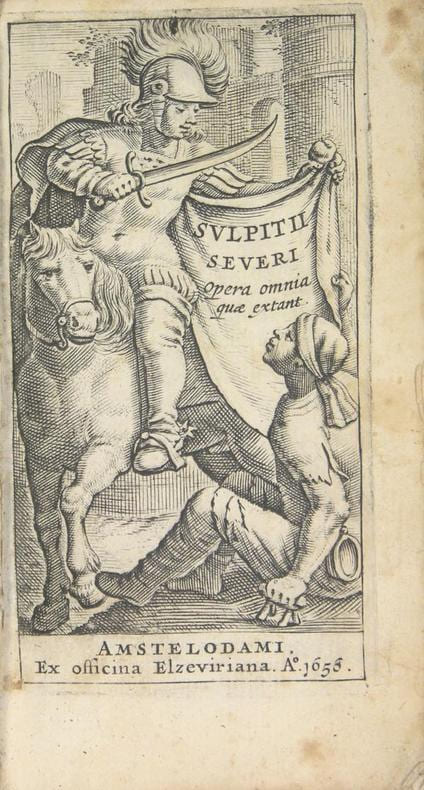
Amsterlodami, ex Officina Elzeviriana, 1658. In/24 (13 x 6.5 cm) en plein veau postérieur tacheté, dos lisse à joli décor doré en écailles et pièce de titre rouge, tranches rouges, page de titre entièrement illustrée, bandeaux, lettrines historiées, cul de lampe, 333 p., 2 ff. (chronologia). Petit manque en coiffe inférieure ; mors partiellement ouverts ; coins usés ; manque de papier en page de garde finale ; rares rousseurs.
Reference : 10059
Saint Sulpice-Sévère né en Aquitaine vers 363 et décédé au cours du premier quart du Ve siècle est un historien et un ecclésiastique de langue latine. Il suivit d'abord la carrière du barreau, devint avocat à Bordeaux. Suite à la mort de sa femme, vers 392, il se retira en ascète, aux environs de Biterrae (Béziers). On présume qu'il s'était fait prêtre et qu'il fut disciple de saint Martin. Son ouvrage principal est une chronique appelée aussi l’Histoire sacrée, en deux livres, qui s'étend de la création du monde à l'an 410, et dont le style élégant et concis lui a valu le nom de Salluste chrétien. Il rédigea également une Vie de saint Martin, ouvrage qui fut très populaire au Moyen Âge.24 mo full spoted calf, smooth gilt spine with red label, red edges, woodcut title page, head & tail-pieces, 3 ornamented initials. Flaws : small loss on the bottom tip, joints partially cracked, rubbed corners ; lack of paper on terminal blank ; rare foxing.
Bookseller's contact details
Librairie ancienne Philippe Lucas
M. Philippe Lucas
9 Quai de la Pêcherie
69001 Lyon
France
04 78 30 94 84
Payment mode


Sale conditions
Pour nous commander un livre : Notez le numéro de référence. Pour 1kg 5€ en fréquenceo, 2kg 8€ RIB : Sur demande.
5 book(s) with the same title
Sulpitii Severi Aquitani Sacrae Historiae a mundi exordio ad sua usq; tempora deductae, libri duo; item Dorothei Episcopi Tyri, qui sub Constantino Magno vixit, De vita Prophetarum & Apostolorum, Synopsis. Quibus accessit rerum & verborum index copiosus.
Paris (Parisiis), Apud Gulielmum Guillard & Almaricum Warencore, 1560.
Small 8vo. (XXXII),156,(2 blank);(24 index) p. Modern hardbound binding. 13.5 cm 'A universal chronicle which is an important source for the history of 4th-century events' (Ref: USTC 153005; Ebert 22005; Schoenemann 2,378/79) (Details: Back with 4 raised bands, and with a gilt short title in the second 'compartment') (Condition: Old inscriptions on the front flyleaf. Front flyleaf worn, thumbed and dustsoiled. Title also thumbed and dustsoiled, and with an old ownership entry and shelf number) (Note: The Latin historian Sulpicius (or Sulpitius) Severus was born in Aquitania ca. 360 A.D. He organized under the influence of Bishop Martinus of Tours a sort of monastic life on his own estate for himself and his friends. His extant works are a 'vita S. Martini Turonensis', and this 'Sacrae Historiae', a kind of universal chronicle to A.D. 402, 'which is an important source for the history of 4th-century events, (...). The whole book is an interesting attempt to present a 'breviarium' of history from the Christian point of view: it uses Christian chronographers, especially St. Jerome, but also Pagan writers. J. Bernays suggested that for the destruction of Jerusalem in A.D 70 Sulpicius followed the lost account of Tacitus. Sallust and Tacitus are his models in the matter of style'. (OCD, 2nd 3d. p. 983) The 'Sacrae Historiae' were first published in Basel in 1556 by the Ilyrian protestant scholar Mat(t)hias Flacius, the latinized slavic name Vlacich, from a old manuscript found in a library in Hildesheim. Flacius, 1520-1575, who taught Hebrew in Wittenberg and the New Testament in Jena, was a pupil and lifelong supporter of Luther. Flacius dedicated his book to the Polish duke Nicolaus Radziuilius, who was a great patron of the Lutherans. (Neue Deutsche Biographie 5 (1961), p. 220-222) Schoenemann's opinion is that Flacius 'accurata fide hos libros exprimendos curavit'. (Schoenemann p. 378) The next edition of the 'Sacrae Historiae', this edition, appeared a few years later, in Paris in 1560. In the 32 page 'praefatio' to this edition, which is in fact a ferocious attack against Lutheranism, that brought nothing but 'latrocinia, furta, praedationes, adulteria, usurae, homicidia & id genus alia flagitia' (p. 2* recto), written by one 'Iacobus Faber doctor theologus, Sorbonicus' we are told that he (Faber) published this work to strengthen the spirit of the Catholics against the heresy of the Reformation, that was raging through Europe, and especially Germany. (p. *3 recto) Faber suggests that he found and edited the text of the 'Sacrae Historiae' himself. ('cuius sacram historiam cum in publicum omnium catholicorum commodum evulgare ex mediis antiquorum seculorum abditissimis scriniis erutam cogitaremus', p. 2*3 recto & verso) Schoeneman explains that the catholic professor of the Sorbonne was a common thief, who misappropriated the edition of his protestant precursor Flacius, without any acknowledgment. ('partam Matthiae Flacio gloriam suffurari non erubuit', Schoenemann p. 379). Schoenemann calls the praefatio of Faber nothing but 'emendicatus pannus', 'begged for rags' (pun for 'emendicatus panis'?) (Provenance: On the title: 'Conv.s ff. erem. s. Aug.ni Bruxell. 1610', indicating that the book once belonged to the convent of the Order of the Eremites of St. Augustine in Brussels. On the front flyleaf the old names: 'Van den Boom', and 'P. v(an)d(en) Hoogen ex Horsten, 18/12/'25') (Collation: *-2*8, A-T8, V4 (last leaf V4 blank), +8, 2+4)(Photographs on request)
Eusebii Pamphili, Ruffini, Socratis, Theodoreti, Sozomeni, Theodori, Euagrij, & Dorothei Ecclesiastica Historia. Sex prope seculorum res gestas complectens; Latine olim a doctissimis viris partim scripta, partim e Graeco a clarissimis viris, Vuolfgango Musculo, Ioachimo Camerario & Iohanne Christophersono Britanno, eleganter conversa; et nunc ex fide Graecorum codicum, sic ut novum opus videri possit, per Ioan. Iacobum Grynaeum locis obscuris innumeris illustrata, dubijs explicata, mutilis restituta; Chronographia insuper Abrahami Bucholceri, ad Annum Epochae Christianae 1598. & lectionis sacrae historiae luculenta Methodo exornata. Cum continuatione in praesentem annum 1611. Et indicibus rerum verborumque locupletiss.
Basel (Basileae), Per Sebastianum Henricpetri, n.d. (1611)
Folio. (LXXX),807,(1 blank),(23 index),(1) p. Overlapping vellum 34 cm (Ref: VD17 23:297069D; Hoffmann 2,107) (Details: Latin translation only. Woodcut printer's mark on the title; 'From 1496 until the seventeenth century, the Petris printed in Basel, and for three generations--Adam Petri, Heinrich Petri, and Sebastian Henripetri--the printers mark alluded to the family name: a stone being smashed by a godlike hammer over which fire is blown by a heavenly face. The symbolism is explained by the biblical motto (Hieremias Propheta, 23,29) printed in Greek, Latin, and Hebrew in some books, 'numquid non verba mea sunt quasi ignis ait Dominus, et quasi malleus conterens petram', 'Is not my Word like fire, like a hammer that shatters stone?' (Source: University Library Illinois, webpage 'Windows Printers' Marks') The printer's mark is repeated on the last page. One woodcut headpiece. Some woodcut initials) (Condition: Vellum soiled, some small brown stains on the upper board. Paper somewhat yellowing. Bookplate on front flyleaf. Short title in ink on the back) (Note: The church father Eusebius Caesariensis, ca. 260-339, was elected to the see of Caesarea in Asia Minor, nowadays Kayseri, in 313 A.D. He had an impressive ecclesiastial career, but his literary achievements made him immortal. His important 'Historia Ecclesiastica' (History of the Church) runs up to 324; The object of this work was to present the apostolic 'succession' of the 4 great episcopal thrones, Rome, Alexandria, Antioch and Jerusalem, and to describe the intellectual, spiritual and institutional life of the Church, the persecutions and the heresies. 'It cannot be too strongly emphasised that Eusebius, like all early church historians, can be understood only if it be recognized that whereas modern writers try to trace the development, growth and change of doctrines and institutions, their predecessors were trying to prove that nothing of the kind ever happened. According to them the Church had had one and only one teaching from the beginning. It had been preserved by the 'succession', and heresy was the attempt of the devil to change it'. (Eusebius, the Ecclesiastical History, With an English transl. by K. Lake, Cambr. Mass., 2001, vol.1, p.XXXIV) The Latin West came to know this Greek work through the translation of 403 by Rufinus of Aquileia. The 'Historia Ecclesiastica' was first published, together with the works of the later church historians Socrates Scholasticus, Sozomenus and Theodoretus in Paris in 1544 by Robertus Stephanus. The editor of our Latin edition of 1611 is the Swiss theologian and classical scholar Joannes Jacobus Grynaeus, 1540-1617, professor at the University of Basel. He was more a theologian than a philologist. In 1570 he had already published for Henricpetri a Latin translation of the 'Opera Omnia' of Eusebius. (GG 421) In the same year, 1570, a separate edition of Grynaeus' Latin translation of the 'Historia Ecclesiastica' was published by the Basler printer Episcopius. (GG 416) Hoffmann says that our 1611 edition is a repetition of the 'Historia Ecclesiastica' edition of 1570. This cannot be correct. The titles are different, and the edition of 1611 has a preface dated 1587. We found in VD16 an edition (not mentioned by Hoffmann), with exact the same title as the one of 1611, and published in 1587 in Basel by Episcopius ( VD16 ZV 5530, also BL shelfmark 3627.ff.4). The only difference being that the 'Chronographia' at the end of the book has been continued till 1611). So this edition of 1611 is a reissue of the Basel edition of 1587, which was brought on the market by Eusebius Episcopius. This title contains Eusebius' 'Historiae Ecclesiasticae libri X', and 'De vita Constantini Magni', translated by Johannes Christophorsonus (John Christopherson), and the 'Oratio Constantini Imperatoris', and Rufinus' 'Historiae Ecclesiasticae libri II', and a Latin translation of Socrates Scholasticus' 'Ecclesiasticae Historiae libri VII', and Theodoretus' 'Historiae Ecclesiasticae libri V', translated by Joachim Camerarius, and a Latin translation of Sozomenus' 'Ecclesiasticae Historiae libri IX', and Euagrius Scholasticus' 'Historiae Sacrae libri VI', and Dorotheus Lector's 'Quomodo apostoli et prophetae vixerint ac mortui sint', translated by Wolfgang Musculus. At the end (p. 625/807) has been added the 'Chronologia' or 'Index Chronologicus' of the German historian and theologian Abraham Buch(h)olzer up to 1611) (Provenance: A modern bookplate with the text: 'Ex libris Henn Wolfram Riedesel Freiherr zu Eisenbach'. At the top a part of the coat of arms of the Riedesel family, the head of a donkey, with 3 reed leaves in its mouth. The Riedesel Freiherren zu Eisenbach family belongs to the ancient nobility in Hesse, Germany) (Collation: alpha8, alpha6, beta6, gamma6, delta6, epsilon8; a-z6 A-Z6 Aa-Vv6 Xx8, Yy-Zz6) (Photographs on request) (Heavy book, may require extra shipping costs)
Synopsis historiae ecclesiasticae novi testamenti : praecipuo juventutis studiosae bono dextro & congruo ordine concinnata atq[ue] in publicam edita a joanne Georgio Layriz, historiae sacrae & civilis professore publico.
sumptobis Joh. Gebhardi. | Baruthi (Bayreuth) 1678 | 13.50 x 8.50 cm | deux ouvrages reliés en un volume
Edition originale. Absent aux catalogues français et anglais. Un exemplaire à Munich de 1678, un autre de 1700. Le second ouvrage est le même livre en allemand imprimé en caractères gothiques, également à Bayreuth chez Gebhard. Reliure en plein vélin d'époque à rabats. Titre à la plume quasi illisible. Lairitz (1647-1716), historien natif de Bayreuth et professeur. - Photographies et détails sur www.Edition-Originale.com -


Epitome Historiae Sacrae suivi d'un dictionnaire français-latin
Auguste Delalain. 1814. In-16. Cartonné. A relier, Plats abîmés, Dos abîmé, Papier jauni. 128+81 pages. Coins rognés. Rousseurs. Mouillures. Annotations à l'encre hors texte. Tâches d'encre en frontispice, page de faux titre et de titre. Texte en latin et français. Partiellement désolidarisé.. . . . Classification Dewey : 470-Langues italiques. Latin
Classification Dewey : 470-Langues italiques. Latin
Epitome Historiae sacrae - 24e édition annotée par L.-M. Mingasson
J. de Gigord. 1930. In-16. Cartonné. Etat d'usage, Couv. convenable, Dos satisfaisant, Papier jauni. VI + 66 pages. Légères taches sur le dos.. . . . Classification Dewey : 470-Langues italiques. Latin
Classification Dewey : 470-Langues italiques. Latin

