 Write to the booksellers
VONDEL,J. VAN DEN.
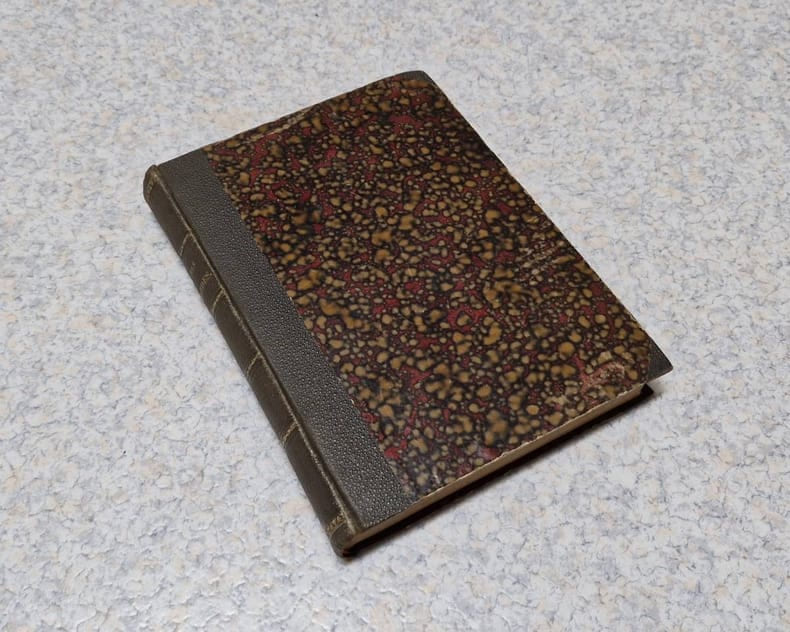
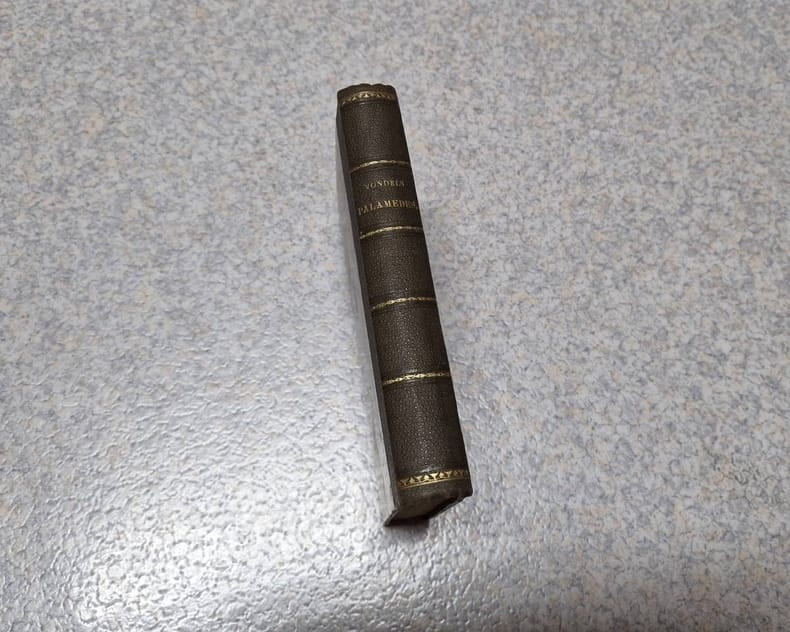
J. v. Vondels Palamedes, of vermoorde Onnozelheit. Treurspel, met aenteekeningen uit 's Dichters mondt opgeschreven. Den derden druk merkelyk vermeerdert. (Bound with:) J. van Vondels Hekeldigten, met aenteekeningen, uit 's Dichters mondt opgeschreven, thans merkelijk vermeerdert. Verciert met koperen platen.
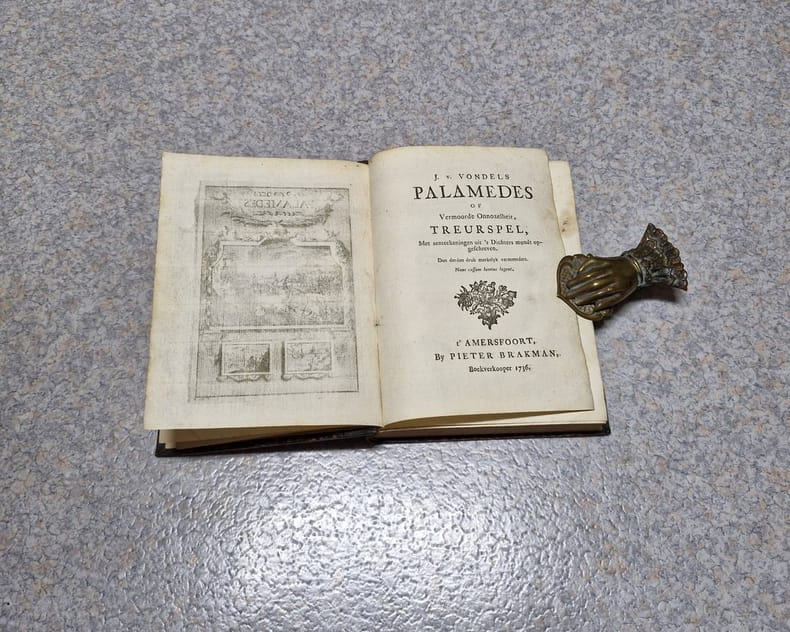
Amersfoort, ('t Amersfoort), By Pieter Brakman, 1736.
Reference : 151885
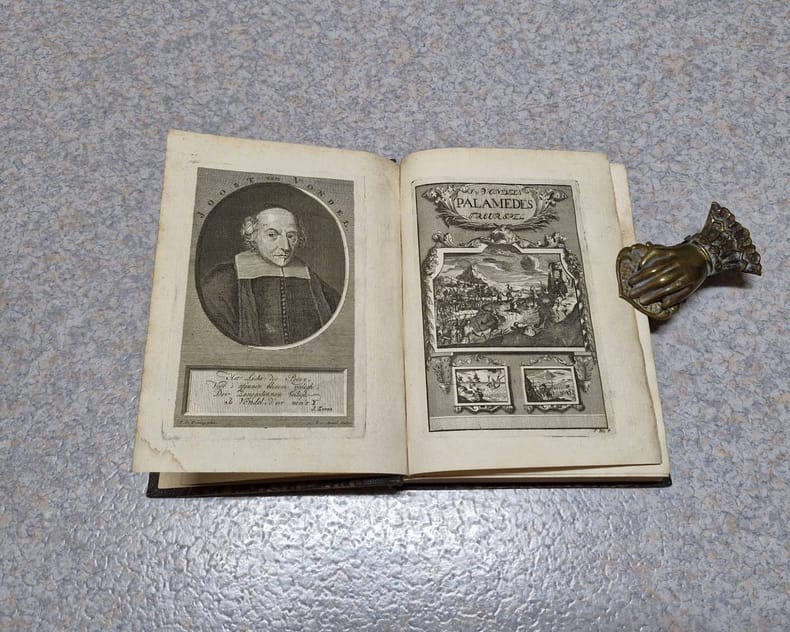
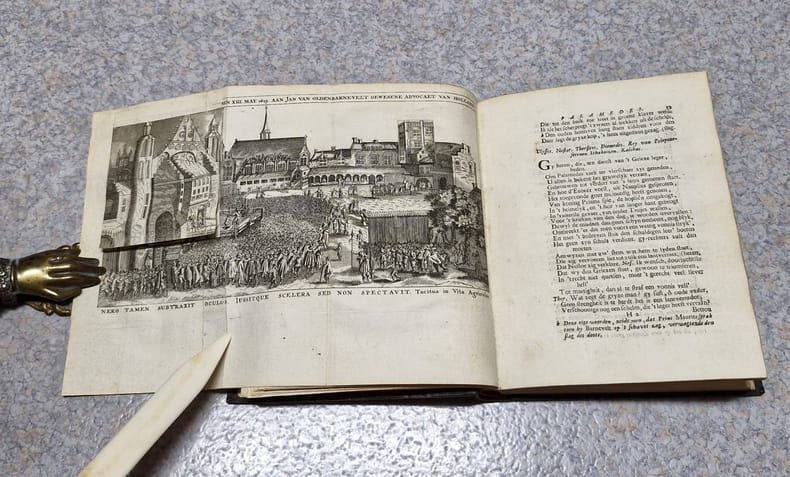
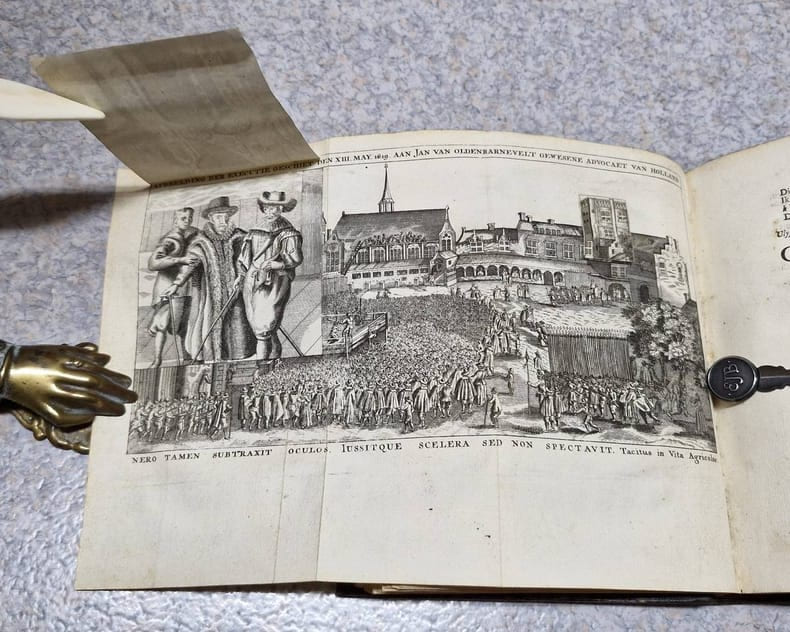
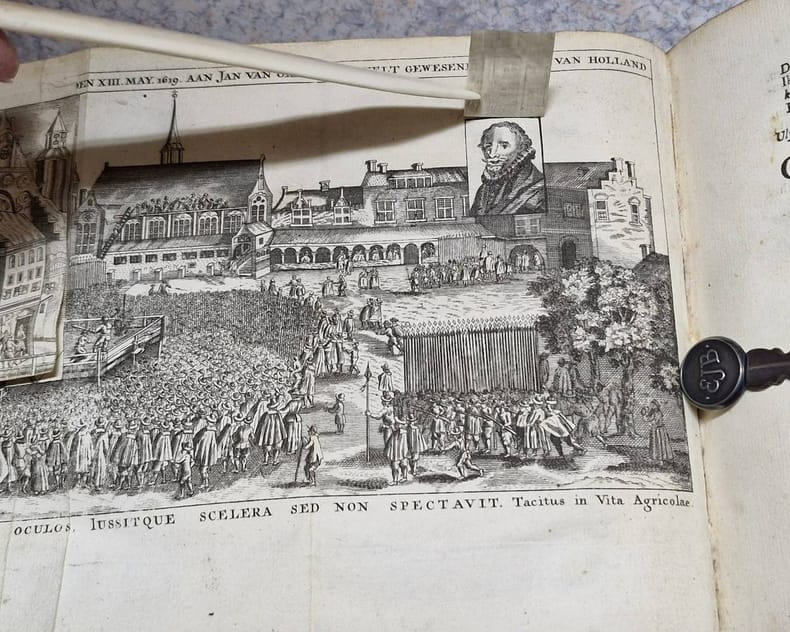
4to. 2 volumes in 1: (IV),(XVI),82;(2),179,(5) p. Frontispiece and plates (see description below). Early 20th century half cloth. 19 cm (Ref: STCN ppn 271408340; Schuytvlot 471; Unger 18,143) (Details: 'Pieter Brakman' was a pseudonym of the bookseller Pieter van der Veer in Rotterdam. (See: Ton Jongenelen. 'De Keurdigten. Het levenswerk van Pieter van der Goes, boekverkooper.' In: Mededelingen van de Stichting Jacob Campo Weyerman. 27 (2004), p. 57-67. Online at the site of DBNL). Volume 1 opens with a portrait of the author, engraved by P. van Gunst; immediately followed by a frontispiece, signed 'F Ble' (possibly Frans van Bleyswyck), it depicts the stoning of Palamedes by the Greeks before the walls of Troy, as told by the Greek poet Apollodorus. Bound before the first page of the play we find an engraving of a proud poet laureate (Vondel) in the role of Wibberley's 'Mouse That Roared', standing amids ferocious animals that want to devour him. In this volume at page 58 also a folding plate, depicting the beheading of J. van Oldenbarnevelt (Palamedes) on the 13th of May 1619 on the 'Binnenhof' in The Hague. This folding plate has 2 small moveable overlays, i.e. a small slip of paper, both depicting parts of a building; the first overlay hides a small portrait of Oldenbarnevelt, the other overlay depicts the 'ridderzaal' and covers the scene with the arrest of Van Oldenbarnevelt. Volume two has 8 plus 1 plates, of which 1 is folding. Plate 1, an engraving of the famous 'scale scene', where Prince Maurits puts his sword on the scale in favour of strict Calvinist Gomarus (p. 4); plate 2, portrait of J. van Oldenbarnevelt, engraved by P. van Gunst (p. 40); plate 3, the famous Rotterdam statue of Erasmus (p. 114); plate 4, a portrait of Hugo de Groot engraved by P. van Gunst (p. 124); plate 5, a folding plate showing the burial of the dog of Schout (bayliff) Bond, made after a painting of Jan Miense Molenaer (p. 130); plate 6, portrait of prince William II, who Vondel attacked for his infamous assault on Amsterdam in 1650 (p. 156); plate 7, portrait of Cornelis de Wit, engraved by P. van Gunst (p. 164); plate 8, portrait of his brother Johan de Wit, also engraved by P. van Gunst (P. 164); between plate 2 and 3 has been added an engraving of an allegoric triumph held by Prince Frederik Hendrik of Orange, protector of the Dutch republic and its freedom (p. 65). This plate is not mentioned in the list of plates on the last but one page) (Condition: Gilt short title on the back) (Note: The playwright and poet Joost van den Vondel,1587-1679, who is considered the most prominent author of the Golden Age of the Dutch Republic, published his tragedy 'Palamedes, oft vermoorde onnooselheit' in 1625. In 1652 he published a second edition with drastic alterations. This edition of 1736 is based on that revised edition. Vondel expressed in the Palamedes his political views, accusing under a thinly veiled disguise of an oscure Greek allegoric story the strict Calvinist Contra-Remonstrants and Prince Maurits of Orange of a political murder, the beheading in 1619 of the 'Land's Advocate of Holland for the States of Holland' Jan van Oldenbarnvelt, who had been the virtual 'Prime Minister' of the Dutch republic for 32 years. The unlawful killing of Palamedes on the ground of false accusations by the Greeks, stood for the execution of this Dutch statesman. The harsh and tyrannical villain, Agememnon, was clearly intended to portray Maurits, stadtholder of the Dutch Republic. Vondel stood for civil liberty, especially in religious matters. Vondel opposed with this 'J'accuse'-like play any form of tyranny, of the church and of the government. The second title in this binding contains Vondel's satires (Hekeldichten). He began to publish them shocked by the execution of Oldenbarnevelt in 1619. One of the first is 'Geuzenvesper' (Geuse Vesper), a satire against the strict Calvinists and the judges who had condemed Van Oldenbarnevelt. The most famous satire is his 'Roskam', in which he attacked corrupt regents, and 'Harpoen' against the view of the strict protestant Contra-Reformists, who found that their authority should also apply outside the church) (Provenance: On the front flyleaf in ink: 'Mijn besten vriend J.D. Peesee (?) ter herinnering aan 1 Januari 1921') (Collation: Volume 1: pi4 (including frontispiece and a portrait of Vondel), *-2*4, A-K4, L1 (Leaf L1 missigned F1). Volume 2: pi1, A4 (minus leaf A4), B-V4, W4, X-Y4, Z2. (This volume contains a rarity: after gathering 'v' it continues with a gathering signed 'w') (Photographs on request)
Bookseller's contact details
Antiquariaat Fragmenta Selecta
+31 20 418 55 65
Payment mode

Sale conditions
Terms of Sale All items offered are subject to prior sale. Your order will be final after you have received our confirmation, with a specification of the availability of the items and the shipping costs. All books are complete and in good antiquarian condition, unless otherwise described. Prices are in EURO. Postage and insurance are not included. Postage will be calculated at cost (no extra charges). Returns Books may be returned within 14 days of receipt, if returned in the same condition as sent, and packed, shipped and insured as received (please always notify us). We will refund the shipping costs of a return shipment only if our descriptions were not correct. How to pay Pre-payment is necessary for new customers. Our order confirmation will provide detailed information and a specification of the shipping costs. Customers who are known to us and libraries will be invoiced as usual. We accept Visa and Mastercard. You can submit your card information through our SECURE PAYMENT FORM. PayPal: we will send you a personal link to the PayPal website. Banktransfers: payment can be made into our bank account in The Netherlands.

