 Write to the booksellers
DIONYSIUS ALEXANDRINUS & POMPONIUS MELA.
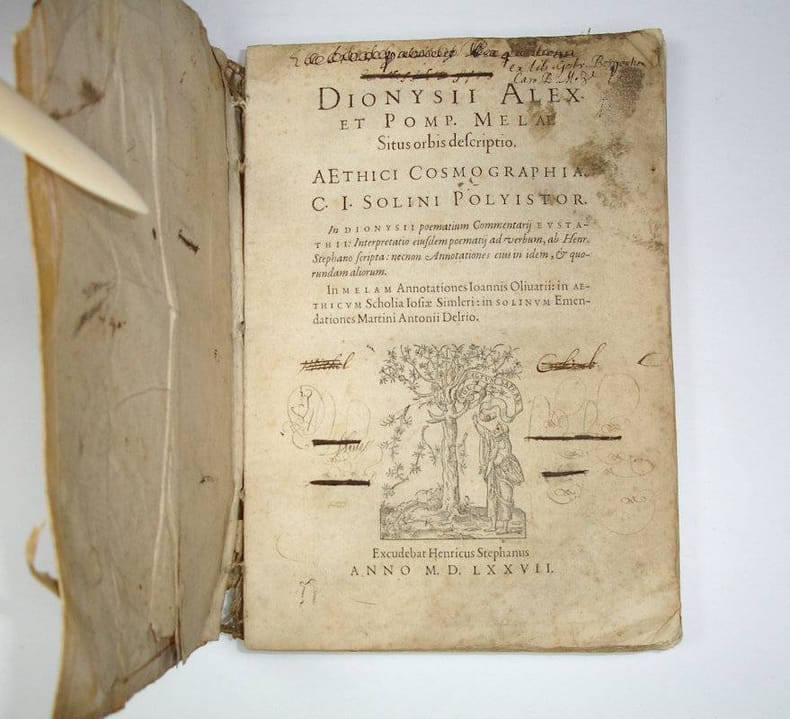
Dionysii Alex. et Pomp. Melae Situs orbis descriptio. Aethici Cosmographia. C.I. Soloni Polyistor. In Dionysii poematium commentarii Eustathii; interpretatio eiusdem poematii ad verbum, ab Henr. Stephano scripta; necnon annotationes eius in idem, & quorundam aliorum. In Melam annotationes Ioannis Olivarii; in Aethicum scholia Iosiae Simleri; in Solinum emendationes Martini Antonii Delrio.
N.pl., (Geneva), Excudebat Henricus Stephanus, 1577.
Reference : 140006
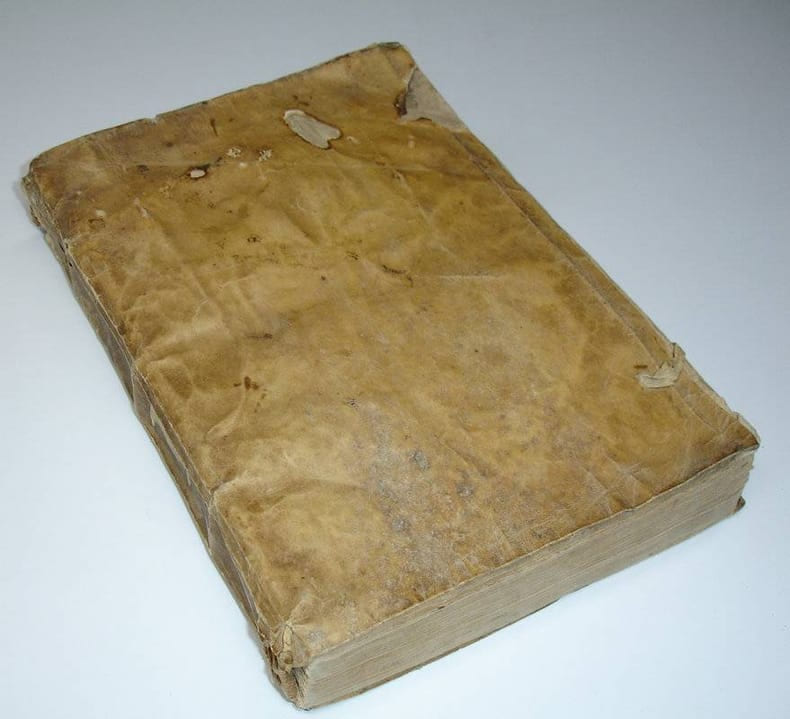
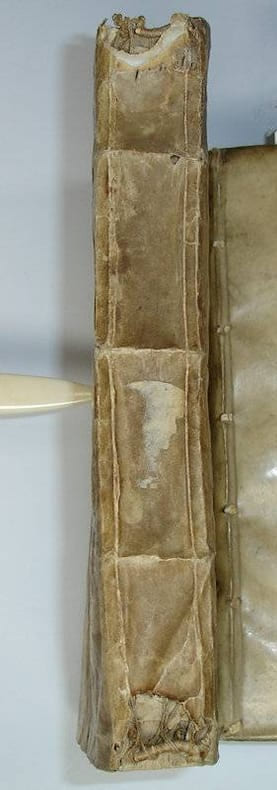
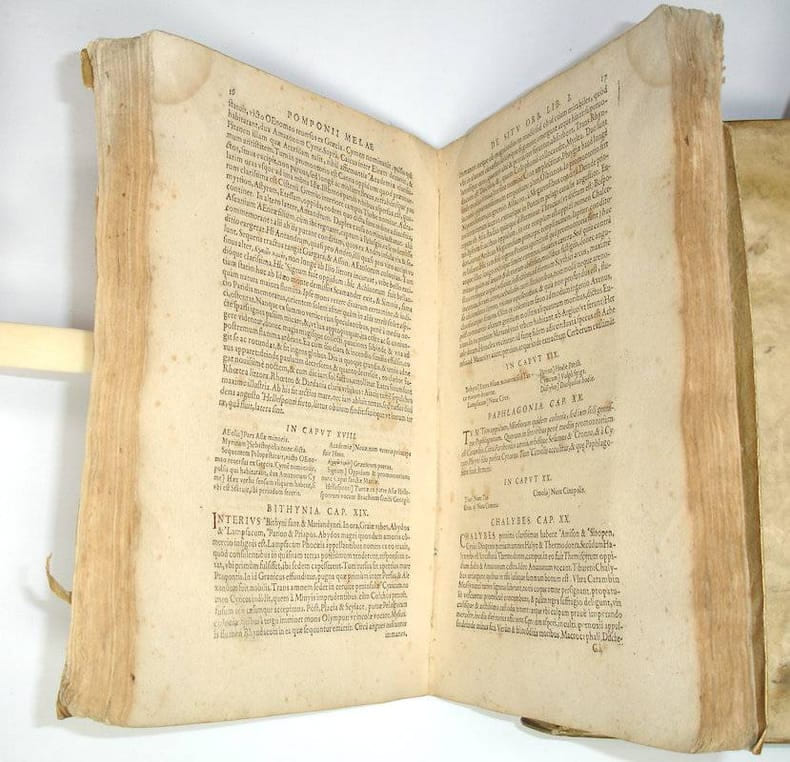
4to. 3 parts in 1: (VIII),158 (recte 160),(24),47,(1 blank); 152 p. Limp vellum 25 cm (Ref: GLN-2627; Hoffmann 1,592, Schweiger 2,690; Renouard p. 145 & 410; Ebert 6199; Graesse 2,401; Brunet 2,729) (Details: Printer's Olive tree device of the Stephanus family on the title, motto: 'Noli altum sapere', short for 'Noli altum sapere, sed time', in Greek 'mê hupsêlophronei, alla phobou', or in English 'Donot be high-minded, but fear'. (Epistola Beati Pauli ad Romanos 11,20) (Condition: Vellum very worn: it is soiled and wrinkled, and shows 4 small holes in the upper board. Small piece of the vellum on the right upper corner of the upper board gone. Left upper corner of lower board also gone. Back damaged at the head & the tail of the spine. Old ownership entries on the title. Some faint and small ink curls on the title. Title soiled and thumbed. Corners of first 5 gatherings dog-eared. Paper slightly foxed. Some faint waterstains) (Note: For this edition of 1577 the publisher, the French humanist scholar Henricus Stephanus (1528/31-1598), brought together 3 geographical works, of which 2 had been published recently. Part 1 contains Dionysius' 'Periêgêsis' ('orbis descriptio'). Stephanus added to the Greek text his own literal translation into Latin. The text is further accompanied by 2 colums of Greek scholia. At the end of this first part, p. 143/58 are Stephanus' notes to the 'orbis descriptio', and to the scholia and the notes of the Byzantine commentator Eusthatius. Part 2 contains a Latin translation of Mela's 'orbis descriptio', now with notes by Petrus Johannes Olivarius. Part 3 contains Gaius Julius Solinus' 'Collectanea rerum memorabilium' in the edition of Martinus Antonius Delrio, and Iosias Simler's edition of Aethicus of Istria's 'Cosmographia', together with his notes. Even today the author and date of the 'Situs orbis descriptio' or 'De situ orbis', also known as 'Orbis descriptio', a didactic poem in Greek of 1187 hexameters, which served as a poetic guide of the known world in antiquity (periêgêsis tês oikoumenês), seems a riddle. (See the fuzzy information about Dionysius Alexandrinus in Wikipedia, the English article is the worst), This riddle was solved already in 1884. 'Much ink was spilt over the question of his (Dionysius') age and country, until G. Leue (Philologus 42 (1884), p. 175 ff) had the perspicacity to notice that the poem is signed and dated; lines 113-134 (Müller) and 522-532 are acrostics, informing us respectively that the work is 'Dionusiou tôn entos pharou', by 'Dionysios, one of those inside Pharos', i.e. in Alexandria, and 'epi Hadrianou', 'of the time of Hadrian'. (H.J. Rose, 'A handbook of Greek literature', London 1965) The poem opens with an introduction (1-26), then the Ocean is treated (27-169), followed by Africa (170-269), Europe (270-446), the islands (447-619), and Asia (620-1165). The pleasant and clear Callimachean versification and its comprehensibility made it an ideal Byzantine schoolbook. The work was much read in antiquity, the Middle Ages, and well into the 19th century. It was loosely translated into Latin in the 4th century by Avienus and in the 5th century by the grammarian Priscianus, and was commented thoroughly by the Byzantine scholar Eustathius. The second part of this collection contains the commentary of the Spanish humanist Petrus Johannes Olivarius (Olivarez) of Valenzia, regarding Mela's ancient sources, style and methods. His Mela edition, together with his commentary was first published in Paris in 1536. The third part opens with Solinus' 'Collectanea rerum memorabilium' in the edition of the Spanish scholar Martinus Antonius Delrio, or Martín Antonio del Rio (1551-1608), Antwerp 1572. It is a geographical summary of parts of the world, their origins, history and customs. Its sources are Pliny's 'Historiae Naturales' and Pomponius Mela. At the end of this last part we find 'Aethici Cosmographia', probably 8th century. This title was coined by its editor, the Swiss theologian, historian and classical scholar Josias Simler (1530-1576), in his edition of the 'Cosmographia', Basel 1575. It succinctly describes the Roman world, and is divided in 2 parts, the first part contains names of seas, rivers, islands, mountains, cities, peoples etc., the second part contains a description of the 3 parts of the world, Asia, Europe and Africa. The sources of the further unknown Aethicus Ister are Pliny, Mela Pomponius, the Bible and Isidorus of Sevilla) (Provenance: At the upper margin of the title: 'Ex libris Gabr. Bergonhon, Can. B. Moz'. Erased have been the name of 2 previous owners. The Benedictine editor Dionysus Sammarthanus of the second volume of 'Gallia Christiana: in provincias ecclesiasticas distributa', Paris 1720, col. 761, thanks the 'vir optimus Dom Gabriel Bergonhon B. Mariae Aniciensis canonicus & syndicus' for his information concerning the series of the abbotts of the 'Abbatia Sancti Evodii Aniciensis', that is, he thanks Gabriel Berghonon, canon of the church of 'Beatae Mariae Aniciensis'. This church must be the 'cathédrale Notre-Dame-de-l'Annonciation' at Puy-en-Velay, a major monument of christian romanesque art, where the famous Black Madonna Maria was venerated. 'Anicium Velavorum', or 'civitas Velavorum' is the Gallo-Roman name of Puy-en-Velay. With this in mind, the provenance reads like this: 'from the library of Gabriel Bergonhon, 'Canonicus Benedictinus', or 'Canon Bénédictin' of Moz. The end of the last letter z of Moz seems to curl. These 3 letters can only refer to the Benedictine Abbey of Mozac, one of the oldest and most important abbeys in the 'Basse-Auvergne'. Bergonhon is a 'famille de robe du Puy') (Collation: 4, a-v4; -24 (index); 4, A-2B4 (leaf F4 verso blank) (Error in pagination: p. 136-160 numbered 134-158)) (Photographs on request)
Bookseller's contact details
Antiquariaat Fragmenta Selecta
+31 20 418 55 65
Payment mode

Sale conditions
Terms of Sale All items offered are subject to prior sale. Your order will be final after you have received our confirmation, with a specification of the availability of the items and the shipping costs. All books are complete and in good antiquarian condition, unless otherwise described. Prices are in EURO. Postage and insurance are not included. Postage will be calculated at cost (no extra charges). Returns Books may be returned within 14 days of receipt, if returned in the same condition as sent, and packed, shipped and insured as received (please always notify us). We will refund the shipping costs of a return shipment only if our descriptions were not correct. How to pay Pre-payment is necessary for new customers. Our order confirmation will provide detailed information and a specification of the shipping costs. Customers who are known to us and libraries will be invoiced as usual. We accept Visa and Mastercard. You can submit your card information through our SECURE PAYMENT FORM. PayPal: we will send you a personal link to the PayPal website. Banktransfers: payment can be made into our bank account in The Netherlands.

