 Write to the booksellers
LIPSIUS,J.
Iusti Lipsii Epistolarum selectarum chilias, in qua I. II. III. Centuriae ad Belgas, Germanos, Gallos, Italos, Hispanos. IV. Singularis ad Germanos & Gallos. V. Miscellanea. VI. VII. VIII ad Belgas. IX. & X Miscellaneae Postumae. Epistolica institutio eiusdem Lipsii. Accessit in gratiam studiosae iuventutis, rerum aliquot insignium, & elegantissimarum similitudinum, quae in nonnullis epistolis occurrunt, index locupletissimus.
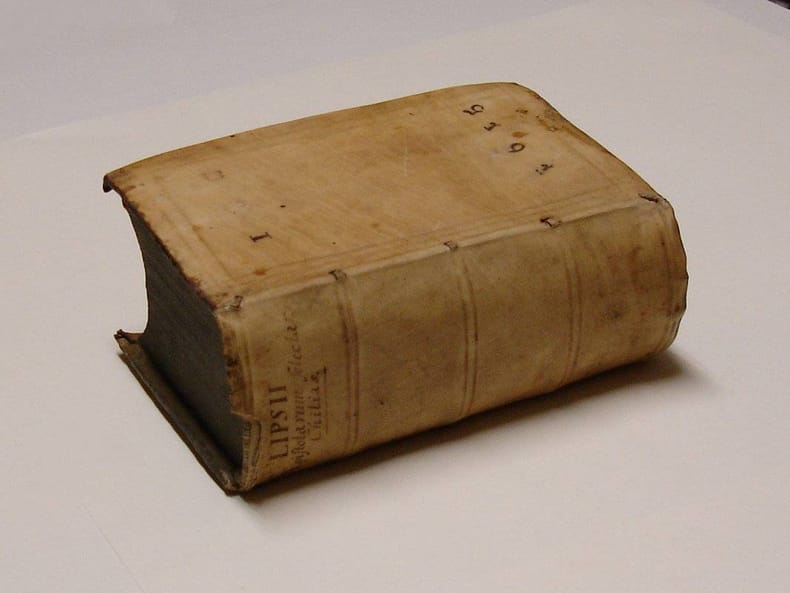
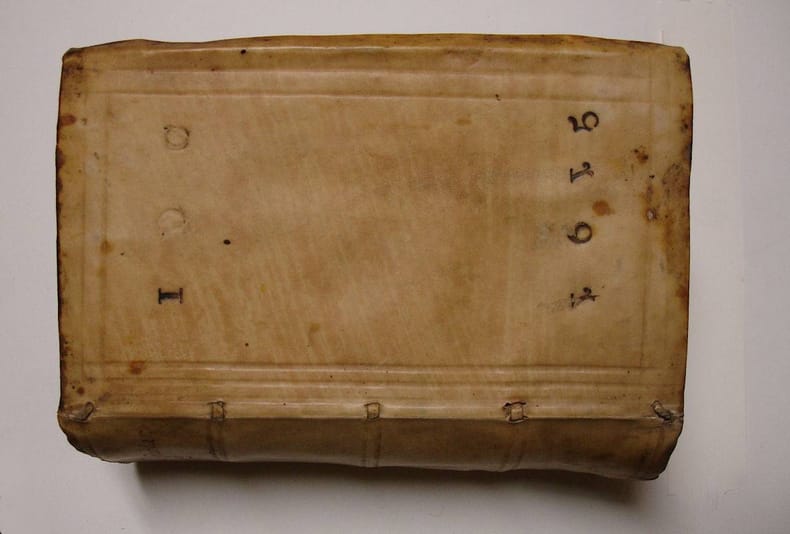
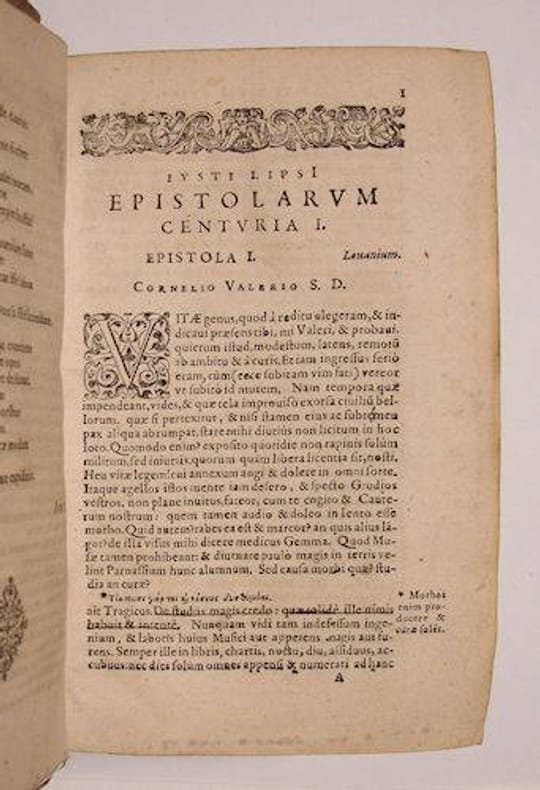
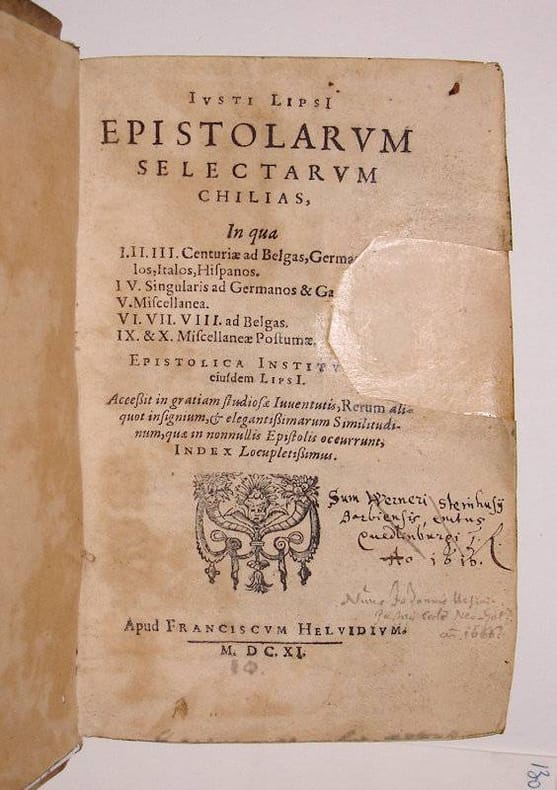
N.pl. (Geneva, Leiden or Cologne), Apud Franciscum Helvidium, 1611.
Reference : 130101
8°, (XVI),1078,(18) p. Full contemporary vellum with overlapping edges (Ref: VD17 12:646081U. VD17 is not sure about the place where this title was published. Mentioned are Cologne, Leiden and Geneva. GLN 15/16 offers a kind of solution: 'Cet 'Helvidius' qui signe au moins six éditions entre 1600 et 1622 est mystérieux. Ladresse genevoise a été ajoutée sur quelques rares exemplaires. Une édition de Juste Lipse de 1611 est souvent située à Leyde (Lugduni Batavorum), mais la majorité des éditions indiquent 'Coloniæ'. Cependant les répertoires dimprimeurs des Pays-Bas et dAllemagne ne connaissent aucun 'Helvidius') (Details: Boards with double fillet blind borders. Initials 'IDC' followed by '1615' stamped on the upper board. Short title in ink on the back. Woodcut ornament on the title) (Condition: Vellum age-tanned, slightly worn & spotted. Small piece missing at the head of the spine. Name cut out of the title at the right margin (4 x 4 cm) with some loss of text. The space is filled up by a blank piece of paper. Two ownership inscriptions on the title; Old inscription also on the front pastedown: 'Male habendo et bone sperando consumitur vita mortalium'. Some brown spots on the title and the following 3 leaves, plus a very minor wormhole at the top right corner. Small wormhole at lower right corner through the last two leaves. A few minor damp spots at the upper margin of pp. 514-692, a few occasional underlinings up to p. 133, otherwise in very good condition internally.) (Note: Justus Lipsius, 1547-1606, the greatest Latin scholar of his time in the Netherlands, came in 1579 to the recently founded University of Leiden (1575) to teach Latin. He resided there with great distinction as honorary Professor of History from 1579 till 1591. The twelve years that Lipsius spent there were the period of his greatest productivity. It was during this time that he prepared his Seneca, and perfected, in successive editions, his Tacitus, and brought out a series of other works. Some were pure scholarship, some were collections from classical authors, and others were of general interest. Lipsius' greatest strength lay in textual criticism and exegesis. 'His masterpiece in this respect was his Tacitus, of which 2 edtions appeared in his life-time' (J.E. Sandys, History of Classical Scholarship, N.Y., 1964, vol. 2, p. 303) Lipsius left the Dutch republic, converted to Catholicism, and finally settled in Leuven to teach as professor of Latin in the 'Collegium Buslidianum'. In an autobiographical letter to his pupil Johannes Woverius, dated 1 Oct. 1600, in this collection Centuria V, letter 87 (p. 492/498), Lipsius presents himself 'as a true humanist, whose uneventful life is filled by reading, teaching and writing. His life was not to be compared to that of real great men, whose political or military deeds (res gestae) merit description. He kept away from politics, depicting his scholarly career as a succession of political innocent travels to interesting places like Italy, Vienna and Jena, and then returning to his beloved fatherland for which he had really longed for all this time. His long stay at Leiden University he portrayed as a period spent in refuge while the civil war was raging in the Netherlands. In the end he felt forced to return to his native country, the Southern Netherlands. He tells us in the autobiographical letter that this decision was mainly inspired by the religious condition of the rebellious provinces and by the attacks he had to suffer on his reputation (Religio et Fama)'. (N. Mout, 'Justus Lipsius between war and peace', in 'Public Opinion and Changing Identities in the Early Modern Netherlands', Leiden/Boston 2007, p. 150) Lipsius lived in turbulent times. He wrote a number of works which were to revive the philosophy of ancient Stoicism in a form that was acceptable to Christianity. The most famous of these is 'De Constantia in publicis malis' ('On constancy in times of public calamity'), first published Leiden/Antwerpen 1584)) (Provenance: 'Provenance Sachsen'. Blind stamped on the frontcover: 'I.D.C., 1615'. On the title in old ink: 'Sum Werneri Sternhusii, Barbiensis, emtus Quedlinburgi 1616'. Werner Sternhausen, or Sternhusen was born in Barby, South of Magdeburg in Sachsen. He bought the book in Quedlinburg. Under this: 'Nunc Johannis Ursini 1666, Pastoris Eccl(esi)ae Neo-Gat., an. 1666'. Who Johannes Ursinus, Pfarrer in Neugattersleben was, we could not find out. Neugattersleben is a Saxonian city some 15 km from Barby On the front pastedown: 'M.J. Fr. A. Kinderling, C. Berg. an. 1770'. Magister Johann Friedrich August Kinderling, born in 1743 in Magdeburg, was also a Pfarrer. In 1768 he was appointed Rector and teacher at the Convent Berge near Magdeburg. During his rectorate in Berge, which lasted till 1771, he acquired this book (october 1770). In Berge it was also his task to arrange the convent library, which numbered some 4300 books, in proper order, and to produce a catalogue. He wrote more than 100 treatises on theology, but also on the German language, especially 'Plattdeutsch'. He died in 1807. (See (www).uni-magdeburg.de/mbl/Biografien/0274.htm) (Collation: *-8, A-3Y8, 3Z4) (Photographs on request)
Bookseller's contact details
Antiquariaat Fragmenta Selecta
+31 20 418 55 65
Payment mode

Sale conditions
Terms of Sale All items offered are subject to prior sale. Your order will be final after you have received our confirmation, with a specification of the availability of the items and the shipping costs. All books are complete and in good antiquarian condition, unless otherwise described. Prices are in EURO. Postage and insurance are not included. Postage will be calculated at cost (no extra charges). Returns Books may be returned within 14 days of receipt, if returned in the same condition as sent, and packed, shipped and insured as received (please always notify us). We will refund the shipping costs of a return shipment only if our descriptions were not correct. How to pay Pre-payment is necessary for new customers. Our order confirmation will provide detailed information and a specification of the shipping costs. Customers who are known to us and libraries will be invoiced as usual. We accept Visa and Mastercard. You can submit your card information through our SECURE PAYMENT FORM. PayPal: we will send you a personal link to the PayPal website. Banktransfers: payment can be made into our bank account in The Netherlands.

