 Write to the booksellers
HORATIUS.- WAGNER,H.
Q. Horatii Flacci Carmina collatione scriptorum graecorum illustrata ab Henrico Wagnero. Praefatus est Christ. Adolphus Klotzius.
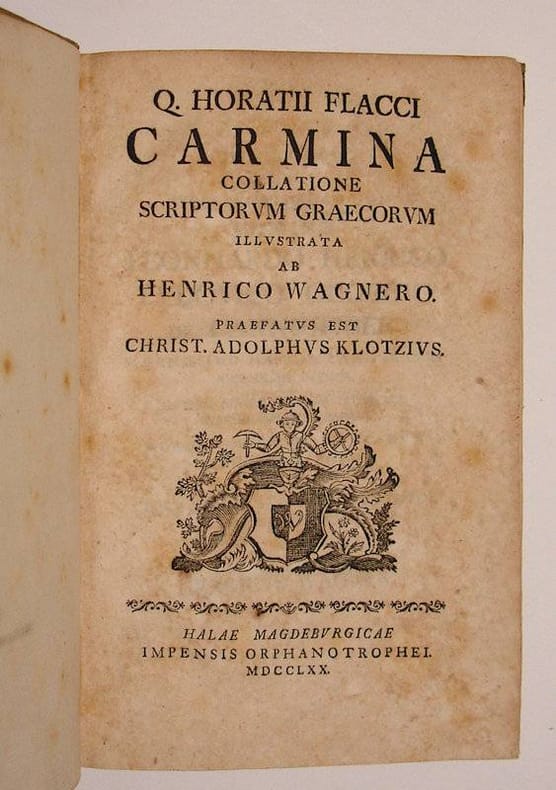
Halle (Halae Magdeburgicae), Impensis Orphanotrophei, 1770.
Reference : 130083
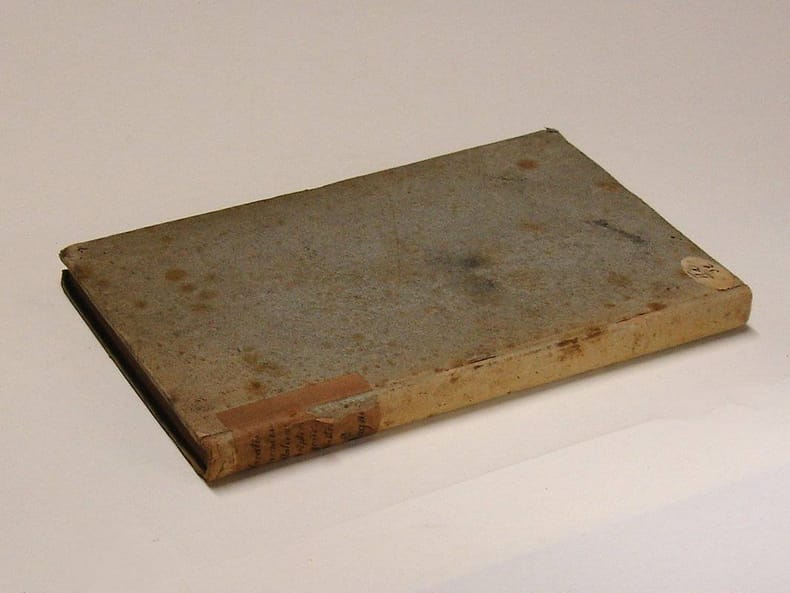
8vo. (VIII),XXII,136 p. Contemporary boards 20 cm (Ref: not yet in VD18; Schweiger 2,461; Ebert 10280; Brunet 6, no. 12507) (Details: Woodcut printer's mark on the title) (Condition: Binding scuffed and spotted. Owner's inscriptions written on the front endpapers. First and last leaves browning, the rest is yellowing) (Note: The works of the Roman poet Quintus Horatius Flaccus, 65-8 B.C., have enjoyed a continuous presence in European culture. His memorable phrases made him the most quoted ancient author. Till well into the 20th century he stood central in school curricula. Earlier, in the Middle Ages, he was next to Vergil the most important school author. Horace is transmitted in around 300 medieval manuscripts. The Renaissance saw the beginning of a flood of editions. 'For Neo-latin poetry until modern times, and for all the vernacular literature of Europe from the 16th through the 18th centuries, Horace provided the dominant model both for private lyrics celebrating wine and love and for public lyrics celebrating affairs of state'. Young poets used Horace to learn the trade. 'Horace's elegant rationalism and moral wisdom, and also his disabused and tolerant tone, made his poems favorite reading during the Enlightenment'. (The Classical Tradition, Cambr. Mass., 2010, p. 454/60)) The style of many of Horace's poems displays polished techniques derived from Hellenistic Greek poetry. In his odes Horace claims the early Greek lyric poets Sappho and Alcaeus as his models, and to have introduced into Latin poetry their style and rythms. The German jurist Heinrich Wagner (Henricus Wagnerus), 1747-1814, tried in his 'Horatii Flacci Carmina collatione' to locate the Greek sources of Horace's poetry. (For Wagner see 'Killy Literaturlexikon', 2nd edition, 2011, vol. 12, p. 73/74)) (Provenance: On the front pastedown: 'Schol. Gustrov. acc. 1816'. This school is the 'Domschule' at Güstrow, in Northern Germany, a 'schola latina' founded in 1552, and later transformed into a Gymnasium. In 1942 the school was merged with the local Realgymnasium. Its new name was 'Vereinigte John-Brinckman-Schule und Domschule'. Nowadays it is called the 'John-Brinckman-Gymnasium'. On the flyleaf: 'No. 58 May 1788'. On the same leaf in a different hand: first an erased name, and then: 'Hic liber a Professore nostro, viro generosissmo, XIVa Cal. Mart. 1802 mihi est datus'. Car. Piper') (Collation: *4, )(-2)(8, -H8, I4) (Photographs on request)
Bookseller's contact details
Antiquariaat Fragmenta Selecta
+31 20 418 55 65
Payment mode

Sale conditions
Terms of Sale All items offered are subject to prior sale. Your order will be final after you have received our confirmation, with a specification of the availability of the items and the shipping costs. All books are complete and in good antiquarian condition, unless otherwise described. Prices are in EURO. Postage and insurance are not included. Postage will be calculated at cost (no extra charges). Returns Books may be returned within 14 days of receipt, if returned in the same condition as sent, and packed, shipped and insured as received (please always notify us). We will refund the shipping costs of a return shipment only if our descriptions were not correct. How to pay Pre-payment is necessary for new customers. Our order confirmation will provide detailed information and a specification of the shipping costs. Customers who are known to us and libraries will be invoiced as usual. We accept Visa and Mastercard. You can submit your card information through our SECURE PAYMENT FORM. PayPal: we will send you a personal link to the PayPal website. Banktransfers: payment can be made into our bank account in The Netherlands.

