 Write to the booksellers
HEMSTERHUIS,T. & D. RUHNKEN.- LINDEMANN,F.
Vitae duumvirorum Tiberii Hemsterhusii et Davidis Ruhnkenii. Altera ab eodem Ruhnkenio, altera a Dan. Wyttenbachio scripta. Olim in Germania iunctim repetitae nunc iterum editae. Accessit Elogium Ioannis Meermanni, auctore Constantino Cras. Curavit Fridericus Lindemann.
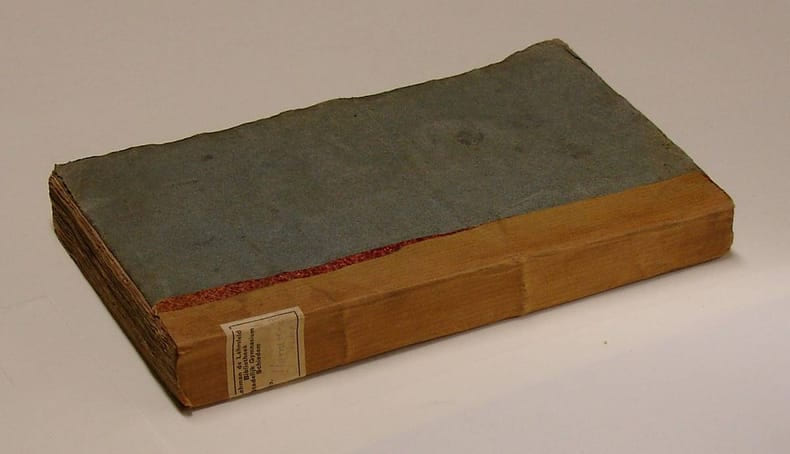
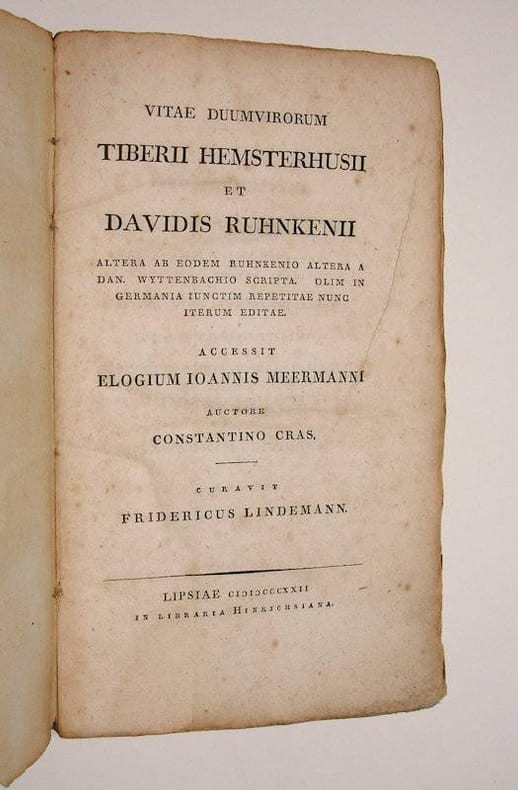
Leipzig (Lipsiae), In Libraria Hinrichsiana, 1822.
Reference : 130076
8vo. 284 p. Contemporary dull stiff wrappers 22 cm (Ref: Graesse 6/1,191; Ebert 19587; Brunet 4,1457) (Details: Margins uncut) (Condition: Spine covered with a strip of brown paper. Boards worn. Paper yellowing and foxed) (Note: The honour of reviving the study of Greek in the Netherlands belongs to the Dutch classical scholar Tiberius Hemsterhuis, 1685-1766, who became professor Mathematics and Philosophy at the Athenaeum of Amsterdam at the age of 19. His great example was the English classical scholar Richard Bentley, 1662-1742 with whom he corresponded early in his career. In 1705 Hemsterhuis was promoted to a professorship in Harderwijk, and in 1717 he was appointed professor of Greek at the University of Franeker. In 1740 he was finally called to Leiden. He produced an edition of Pollux (1706), 'Luciani colloquia et Timon' (1708), the complete works of Lucianus (1743) and of the Plutus of Aristophanes (1744), a work which Gudeman calls 'epochemachend'. He contributed also notes to the editions of many other scholars. Sandys observes that 'the work of a Hemsterhuis was worth whole bundles of the mechanically manufactured products of a Burman'. (Sandys 2,451) Hemsterhuis was the founder of a Dutch school of criticism, the so-called 'Schola Hemsterhusiana', which had disciples in Valckenaer, Jacob van Lennep and David Ruhnken. The last one was the most famous of his pupils. 'Hemsterhuis has had the supreme felicity of being immortalised by a 'laudator eloquentissimus'. The 'Elogium' delivered in 1768 by his devoted pupil Ruhnken, on resigning the office of Rector, is one of the Classics in the History of Scholarship. It presents us with the living picture of the perfect critic'. (Idem, ibidem) The Dutch scholar of German origin David Ruhnken, or Ruhnkenius, 1723-1798, was born in Pommern, and was sent by his parents in 1737 to the Friedrichscollegium in Königsberg, where he read Latin authors together with his friend Immanuel Kant. To finish his studies he went in 1744 to Leiden, to study Greek under Tiberius Hemsterhuis, whom he admired. He later told his biographer Wyttenbach that he found in his teacher the combined gems of Leiden classical scholarship, Scaliger and Salmasius, in one person. Hemsterhuis wanted to create a worthy successor, and appointed him to assist him as Reader in Greek. In 1761 Ruhnken succeeded the Latin chair vacated by Oudendorp. He became one of the leading scholars of his days. 'Die Führerstellung der Philologie erbte (...) von Hemsterhuys der Pommer David Ruhnken, der ganz zum Holländer ward und die vornehme und behäbige Würde eines Princeps criticorum zu wahren wusste. Als solchem hat ihm Fr.A. Wolf die Prolegomena gewidmet. (...) Musterhaftes Latein galt ihm soviel wie Wissenschaft. Aber als Lehrer muss er glänzend gewesen sein. (...) Alles was Ruhnken veröffentlicht hat, ist in seinen Grenzen tadellos'. (U. von Wilamowitz-Moellendorff, Geschichte der Philologie, Lpz./Bln. 1921, p. 39/40) Ruhnken was immortalized by Daniel Wyttenbach, 1746-1820, born at Bern in Switzerland, who came to Holland in 1770 to stay there, like Ruhnken before him. 'In the next 28 years he held professorships at Amsterdam (1771-99), and then returned to Leyden as Ruhnken's successor for 17 years (1799-1816)'. (Sandys 2,463) He published an edition of the complete Moralia of Plutarchus (with Latin translation) (1795-1806), a work of permanent value. On the death of Runken he became the most influential classical scholar in the Netherlands. 'The highest praise must be assigned to his 'Life of Ruhnken', a work of absorbing interest to his scholarly contemporaries, which still retains its importance as a comprehensive picture of the Scholarship of the Netherlands, and not of the Netherlands alone, in the age of Ruhnken'. (Idem 2/465) The third biography in this convolute concerns the Dutch politician, author and bibliophile Johannes Meerman, 1753-1815. The eulogy was first published in Amsterdam/The Hague in 1817. Lindemann was aware that Meerman was not a classical scholar, and that he in no way equalled Hemsterhuis and Ruhnken in scholarship and style, yet he added the Life, because he derived much pleasure from reading it, he tells in the preface, and hoped that it would stimulate young students ('iuvenes ad meliora eninentes et litterarum studia penitus amplecti cupientes'). (Praefatio editionis secundae, p. X) Meerman, who received private tuition from Ruhnken (p. 232) , is best known as a bibliophile. The Museum Meermanno, (House of the Book, Huis van het boek) in The Hague, formerly called Museum Meermanno-Westreenianum, was named after him, and holds part of his huge collection of rare books and manuscripts. The museum focuses on the written and printed book in all forms) (Collation: pi6 (minus blank leaf pi6), A-R8, S6 (signature of gathering S irregular)) (Photographs on request)
Bookseller's contact details
Antiquariaat Fragmenta Selecta
+31 20 418 55 65
Payment mode

Sale conditions
Terms of Sale All items offered are subject to prior sale. Your order will be final after you have received our confirmation, with a specification of the availability of the items and the shipping costs. All books are complete and in good antiquarian condition, unless otherwise described. Prices are in EURO. Postage and insurance are not included. Postage will be calculated at cost (no extra charges). Returns Books may be returned within 14 days of receipt, if returned in the same condition as sent, and packed, shipped and insured as received (please always notify us). We will refund the shipping costs of a return shipment only if our descriptions were not correct. How to pay Pre-payment is necessary for new customers. Our order confirmation will provide detailed information and a specification of the shipping costs. Customers who are known to us and libraries will be invoiced as usual. We accept Visa and Mastercard. You can submit your card information through our SECURE PAYMENT FORM. PayPal: we will send you a personal link to the PayPal website. Banktransfers: payment can be made into our bank account in The Netherlands.

