 Write to the booksellers
DECLARATIO ORDINUM HOLLANDIAE WEST-FRISIAEQUE,
Declaratio Ordinum Hollandiae West-Frisiaeque, ex ipsis fundamentis Regiminis Belgici desumpta, qua jus & potestas singularum Provinciarum cum externis Princibus contrahendi, & de quibuscunq: negotiis constituendi proponitur, nisi quid foedere unionis An. 1579 Ultrajecti composito, aut speciatim Foederatorum Procerum conventui delatum fuerit. Qua legitima & justa esse ostenditur concessio instrumenti seclusionis Principis Auriaci, sicut a Nobil. & Potentibus Ordin. Hollandiae West-Frisiaeque anno 1654, IV Maii decretum fuit; (...) Versum Exemplar ex Belgico, quod impressum est Hagae-comitis a Typographo Nob. & Potent. Ord. Hollandiae West-Frisiaeque, cum privilegio.
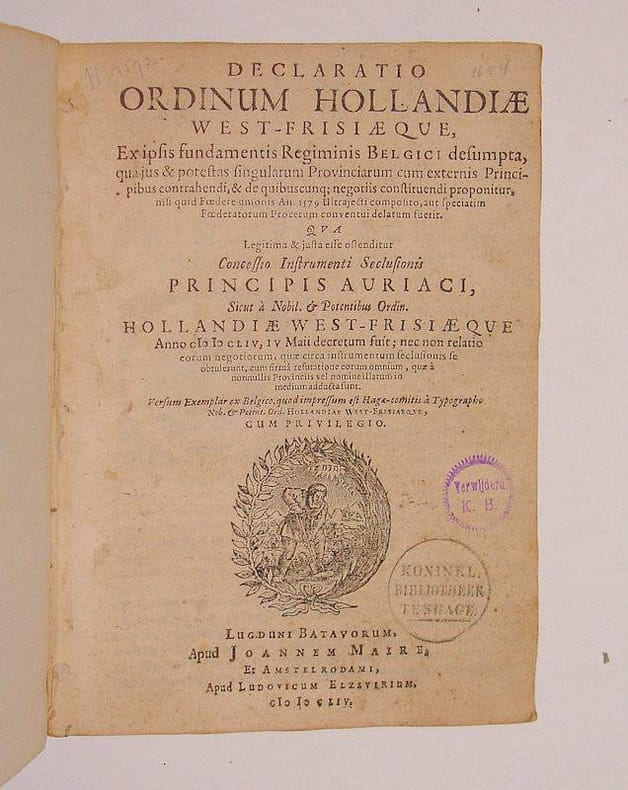
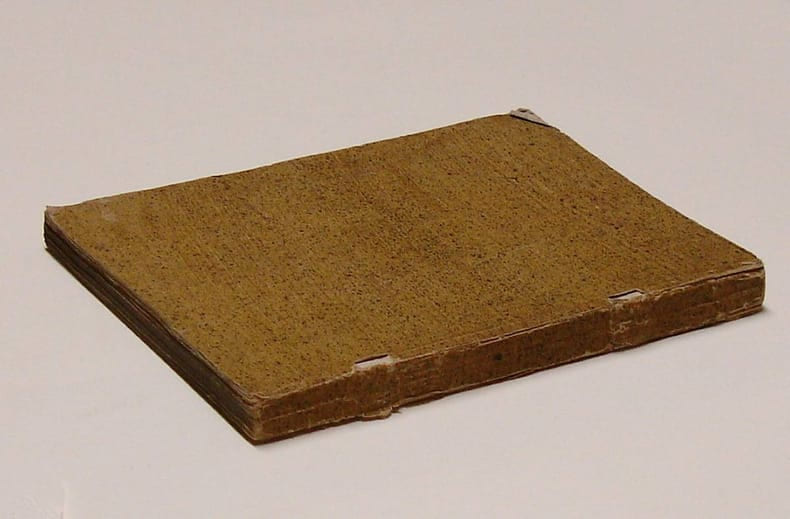
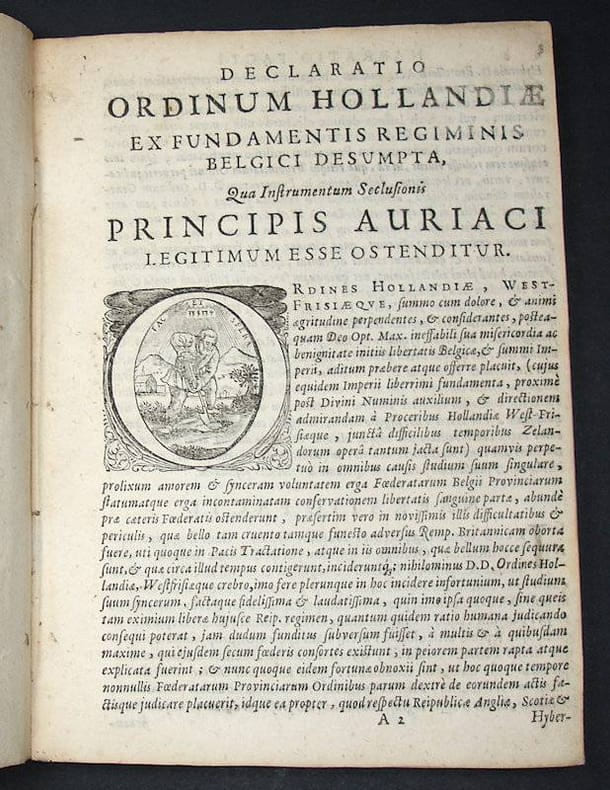
Leiden, Amsterdam, (Lugduni Batavorum, Amstelrodami), Apud Joannem Maire, et (...) apud Ludovicum Elzevirium, 1654.
Reference : 130049
4to. 196 (recte 192) p. 18th century boards. 19 cm (Ref: Willems 1172; Berghman 302; Not in Rahir; Breugelmans, p. 688, 1654:3) (Details: Printer's device on the title: a shoveling farmer, above his head the motto 'fac & spera') (Condition: Cover scuffed, especially on the joints. 2 small library stamps on the title) (Note: In May 1654 the Dutch Prime Minister (Raadspensionaris) of the Republic of the United Provinces of the Netherlands Johan de Witt, 1625-1672, brought about peace with England after the First Anglo-Dutch War, a naval conflict over trade which had begun in 1652. The peace treaty, called the Treaty of Westminster, had a secret annex, the Act of Seclusion, in which the Republic promised to appoint never again as stadholder offspring of the prince of Orange, stadholder William II, who had died in 1650, the offspring being the not yet four year old infant William III, born after the death of his father. His mother was Maria Henriëtte Stuart, the oldest daughter of the English King Charles I. This annex had been attached on the instigation of the dictator (Lord Protector) Oliver Cromwell, who felt that since William III was a grandson of the executed Charles I, it was not in the interests of his own republican regime to see William or a Stuart ever gain political power. The republican Johan de Witt kept the annex secret from fear that some of the provinces where the House of Orange had much influence, wouldnot sign the peace treaty. Soon the annex got leaked out, and De Witt was blamed for excluding the House of Orange from power. With a speech, called the 'deductie, ofte declaratie van de Staten van Hollandt ende West-Vrieslandt', De Witt succeeded in convincing the other provinces. The speech brought about much political turmoil. The speech 'Deductie, ofte declaratie van de Staten van Hollandt ende West-Vrieslandt : behelsende een waerachtich ende grondich bericht van de fondamenten der regieringe vande vrye Vereenichde Nederlanden (...) ingestelt ende dienende tot justificatie van 't verleenen van seeckere Acte van Seclusie, raeckende 't employ vanden Heere Prince van Oraigne (...) op den vierden Mey 1654 ghepasseert' was published in The Hague the same year, 1654. Later that year the speech was translated into Latin and published by Maire and Elsevier. William III got his revenge in the Disaster Year (Rampjaar) 1672 when the Dutch republic was attacked from all sides simultaneously by England, France, and the prince-bishops of Münster and Cologne, who quickly defeated the Dutch States Army and conquered part of the Republic. Orangists then took power by force and deposed de Witt, who recovering from an earlier Orangist attempt on his life in June, was lynched by an organized Orangist mob. William greatly rewarded the assassins of his greatest political opponent. In 1688 William III invaded England, deposed King James, and became together with his wife Mary, the daughter of his maternal uncle James, Duke of York, joint sovereigns of England, Ireland, and Scotland) (Provenance: Small stamp of the Dutch 'Koninklijke Bibliotheek' (Royal Library), and a smaller withdrawal stamp on the title) (Collation: A-E4, F2, G-2A4, 2B2)(Photographs on request)
Bookseller's contact details
Antiquariaat Fragmenta Selecta
+31 20 418 55 65
Payment mode

Sale conditions
Terms of Sale All items offered are subject to prior sale. Your order will be final after you have received our confirmation, with a specification of the availability of the items and the shipping costs. All books are complete and in good antiquarian condition, unless otherwise described. Prices are in EURO. Postage and insurance are not included. Postage will be calculated at cost (no extra charges). Returns Books may be returned within 14 days of receipt, if returned in the same condition as sent, and packed, shipped and insured as received (please always notify us). We will refund the shipping costs of a return shipment only if our descriptions were not correct. How to pay Pre-payment is necessary for new customers. Our order confirmation will provide detailed information and a specification of the shipping costs. Customers who are known to us and libraries will be invoiced as usual. We accept Visa and Mastercard. You can submit your card information through our SECURE PAYMENT FORM. PayPal: we will send you a personal link to the PayPal website. Banktransfers: payment can be made into our bank account in The Netherlands.

